The story of the the Green Children of Woolpit, Suffolk, has always been one of the strangest medieval folktales, and that’s up against some pretty stiff competition. If you don’t know it, it goes a bit like this…
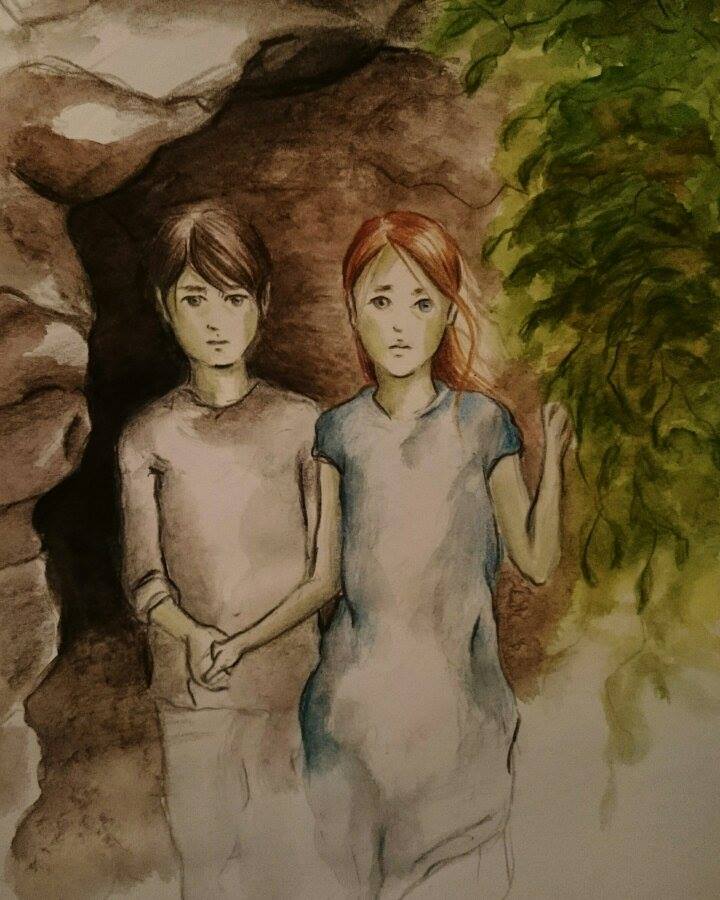
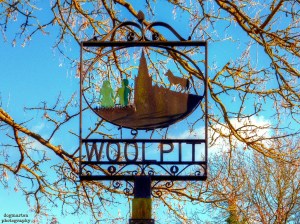
The story is set at some point in the 12th century. The location is the village of Woolpit in Suffolk, England. One day during the harvest, the villagers discovered two children loitering around the ‘wolf pits’ (deep excavations designed to trap wolves, which at that time were still relatively common in England) and apprehended them. Apparently, they “had the form of all their limbs like to those of other men, but they differed in the colour of their skin, which was tinged all over a green colour.” They also could not speak English or any language known to the villagers, who escorted them off to a local lord, a knight by the name of Sir Richard de Calne. Here they were offered food but would not eat anything until some beans (probably either broad beans or a type of vetch, both common crops throughout the medieval period) were brought to them. They lived on such beans until they were eventually induced to eat other food within the manorial residence. In a short time the boy sickened and died, but the girl survived, lost her green colour, was baptised and was given a position of some sort within the knight’s household. One version of the story suggests that she was “rather loose and wanton in her conduct.”
The story then reports her words, after learning English, in response to questions about how the children arrived at Woolpit and where they came from. She asserted that they came from a land where all the inhabitants had green skin, ate only green food, and that there was perpetual twilight. “Moreover, a certain luminous country is seen, not far distant from ours, and divided from it by a very considerable river.” On the day they arrived in Woolpit they had been tending their father’s flock (the insinuation is that they are siblings, although this is never directly stated) when they came upon a cave, from which they heard the sound of bells. They wandered into the cavern and after some time emerged into the Suffolk landscape where they were struck senseless by the excessive sunlight and unusual temperature of the air. Frightened and disorientated, they were caught by the harvesting villagers and so the story comes full circle.
What can be made of this story? For a medieval folktale it has the unusual quality of authenticity about it. There is no Christian moral, places and people are named, and it appears to be a unique incident, reported in the chronicles much as more everyday historical occurrences were mentioned. These two chronicles were those of Ralph de Coggeshall and William de Newburgh, both written in, or shortly before, c.1200, compiling both earlier texts and oral testimony. In Ralph’s case, some of the oral testimony came from the knight Sir Richard de Calne himself, and it is clear that both chroniclers made the effort to retrieve the story from villagers who were alive at the time of the incident. William puts the timeframe of the tale as within the reign of King Stephen (1136-54), but Ralph implies that it happened under Henry II (1155-89). Whatever the exact date, and whatever folktale motifs have been overlain on the story, this seems like a chronicled version of something that actually happened. So how can it be explained?
 Prosaic Explanations In a concerted effort to dispel any supernatural elements from the story, Paul Harris (in a 1998 article for Fortean Times) put forward the theory that the children were Flemish orphans, displaced from their community after Henry II’s co-ordinated persecution of the Flemish population in Eastern England, culminating in a military offensive in 1173. Left to their own devices, they lived in the woods before wandering into caves (Harris suggests the Neolithic Grimes Graves in Norfolk), following tunnels and emerging near Woolpit, green through malnutrition and speaking a foreign language that the locals couldn’t understand. But as with many materialistic-reductionist explanations of strange stories, it is soon found to be baloney. Grimes Graves is 40km from Woolpit, there are no known tunnels extending beyond the locality and even if there were, they do not extend to the clay geology of northern Suffolk. Flemish immigration to Suffolk had been happening since the 11th century and so the linguistic argument also breaks down – the villagers would have been well-acquainted with the Flemish language, even if it were a dialect or (even more so) an Anglicised version of Flemish. And an educated aristocrat like Sir Richard de Calne would definitely have recognised their speech. Despite being cited as the most likely interpretation in several retellings of the story, it’s actually a non-starter.
Historian Derek Brewer avoids any such tortuous interpretative-bending, and reduces the story even further, suggesting that:
The likely core of the matter is that these very small children, herding or following flocks, strayed from their forest village, spoke little, and (in modern terms) did not know their own home address. They were probably suffering from chlorosis, a deficiency disease which gives the skin a greenish tint, hence the term “green sickness”. With a better diet it disappears.
The possibility of the children suffering from Chlorosis (or Hypochromic anemia) is an interesting hypothesis. This condition is usually caused by an iron deficiency and can tinge parts of the skin green, which will return to normal colour when the iron is replaced in the diet. This might explain the children’s colour and their losing it after starting to eat the local food. However, there is no historical mention of the condition before 1554, and even in the cases noted after this date the green colouration is restricted to parts of the body, such as around the eyes and neck. In most cases there is no discolouration. So although Chlorosis might offer an exceptional explanation for the children being green, it is reliant on their having been subject to a long period of malnutrition, which is not part of the story. If the explanation were that simple, why did they not tuck into the food they were offered on arrival at Richard de Calne’s household? We’ll come back to the colouration issue, but whatever the true explanation is, the green colour of the children cannot be taken as an independent part of the story, divorced from the other surreal elements. And let’s remember, this is a very surreal story.
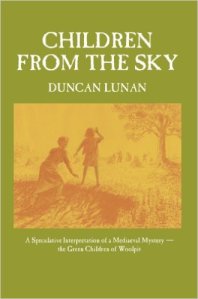 Out-there Explanations In his 2012 book Children from the Sky, Duncan Lunan presents a highly unorthodox theory of alien intervention in 12th-century England. Lunan goes into considerably more historical detail than any other writer on the subject, and his close reading of the historical sources teases out the context of the story and the characters involved. Of particular importance is his interpretation of the original texts, pointing out the usages of language by the two medieval chroniclers, and how the original Latin has been skewed by later translators and story summaries. But the historical detective work soon gives way to a ‘speculative interpretation’ that suggests the Knights Templar (he identifies Sir Richard de Calne as a Templar) were in contact with an alien civilization, who were abducting humans to populate a colony world – a world where it was always twilight due to a synchronous orbit, and where genetically modified algae turned the inhabitants green. The green children were part of this colony and were accidentally transported to Earth due to a matter transmitter malfunction. Sound wackadoo? You bet. But the sci-fi angle taken by Lunan is a lot of fun and allows for some free-thinking speculation on the oddities of a story that refuses to fit in with a reductionist interpretation. A mind-bogglingly melodramatic National Geographic documentary has Lunan dashing around the Suffolk countryside in a Morris Minor in pursuit of the alien connection. You might want to take a look here: Ancient X-Files (from 25.50).
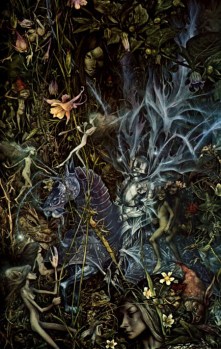
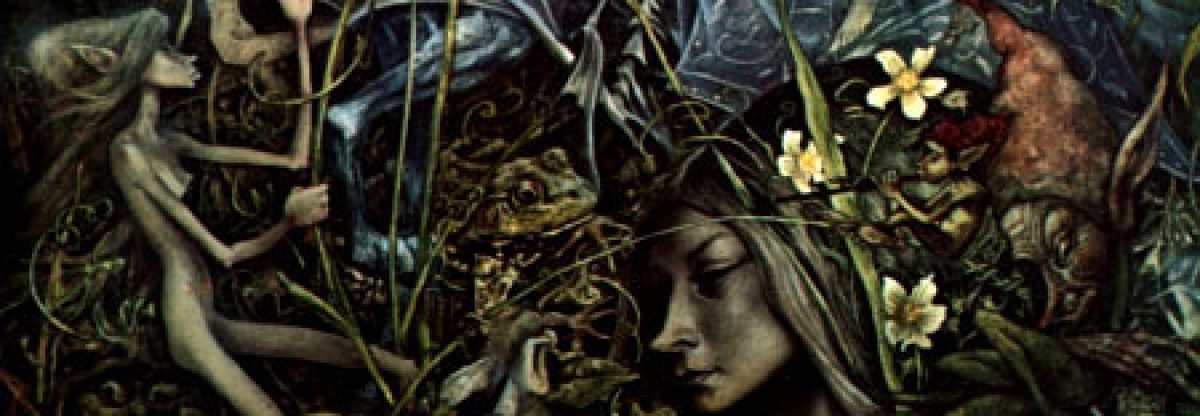
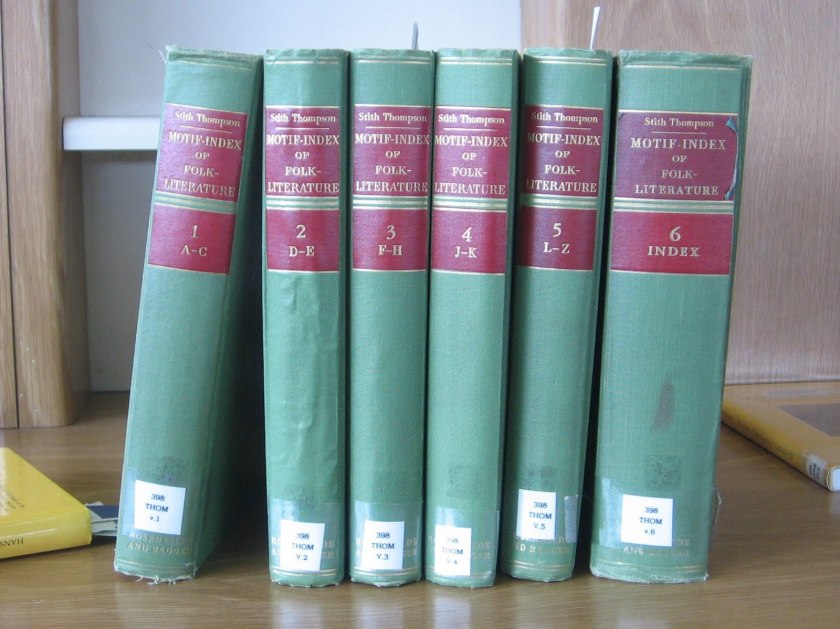
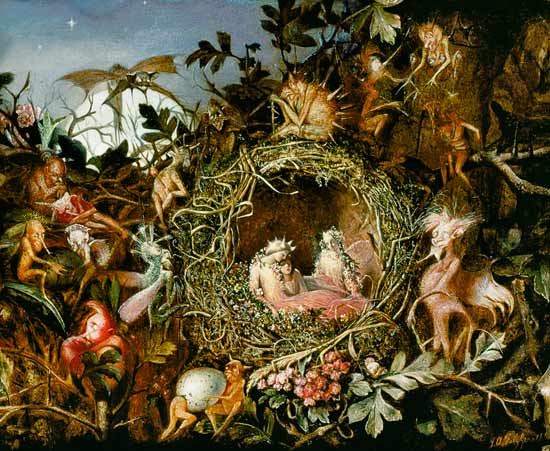
Folkloric Explanations The folkorist EW Baughman suggests the story is the only example in English folklore of the motif: Inhabitants of lower world visit mortals, and continue to live with them. It is certainly an inversion of the common faerie-tale motif of mortals travelling to faerieland and living there for various periods of time, either willingly or not. But the fact that the children come from underground is important, as the faeries were commonly thought to reside under the earth, usually beneath hollow-hills or burial mounds, but also in caves. The strange description of their world being always twilight also fits in with many folkloric descriptions of an underground faerieland. With this in mind, the story may be a jumbled attempt to overlay faerie motifs onto an historical incident. It does seem that both medieval chroniclers categorised the story as a faerie-tale that fitted in with their other accounts of supernatural beings interacting with humans. But the green children do not behave like folkloric faeries. They have none of the faeries usual attributes or magical powers. They really do seem like lost human children.
However, as usual with folktales, deeper meaning can be read into story by asking what it is telling us about the human condition. A follower of the Carl Jung school of psychoanalysis would immediately spot the archetype of the outsider/s (see The Deeper Meaning of Faerie-tales). The children were green, came from an unknown and strange land and spoke no known language. They represented an otherworldy intrusion into the regular, consensus reality of the 12th-century villagers, that may have been treated as a threat. In a time of Christian fundamentalism their fate may have been to be seen as demonic beings in need of persecution. Things could have ended badly for them. But they were also vulnerable and frightened, and the story is never about the threat of outsiders but rather of tolerance and kindness to them. As has already been discussed, there had been largescale immigration into eastern England through the 12th century, and communities would have been forced to come to terms with foreign ideas and behaviours within the space of two or three generations… sound familiar? In the case of the green children they were accepted, protected and then integrated into the dominant society. We can see the story as a folkloric method of teaching tolerance of outsiders by using an archetypal concept.
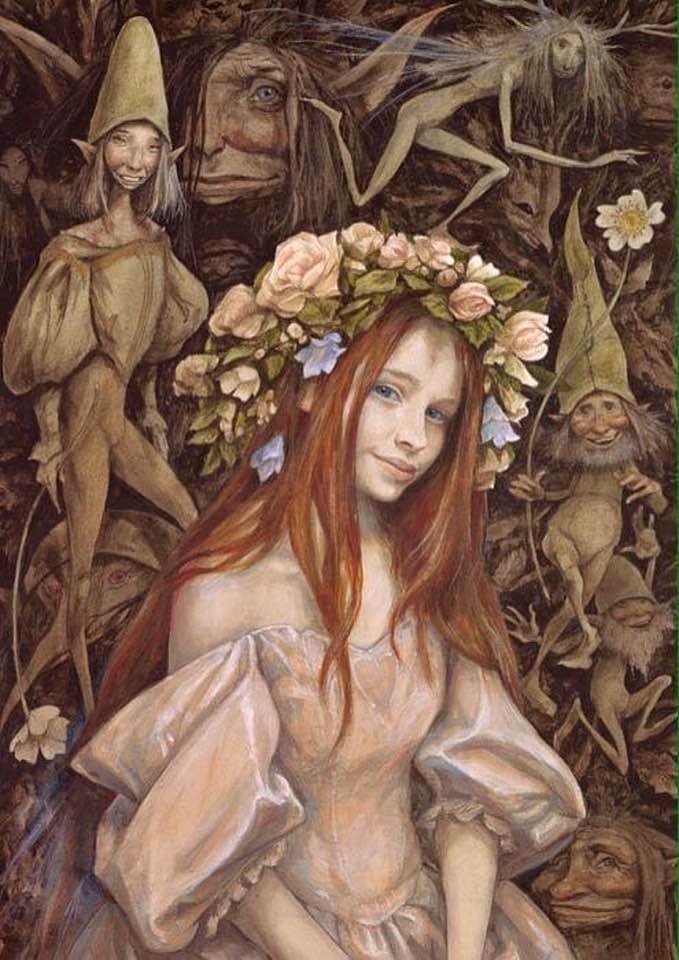
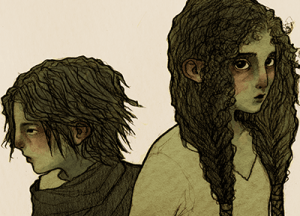 But instead of using real foreigners, such as Flemish immigrants, the story is made timeless and archetypal by turning the children into faeries. Their otherworldy status makes the tale bigger and more fundamental – it becomes a tool for teaching us about ourselves. The story embeds certain faerie motifs, such as their green colour. The most common colour of the faeries was green (usually their clothing, but also sometimes their food and their skin), and people hearing the tale in the Middle Ages (and beyond) would have automatically understood and accepted that they were associated with an otherworld, most usually represented as faerieland.
Whatever the deeper meaning though, the story is still strongly grounded in a specific time and location. Something material and real happened in a small Suffolk village in the 12th century, which will never be fully understood or explained, because so much of the story is strange and edged with the supernatural. Despite the uncommon and inverted motifs, it is in effect a faerie-tale that uses an historical event as a vehicle for telling a story with a lesson. But then that’s usually what faerie-tales do.
—–
A recent detailed and exhaustive examination of the story by historian and folklorist John Clark, with the original sources printed in full, can be found here: John Clark’s The Green Children of Woolpit. This correlates all the sources and secondary literature into a fully referenced article, that deals comprehensively with most interpretative aspects of the story. It will most likely become the standard reference point for all future discussion about The Green Children of Woolpit.
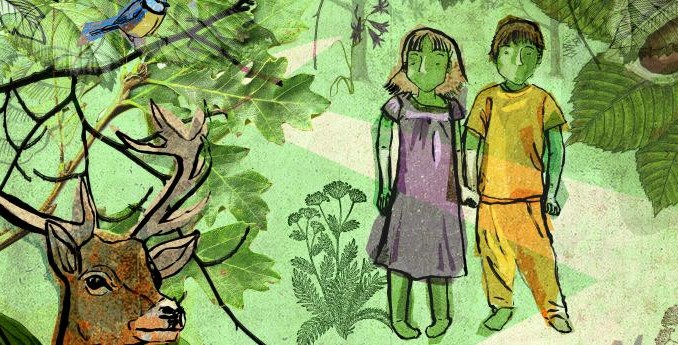
The cover image is by my friend and artistic colleague Katalin Polonyi.
Here is Paranormal Kativity telling the story of the Green Children of Woolpit: Paranormal Kativity tells the story of the Green Children of Woolpit
And finally, here are The Green Children singing about… well, The Green Children: The Green Children — Encounter
 deadbutdreaming