She was like me in lineaments — her eyes
Her hair, her features, all, to the very tone
Even of her voice, they said were like to mine;
But soften’d all, and temper’d into beauty;
She had the same lone thoughts and wanderings,
The quest of hidden knowledge, and a mind
To comprehend the universe: nor these
Alone, but with them gentler powers than mine,
Pity, and smiles, and tears — which I had not;
And tenderness — but that I had for her;
Humility — and that I never had.
Her faults were mine — her virtues were her own —
I loved her, and destroy’d her!
Lord Byron, Manfred, Act II, Scene II.
***
It is the hardest thing to watch your child die. The doctor had instructed me to ensure that in her final days she was able to look out upon God’s bounty (the doctor, despite the usual leanings of his profession, was first and foremost a Baptist), and so I had set up a bed in the upstairs study with the large sash window, where Medora could look out across fields and hills to the distant canopy of the orchard. The orchard. I wish I had never known of its existence; or that it had always remained as nothing but a distant, detached arboreal view. I would always sit with my back to the window when abiding with Medora. I could not bear the sight of it — its loathsome September opulence infecting the air, and coaxing disaster from my memory.
In the final days Medora began coughing up more blood. I did not want to wash the handkerchiefs — they were to be saved so that I would have a part of her when she was gone. Instead, I ripped up some of my linen shirts for the purpose. Each tear felt like the cleaving of a life-force; existence coming apart at the seams. But for her I always smiled and hid my tears. And mostly she slept, sedated by the doctor’s potions, which allowed me to leave her for periods and cry my tears and rue what I had done; the destruction I had brought upon her, and upon another.
One gloom-filled dusk, close to the end, I returned from the well, brought a pitcher to her bedside, and found her more lucid than she had been for days. She even had the equanimity to hide one of the bloodied linen cloths beneath the pillows. I sat with her and listened to her babble for a while, stroking her hair and attempting to be present. After a lull she settled down, eased herself back in to the pillow and brought her blue-eyed gaze to mine.
‘Tell me about mama,’ she said, her voice suddenly older, manoeuvring the air between us.
‘Mama?’
‘You never talk of her. Why was she called Astarte?’
‘This might not be the time my sweet,’ I said, trying to suppress the shake in my voice.
‘Please papa… pleeease.’
I kissed her forehead and pulled the blanket up to her chin. Soon her eyelids flickered close and her breathing began to sink in to the rhythm of sleep.
‘Please papa,’ she murmured, as her head lolled.
I got up gently, lit a candle, placed it in the holder and put it on the table next to the bed. The room transformed from dusk grey to softened arylide yellow. I sat back on the bed and assured myself she was asleep. Why should she not know? The words would live only in her dream world, but I needed to tell myself what had happened, what I had done, and what had been wrought. I had occulted it, but now it needed to be revealed. Be it so.
*
I found the orchard one midsummer day as the Earth turned and became a darker green. And yet I always remember the arboreal presence as cornflower blue — a cyan haze in the sweetened air transformed the grove in to a sacred space, its colour marking it out as separate from its surroundings. It was strange that I had not discovered the orchard before. I thought I knew the land hereabouts; its folds and combes were the setting of my youth, and it should have been visible from the much-travelled track to my house. From there, it could be discerned, but only as a distant tenebrous blur, partly obscured by treeless hills. Perhaps an enchantment kept me from its confines until the fatal days came, or maybe it was never really there, at least not as it should have been.
I always felt the presence of something in the orchard; some mind, or minds, inhabiting the trees and watching me. It attracted and repelled me in equal measures, but I never saw anything apart from fleeting movements amidst the gnarled branches and shadows slithering up and down the twisted trunks. The summer heat usually made me feel the pull of sleep as I sat beneath the cover of the largest tree in the orchard, but I never succumbed to it completely, and would manage to haul myself from slumber for fear of being left vulnerable. Vulnerable to what I knew not, but the undisclosed existence in that space became more tangible and minacious when drowsiness brought on its unreal vistas and sounds, so I always managed to remain awake and aware within its bounds.
And then, one day, she found me there. The lineaments of our blood drew her to me I suppose. I watched her glide through the grass, hitching up her long chiffon dress and being sure to touch each tree she passed. She never wore a bonnet, and this day her hair had been let down, so that it shimmered gold in the dappled sunlight. I made a token effort to conceal myself in the longer grass under my tree, but I wanted her to find me, and she did. She sat down beside me as if in a huff, just as she had always done, and began to talk away as if both of us being in that strange and formerly unknown refuge was the most natural thing in the world. But it was not natural — there had been a passing of something, and we were changed by the place. It had cast its spell.
As the days passed we became closer. We began to talk about things we had never talked about before. Like me, she had the quest of hidden knowledge, and in that place we speculated on universal unknowns and ghosts of ages past. My lone thoughts became spoken words for the first time; her ruminations found a willing host, where none had previously been. I spoke of lights in the sky and angels, she told of the fair folk hidden in mysterious otherworlds. Our secret chatter made its mark there — the orchard heard us and soaked up our confidences in to its occult memory. And closer still we became. But she recognised the limits more than I. Her love was different than mine. Her tenderness was refined by our blood, mine was explicit.
One day she did not come, and I became irritable and despondent at her absence under the tree. My thoughts seemed purposeless and they drifted, without her to unlock their code. It was the hottest day of summer and I began to succumb to a sultry daze. The undisclosed presence of the orchard bristled over me, but I could not stave it off with wakefulness, and within minutes I slept, allowing my subdued mind to be opened up to the company of another.
*
I had a dream, which was not all a dream. The tree became animate, not of its own accord but from that which lived within it. Skulking from out of the bark, whilst retaining its gnarly aspect, came a creature who lured me in to a slithering embrace, filling my mind with his memories and scenting the air with the moss of years. His was an existence dictated by the seasons and his responsibility for fertility, and midsummer was his enchanted time. This allowed him to offer me what I wanted more than anything. I wanted her, despite the proscription. He held on to me in his lascivious way and took me somewhere with stars in the sky and bathed in the smell of fermentation. I was made promises, but the result of those promises would have a price to pay. He instilled in me a sense of dread but the transaction was made. I accepted it thinking the pact might mean a quietus for me, but for her I was willing to take the Apple-Tree Man’s nebulous offer. Then a change came over the spirit of my dream, and voices from the deep abyss revealed a marvel and a secret — be it so.
*
The secret end of the dream was only dimly remembered, but the contract with my strange being was instilled within me and I was fated to use it to parlay what was implicate into something real. Despite the lingering disquiet about my reverie I knew it was in some way a true vision, and the dread of the vanished shadow became dispelled in the face of me gaining her… gaining her completely.
The next day she came again. I held her and she shied away. But then she saw the single apple hanging at head height from the tree. Absinthe green it was — unnatural in both its midsummer ripeness and its colour, but alluring beyond measure. We glanced at each other, I plucked it from the tree, and we both ate it in turns. Then a summer storm glistened over the orchard and we fell together, and remained together in our recondite love.
*
‘She died when you came in to the world my sweet,’ I whispered. But Medora was gone — her mind resided elsewhere. However, for a few glimmering moments her essence accompanied my trembling body to the window, where we stared out towards the orchard in the last remnants of twilight. The bare landscape stretched away. The orchard was gone, and so were they. I had loved them and destroyed them.
***
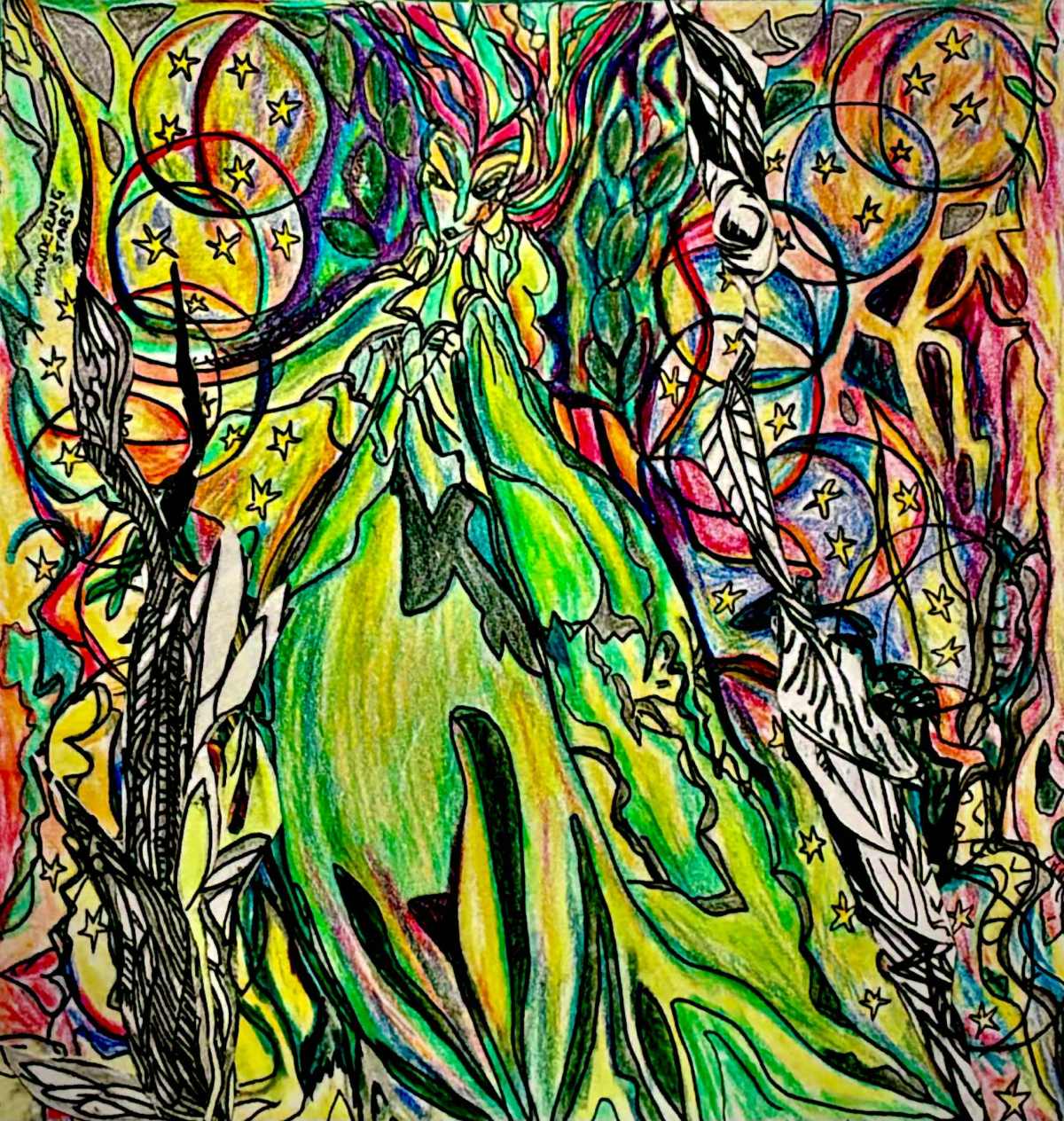
The cover image is ‘Wandering Stars’ by Victoria Darcy.
*
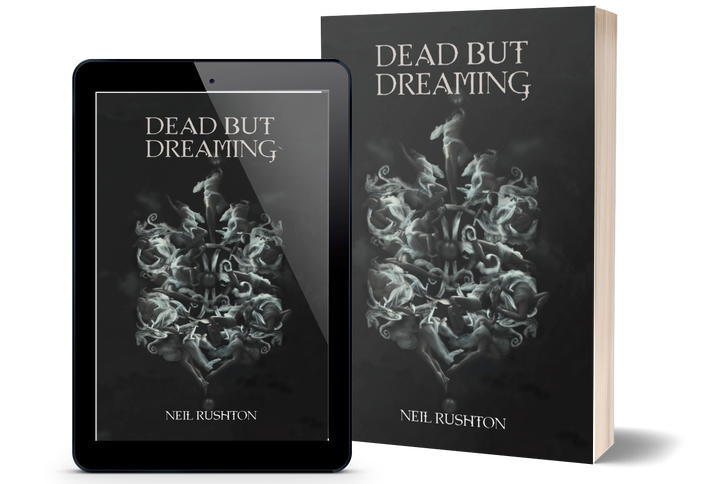
Dead but Dreaming the novel is available now…
***
 deadbutdreaming