A version of this article appeared originally in the online magazine Ancient Origins.
There are numerous stone sculptures and wood carvings in European medieval churches that depict what may appear to be non-Christian imagery. Most discussed are those of the Green Man and the Sheela na gig, which have found various interpretations, from pagan symbols existing surreptitiously within Christian sacred spaces, to simple decorative adornments, created by masons and carpenters with the implicit approval of the Church. Unlike many of the more straightforward carved images of animals and therianthropes in churches, the Green Man and Sheela na gig portrayals are not drawn from passages in biblical texts, strengthening the hypothesis that they are derived from naturalistic pagan belief systems and folkloric ideas, which continued to operate at some level below the radar of Christian orthodoxy throughout the Middle Ages. It appears as if there were a certain ecclesiastical allowance to tolerate these coded populist images, even if they were evoking (especially in the case of the sexually explicit Sheela na gigs) a potentially heretical cosmology. But there is another popular non-Biblical image regularly found in churches of all status, especially prevalent in Britain and Ireland: mermaids. They can be found in stone reliefs, bench-ends, misericords, roof bosses, and occasionally in wallpaintings in almost a hundred medieval churches, usually prominent, sometimes hidden but most often following a similar design, which remained largely unchanged between the 11th and 15th centuries. Why would an ancient, folkloric, but non-Biblical, character such as the mermaid find its way into so many medieval churches? And can such mermaid imagery and symbology be correlated with the more overt pagan symbols of the Green Man and Sheela na gig?
Mermaids in Mythology and Folklore
Mermaids have been a part of the global mythological ontology for thousands of years. They make their first literary appearance in Assyria in c.1000 BCE, when the goddess Atargatis turns herself into a mermaid as a self-imposed punishment after accidentally killing her human lover. But this rendering of a mermaid creature may be based on the even earlier tradition of the Babylonian God Ea, who was portrayed as a fish with a human head. This idea of a half human, half fish creature continued to pervade mythological story cycles from this time, finding their way into Greek and Roman cosmologies and then into north-west European traditions. They were often the harbingers, and sometimes the cause, of disasters at sea, but there is also a tradition of mermaids being lured onto land to become the wives of men who have tricked them into such a relation, stories that usually end badly for the enticing male.
By the time the concept of the mermaid reached Britain and Ireland at the end of the first millennium, it had made the subtle transition from mythology to folklore; the mermaids were no longer deities to be revered but were supernatural aspects of the material world, to be feared and propitiated in equal measure. Most British and Irish folklore about mermaids (usually termed merrows) included motifs that included both warnings to seafarers and cautionary tales about desiring metaphysical beings. In the Faroe Isles the mermaid morphed into a creature known as the kelpie, half seal, half human, who could be captured by any amorous male when she beached and shed her seal skin. The most famous story is of Kópakonan (‘seal woman’) who was lured onto land to marry a fisherman, only for him to abuse her and her kelpie family, resulting in disaster for the inhabitants of Faroe. This theme of mermaids (and their analogues) as creatures of retribution became a mainstay of folklore – they were desirable and supernally beautiful, but they were also dangerous, and contact with them led (almost invariably) to calamity.
Examples of Mermaids in Medieval Churches
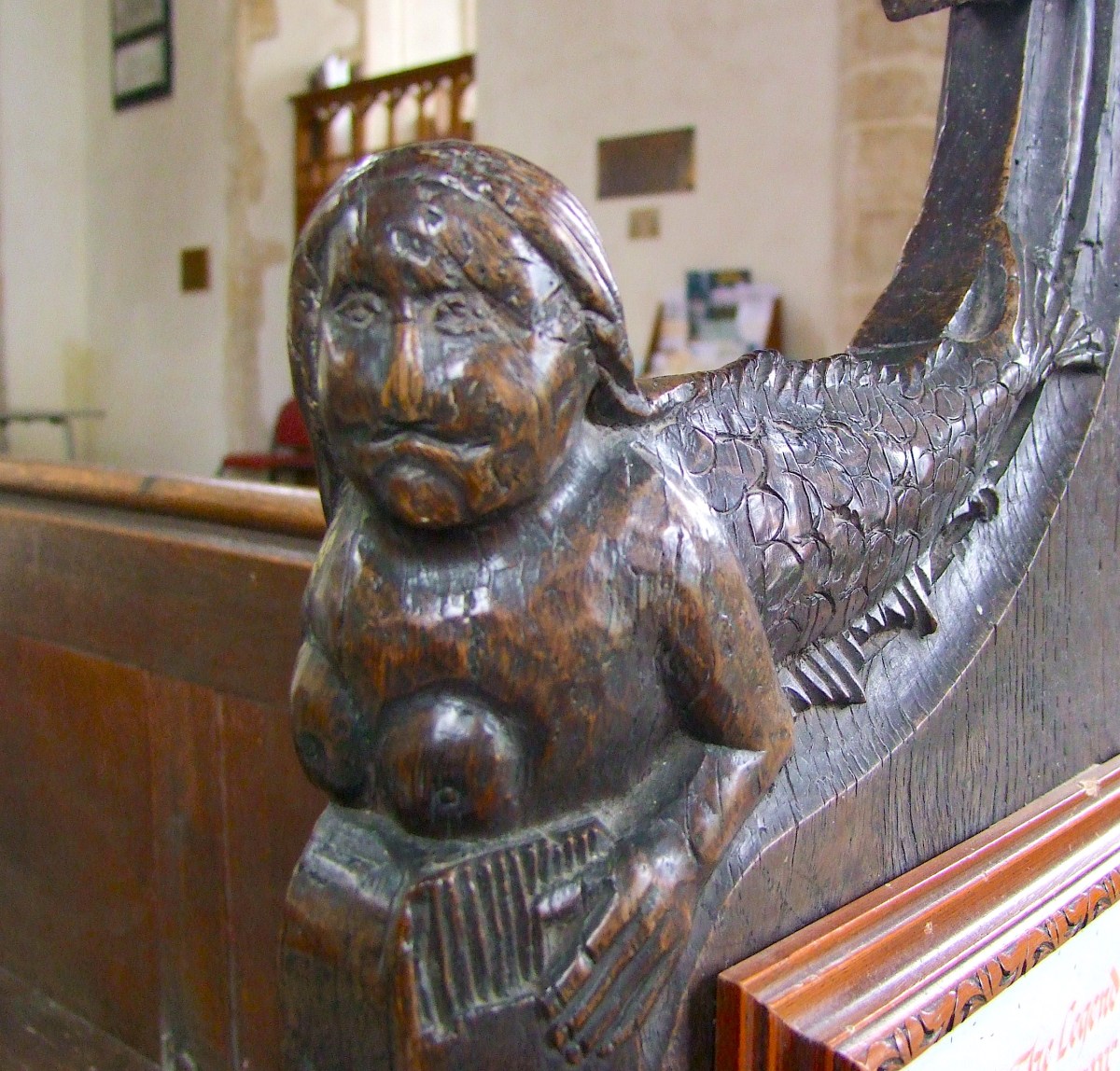
Images of mermaids abound in British and Irish medieval churches. There are a range of stylistic types, from the Romanesque stone relief at the chapel of Durham Castle (dated to 1078 and thought to be the earliest depiction of a mermaid in an ecclesiastical context) through to the late medieval carved bench ends in churches such as at All Saints church, Upper Sheringham (Norfolk), St Mary’s church, Ivinghoe (Buckinghamshire) and Holy Trinity church, Great Hockham (Norfolk).
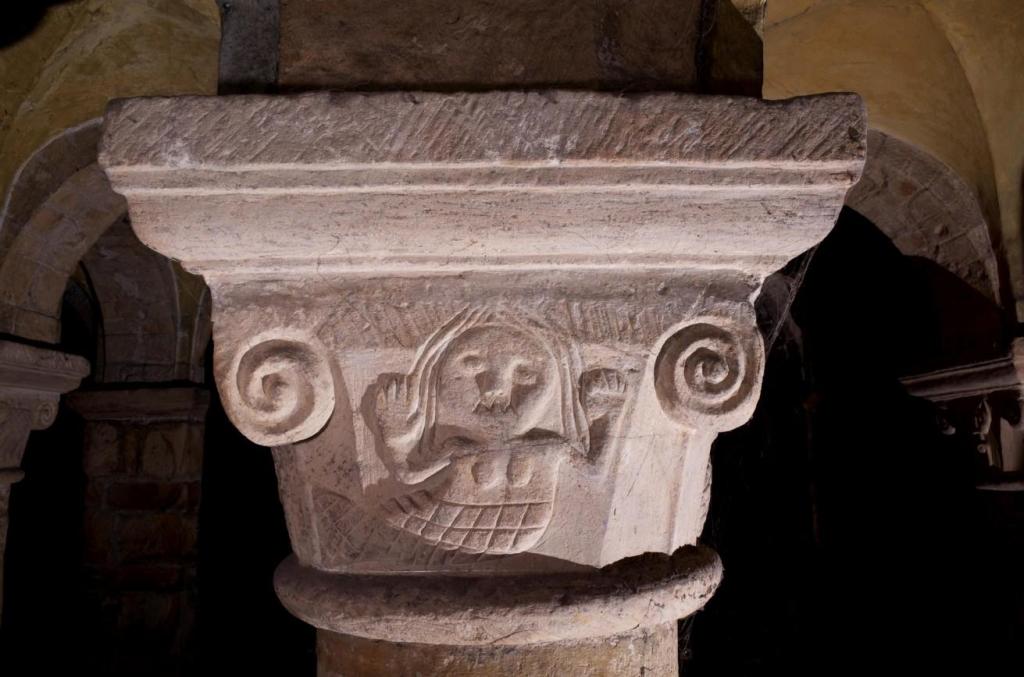
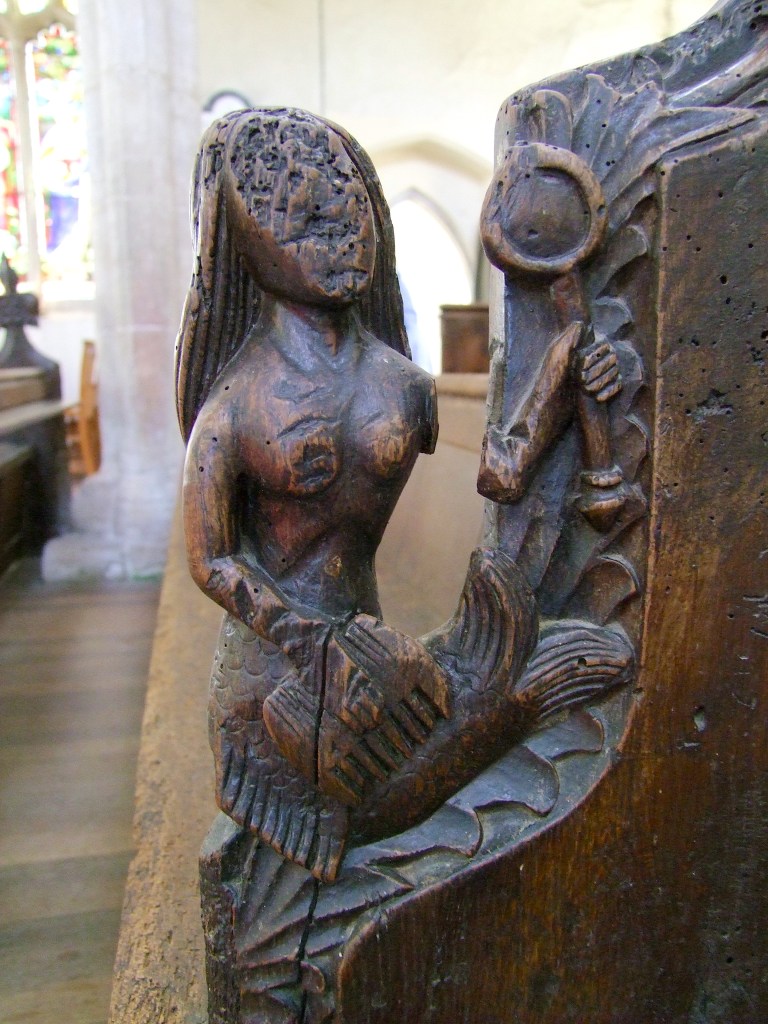
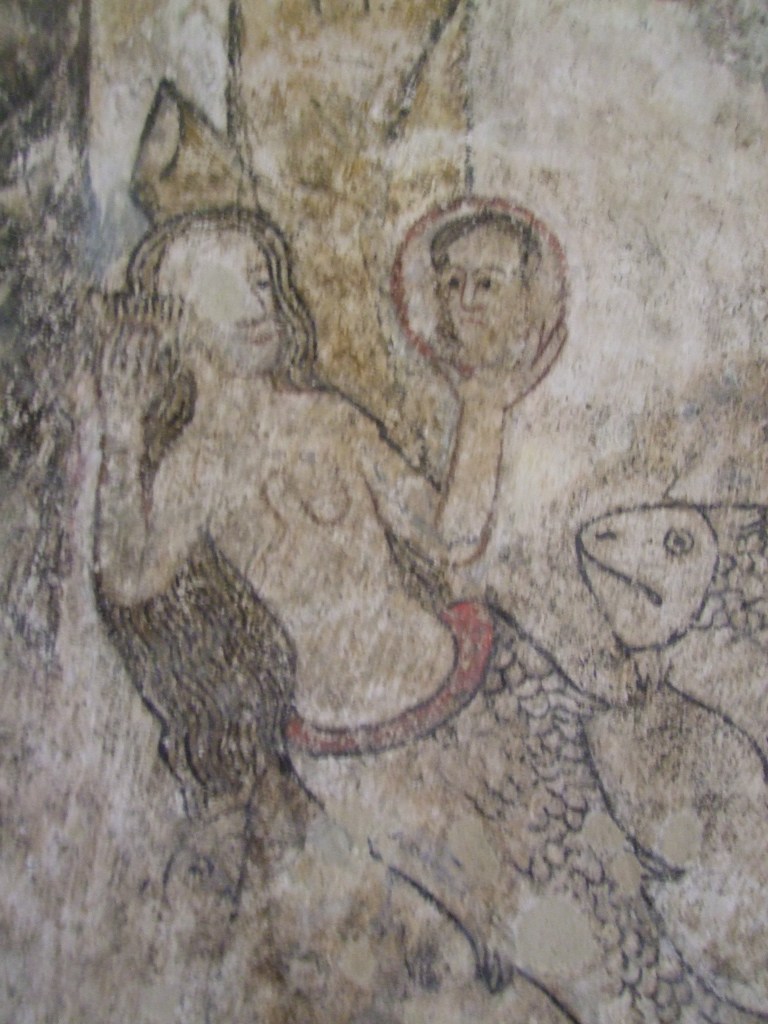
There are also a small number of mermaids shown in wallpaintings, such as at St Botolph’s church, Slapton (Northamptonshire). But despite the stylistic changes through the course of the Middle Ages the mermaids are always portrayed as distinctive characters, with fish tails (usually double-tails), naked upper human bodies, and with long flowing hair.
There are a few depictions of mermen (the male equivalent of mermaids), as at St Buryan church in Cornwall, but the vast majority are of the female form. Those carved on the underside of misericords in church choirs, such as at St Mary’s church in Edlesborough (Buckinghamshire), would have been largely unseen by the majority of people frequenting the church, but most of the sculptures, carvings and wallpaintings are in prominent positions, in full view of the congregations, such as at St. Brendan’s Cathedral at Clonfert, Co. Galway, Ireland, where the image of a foot-high mermaid is located at eye level on a soffit facing the nave from a pier of the chancel, and would have appeared directly to the left of a priest as he addressed the congregation.
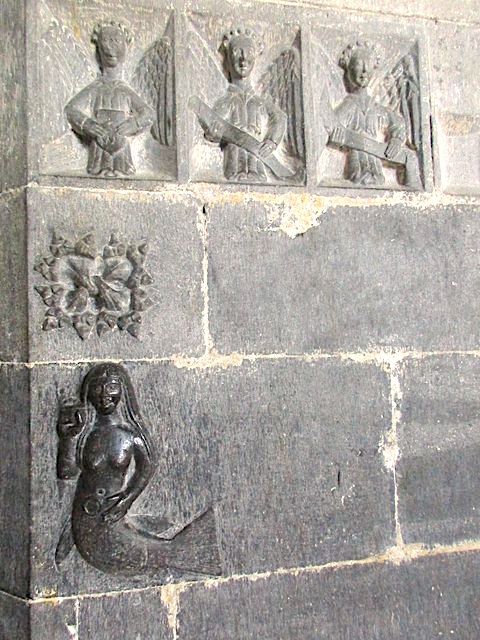
The stone sculpted mermaid at All Saints church in Thornham, Norfolk, is also a prominent feature in the nave and must have been located there by design, in order to convey a message to the (mostly illiterate) congregation. Indeed, most stone reliefs of mermaids are found in the communal areas of medieval churches, intrinsic parts of the experience of attending church for generations of medieval people. Even more common were bench-end mermaids, wooden carvings that would have been both visible and touchable to everyone attending the church. These are exclusively late medieval in date, making it clear that the mermaid had continued as a defined symbol through to the Reformation.
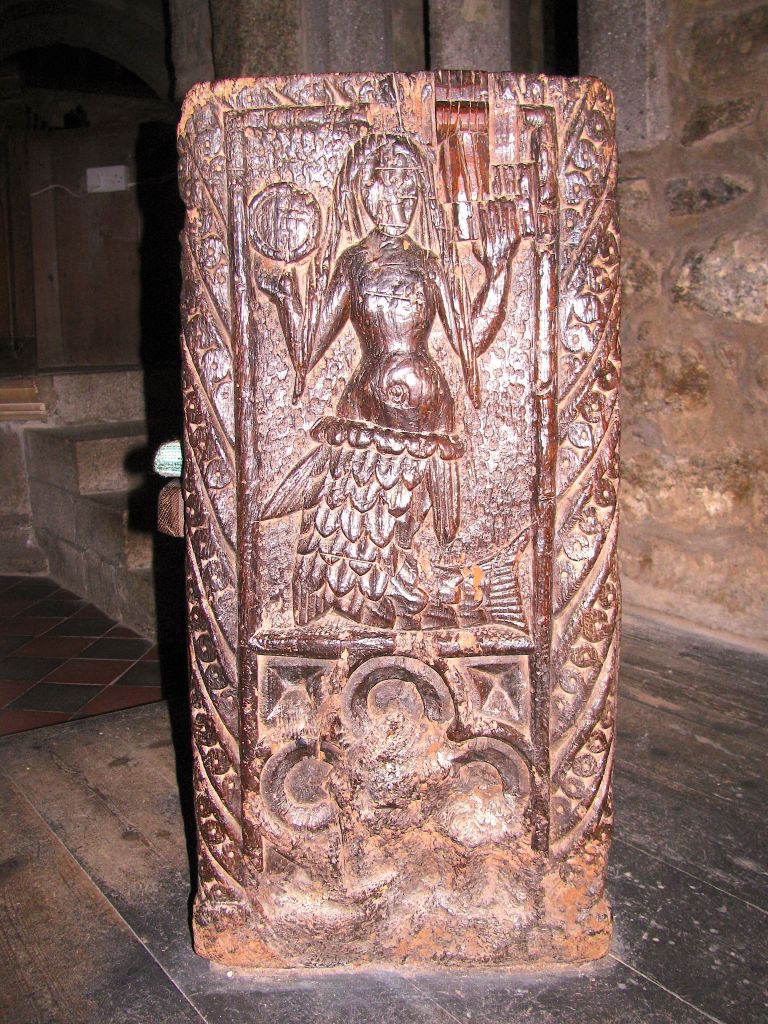
One of the best known representations of a mermaid from a medieval church is at St Senara’s church, Zennor in Cornwall. Carved into the side of a bench-chair in the 15th century, it depicts a typical mermaid figure, naked to her fish tail, and holding aloft a mirror and comb. The image seems to relate to a piece of local folklore, where a mermaid, in the form of a woman, came to church each Sunday and charmed the parishioners with her beautiful singing before returning to the sea. A local man called Mathey Trewella was enticed to return with her to the sea one day, and neither was seen again. Although not recorded in literary form until 1873 by the folklorist William Bottrell, this folktale had evidently been doing the rounds as an oral tradition long before. Although it is possible that it was the bench-end carving that gave rise to the story, it is equally likely that the medieval image of the mermaid was commemorating a folktale in circulation in the 15th century. This is unusual; mermaid images in churches do not normally come packaged with an associated folktale. They were more likely timeless symbols, which despite their pagan connotations, were allowed to be displayed in churches by the ecclesiastical authorities as a didactic tool; visual symbols to persuade the faithful towards virtue.
The Symbology of Mermaids in Medieval Churches
One interpretation of the symbolic meaning of church mermaids is that they were warnings against the sin of lust, possibly in the same way as the Sheela na gig sculptures. The mermaids were portrayed as young women with flowing hair, whose folkloric attributes were often those of temptation – they were designed with negative connotations. Patricia Radford describes how this was offset at St Brendan’s Cathedral, Clonfert:
‘Directly above the mermaid at Clonfert, and at many other locations including Clontuskert, is a beautifully carved, symmetrical knot. Knot-work in Irish and Celtic art has protective associations, so it seems the purpose of this motif is to protect the viewer from the mermaid’s dangerous pull since merely gazing upon the creature might incite lust. At Clonfert, on the pier opposite the mermaid, at the priest’s right, are three carved angels. It is typical of Irish churches that images associated with good are placed so that they can be seen to balance the potential evil of images of warning, such as mermaids. It is the nature of medieval art that an image may have multiple layers of meaning.’
This insightful observation may have been true at some Irish churches, but most British church mermaids exist in isolation, without any potentially protective symbols or angels. However, the majority of these British mermaids are portrayed with symbols that would have been understood as displaying attributes of the sins of pride and vanity – as per the Zennor carving, the mermaids often held combs and mirrors. Not only were the mermaids sexual temptresses, they were made explicit in their vanity. This may have allowed for a dual meaning in their symbology, where the mermaids known tendency to draw men to their destruction was coupled with a warning to women to guard against excessive vanity. The depiction of the mermaids with long flowing hair also fed into this; medieval women of good virtue were expected to wear their hair ‘tamed’ and concealed beneath a covering – loose hair was for pre-pubescent girls and virtueless women. It might be wondered whether such portrayals of alluring femininity in churches may have had the opposite effect of that intended, but it seems as if the ecclesiastical authorities were able to use effectively the symbology of the mermaid, known for destruction and misfortune, to inculcate Christian virtues. It is unlikely that mermaid iconography would have been so regularly displayed in such prominent positions in churches if this were not the case.
In this respect mermaid imagery in medieval churches differs from that of the Green Man and the Sheela na gig images, despite all having pagan connotations. They served different purposes. Green Men and Sheela na gigs were, and remain, amorphous in their symbolic meaning. They represent liminal aspects of medieval belief systems, that were likely interpreted by medieval congregations (as well as modern commentators) as unexplained aspects of a subversive cosmology, allowed into ecclesiastical precincts through custom and convention, almost as a propitiation to underlying non-Christian phenomenology. Their liminal nature meant they rarely found significant locations in churches, but were rather subsumed in vaults and side-chapels, tolerated but not generally exposed to general view. In contrast, mermaid sculptures and carvings were usually in full prospect, allowed into the nave and communal areas, often within touching distance of the congregation. It is likely that people were well aware of the folkloric properties of the mermaids, and the Church was able to appropriate this knowledge to expound core Christian values in a dynamically visual way. But at the same time, the mermaids were skilfully rendered works of art, which may not always have served a symbolic purpose. The medieval churchgoers who would have viewed such accomplished carpentry and stonework throughout their lives may, like their modern counterparts, have simply enjoyed the mermaid imagery as something that enhanced the church space, while invoking a supernatural being and the stories that accumulated around it.
References
Alexander, S. 2012. Mermaids: The Myths, Legends and Lore. Adams Media, Avon, US
Andrews, T. 1998. Dictionary of Nature Myths: Legends of the Earth, Sea, and Sky. Oxford University Press
Bottrell, W. 1873. ‘The Mermaid of Zennor’, in Traditions and Hearthside Stories of West Cornwall. Available at: https://www.sacred-texts.com/neu/celt/swc2/swc274.htm
Briggs, K. 1976. An Encyclopaedia of Fairies. Pantheon Books, New York
Kemble, M.J. 1992. ‘Mermaids in Folk Literature’, in Ichioka, C.S. (ed.), Stories from around the World: An Annotated Bibliography of Folk Literature. Honolulu: University of Hawaii at Manoa, 67–82
Platt, C. 1995, The Parish Churches of Medieval England. Chancellor Press, London
Radford, P. 2003. Lusty Ladies: Mermaids in the Medieval Irish Church. Available at: http://homepage.eircom.net/~archaeology/three/mermaid.htm
Rushton, N. 2019. Selkies, Sirens, Swan Maidens and Otherworldly Brides. Available at: https://www.ancient-origins.net/history/selkies-sirens-swan-0011483
Weir, A., 2017. Satan in the Groin: Exhibitionist Figures on Mediæval Churches. Available at: http://www.beyond-the-pale.org.uk/
Wingren, W. 2017. Why Are There Carvings of Women Flashing Their Genitals on Churches Across Europe? Available at: https://www.ancient-origins.net/artifacts-other-artifacts/why-are-there-carvings-women-flashing-their-genitals-churches-across-021737
Winters, R. 2015. Unraveling the Nature and Identity of the Green Man. Available at: https://www.ancient-origins.net/myths-legends/unraveling-nature-and-identity-green-man-002620
Winters, R. 2015. Unraveling the Nature and Identity of the Green Man, part 2. Available at: https://www.ancient-origins.net/myths-legends/unraveling-nature-green-man-part-2-how-pre-christian-icon-020186
***
Thanks to my friend and church historian John Vigar for all the images, apart from the Durham Castle Chapel mermaid, which comes from a conservation assessment of the chapel by Howarth Litchfield. The cover image (by John Vigar) is a 15th-century mermaid bench-end at All Saints church, Upper Sheringham, Norfolk.
***
Dead but Dreaming the novel is available now
***
 deadbutdreaming