This is a recent post by Dr Simon Young on his excellent Simon’s British Mythology Substack. He is currently compiling the posts on this site in to a book project, which will be something to look out for. ‘Fairy Encounters of the Third Kind’, is a concise assessment of the connection between faeries and aliens, which attempts to introduce a three-point system of faerie encounters based on that traditionally used in UFOlogy. Thanks to Simon for allowing the piece to be republished on deadbutdreaming.
*
I have spent a good deal of time in the last decade, trying to understand mutating human-fairy relations in our historical sources. It is, after all, extraordinary how fairies have changed in human eyes. In Anglo-Saxon England they were lithe daemones of human dimensions who were likely to kill you: in modern times, they are SWFs (small winged fairies) that hover over rosebushes like butterflies.
How can we best measure that change? It would be comical to try and be empirical with the supernatural: ‘Chase myths like moths, and fight them with a pin.’ But, if you promise not to laugh, reader, I have a confession. For a number of years I have tinkered with a fairy scale, that ranges from 1-3.1 This is a shameless borrowing from UFOlogy. J. Allen Hynek laid out his famous three point system in The UFO Experience: A Scientific Inquiry in 1972.2 Those interested in UFO-lore will remember:
First kind (CE1): close visual sighting of a ‘craft’.
Second kind (CE2): physical effects or traces. For instance, the car’s engine cuts out when the ‘craft’ passes over; there are burn marks on the ground where the ‘craft’ landed.
Third kind (CE3): an actual entity is present. The ‘craft’ drops into my garden and then the little folk start to stream out and I see them/talk to them etc.
Hynek’s system broke down because in the mid late 1970s the energy in UFO experiences shifted to CE3. From then on any classification really needed to look at different forms of interaction with ‘entities’. And this brings us to fairies…
Close Encounters in Fairy Lore
For fairies we require a division based on the level of interaction:
FCE1: There is a sensorial encounter. People see, hear or (in one memorable case from Yorkshire) smell fairies, but there is no interaction.
FCE2: There is light interaction between fairies and humans with no long-lasting effects: fairies, for example, plait your horse’s mane; or perhaps they pixy-lead you in the marshes.
FCE3: There is strong interaction, with serious consequences. This might include marrying a fairy (and/or having kids); using a fairy as a familiar to get magic powers; or fairies killing or changing human neighbours who annoyed or intrigued them.
In the nineteenth century there was a strong regional basis to these three. Let’s limit ourselves to what was then the United Kingdom. In areas with weak fairy traditions, for example, south-eastern England, only FCE1 experiences were reported; and there were not many of them. In areas with intermediate fairy traditions, like, say, Devon in the 1800s, FCE1 and FCE2 featured. Then, in areas with strong fairy traditions all three levels appeared. In County Cork or County Galway or, perhaps best of all, County Tipperary in Ireland nineteenth-century men and women were stolen by the fairies, killed by the fairies, and family members were changed by the fairies.
Today’s Close Encounters of the Fairy Kind
And today? The intensity of encounters has generally gone off the boil. Fairy Census 1 and Fairy Census 2, collections of modern fairy experiences, are overwhelmingly centred on FCE 1 and FCE 2 experiences. But there are some people who claim to have or to have had FCE3-style relationships with fairies, including sexual relationships.3 These speak, I think, more to the psychological proclivities or gifts of these people rather than local traditions. There are, as is the case with UFO-lore, no local traditions to speak of in contemporary fairylore: and only weak national traditions.
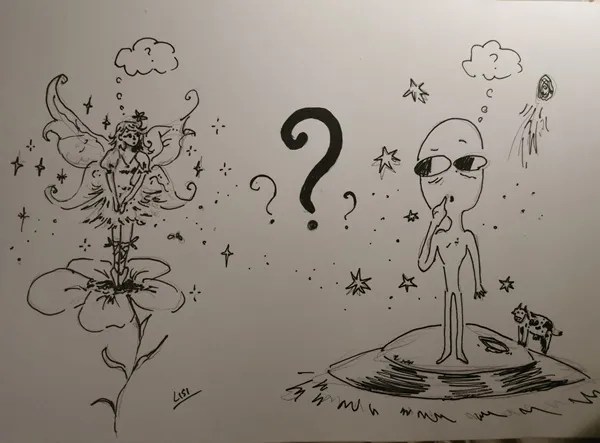
Here we return to daemones vs SWFs. Perhaps we need to acknowledge that these modern experiences are not meaningfully ‘fairies’. At least they are not fairies in the way that these were understood in British or Irish rural communities two hundred years ago. Are modern fairy sightings significant events for those who see them? Yes, they often change lives. Are they worth studying? Yes, they are absolutely fascinating. Do they have anything to do with the social, virile and often scary fairies of, say, nineteenth-century Tipperary? Not much. In fact, and this bit you have to say really quietly, aliens are, by that definition, far closer to traditional fairies than the butterfly SWFs glimpsed in the gloaming.
Notes
- Chicago: Henry Regnery Company.
- I wrote about this in my column in Fortean Times in 2016. I then went further in a chapter on Canadian fairies: Simon Young, ‘Atlantic Canada: Fairy Bread and Fairy Squalls’, Magical Folk: British and Irish Fairies at Home and Overseas, Simon Young and Dr. Ceri Houlbrook (London: Gibson Square, 2017), 210-222 at 220-222. No one cared…
- E.g. §594, §677, §771, §783 in the Fairy Census.
Simon runs a monthly supernatural-themed podcast, Boggart and Banshee, with Chris Woodyard: the first episode of 2026 has just gone out and may be of interest.
***
Dead but Dreaming the novel is available now…
 deadbutdreaming