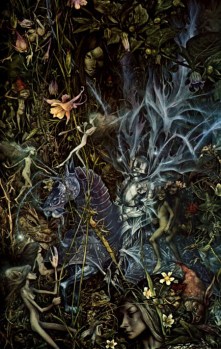
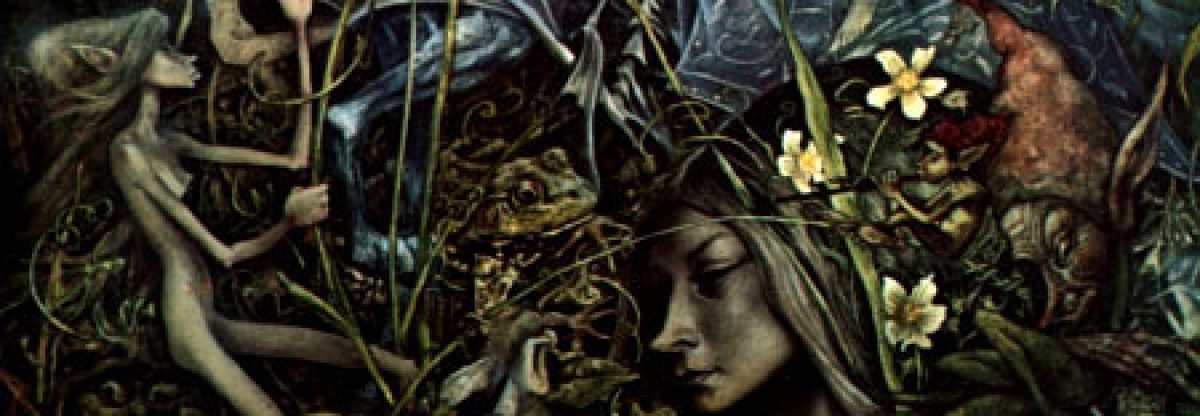
This article is from Fairy Films: Wee Folk on the Big Screen, edited by Joshua Cutchin (published in 2023). The book contains a wide range of discussions on filmic representations of the faeries by some acclaimed authors. Thanks to Joshua and the publisher for permission to republish my piece here.
Handmaidens of the Eternal: Consciousness and Death in Photographing Fairies
Neil Rushton
Introduction
“We humans are not alone. We share our planet with a quite different order of life. Fairies. They are spoken of in every culture of the world from New Zealand to the New Hebrides. Handmaidens of nature according to some, assisting in propagation and growth. Another theory: Exiles from heaven, God’s orphans straddling this world and the next; messengers between the two worlds.”
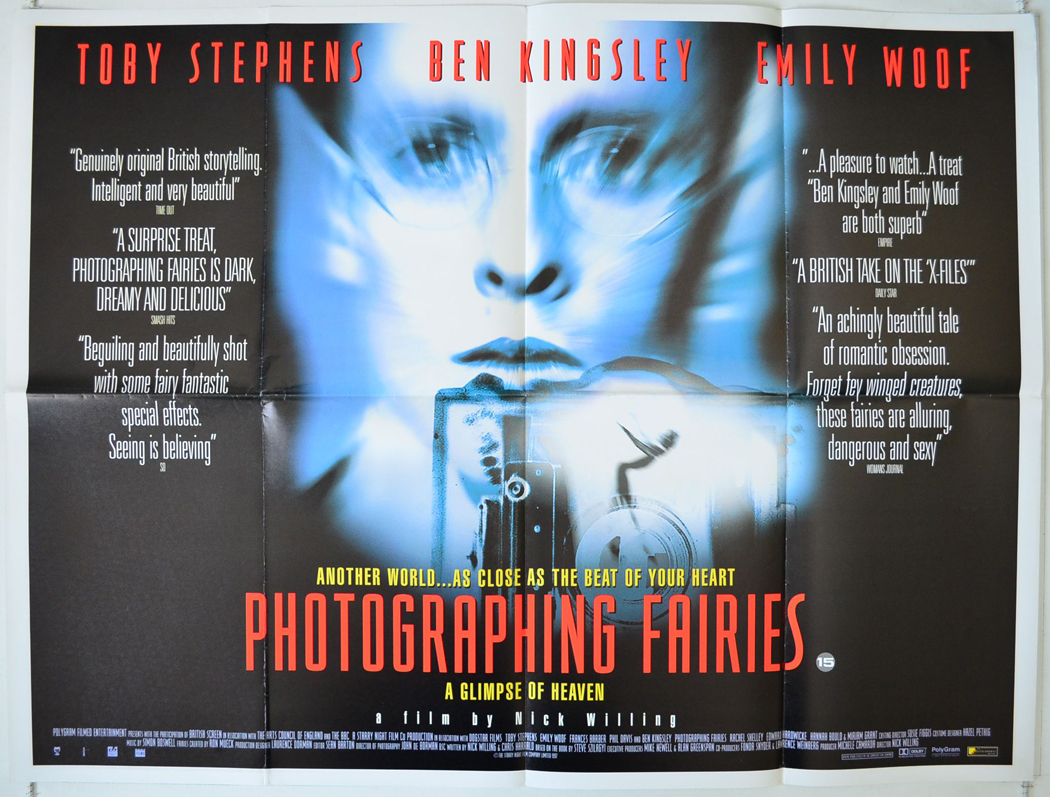
Photographing Fairies is a 1997 British film based on the 1992 novel by Steve Szilagyi.1 It was directed by Nick Willing, who also co-wrote the screenplay with Chris Harrald, and was Willing’s first outing as a film director, after previously directing music videos through the 1980s and 1990s. This background is apparent in the aura and mood of the film, which relies much on the musical backdrop to create its metaphysical atmosphere, from Simon Boswell’s original score to the frequent interjections of the Allegretto from Beethoven’s 7th Symphony.
The film also benefits from the acting acumen of Toby Stephens, Ben Kingsley, Emily Woof, Frances Barber, and Philip Davis, as well as the two child actors Hannah Bould and Miriam Grant, who seem preternaturally disposed to their roles. The exquisite cinematography of John de Borman adds much impressionistic ambience, and while the visual effects may seem somewhat primitive from the perspective of the 2020s, they retain an authenticity in line with the tenor of the film. The production company was PolyGram Filmed Entertainment (mooted as a European equivalent to Hollywood, but which folded in 1999), which joined forces with BBC Films and The Arts Council of England to fund, produce, and distribute the film. Its budget was c. $1.1 million and it made c. $4.7 million at the box office, despite receiving only limited release in cinemas.2
It is a film operating on many levels, rooted in the effects of the World War I yet managing to incorporate a myriad of cultural and supernatural tropes: the British class system, Theosophy, regional identity, religious faith, familial affiliations, the relatively new profession of photography, altered states of consciousness, and, of course, the fairies. While its love story is also a central theme, the main emphasis of the film is death. Death has long been an important province of fairy folklore, and a study of Photographing Fairies gives an opportunity to bring this into relief; to understand the relationship between the fairies, consciousness, and death.
Photographing Fairies
The standard spoiler alerts apply, but the film goes something like this (although such a brief summary cannot convey the existential magic that only watching it can transmit): Charles Castle (Toby Stephens) marries Anna-Marie (Rachel Shelley) in the Alps just prior to WWI. While taking an ill-advised walk along a high peak, the couple are trapped in a storm, sucking Anna-Marie into a crevice in the ice. She dies, leaving Castle with nothing more than a pocket-watch containing her image and a lamellophone that plays a Strauss-like musical tune. This segues into Castle in the trenches of the war, evidently not valuing his life as a bomb falls close to him while he carries out his photography of dead soldiers, heedless of the ticking explosive. Within a few minutes we have been introduced to death, both at a very personal level and also at the industrial level of WWI casualties.
In London after the war, Castle runs a photography business with his partner Roy (Philip Davis). One moving scene shows the parents of a dead soldier coming to the studio to have their photo taken with Roy, whose face is afterwards photomontaged with that of the son. As he carries out the procedure, Castle recites John 11:25: ‘I am the resurrection and the life.’ This portrays him as a somewhat hard and cynical character, magnified when he visits the headquarters of the Theosophical Society. There, Castle turns his nose up at glimpsed séances taking place in side rooms before castigating the gullibility of Gardner (Clive Merrison) as he delivers a lecture showing one of the infamous (and fake) Cottingley Fairy photos, which he proclaimed as evidence of inter-dimensional beings.
Things are about to change for Castle, however. An attendee at the lecture, Beatrice Templeton (Frances Barber), turns up at his studio with a photograph of her daughter, which seems to show an entity balancing on the palm of her hand. Castle dismisses it, but concedes to magnify the image for closer examination. When he does, he sees the image of the entity in the girl’s hand reflected laterally in her eye. It is the turning point in the film; the dissolving of his scepticism. Off he goes to the village of Birkenwell, where Beatrice lives, to find out some truths.
He meets Beatrice’s daughters (Hannah Bould and Miriam Grant) who evade his questioning, but then he agrees to meet Beatrice at what they have dubbed ‘The Great Tree’ in the local woods. She is there already, and we get our first glimpse of the unnamed white flower, which Beatrice eats to alter her state of consciousness. In her altered state, she climbs the tree and falls to her death—Castle arrives to find her body beneath the tree. This brings Anglican minister and Beatrice’s husband Reverend Templeton (Ben Kingsley) into the story, immediately rendered with Kingsley’s characteristic style: sinister, overlain with an air of compassion.
There follows an amazing five-minute scene, starting at the inn where Castle is staying. He procured one of the flowers from Beatrice’s dead hand, and after reading her description of its effects in her notebook, pops it into his mouth. The next few minutes are a portrayal of a psychedelic experience: tracers, time dilation, changes in colour, a skewed musical backdrop, and, after Castle runs to The Great Tree, a numinous episode where the fairies appear as luminous, small humanoids flying around the tree, able to penetrate matter. They are evidently only partly within physical reality.
Castle climbs the tree to get closer to them and falls, transporting him to a white-out bedroom with his deceased wife. The non-linear frames end with them making love, before she rolls over in the bed and whispers (albeit rendered with enhanced volume): “This is not a dream.” The power of this scene is difficult to convey (as is a real psychedelic experience), but changes the tenor of the film from ‘period drama’ to ‘supernatural magical realism’ in an instant.
From this moment forward, Castle knows the fairies are real. After regaining consciousness from his fall and attending Beatrice’s funeral (with a bloodied head and not all his wits), he directs Roy to bring a load of photographic equipment to Birkenwell in an attempt to capture them on film. The girls’ governess/nanny, Linda (Emily Woof) enters the story and is soon falling in love with Castle. Both she and Roy provide the grounded rational counterpoint to Castle’s new evangelical belief in the existence of the fairies… but, then again, they haven’t taken the flower.
The film quickens its pace from here: Linda falls deeper in love with Castle (unrequited, as he is still in love with his dead wife); the girls perform a very risqué pseudo-mass beneath the tree; the Reverend Templeton shows his true colours by threatening to kill Castle, whom he believes had designs on his wife; and Castle ends up taking another flower beneath the tree as Roy and Linda operate cameras to capture an image of the fairies—the results are ambiguous. Amidst this, the youngest girl, Clara, takes the flower, climbs the tree and enters ‘slow time’ (as announced by her sister Ana). She falls, but survives.
This finally leads to Templeton appearing at the tree in a disordered state, destroying the photographic equipment Castle had set up on timers to capture the fairies and cutting down and burning the tree itself. Castle arrives and once more enters an altered state of consciousness by swallowing another of flower. He sees some of the fairies on fire, attacks Templeton and accidentally pushes him onto a sharpened spike from the equipment. Templeton dies. Yet more death; but there is, of course, even more to come.
The film’s denouement comes with Castle’s trial for Templeton’s murder. He pleads guilty and delivers a speech in which he suggests that death is not what it seems: “There is another world, as close to this one as I am to you. I have seen it and I have felt its force… death is a small thing. Death is merely a change of state. The soul is a fresh expression of the self.”
Castle is convicted, and the final scene shows him being led to the prison gallows and hanged (where the minister repeats the line Castle uttered from John 11:25: “I am the resurrection and the life.”). It is a brutal end to the film (set to Beethoven’s Allegretto), but as he drops through the trap-door to his death there is one last hallucinogenic treat: a luminous fairy appears again and his consciousness is ushered back to the mountaintop with his wife. This time, he manages to save her from the fall into the crevice and they are together again in the last frame. Death is, after all, an illusion, and the fairies are arbiters between this world and the Otherworld.
Tropes, Themes and Sources
There is much to unpack from this film. The fairies themselves appear only fleetingly, and the main emphasis is on the concept of death and how it came to be perceived in the aftermath of the First World War. The counterpoints are primarily between secular rationalism, a traditional religious view (represented by Reverend Templeton), and a more animistic idea of consciousness, reliant on supernatural entities to ease the passage from life to death and back to a new transcendence. This is achieved in a number of ways. Perhaps the best starting point is to assess how the secular reductionism prevalent in the years after the war conflicted with the revived Theosophical movement, which sought to give hope of a supernatural reality to the millions of people who had lost loved ones in the carnage of the Great War.
The Theosophical Society was founded in 1875 in the United States by Russian immigrant Helena Petrovna Blavatsky along with Americans Henry Olcott and William Quan Judge.3 They described the Theosophy movement as an occult esoteric philosophy, which taught that a secretive order of adepts, or masters, existed throughout the world, with access to supernatural wisdom which they were able to disseminate via Blavatsky. In the decades following its founding the society underwent numerous schisms as differing belief systems diluted the original vision into factions, and as Theosophy spread to other countries, it became sometimes unrecognisable from its initial incarnation. Rudolf Steiner was one prominent adherent to Theosophy in the early 20th century who became disillusioned with the constant manoeuvring of precepts, and so founded his own (Theosophy-based) Anthroposophical Society in 1913.4 His ideas about how to interact with the fairies (‘elementals’ or ‘nature spirits’ as he termed them, following the 16th-century alchemist Paracelsus) were an important influence on later occult groups.5
But in Britain, after the First World War, the Theosophical Society had quickly integrated many aspects of Spiritualism, most especially mediumship (relying on psychics able to directly contact the dead) and the concept of supernatural entities existing alongside physical reality, who were sometimes able to interact with it. With so many grieving in the aftermath of the war, the movement gained popular traction as people sought to reassure themselves of a transcendent supernatural reality in the face of the mass death brought about by the conflict. For over a decade after the end of the war, Theosophically-tinged Spiritualism threatened to overtake traditional religion as the default belief system.
And so we find Charles Castle making his visit to the Theosophical Society headquarters in 1920 London. As with so much in the film, there is a subtlety of approach: the inscribed brass plaque outside the society’s HQ is only glimpsed in a few frames as he enters, and to the uninitiated, it would be missed or mean nothing. He passes a couple of rooms where séances are in progress, with the distinct insinuation they are fraudulent. He curls his lip and proceeds to the main event: a lecture where the audience is being assured that a final proof of the existence of fairies has been discovered.
Here is another subtlety. While the film is not about the Cottingley Fairies—although it does hold many similarities to the story, and the two young girls, Ana and Clara, are evidently based in part on the Cottingley children Elsie Wright and Frances Griffiths—the lecture shows Gardner presenting one of the Cottingley photographs as proof of inter-dimensional beings in our midst: “We humans are not alone. We share our planet with a quite different order of life. Fairies… the handmaidens of nature… messengers between the worlds” (Gardner is based on Edward Gardner, a member of the executive committee of the Theosophical Society).
Castle interrupts proceedings and demonstrates the fallacy of the image from a photographic perspective. His intervention breaks up the meeting and we are introduced to Sir Arthur Conan Doyle (Edward Hardwicke), a member of the society, who extends some words of solace to Gardner and his audience: “We’re travelling in the dark. We must expect to bark our shins now and again. We are pioneers exploring the borderland between this world and a better one.”
The trope of Theosophy/Spiritualism seems to have been discredited as a deluded belief system on par with Castle’s customers, the parents who were happy to have a photomontaged fake photo of their son from the earlier scene. But there is evidently an undercurrent to the phenomenon; the balance of rational scepticism against supernatural belief is about to be tipped. It’s easy to mock gullible people believing in ghosts and fairies, but one of the most important elements of the film is how it draws us into that reductionist mindset before pulling it apart to reveal something more dynamic. This is achieved, in part, through the trope of distillation through the photographic record. The theme of photography is core to the film’s narrative. The first scene shows Castle setting up a camera to capture his own wedding, he is evidently employed in WWI’s trenches to photograph the dead, he runs a photography studio after the war, and the Cottingley incident itself was based on the photos of Elsie Wright and Frances Griffiths with their fairies.6
These scenes all suggest that photography—still a relatively new technology in the first decades of the 20th century—provides an absolute, impartial record of reality, and that when events are faked (as per the Cottingley fairies) photographs offer confirmation, provided photographic expertise is deployed. The photographic record is unimpeachable. Therefore, when Castle blows up the image of Templeton’s daughter holding the blurred fairy on her palm and notices its presence in a reflection on her eye, we immediately realise that, due to its physicality captured on film, there may be something supernatural which is nonetheless real.
This is brought to fruition when Castle brings a full kit of photographic equipment to The Great Tree in order to photograph the fairies, which he has already seen. The technical details for the job are described by Castle to a suspicious and sceptical Roy. Something fast-moving needs to be captured: “Hence the special emulsions and lenses. We’ll be using fast shutter speeds and flashes throughout.” The scientific method is employed to record something beyond physical reality. Photography, already demonstrated as a means of capturing the mundane, is to be used as the ultimate method of proving the supernatural’s existence. By the time Castle gets Roy and Linda to take photographs of him communing with the fairies at The Great Tree (after taking the consciousness-altering flower), we are in no doubt that the absolutism of photography is the means through which the truth will be told. If a photographic image shows something, it must be true.
But, of course, the resulting images, while intriguing, are indecisive. Even Sir Arthur Conan Doyle, when shown the photographs of Castle surrounded by light-emitting fairies, is unconvinced. It turns out that photographs are not definitive arbiters of truth after all. By the time Reverend Templeton destroys Castle’s photographic equipment beside the tree, we are confronted by a complex dichotomy. Photography is scientific; it is a means to capture an absolute record. But here it is used to give testimony to something outside physical reality. This highlights another important trope in the film: faith.
In some ways Castle has put his faith in the photographic testimony. Throughout the film he uses photography to arbitrate reality. It is the means with which he understands the world and records it. By the time he comes up against Reverend Templeton, he has already shifted his faith, so that instead of using his photographic knowledge to debunk fraudulence—as in the Cottingley images—he utilises it in an attempt to prove the existence of supernatural entities. This brings him into direct conflict with Templeton’s absolute Christian faith. The friction between the two can be seen as that between a pagan animism and a faith-based Christianity. Templeton makes several pronouncements on the need for faith and has no time for any investigation of anything outside of doctrine.
A pivotal example of his attitude appears during an exchange between the two while sacking up flour, milled from the recent harvest in the village. Templeton throws down sacks of flour from the upper loading door of the storage barn to Castle, and they exchange a terse dialogue, ending with Castle being floored by a full flour sack:
TEMPLETON: Are you going to turn our woods into a laboratory? You can’t capture God with a camera.
CASTLE: It’s not God I’m looking for.
TEMPLETON: It’s not proof you need, it’s faith.
CASTE: Tell me about your faith reverend.
TEMPLETON: Faith? It’s what a man must live by.
CASTLE: Sometimes a man can hide behind it.
When Templeton destroys the photographic equipment, chops down the tree and is accidentally impaled after his fight with Castle, he still refuses to accept any belief-system not built on faith in God, even as he takes his last breath. Castle implores him to swallow the flower, but he does not want any type of gnosis. Templeton represents an ingrained Christian worldview built on faith, which cannot allow any intrusion from a metaphysics outside its system, even when offered the opportunity to embrace it directly. This theme of faith in the film finds a counterpoint in the gnosticism of explicit experience—experience presenting the fairies as its primary element.
The fairies (despite only making fleeting appearances in the film, totalling less than four minutes) are the primary movers in the plot-line. A bona-fide folklorist might criticise their representation as winged beings, and point out that folkloric fairies, while often able to fly, were never described as having wings in the traditional record. While there are instances of winged fairies from as early as the 17th century, their portrayal as aileron creatures dates mostly to 19th century artists such as John Atkinson Grimshaw and Richard Doyle (uncle of Sir Arthur Conan Doyle), further popularised by J.M. Barrie’s Tinkerbell in the early 20th century.7 This type of fairy has, of course, been mainstreamed by the Disney version of Peter Pan and the subsequent morphing of folkloric fairies into the winged entities of popular culture.
But while the film’s depiction of the fairies does show them buzzing through the air in the manner of dragonflies (the buzz itself is a clever and sensual auditory addition), they are evidently sourced from more legitimate folkloric roots. On the few occasions they are seen in close-up, the fairies appear more like Brian Froud-designed entities than Tinkerbell.8 They are mostly amorphous, naked females (although there is also a portly, bald male) with a sinister edge. They have no compunction about dealing Castle some blows as they penetrate his material body and even climb out of his mouth. Although they never speak, they seem suspicious of his motives and don’t mind harm coming to him. They predicate Beatrice’s death, and even allow her young daughter, Clara, to fall from the tree during her communion with them.
These are the fairies of folklore; interested in humanity but mad, bad, and dangerous to know. They are rendered as winged fairies, recognisable to a modern audience, but they are based upon the supernatural characters found in thousands of folkloric stories and testimonies of people who have interacted with the fairies over centuries. Most of these people were terrified of the fairies and did what they could to propitiate them. They were alluring, but best avoided. And as in many of those stories and testimonies, the fairies make their appearance when the protagonists, by whatever means, alter their states of consciousness.
Altered States of Consciousness and the Fairies
There are three episodes in the film where an altered state of consciousness is portrayed. All are seen from Castle’s perspective after he has consumed the white flower, which seems to grow in and around The Great Tree. We also see the youngest Templeton daughter, Clara, enter ‘slow time’ after taking the flower, but her experience is implicit and viewed only by her sister and Linda as she climbs the tree, carries out a communion with the unseen fairies, then falls from a high bough. This is quite a bold move by the filmmakers, particularly in 1997—showing a young girl taking a psychedelic compound and experiencing the results, for better and worse. And the flower is certainly a psychedelic. Its provenance and attributes are never explained, but it might be seen as a discursive way to render a known psychedelic such as psilocybin or Amanita muscaria mushrooms.
The first time Castle ingests the flower we are dipped into an altered state of consciousness with him, which, in many ways, mimics a psychedelic experience. Apart from the well-constructed visual and audio gymnastics, the main design of this episode is to introduce viewers to the fairies. It is made explicit that they can only be interacted with via altered states of consciousness. Castle sees them, is knocked around by them, and then climbs The Great Tree before falling to the ground and experiencing a numinous interlude with his dead wife. When she whispers in his ear, “This is not a dream,” Castle (and we) are convinced there is a supernatural reality, which appears accessible by altering consciousness with a prescribed compound. This taps into a deep vein of both folkloric and modern testimonies of people who have encountered fairylike entities while under the influence of either a mind-altering aggregate or through more spontaneous means.9
This can be taken back a very long way. Graham Hancock has called Palaeolithic cave art “the earliest folklore,” and recent anthropological studies convincingly suggest that many of these ancient depictions of entoptic geometric patterns and humanoid entities were created by people under the influence of mind-altering substances.10 As a greater anthropological understanding of indigenous shamanism developed, most especially through the work of Mircea Eliade and his 1951 publication Shamanism: Archaic Techniques of Ecstasy,11 a new awareness evolved that the rock art produced by Palaeolithic cultures might be the artistic result of shamanic processes, preeminently those brought about by inducing altered states of consciousness.
This was mainstreamed in the 1980s by anthropologists David Lewis-Williams and Thomas Dowson, when they advanced a neuropsychological model for analysing the motifs of parietal art of this period, proposing that the geometric images are in fact artistic representations of universal optical patterns, intrinsic to the human visual system, once perceived by our shamanic ancestors during altered states of consciousness.12 An important element of this model is the entoptic imagery displayed in the rock art and how it matches closely the geometric patterns seen by people in modern clinical conditions who have altered their state of consciousness. But the cave art also includes copious examples of therianthropes, humanoid/animal creatures often bearing a striking resemblance to the fairies of historic folklore, as well as entities encountered in the modern era by people who have undergone a transformation of consciousness.13
There is a growing body of evidence that suggests much historic folklore can be related intimately to the type of stories told in cave art by Palaeolithic shamans, with which the descriptions are often remarkably similar. Writers such as Carlo Ginzburg and Emma Wilby have argued a direct link exists between prehistoric shamanism and the folklore embodied in classical, medieval and later periods, often incorporating entities such as nymphs and fairies: supernatural beings who interact with humanity when the conditions are right.14
Those conditions may well be reliant on the human participants undergoing an altered state of consciousness as a result of the ingestion of psychedelic compounds. There is certainly a preponderance of mushroom imagery present in historic depictions of fairies, most especially the highly psychedelic red and white Amanita muscaria (fly agaric) mushroom and the psilocybin mushroom, both prevalent throughout Europe and Asia. If these historic folkloric manifestations of interactions with supernatural entities can be linked to the cave art of prehistory and preliterate societies, then we see a continuous relationship with an alternative reality over a very long period of time. Katherine Briggs pointed out in The Fairies in Tradition and Literature that many British fairy motifs repeated in stories and anecdotes through the centuries through the present day were already in place during the medieval period.15 When folklorists began collecting these stories in earnest from the 19th century onwards, they found a belief in fairies amongst the rural population that was probably very close to the medieval belief and understanding of what fairies were, and how they interacted with humanity.
Many of the stories include situations where the protagonist interacts with the fairies in what seems an altered state of consciousness: Fairyland doesn’t comply with Newtonian physics, it is consistently inhabited by strange humanoids and therianthropes (the fairies), and there are mountains of recurring story motifs that are highly suggestive of an autonomous reality being described. But this is not consensus reality; this is folklore recording stories from people operating outside consensus reality. They may have arrived there through a variety of means apart from the ingestion of psychotropic plants or mushrooms, many of which are part of the plot device in these stories: dancing in circles, sitting out on cold hillsides, crying emotional tears, becoming panicked whilst lost… there are many ways these stories drop clues as to what is really taking place. The folktales about fairies have been overlain with much allegorical storytelling, but at their root the realities they describe are of people entering altered states of consciousness, perhaps not too far from the realities experienced by the Palaeolithic cave painters.
One folkloric story, in particular, describes an interaction with diminutive fairies following an episode that sounds like Temporal Lobe Epilepsy. This is the 17th century story of Anne Jefferies, who apparently suffered from this neurological condition and ended up consorting with the fairies during her altered state.16 It is an unusually well-documented story perhaps lending weight to the hypothesis that altered states of consciousness were responsible for many of the testimonies and stories collected from more nebulous folklore.
However, alongside the folkloric record there is the archive of European witch trials, which exist from the 16th to 18th century.17 With caveats as to the genuine nature of confessions obtained during intimidation and torture, many of the accused witches described meeting with familiars, sometimes animals, but just as often fairies, who assumed humanoid shape. This was often achieved through the use of salves, unctions and potions. Although rarely described in detail during the trials, Early-Modern authors were able to define the ingredients consumed by witches in order to alter their state of consciousness: belladonna, henbane bell, jimson weed, black henbane, mandrake, hemlock, and wolfsbane, all of which contain atropine, hyoscyamine, and scopolamine, which can cause psychotropic effects when absorbed orally or transdermally. The accused witches seem to have taken these psychotropic substances and were then able to commune with supernatural entities, some of which were recognised as fairies. While historic records of these communions can be subjected to the usual critical analyses, modern testimonies—although always anecdotal—are more immediate. People continue to witness the fairies.
This can happen spontaneously, as demonstrated by the c. 500 testimonies from the 2017 ‘census’ conducted by The Fairy Investigation Society.18 But there is an ever-burgeoning amount of evidence indicating people who have altered their states of consciousness with a wide-range of psychedelic compounds are likely to encounter fairy-like entities during their trips.19 There appears to be a clear correlation between the fairy-like creatures turning up during psychedelic episodes (most especially those instigated by the compound N,N-dimethyltryptamine [DMT]) and the beings reported in folkloric and modern fairy encounters.
Some of the best clinical evidence for these correlations is the research study conducted between 1990 and 1995 in the General Clinical Research Center of the University of New Mexico Hospital by Dr Rick Strassman, which found that volunteers injected with varying amounts of DMT underwent profound alterations of consciousness.20 This involved immediate cessation of normal consciousness and perceived transportation to a different realm of reality with divergent physical properties, inhabited by a range of creatures described as elves, fairies, lizards, reptiles, insects, aliens, clowns (yes, clowns) and various therianthropic entities. One woman even described a pulsating entity she called ‘Tinkerbell-like.’ The experiences, especially at higher doses, represented to the participants a parallel reality that was ‘super real’, i.e. not a hallucination, not a dream, but a substantially-built reality with full sensory interaction and telepathy.
The experiences reported from the study are irrational, absurd, frightening, illogical and surreal. There is no question of any of the volunteers physically leaving the hospital bed during their experiences, but for all of them (without exception) the DMT-world was every bit as real as the one their minds left behind. After the injections participants frequently talked about ‘blasting through’ or ‘breaking through a barrier,’ after which they found themselves in a realm with its own laws of physical space, movement, and its own inhabitants. There are dozens of recorded experiences from the study, and the participants all engaged in a non-physical reality directly via their consciousness, seemingly separated from their physical selves. Some of the experiences agree in type to certain aspects of the fairy phenomenon, but what the research demonstrates is that—under the right conditions—human consciousness can operate within a distinct and separate universe inhabited by a range of apparently autonomous entities. These entities may be one-and-the-same: the metaphysical beings recorded in folklore and modern fairy encounters and the beings met during various types of altered states of consciousness, brought on either actively or passively.
Since c. 2010 there has been a quickly-growing literature devoted to the fairy-types appearing in the DMT-world, and however uncomfortable it may be for people who have not taken psychedelics to accept any authenticity in these accounts, the consistency of the experiences should make us take notice and accept them as a dataset worthy of analysis.21 While it may seem a stretch to equate ‘real world’ fairy encounters with the entities turning up in a chemically-induced reality, the data insinuates very strongly that there is a parallel equivalence demanding to be taken seriously.
The producers of Photographing Fairies would have likely been unaware of Strassman’s study, but they evidently tapped into the folklore that suggests the fairies can be encountered during altered states of consciousness. The unidentified white flower is clearly a surrogate for a psychedelic substance, and the scenes where Castle consumes it (and even when Clara takes it — snaking her fingers and staring at invisible entities) demonstrate his altered state is a psychedelic episode. The scenes in which he witnesses the fairies beneath The Great Tree are replete with motifs recognisable as psychedelic: tracers, slowed-time, enhanced colours, and, of course, the appearance of supernatural entities.
Director Nick Willing and his compatriots knew what they were doing. They understood the psychedelic state and they appreciated and appropriated the folklore, which included it. The fairies exist, but consciousness needs to be tweaked to see them and interact with them. The genius of the film is to incorporate all of this into a narrative that allows anyone (whether they have experienced psychedelics or not) to be subsumed into the intimacy of the numinosity. This is brought to denouement during the final scenes, where the theme of death—ever present in the film—is incorporated into the altered state of consciousness trope. Death is, after all, the ultimate altered state, and here we understand that the fairies are the arbiters between physical reality and what lays beyond.
The Fairies and Death
When Castle clicks open his pocket watch with its Straussian tune to attract Ana and Clara, they notice the portrait of his dead wife inside. “She’s alright you know,” says Ana. The girls have taken the flower (implicitly many times) and seem aware that their communions with the fairies overlap with the world of the dead. They even set up an altar beneath The Great Tree and hold their own mass for their dead mother — the flower is centrepiece to the altar.
Apart from the death of Castle’s wife in the opening scenes, the fairies have a role in all other fatalities in the film. This is made most explicit in Castle’s own death at the end. It is unequivocal: he is executed by hanging, he enters a tunnel of light (filmed from his perspective), and a fairy appears with an expression suggesting he should have known what to expect. The fairy disintegrates, and Castle returns to the Alpine mountain—evidently now a post-mortem Otherworld—to be reunited with his wife. The film sets up the fairies as psychopomps, facilitators between this world and the next, perhaps suggesting they are in league with the dead, or even the dead themselves, manifesting as luminous entities in physical reality when certain conditions are met, or when someone’s life ends. Just as with the altered state of consciousness motif, the fairies have a deep connection with the dead in folklore, which is repurposed by the film, creating another layer of authenticity.
The relationship in folklore between the fairies and death, and/or the land of the dead, is illustrated in a variety of ways. In fact, many of the folktales and anecdotes involving fairies invoke some kind of transcendence from consensual reality—one of the most typical motifs is the dilation or expansion of time in Fairyland, rendered in the film as ‘slow time’—even if death is not an explicit part of the story. It would seem as if the fairies are with us but not with us at the same time… much like the dead.
One rooted tradition is that the fairies are the Pagan dead (or perhaps post-Purgatory Christians not good enough for heaven but too good for hell, a concept explained by Conan Doyle to Castle in the film). They live in a world of limbo occasionally coinciding with our own. A story capturing this idea well was collected by the folklorist William Bottrell in Cornwall in the early 1870s.22 In The Fairy Dwelling on Selena Moor, we find Mr. Noy, a farmer in the district of Buryan, lost and bewildered on the moors at night, a common motif in fairy folklore and perhaps an embedded code or metaphor in the story for the protagonist entering an altered state of consciousness. Noy is missing for three days before a search-party on Selena Moor finds him with his horse and dogs tied up nearby. Incredulous at the passage of time—he was convinced he had spent no more than a few hours sleeping—Noy tells the story of what happened to him after becoming disorientated on the moor. This involved meeting an old-flame, Grace, who had died three years previously. Noy recounts what she told him about her existence with the fairies:
Their mode of life seemed somewhat unnatural to her, for all among them is mere illusion or acting and sham. They have no hearts, she believed, and but little sense or feeling; what serves them, in a way, as such, is merely the remembrance of whatever pleased them when they lived as mortals—maybe thousands of years ago… “For you must remember they are not of our religion, but star-worshippers. They don’t always live together like Christians; considering their long existence such constancy would be tiresome for them.”
When Noy returns to consensus reality he explains that many of the fairies he saw:
“… bore a sort of family-likeness to people he knew, and he had no doubt but some of them were changelings of recent date, and others their forefathers who died in days of yore, when they were not good enough to be admitted into heaven, nor so wicked as to be doomed to the worst of all places. Over a while, it is supposed they cease to exist as living beings, for which reason fewer of them are now beheld than were seen in old times.
This idea was encountered many times by W.Y. Evans-Wentz as he travelled throughout Britain, Ireland, and Brittany between 1907-1911, collecting the fairy traditions that he would ultimately publish as The Fairy-Faith in Celtic Countries.23 The belief that the fairies were intimately connected to the dead seemed to be especially prevalent in Ireland and Brittany, where Evans-Wentz repeatedly encountered the view that they were one-and-the-same, summed up by an unnamed Dublin engineer talking about the folk traditions in his home county: “The old people in County Armagh seriously believe that the fairies are the spirits of the dead; and they say that if you have many friends deceased you have many friendly fairies, or if you have many enemies deceased you have many fairies looking out to do you harm.”
In Brittany, the fairies were known as fées or corrigans, and were usually understood as ancestral spirits, often appearing to warn of, or predict, death. Evans-Wentz found many folktales about the fées and the dead in and around the village of Carnac, where there are extensive remains of prehistoric megalithic stone rows and burial chambers. One M. Goulven Le Scour was a source of many traditions:
My grandmother, Marie Le Bras, had related to me that one evening an old fée arrived in my village, Kerouledic (Finistère), and asked for hospitality. It was about the year 1830. The fée was received; and before going to bed she predicted that the little daughter whom the mother was dressing in night-clothes would be found dead in the cradle the next day. This prediction was only laughed at; but in the morning the little one was dead in her cradle, her eyes raised toward Heaven. The fée, who had slept in the stable, was gone.24
There are many more testimonies along these lines in all the regions visited by Evans-Wentz. They are often confused and ambiguous, and some of his interviewees deny any connection between the fairies and the dead. But there is an underlying consistency in the belief, allowing Evans-Wentz to summarize: “The animistic character of the Celtic Legend of the Dead is apparent; and the striking likenesses constantly appearing in our evidence between the ordinary apparitional fairies and the ghosts of the dead show that there is often no essential and sometimes no distinguishable difference between these two orders of beings, nor between the world of the dead and fairyland.”25
This links the folklore to the psychogenesis that created it; the stories, anecdotes and testimonies are embedded with meaning. This meaning is our culture’s attempt to understand what death is and who might be around to help us, be with us, or warn us, when death is close or upon us. Folklore sends us messages which seem to infer that there are metaphysical entities more familiar with the land of the dead than we are, and that death is simply an alternative form of consciousness, available to everyone given the right circumstances, and perhaps not something to fear. Folklore portraying the fairies as inhabiting the land of the dead, and occasionally showing up in our living reality, shows them as representatives of the past and what is gone. In the same way as a memory of someone dead can be conjured up in consciousness before disappearing into the subconscious, so the fairies are able to make appearances in our collective stories that attempt to understand death and its connection with life. Their somewhat wacky behaviour perhaps exemplifies our fear of the unknown—they live in an undiscovered country, and have their own customs and rules. But it’s a place that can be accessed and brought into our comprehension of reality—physically and metaphysically—so as to come to terms with death, both our own and of others.
The folkloric relationship between the fairies and the dead are filtered throughout Photographing Fairies. Its filmic artistic licence transforms all this into a watchable piece of cinema, where the fairies become representatives of not only the supernatural but also purveyors of death. They become ‘the in-betweeners,’ partly based on the folklore but transformed into something new, which can be understood by a modern audience who may have no knowledge of fairy folklore.
But in many ways, the fairies are peripheral characters in the film. The main emphases in the story are upon death and grief, dealt with at a level that does not require supernatural entities. Castle’s attempt to come to terms with the death of his wife is the primary running theme, but the movie presents many other takes on death and grief: Castle’s ambivalence to the dead soldiers in the trenches, the parents’ stoic attempt at understanding their son’s death in the photographic studio, Templeton’s confused and wavering reaction to his wife’s death, the young girls’ apparent nonchalance to both their parents’ deaths, and Linda’s and Roy’s uncomprehending distress at Castle’s unnecessary death at the hands of the State executioner. It is only when we see the fairy usher Castle into an after life that we finally understand the necessity for supernatural arbiters between the physical and the metaphysical.
This is one of the accomplishments of Photographing Fairies—the presence of the fairies is fundamental and yet the emotional resonance of the storyline is achieved not through their appearances, but rather through a study on how various characters deal with death. The insinuation is that consciousness survives physical death and that the fairies are messengers of this fact. “We stand on the boundary,” Castle tells Doyle. “Touch them and that’s what you feel. The physical reality of the next world. A taste of heaven; a place where all wounds are healed and fractures mended. Where people are made complete.” He proposes that “the next world is as real as Clacton-on-Sea.”
This is always grounded in the everyday throughout the film, which, of course, makes the idea more persuasive. Linda sums it up as she visits Castle in his cell prior to his trial: “Out there’s the real world. With trams, and tea dances, and bills the pay, and children to raise. Where real live people fall in love with other real live people. It’s my world and I want you in it.” Linda is, indeed, the lightning rod in the film, giving a materialistic, yet sympathetic view on proceedings. She witnesses all the death (albeit second hand) and is always a conduit through which the viewer can associate, whether or not they want to believe in the fairies. Castle’s comeback to her speech in the cell is the parting of the ways between the everyday reality of Linda and the metaphysics of death: “But it isn’t the only world.”
Pulling Together the Threads — Can We Photograph Fairies?
But can the fairies be photographed? Castle’s attempts to do so are inconclusive, yet his early 20th century equipment is able to record something. This brings us to the most important question: what are these entities that have been a part of humanity for thousands of years, and where do they come from? They may be adapting to cultural codes, even evolving into new forms, but at what level of reality do they exist?
An answer may be to utilise the three-part interpretation for metaphysical entity contact proposed by David Luke, Senior Lecturer for Psychology at the University of Greenwich (based on Peter Meyer’s 2006 study).26 Luke used this rubric to assess a study into the otherworldly beings (many of which had fairy attributes) encountered by people who entered altered their states of consciousness with DMT. However, it is also a valid tool to evaluate what may be happening to anyone reporting a numinous experience that includes interaction with non-ordinary entities such as the fairies:
- They are subjective hallucinations without any objective reality. Such a position is favoured by those taking a purely materialist (i.e. physicalist), reductionist, neuropsychological approach to the phenomena.
- They are psychological/transpersonal manifestations. The communicating entities appear alien but are actually unfamiliar aspects of ourselves, be they our ‘reptilian brain’ or our cells, molecules or sub-atomic particles’.
- The entities objectively exist in Otherworlds and can interact with our physical reality. A numinous experience provides access to a true alternate dimension inhabited by independently existing intelligent entities in a stand-alone reality, which exists co-laterally with ours, perhaps interacting with our world when certain conditions are met. The identity of these entities remains speculative.
Of course, all three interpretations may be true at different times and under various circumstances. From a materialist-reductionist standpoint, all fairy experiences could be reduced to hallucinatory events. There is no physical residue as an after-effect of the interactions, and the reports are all limited to visual and aural experiences. While the specific adjuncts allowing for these hallucinations to take place cannot be properly analysed, seeing them all as sensory aberrations remains one legitimate interpretation. The film allows this interpretative model to any viewer unable to make the conceptual leap into accepting the existence of fairies. This explanatory model is reliant on the theory that consciousness is an epiphenomenon of the brain. The implication is that the brain, for whatever reason, is simply misconstruing sensory input from a physical world where things like fairies simply do not exist. This is the hard and fast materialist-reductionist standpoint, which is deeply embedded in Western culture.
It is also a standpoint that is now challenged at a fundamental level not only by religious and mystical traditions, but also by the recently reinvented philosophy of Kantian Idealism, panpsychism, and by a growing number of quantum physicists, who—using a wide range of methodologies—suggest that the brain is a reducer of consciousness, not a creator of it.27 This model sees consciousness, not matter, as primary; it is everywhere and it is everything, and individual human (and animal) brains are merely conveying it within the remit of what then becomes physical reality. For the most part, this physical reality has a closely defined rule-set, but under certain conditions the usual laws break down and metaphysical events can occur. These supernatural occurrences are thus as legitimate as any natural occurrence. The philosopher Jeffrey Kripal describes this in relation to traumatic episodes that cause apparently non-ordinary experiences, which include entity contact:
The body-brain crafts consciousness into a human form through a vast network of highly evolved biology, neurology, culture, language, family, and social interactions until a more or less stable ego or ‘I’ emerges, rather like the way the software and hardware of your laptop can pick up a Wi-Fi signal and translate the Internet into the specificities of your screen and social media. The analogy is a rough and imperfect one, but it gets the basic point across. Sometimes, however, the reducer is compromised or temporarily suppressed. The filtering or reduction of consciousness does not quite work, and other forms of mind or dimensions of consciousness, perhaps even other species or forms of life, that are normally shut out now ‘pop in.’ In extreme cases, it may seem that the cosmos itself has suddenly come alive and is all there. Perhaps it is.28
While most fairy encounters are not the result of trauma, this perspective helps us perhaps understand preternatural fairy experiences as something metaphysical being allowed to ‘pop in’ from either a greater, transcendent form of consciousness, or from an alternative reality to which humans do not typically have access. This would fit with either of David Luke’s second and third interpretations for supernatural entity contact. Simply put, a numinous zone has been entered and the participant is able to make contact with what usually resides external to their ordinary consciousness.
One of the achievements of Photographing Fairies is to tie much of this together and present us with a layered and nuanced view of what role metaphysical creatures like the fairies might play in our world. By using folkloric and Theosophical tropes as manifested in the immediate post-WWI period, we are opened up to the possibility of the fairies existing at some level. Photography is the means with which they may be brought into view in physical reality, but it is only through an altered state of consciousness that this actually occurs, thus plugging into the plausible concept that this is how non-physical entities have been experienced from prehistory through to the present day.
This is accomplished with much artistic licence, relying on a skilful screenplay and outstanding acting, but is always rooted in an understanding of the cultural role of the fairies. Perhaps most importantly, Photographing Fairies integrates the idea that the fairies are handmaidens of the eternal; they are arbiters between physical existence and what is usually thought of as death, with the ultimate cosmic message that there is no death… only a continuance of consciousness.
References
- Szilagyi, S. (1992). Photographing fairies, Ballantine Books. ↩︎
- IMBd. (n.d.). Photographing fairies. https://www.imdb.com/title/tt0119893/?ref_=ttfc_fc_tt ↩︎
- Lavole, J.D. (2012). The Theosophical Society: The history of a spiritualist movement. Brown Walker Press. ↩︎
- Lachman, G. (2007). Rudolf Steiner: An introduction to his life and work. Floris Books. ↩︎
- Rushton, N. (2019). ‘Paracelsus, nature spirits and faeries’ https://deadbutdreaming.wordpress.com/2019/11/17/paracelsus-nature-spirits-and-faeries/ ↩︎
- Simaneck, D. (n.d.). ‘The case of the Cottingley fairies’ https://www.lockhaven.edu/~dsimanek/cooper.htm ↩︎
- Beach Combing. (2017). ‘In search of the earliest fairy wings’ http://www.strangehistory.net/2016/12/17/search-earliest-fairy-wings/ ; Rushton, N. (2017). ‘The art of faerie’ https://deadbutdreaming.wordpress.com/2017/06/22/the-art-of-faerie/ ; Lancelyn Green, R. (1954) Fifty years of Peter Pan. Peter Davies Publishing. ↩︎
- Froud, B. and Lee, A. (1978) Faeries. Pan Books. ↩︎
- Rushton, N. (2017). ‘Altered states of consciousness and the faeries’ https://deadbutdreaming.wordpress.com/2017/02/03/altered-states-of-consciousness-and-the-faeries/ ↩︎
- Hancock, G. (2005). Supernatural: Meetings with the ancient teachers of mankind. Century. ↩︎
- Eliade, M. (2004, first published 1951). Shamanism: Archaic techniques of ecstasy. Princeton University Press. ↩︎
- Lewis-Williams, D and Dowson, T. (1988). ‘The signs of all times: Entoptic phenomena in upper Palaeolithic art’ Current Anthropology, 29, 201-45. http://psimg.jstor.org/fsi/img/pdf/t0/10.5555/al.ch.document.sip200035_final.pdf ↩︎
- Peake, A. (2019). The hidden universe: An investigation into non-human intelligences. Watkins. ↩︎
- Ginzburg, C. (2004). Ecstasies: Deciphering the witches’ sabbath. University of Chicago Press; Wilby, E. (2005). Cunning folk and familiar spirits: Shamanistic visionary traditions in Early Modern British witchcraft and magic. Sussex Academic Press. ↩︎
- Briggs, K. (1967). The fairies in tradition and literature. Routledge & Kegan Paul Ltd. ↩︎
- Rushton, N. (2017). ‘The faerie abduction of Anne Jefferies’ https://deadbutdreaming.wordpress.com/2017/09/23/the-faerie-abduction-of-anne-jefferies/ ↩︎
- Ginzburg; Wilby. Op. cit. ↩︎
- Young, S. The Fairy Investigation Society. (2017). ‘Fairy census 2014-2017’ http://www.fairyist.com/wp-content/uploads/2014/10/The-Fairy-Census-2014-2017-1.pdf ↩︎
- Hanna, J. (2012). ‘Aliens, insectoids, and elves! oh, my!’ https://www.erowid.org/chemicals/dmt/dmt_article3.shtml ↩︎
- Strassman, R. (2001). DMT: The spirit molecule. Park Street Press. ↩︎
- Luke, D. (2017). Otherworlds: Psychedelics and exceptional human experience. Muswell Hill Press. See also Rushton, N. (2023). ‘Faerie-Type Entities and the DMT Experience: An Ontological Survey,’ Psychedelic Press 40, 51-63. This article is republished here. ↩︎
- Bottrell, W. (1873). Traditions and hearthside stories of West Cornwall, Vol. 2. (pp. 94-102). Beare and Son. https://www.sacred-texts.com/neu/celt/swc2/swc216.htm ↩︎
- Evans-Wentz, W.Y. (2004, first published 1911). The fairy-faith in celtic countries. New Page Books. A version is also available online at: https://sacred-texts.com/neu/celt/ffcc/ ↩︎
- Evans-Wentz. Op. cit., pp. 197-98. ↩︎
- Evans-Wentz. Op. cit., pp. 277-78. ↩︎
- Luke, D. (2011). ‘Discarnate entities and dimethyltryptamine (DMT): Psychopharmacology, phenomenology and ontology’ Journal of the Society for Psychical Research, 75, 26-42. https://dmttimes.com/david-luke-papers-and-articles/2020/1/2/discarnate-entities-and-dimethyltryptamine-dmt-psychopharmacology-phenomenology-and-ontology ↩︎
- Kastrup, B., Stapp, H.P., & Kafatos, M.C. (2018). ‘Coming to grips with the implications of quantum mechanics’ https://blogs.scientificamerican.com/observations/coming-to-grips-with-the-implications-of-quantum-mechanics/ ↩︎
- Strieber, W., & Kripal, J.J. (2017). The super natural: Why the unexplained is real (p. 219). Tarcherperigee. ↩︎
***
Unfortunately, Photographing Fairies was never released officially on DVD (DVD copies are pirated but seemingly impossible to find second hand online). But it is available to stream at VUDU/JustWatch (available in the US, Canada, Australia and New Zealand) or for free at Internet Archive.
***
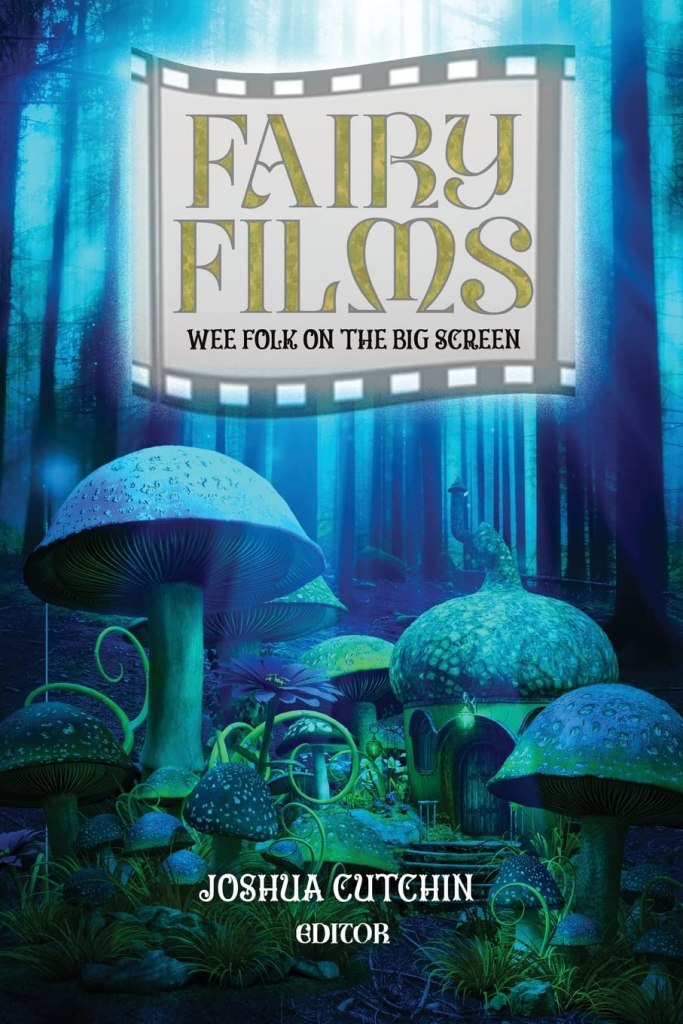
Featuring essays by Wren Collier, Joshua Cutchin, Susan Demeter, Patrick Dugan, David Floyd, Jack Hunter, Allison Jornlin, James P. Nettles, Neil Rushton, Mark Anthony Wyatt, and Simon Young.
***
Dead but Dreaming the novel is available now…

 deadbutdreaming
Thanks for this article, which I have not even read yet but know I will enjoy. I will seek out the film, too.
LikeLiked by 1 person
Thanks for this Victoria – links to the film are at the end of the article.
LikeLiked by 1 person
Finished reading this, and I did enjoy it and believe I have seen the film Photographing Fairies, although quite a while ago. I remember the Great Tree and the zipping sound of the fae. Your well documented sources and scholarly treatment of this ephemeral subject is admirable and appreciated. The inter dimensional aspect of fairies and other entities is something I believe to be true.
LikeLike
Fascinating article. Thank you for posting the link to the movie, which I wasn’t aware of at the time. It’s a pity movies like this don’t get more publicity.
LikeLiked by 2 people
Thank you Annabelle – the Internet Archive version is very high quality, but it is a shame the film never had a DVD release, as I’d love to watch to some extras. Thanks again for reading and commenting.
LikeLiked by 1 person
Much more than a film review. Thoughtful and thought provoking, as is your novel. As someone who takes a large interest in these things I think your take( however much of one we can gather, anyway) might be similar to my own. Cutchin has much the same idea and I’m glad to see you present one of his books. They are all very good. Great essay. Write more, please.
LikeLiked by 2 people
Thank you very much – this is appreciated. And I will write more! Thanks again.
LikeLike
I tried to click the star/ “like ” button but was told this is now a private website….seems to be accessible now though 🤔 What’s going on? Just WordPress being bizarre??
Whatever. Loved this article. ” Photographing Fairies ” is one of my favourite films. Weirdly, it was called ” Apparition ” here in Aus. Unsure why the name change was necessary, although I do think it’s more popular title is too literal, and could afford to be a little more imaginative.
The ending of the film always intrigued me. I find myself wondering if- almost hoping that when we die we can indeed go back to a certain pivotal point in our lives for a redo….and when people talk of parallel dimensions as alternative paths we might have taken, I can’t help but spend way too much time fantasising about the possibly multifaceted aspect of time, and wondering if a billion different me’s exist somewhere and someWHEN. It’s a comforting idea to me, because it means SOMEWHERE out there exists a version of me that didn’t fuck up so spectacularly.
Bloody love the film, anyway- especially the soundtrack. You’ve described the themes better than I ever could, so I’ll just say thanks for sharing it with us. I haven’t had access to the internet until quite recently, so I see I’ve missed a few posts by you. I look forward to reading them when my currently limited resources allow. I’m even considering braving the recounting of some weird, otherworldly experiences on my old blog….it’ll be a bit out of my comfort zone to do so, but people such as yourself – and others, such as the lovely Jo Hickey Hall- make me feel more comfortable with the idea.
Cheers✌️
LikeLiked by 1 person
*its
LikeLike
Thank you my friend – it is indeed a fabulous film, and I was pleased to be able to write about it for Joshua’s publication. I hope you get your mojo back soon, and don’t worry, all wrongs will be righted at death! As you mention Jo Hickey-Hall, look out for her next Modern Fairy Sightings podcast this week sometime, when she’ll be interviewing… me! Not sure what the problem was hitting the like button – WordPress has been glitchy of late. I have noticed the views have dropped off dramatically over the last few days, so I hope they haven’t put me in some type of private mode without me knowing. Thanks again.
LikeLiked by 1 person
Oh, cool- I’ll definitely be tuning in to your interview. Jo seems like such a nice lady, and I just love the fascinating stories her guests present us with. I’m sure hearing you both discuss the otherworlds will help me ( and others, I’m sure) to speak more openly about some of my own weird experiences.
Thanks for the well wishes re getting my mojo back 🙏. I wholeheartedly agree with what you say about death. Life feels like some kind of a weird game at times…and that’s oddly reassuring. Anyhoo, cheers ✌️🧚
LikeLiked by 1 person
I sent you an email
Please send me something by email
LikeLike