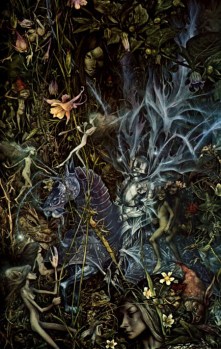
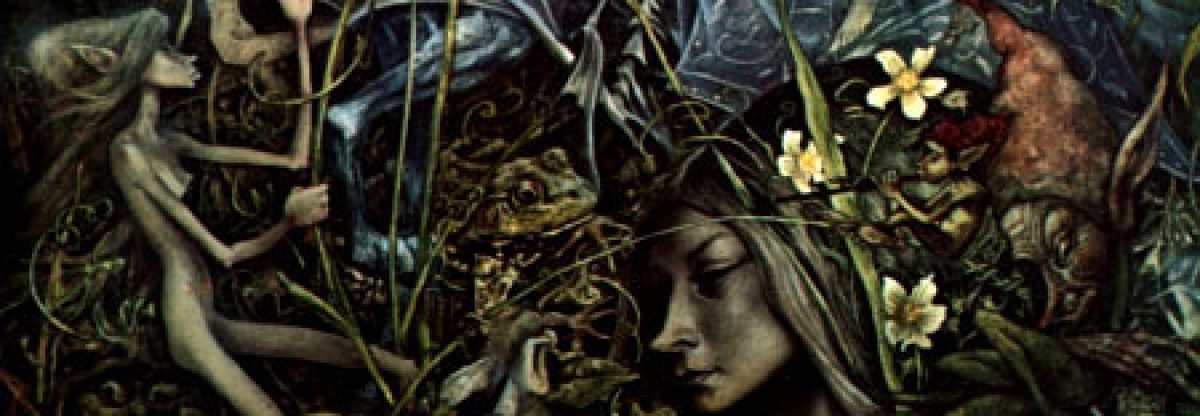
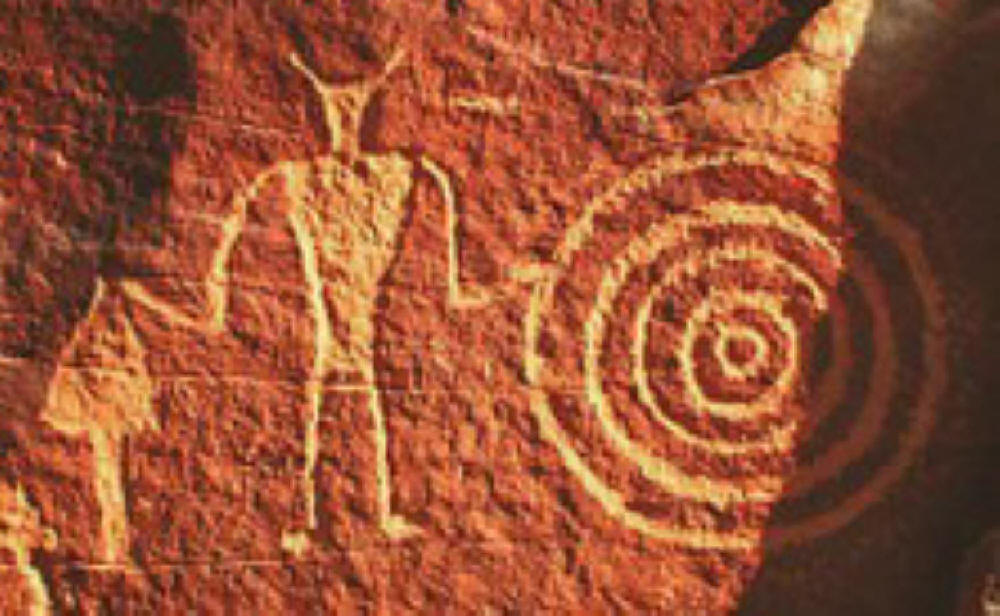
A version of this article appeared previously on Ancient Origins. While slightly peripheral to the faerie phenomenon, it does seem that the study of prehistoric rock art may provide some evidence that our ancient ancestors were interacting with faerie-type entities, and were doing so by altering their states of consciousness.
Throughout the world, prehistoric and pre-industrial shamanic cultures have rendered painted imagery onto rock faces; often in deep cave systems but also in above-ground shelters. This ‘rock art’ ranges in date from Palaeolithic designs in Europe, Australia and Asia through to the near-contemporary images of the San culture in southern Africa and the designs of indigenous cultures of North America and the Amazon basin. Until the mid-20th century the consensus anthropological view was that the rock art — while probably having magical meaning to the people who painted it — represented scenes from the natural environment, such as people, animals and landscapes. But as a greater anthropological understanding of indigenous shamanism developed, most especially through the work of Mircea Eliade and his 1951 publication Shamanism: Archaic Techniques of Ecstasy, a new awareness evolved that the rock art produced by indigenous cultures might be the artistic result of shamanic processes, preeminently those brought about by inducing altered states of consciousness. This was mainstreamed in 1988 by the anthropologists David Lewis-Williams and Thomas Dowson in their paper for Current Anthropology: ‘The Signs of all Times: Entoptic Phenomena in Upper Palaeolithic Rock Art’, where they advance a neuropsychological model for analysing the motifs of parietal art of this period, proposing that the geometric images are in fact artistic representations of universal optical patterns, intrinsic to the human visual system, once perceived by our shamanic ancestors during altered states of consciousness. The most important element of this model is the entoptic imagery displayed in the rock art and how it matches closely the geometric patterns seen by people in modern clinical conditions who have altered their state of consciousness.
The Entoptic Model
The word ‘entoptic’ derives from the Greek ἐντός ‘within’ and ὀπτικός ‘visual’. Entoptics usually consist of geometric patterns seen as overlays in the visual horizon. These patterns may be an array of dots, parallel lines, labyrinths, zig-zags, waving lines, etc. Sometimes they appear detached from the visual surroundings while at other times more integrated. Entoptics are usually experienced during altered states of consciousness, which may be achieved through a variety of means. The best evidence for the consistency of visual entoptics comes from clinical trials (from the 1950s onward), which analysed subjective narratives of people administered a variety of psychedelic substances. Many of these narratives described the geometric entoptics as antecedents to deeper experiences, as if they were a geometric gateway to the main substance of the experience. The entoptics were, in effect, neuropsychological codes for signalling change in the state of consciousness.
Lewis-Williams and Dowson’s model took sketches made by people experiencing consciousness modification via psychedelic drugs in clinical trials and applied the imagery to the rock art produced by indigenous tribal communities in modern day South Africa, the Amazon and by the Native American Shoshonean Coso culture of the California Great Basin. The geometric images demonstrated extensive similarities. The rock art contained many of the geometric motifs recorded by modern trial results. These entoptics appeared to be some universal code, experienced and recorded by both modern-day psychonauts and people in indigenous communities experiencing altered states of consciousness through a variety of methods. Because the San and Coso indigenous peoples are verifiable shamanistic cultures, able to describe the meaning of the rock art of their immediate ancestors from personal viewpoints, Lewis-Williams and Dowson took their descriptions of entoptics at face value. Whether through the consumption of psychedelic compounds or dancing in a ring for hours (the San’s primary way of entering an altered state of consciousness), people in these cultures were entering a divergent reality and sometimes they recorded this reality in rock art. A lot of this was composed of entoptic imagery.
An intensive study of this rock art by Lewis-Williams and Dowson suggested that comparisons might be made to Palaeolithic parietal art in Europe. In their 1988 paper they compared rock art (primarily in caves) from Upper Palaeolithic Europe to the San and Coso examples, as well as against the data from modern clinical trials where entoptics were reported. Using a large dataset, they found a tight correlation between the styles of entoptic designs in their African and American examples and those from the caves of Europe dating between 20 and 30,000 BCE. The rock art contained all six of the coded entoptic patterns, as designated from the clinical studies. While not universal in Palaeolithic parietal art, entoptic designs do form part of a majority of the imagery. This allowed Lewis Williams and Dowson to profile their neuropsychological model as an interdisciplinary explanation for entoptics, whether recorded as experiential reports from a modern clinical trial or in Palaeolithic rock art. With the oral testimonies and relatively recent rock art from the San and Coso cultures, both of which are shamanic and use various techniques to alter states of consciousness, the dataset allowed a testable model, which might help bridge a gap of tens of thousands of years.
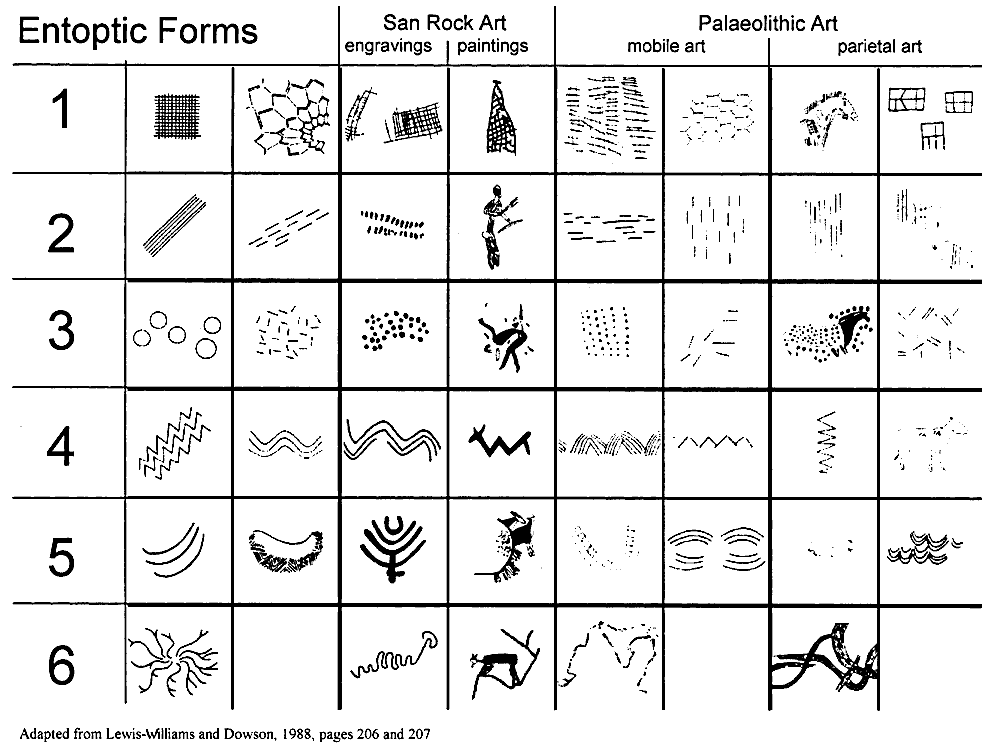
Lewis-Williams and Dowson assumed four main elements to their model: 1. Entoptic phenomena occur universally in altered states of consciousness; 2. The people producing rock art used one or more techniques for altering states of consciousness; 3. A quantity of Upper Palaeolithic rock art represents the entoptic phenomena experienced during altered states of consciousness; 4. The visual content during an altered state of consciousness may vary with the cultural context but the basic features of the experience, such as entoptics, are a universal and have been repeated through time.
This model does sit well with the evidence presented by Lewis-Williams and Dowson. But introducing the known phenomenon of entoptic visuals in an attempt to explain the previously indecipherable geometric painted patterns from distant prehistory represents a radical reinterpretation of the rock art data. It appeared as if there were a genuine link between shamanic cultures separated by tens of thousands of years and altered states of consciousness, which might be experienced by anyone, at any time, if conditions are met. But as with any model that challenges the mainstream orthodoxy it has been challenged.
The Kickback to the Entoptic Model
Using ethnographic techniques to attempt building a new model to breach the gap between Palaeolithic culture and ours was always going to cause controversy. Two of the academics who have criticised the Lewis-Williams/Dowson model are Paul Bahn (archaeologist) and Patricia Helvenston (psychologist). Their main contention is that we cannot know what sort of shamanism was practiced in the Palaeolithic period and that projecting ethnographic data back tens of thousands of years is invalid. They also contend that there is no evidence of psychotropic plants in the European Upper Palaeolithic, and that therefore there was no recognisable substance that could be used as a means for altering consciousness states, as would be necessary to adhere to Lewis-Williams and Dowson’s model. Their former point has some substance. Any attempt to explain Palaeolithic consciousness states in terms of recent ethnographical studies and modern clinical trials will invoke legitimate sceptical reactions, even when proposed by respected anthropologists and backed up by a mass of convincing data. There will always be an interpretative leap required to move away from a consensual orthodoxy to a new hypothesis, especially when dealing with such ancient cultures with no written record.
But their second contention is inaccurate. Bahn and Helvenston contend that the neuropsychological model is dependent on entoptics produced by altered states of consciousness facilitated by LSD, Mescaline or psilocybin, and that these compounds would not have been available to European Palaeolithic artists. This is true for LSD and Mescaline but not for psilocybin. The clearest example is the psilocybin-producing mushroom Psilocybe semilanceata (commonly known as the Liberty Cap), which is native to Europe and thrives as far north as the Arctic Circle. This would have been available as an entheogenic substance to the Palaeolithic cave painters. The mycologist Roy Watling (recently backed up by recent research by Froese, Guzmán, and Guzmán-Dávaloshas) also suggested there may have been up to thirty further species of psilocybin-producing mushrooms available in Upper Palaeolithic Europe as well as the Amanita muscaria (fly agaric) mushroom, which has also been demonstrated to induce entoptic visuals. It seems as if shamanistic cultures of Palaeolithic Europe did indeed have access to psychotropic substances, which would have produced the exact entoptic visuals we find recreated in their parietal art. They may have also been using other techniques to alter their state of consciousness, such as the rhythmic dancing of the San people.
So, although we cannot know how Palaeolithic people were altering their states of consciousness, it is clear they certainly had the opportunity, and if they behaved as every other shamanistic culture in the anthropological record, they would have been doing so. The entoptics catalogued by Lewis-Williams and Dowson are, in effect, a code that links shaman-visions painted on cave walls from distant prehistory to the experience of indigenous cultures in Africa and the Americas, and the first stages of modern psychedelic trips by people experiencing a peripheral shamanic episode.
Reality or Illusion? Taking the Entoptic Model Further
The debate continues among anthropologists as to whether we can warrant the ethnographic-stretch that joins the experiences of altered state of consciousness across tens of thousands of years. Lewis-Williams and Dowson’s model has gained relatively wide academic acceptance, but this is mostly from the perspective of a reductionist worldview, where altered states of consciousness — whether Palaeolithic or 20th/21st century — are simply delusions produced by chemical alterations in the brain. From this viewpoint, even if the entoptic model is accurate, it is simply a model of delusional thinking carried out over a very long time-span, effected by substances (or activities) that cause hallucinatory images. This viewpoint is a standard Western academic position. Fortunately, there is a new wave of academic thinking that looks to go beyond such reductionism in an attempt to get a closer epistemological view as to what the neuropsychological model might mean to the human condition.
A foundation of the neuropsychological model is Lewis-Williams’ assertion that entoptic phenomena are: ‘visual sensations derived from within the optic system anywhere from the eyeball to the cortex.’ So while the entoptics are produced by altered states of consciousness, the model relies on them being purely the result of neurochemical changes in the brain. It is a reductionist approach, which gives no credence to the potential reality of the phenomenon. The psychologist David Luke (who specialises in the psychology of altered states of consciousness), while accepting the general remit of the entoptic, neuropsychological model and its temporal/geographical universality, has attempted to demonstrate that viewing the entoptic phenomenon as something that happens in the brain, fooling both us and our Palaeolithic ancestors by way of a simple hallucination, is not necessarily valid. Luke uses a large dataset of people who have experienced entoptics during altered states of consciousness, either through the consumption of psychedelics or through a range of other triggers. Many describe the omni-directional and trans-optic nature of the visuals, and a large minority of the testimonies are from people who have undergone an out of the body experience. For them the entoptic experience is more than a hallucination — it is a manifestation of a reality that conjoins with our usual state of consciousness and expresses itself in a manner that suggests the visuals are part of an autonomous reality. The cosmic multidimensionality of the experience means that its reality is ineffable — for modern participants this means they cannot articulate the experience, whilst Palaeolithic (and more recent) shamans were reduced to attempting to capture their enlightenment by producing 2-D rock art.
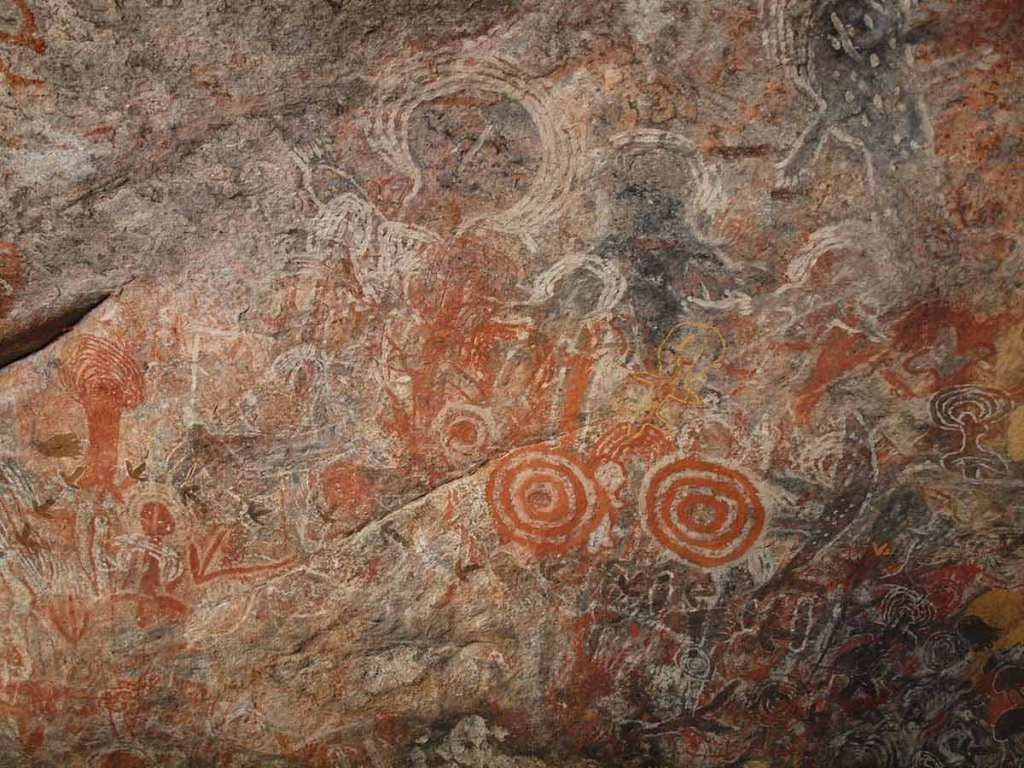
This interpretation also brings in to play the ‘next stage’ of an experience brought about by altered states of consciousness. The entoptics were/are just primers for the more sublime experiences brought on during an altered state. Many modern testimonies describe the entoptic phase of a numinous episode as the precursor to a more intense experience that includes strange and non-human intelligent entities, some of which may be described as faerie-type entities. Likewise, much of the rock art that has entoptic designs also includes images of entities that are humanoid but evidently not human. This suggests there is an intimate connection between people experiencing altered states of consciousness, moving from entoptics to entity encounters, in time periods separated by millennia. The rock art produced by Palaeolithic shamanic cultures would appear to be a template for the future. Subsequent cultures have worked out the importance of the message — we can experience different realities under certain circumstances — but the message is subtle; the experience is dependent upon a subjective view of reality. Whatever that view is, it seems as if our Palaeolithic ancestors may have had the same route into it as we do, and that their art should be considered as an expression of the numinous (however that may be interpreted), common to all humanity through to our own time.
References
Eliade, M. 1972. Shamanism: Archaic Techniques of Ecstasy. Princeton University Press (first published in French in 1951)
Froese, T., Guzmán, G. & Guzmán-Dávalos, L. 2016. ‘On the Origin of the Genus Psilocybe and Its Potential Ritual Use in Ancient Africa and Europe’ . Economic Botany 70, 103–114
Hancock, G. 2005. Supernatural: Meetings with the Ancient Teachers of Mankind. Century, London
Helvenston, P and Bahn, P, et al. 2003. ‘Testing the Three Stages of Trance Model.’ Cambridge Archaeological Journal 13, 213-24
Lewis-Williams, D. 2002. The Mind in the Cave. Thames & Hudson, London
Lewis-Williams, D and Dowson, T. 1988. ’The Signs of All Times:Entoptic Phenomena in Upper Palaeolithic Art’, Current Anthropology 29, 201-45.
Luke, D. 2010. ‘Rock Art or Rorschach: Is there more to Entoptics than meets the Eye’, Time and Mind: The Journal of Archaeology, Consciousness and Culture 3, 9-28.
Luke, D. 2017. Otherworlds: Psychedelics and Exceptional Human Experience. Muswell Hill Press, London
***
Dead but Dreaming the novel, is available now.

 deadbutdreaming
Fascinating possibilities, Neil. I’ve also considered that the psychotropic plants allowed primitive humans to travel between the different realms of existence.
LikeLiked by 2 people
Thank you Colleen – and yes, I think you’re correct.
LikeLiked by 1 person
When I looked at the first column on the table of drawings, I was struck by the thought that many of these patterns and shapes are things people sketch absentmindedly and near-automatically. A child who is “zoned out” during a lesson in a classroom, or a person who is on a phone call with a piece of paper in front of them; both are sure to draw a form of one of these symbols–a cross-hatch, circles, swirls, zigzagged lines, etc.
I don’t mean to reduce the meaning or significance of these drawings by saying this. Rather, maybe it reinforces their existence in the unconscious. Is a “half-listening” distracted state not a minor form of trance?
Also, in an entry in the second Fairy Census from Australia (#935) the witness recalls, “I do remember one dream of that night where three very tall luminescent beings were standing next to my bed. I called them Elves. They seemed to me to come out of the Earth rather than outer space. I don’t recall any other details, except they look like those Australian indigenous rock art paintings of spirit beings.”
I’m not familiar with much Australian indigenous rock art paintings so I don’t know what exact artwork she is referring to, but maybe you will have an idea! Thought that was very interesting…
Great article! I’ll be looking into the sources you posted, as well. I might have to trouble you for the one on Psilocybe from Economic Botany. Thanks!
LikeLiked by 2 people
Interesting thoughts Anastasia – thank you. The Mind in the Cave book is definitely the place to start for Lewis-Williams’ detailed discussion of the entoptics in modern psychedelic experiences. But I agree with you that there can be many ways (other than psychedelics) to induce a trance state – even distracted boredom! And I’m glad you’ve been delving into the second fairy census – it’s an important collection. Thanks again.
LikeLike
Fascinating stuff Neil. Whilst reading this I was wondering about Irish rock art. There are a huge amount of rock carvings throughout that country, particularly concentrated in the east and south-west. The fact that they are carved (rather than painted or etched) I suppose means that they have survived the passage of time whereas I guess many paintings have been lost. Most are of the ‘cup-and-ring’ type or otherwise geometric – I guess intricacy is less easily carved than painted. Your theories could equally apply to these I imagine and perhaps David Halpin might agree.
LikeLiked by 1 person
Thank you Roy – and yes, the Irish (and British) rock carvings could very well fall into the same category. The triple spiral at Newgrange is the most obvious example. I think David touched on this in a Circle Stories post a few years ago. All fascinating stuff. Thanks for reading and commenting – always appreciated.
LikeLiked by 1 person
Fascinating subject and fantastic article. Very thought provoking. It’s also a nice bit of synchronicity to read this today, as the other week I attended the Yayoi Kusama exhibition being shown in Melbourne, and was struck by how much Kusama’s paintings reminded me of Australian Aboriginal art. I’m not sure how much you know about Yayoi Kusama ( I plan to post some photos of her exhibition on my blog soon), but she has experienced spontaneous hallucinations her entire life, and when I considered this alongside the visual resemblance to Aus indigenous art, I couldn’t help but think about whether A) altered states of consciousness played a role in Aboriginal “Dreamtime” imagery ( as with most original cultures worldwide, they likely did) – and whether- no matter how they’re reached, altered states might lead people- no matter where or when- to the same seemingly timeless realms.
I loved what one of the other commenters up there said about the kind of imagery generated when we’re absentmindedly doodling lines on a page, too. I’ve definitely noticed this also. One of the first things my daughter used to draw as a toddler were spirals and eyes- motifs we see not only in indigenous art all over the world, but in psychedelic art and during psychedelic experiences.
Always nice to see David Luke mentioned , too. He’s a cool guy (with a good sense of humour!) and I’m definitely a fan of his work.
Lots more I could say, but I’ll spare you the essay ( for now!). Hope your 2025 is off to a good start! I’ll be back to read your other new posts when I have the time to give them the attention they deserve.
Have a magickal day!
LikeLiked by 1 person
Thank you for this – it’s a deep topic and I have only scratched the surface, but Lewis-Williams’ hypothesis seems sound to me. I have not heard of Yayoi Kusama, but will look out for your posts from the exhibition. All the best back to you for MMXXV.
LikeLiked by 1 person