This is my article from a new publication The Cottingley Fairy Photographs: New Approaches to Fairies, Fakes and Folklore, edited by Dr Simon Young. This volume contains fifteen essays by faerie researchers and is accompanied by a separate volume The Cottingley Fairies: A Source Book compiled by Simon. My article below does take some familiarity with the story for granted (Simon Young’s Introduction in the volume of essays provides an invaluable overview) and is an attempt to dig below the faked photographs to excavate the more numinous aspects of the story of what happened in Cottingley Beck. Thanks to Simon for permission to republish.
Photographing Fairies
In the 1997 film Photographing Fairies (based on the 1992 novel by Steve Szilagyi1, and set shortly after WWI), there is a scene where the main protagonist, Charles Castle (played by Toby Stephens), bursts in to a meeting of the Theosophical Society where Edward Gardner (Clive Merrison) is showing a slide of one of the Cottingley photographs as proof of the existence of faeries.2 Castle proceeds to demonstrate that the image is a fallacy, and that the faeries are quite evidently cardboard cut-outs. His intervention breaks up the meeting and we are introduced to Sir Arthur Conan Doyle (Edward Hardwicke), a member of the society, who extends some words of solace to Gardner and the audience: ‘We’re travelling in the dark. We must expect to bark our shins now and again. We are pioneers exploring the borderland between this world and a better one.’ In this three-minute scene the Cottingley story, and the involvement of Gardner and Doyle, is distilled and made to seem preposterous. The photographs are quite evidently fake and, seen from the rationalist perspective of Charles Castle, the Theosophist belief in such supernatural entities is deemed ridiculous – a refuge of naive superstition. The rest of the film is concerned with overturning this viewpoint, as Castle discovers that photographs taken by two other girls appear to show real humanoid — faerie — entities. He travels to their village and proceeds in an attempt to photograph the faeries, but only succeeds in encountering them whilst in an altered state of consciousness brought about by the consumption of a mysterious white flower.
While the film is not about the Cottingley faeries, it is quite evidently using the trope of the story (as was Szilagyl’s novel) to create the narrative. When Castle travels to the village he encounters the girls Ana and Clara — patently representatives of Elsie and Frances (although they are sisters in the book and film); they are several years apart and seem to spend much of their time communing with nature (in the film a woodland rather than the beck at Cottingley). What the film so skilfully depicts is the nature of interaction with the faeries — they can only be perceived during an altered state of consciousness, brought about by the consumption of the white flower. The photographic equipment Castle brings to the woodland to capture images of the faeries never really works — they can only be truly seen once the consciousnesses of the girls and Castle are in the correct state for it to happen. Whilst the relationship of photographic images depicting faeries in the film is very different to what happened at Cottingley, there is, in the film, an intuitive (explicate or implicate) portrayal of human consciousness being able, under certain circumstances, to see the unseeable, and that capturing the unseeable on photographic plates may or may not be possible. The white flower is a proxy for this to happen, an artistic device to render altered states of consciousness. But in the early 20th century the ability to discern non-human intelligent entities such as the faeries was known simply as clairvoyance. It has become an unfashionable word, but its intrinsic meaning was well understood at the time of the events at Cottingley, and there seem to have been at least two people engaged in clairvoyant activity in the beck.
Frances Griffiths
Frances Griffiths was nine years old when she arrived in Cottingley in the Spring of 1917, after spending most of her life in South Africa. In her memoirs, written over sixty years later, she makes light of what must have been a dramatic, and potentially traumatic, change in her life.3 But she was an outsider in a strange environment, suddenly finding herself lodged in a bedroom with her older cousin Elsie and having to adjust to a cold, extended Yorkshire Winter. Whilst the contents of a memoir written so long after the events it describes needs to be treated with caution, it does seem to have been compiled from earlier written reminiscences, and there is a consistency in Frances’ description of events that seem relatively authentic. Within fourteen pages she is already describing how she first saw a faerie-type entity in Cottingley Beck:
I suppose I must have been day dreaming one day when I looked across the beck and saw a willow leaf twirling around rapidly, moving as it were, on its own… I had never seen a leaf do that before, but then everything here was new to me… That was the beginning, although at the time I didn’t realise it. The leaf was being held by a little man. The first time I saw the little man – he was about eighteen inches high – he was walking purposefully down the bank on the willow side of the beck, holding a willow leaf in his hand, twiddling it very fast as he crossed the water to the other side.4
The day dreaming element of Frances’ description is important in relation to the nature of clairvoyance, and how this type of altered state of consciousness may be an access-point to potentially numinous experiences. Frances was in a new environment, and the beck probably seemed quite magical as Spring broke through it. For a few weeks she had it mostly to herself as Elsie was working during the days, and it seems that she continued to see faerie-type entities. Frances suggests they would notice her, and look at her, but there was never any audial communication. The only sound she describes is ‘a high-pitched sound, similar to a ringing in one’s ear.’ Other than this the encounters were visual only and seem to describe the same entities over a period of time. The original ‘little man’ was soon joined by a number of compatriots:
Once I saw him leading three or four little men who were dressed as he was, in green jerkin and darker-coloured green loose-fitting tights – rather like our young people wear their Levis today! They all walked very purposefully and when they had crossed the beck they turned towards the right. I watched them until they went behind a clump of willow herb and were lost from sight.5
Apart from the little men, Frances also described ‘conventional faeries’, although she never explained exactly what these were. The insinuation is that they were the winged faeries depicted in the photographs. Interestingly, Frances never describes seeing the faeries with Elsie. Her language about this is often ambiguous, such as when she talks of the adults teasing both of them about seeing faeries, suggesting that Elsie was also seeing Frances’ entities. But there is no explicit reference in Frances’ memoirs or later interviews that she and Elsie saw the faeries together. In a letter to Gardner, Elsie repeats a line she had used in several interviews, that the images were ‘photographs of figments of our imagination’ — a cleverly worded sidestep in itself that could be interpreted several ways.6 But in the same letter she writes that Frances was angry with the phrase, and had castigated Elsie, asking: ‘What did you say that for? You know very well they [the faeries] were real.’ If Elsie had not seen the faeries with Frances, why would Frances be so annoyed at Elsie’s ambiguous words? Perhaps Frances simply expected Elsie to accept her own encounters with the faeries. But it does seem that Elsie was at least with Frances in the beck when the younger girl saw faeries.
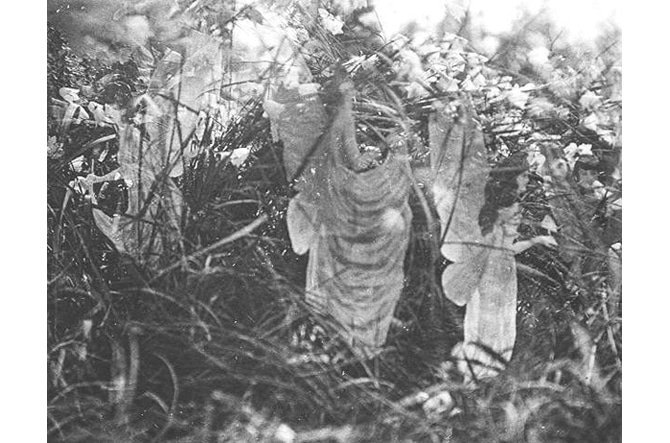
They were certainly together to take all the photographs in 1917 and 1920, including the final fifth photograph, which is perhaps the most interesting of the set, as it wasn’t contrived by Elsie, and seems to have been taken by Frances at the end of a wet day wandering around the beck, with both girls worrying about the responses of Gardner and Conan Doyle to the previous photographs. Frances describes seeing a bird’s nest on the ground:
My camera was loaded and the plate ready for taking, and on an impulse I pointed the lens towards the bird’s nest, pulled out the bellows and took a 5 second — I think — shot. It was done without a thought… That was the fifth photograph.7
This photograph is very different than the other four and does seem to show amorphous humanoid entities, although this might be put down to pareidolia, or even a double exposure with blurred images from Elsie’s cut outs. Either way, the fifth photograph may be seen as a better representation of the types of entities Frances described as seeing in the beck between 1917 and 1920. But, in Frances’ own words, she thought the photographs — and what they may or not prove, and whether they were faked or not — less important than her own real psychic experiences:
This is where I feel angry with Sir Arthur Conan Doyle and Edward Gardner. They never sought for any explanation of fairy life. It was enough that they could get the copyright for the photographs we took, and later use them on world tours lecturing on something neither they — nor I — knew anything about. If they had only suggested some ways of finding out more about ‘my’ little men and the fairies, who knows what might have been discovered!8
Geoffrey Hodson
In the Summer of 1921 the girls were redrafted in to a new investigation at the beck as Edward Gardner turned up in Cottingley with a new camera and plates. Shortly after, on 6 August, Geoffrey Hodson (along with his wife) came to the village in order to undertake further psychic appraisals.9 Hodson had been chosen by Conan Doyle for the task, and seems to have been, at that time, an upcoming member of the Theosophical Society, with clairvoyant abilities.10 Hodson was thirty-five and had been involved in action as a Tank Commander in the Tank Corps during the final days of WWI, just three years previously in 1918.11 Hodson spent two weeks at Cottingley with the girls and reported back to Conan Doyle on his experiences, which were then edited in to chapter five of The Coming of the Fairies, the following year.12 It is quite clear that Hodson believed he was encountering an array of non-human intelligent entities in the beck, and that both girls were also seeing them. The chapter is a simple explanation of where they saw the faeries and the different types of entities that seemed to inhabit the beck. It needs to be read in full for a true understanding of how full-on Hodson was, but an example from 12 August gives an impression of the whole:
Two tiny wood elves came racing over the ground past us as we sat on a fallen tree trunk. Seeing us, they pulled up short about five feet away, and stood regarding us with considerable amusement but no fear. They appeared as if completely covered in a tight fitting one-piece skin, which shone slightly as if wet. They had hands and feet large and out of proportion to their bodies… There were a large number of these figures racing about the ground. Their noses appeared almost pointed and their mouths wide. No teeth and no structure inside the mouth… It was as if the whole were made up of a piece of jelly. Surrounding them, as an etheric double surrounds a physical form, is a greenish light, something like chemical vapour.13
The entities then sank below the ground. This particular incident seems to have been witnessed by only Hodson and Frances, but many of the other sightings involve both girls, and it is clear that the three of them spent a lot of time together in the beck attempting to discern the faerie-type entities that would manifest there. Hodson wrote further about his expedition to Cottingley in two books, The Kingdom of the Gods and The Fairies at Work and Play, and his thoughts were again recorded in an interview just before he died; he was always consistent in what he saw with the girls at Cottingley.14 But Elsie and Frances were not complimentary about Hodson, when interviewed many years later in 1976. Frances went as far as to call him ‘a phoney.’ However, in the same interview they also suggested they all did see faeries during Hodson’s stay.15 In fact, in both girls’ dispositions on Hodson and his visit, on the rare occasions they mentioned it, seem rather nervy. They did not seem to know what to make of him, and it may be that his Theosophical outlook was a philosophical mindset that was simply beyond them. Frances saw faeries, Elsie may have seen them, but the quest for an ontological reality of the entities never seemed to have entered their minds, whereas for Hodson (as well as Gardner and Conan Doyle) this was the primary interest. Elsie even suggested (in a 1983 conversation with Marjorie Johnson, honorary secretary of the Fairy Investigation Society, and author of Seeing Fairies) that they had only spent three days with Hodson in the beck, whereas it is quite evident from Hodson’s report, and Gardner’s notes, that he was with the girls for two weeks, and spent almost every day with them in the beck.16
Hodson appears to have been a man with genuine psychic abilities — he was what Bill Keidan (Hodson’s online biographer) terms an ‘illumined occultist.’ He spent the rest of his long life producing a prodigious amount of books and articles on a wide-range of esoteric subjects from reincarnation to the Angelic Kingdom, which were well thought of in Theosophical and esoteric circles. He also collaborated with scientists on a spectrum of surprising subject matter from sub-atomic physics to anthropology, gaining genuine respect for his (non-scientific) insights into quantum mechanics and the potential consciousnesses of early hominids.17 Hodson does not seem to have been a fraud. He would appear to have been a genuine clairvoyant, who simply reported what he perceived. But what does clairvoyance mean, and were Frances’ and Hodson’s clairvoyant experiences with faeries at Cottingley Beck the same thing?
Clairvoyance and Faerie-Type Entities
In his later writings, Hodson would often describe clairvoyance as ‘thought forms’, which manifested during certain states of consciousness that were either inherent to an individual or which could be learnt. These forms could often take the aspect of non-human intelligent entities, such as faeries. This does not mean they are figments of imagination, but rather that they are, at some level, real and able to be seen and encountered whilst a person is in the appropriate state of consciousness. Hodson’s extensive writings describe the different types of faerie-type entities he experienced throughout his life. His prose-style can seem a little opaque at times, but his sincerity and dedication to investigating what he would often term the occult realms are indisputable. In one of his most wide-ranging books, The Kingdom of the Gods (first published in 1952), he succinctly — albeit in his usual, gnomic (pun intended) language — describes the clairvoyance, or seership, that allowed him to interact with non-material intelligent entities:
As part of the unfoldment of the human intellect into omniscience, the development occurs at certain stages of human evolution of the faculty of fully-conscious, positive clairvoyance. This implies an extension, which can be hastened by means of self-training, of the normal range of visual response to include both visual rays beyond the violet and, beyond them again, the light of the superphysical worlds…It is important to differentiate between the passive psychism of the medium, and even the extra sensory perception of parapsychology, and the positive clairvoyance of the student of Occultism. This latter, completely under the control of the will and used in full waking consciousness, is the instrument of research with which during the past thirty years I have endeavoured to enter and explore the Kingdom of the Gods.18
Hodson’s language for describing clairvoyance correlated closely with another Theosophist (albeit dissident to the established structure of the organisation), and contemporary to the Cottingley story, Rudolf Steiner, who most often described faerie-type entities as nature spirits or elementals, basing his taxonomy of them on the 16th-century alchemist Paracelsus.19 Steiner describes how a clairvoyant can enter the world of the elementals — in normal consciousness thoughts:
… allow themselves to be connected and separated, to be formed and then dismissed. This life of thought must develop in the elemental world a step further. There, a person is not in a position to deal with thoughts that are passive. If someone really succeeds in entering the world with his clairvoyant soul, it seems as though his thoughts were not things over which he has any command; they are living beings… You thrust your consciousness into a place, it seems, where you do not find thoughts that are like those in the physical world, but where they are living beings.20
This became a mainstay in Theosophical ideology — clairvoyance is, in part, simply a methodology for interacting with elementals, nature spirits, faeries (or whatever desired terminology is used to describe these beings), and it allows a person to see entities that are not normally available to everyday consciousness. Hodson’s testimony from his time at Cottingley is certainly an example of someone who was using his apparent clairvoyant abilities to interact with, or at least view, incarnate entities.21
A few years earlier WY Evans-Wentz, in his 1913 publication The Fairy-Faith in Celtic Countries, was recording similar testimonies from people in the Celtic nations, who were not aligned with the Theosophical movement, but seem the have had much the same mindset when it came to the faeries.22 These people were usually called seers (as Hodson himself often described clairvoyants). Evans-Wentz met one such (anonymous in the text, but evidently George William Russell, aka “AE”) Irish seer in Rosses Point, County Sligo. He talked about various types of faeries that inhabited the landscape of Sligo, making them sound like a cross between nature spirits and mystical visions. But Evans-Wentz was just as interested in the mechanics of interacting with the faeries as he was with the stories themselves. How did the seer interface with them?
I have always made a distinction between pictures seen in the memory of nature and visions of actual beings now existing in the inner world. We can make the same distinction in our world: I may close my eyes and see you as a vivid picture in memory, or I may look at you with my physical eyes and see your actual image. In seeing these beings of which speak, the physical eyes may be open or closed: mystical beings in their own world and nature are never seen with the physical eyes… I usually find it possible to throw myself into the mood of seeing; but sometimes visions have forced themselves upon me.23
Over two centuries earlier, Robert Kirk was describing much the same form of seership amongst certain inhabitants in and around Aberfoyle in Scotland, usually described as the second sight.24 The Theosophists of the early 20th century appear to have been unaware of Kirk’s Secret Commonwealth, but the basic mechanics of seeing and encountering faerie-type entities through clairvoyant attributes were much the same. Were the Cottingley girls clairvoyant, in the way described by Kirk, Steiner, Russell and Hodson? It would be easier to think of Frances as a clairvoyant than Elsie, but even then this might be stretching the credentials of a young girl who simply saw faeries that should not have been part of the material world. Frances certainly never described herself as having any special psychic abilities, and her later scepticism of Hodson may have been, in part, to distance herself from the rubrics of Theosophy and the Fortean qualities of clairvoyance. But there are a few clues that might suggest Frances was able to enter an altered state of consciousness, which enabled her to engage with supernatural entities. Her describing being in a day dream state when she first saw the faerie man in the beck indicates a meditative state, and in the addenda to her memoirs, her daughter Christine states: ‘Strangely, she told me later that she didn’t see them straight on, but obliquely.’25 Christine also suggests that Frances may have had certain telepathic abilities from a young age, when: ‘she had got into the habit of closing her mind to stop others from hearing what she was thinking.’26 The insinuation is that Frances may have been more of a clairvoyant in the mold of Hodson than she realised. Or perhaps she was just another person who occasionally slipped into an altered state of consciousness and saw faeries.
The connection between encountering faerie-type entities and being in an altered, or non-ordinary state of consciousness is well attested in both historic and modern accounts. The folklore is replete with protagonists being agitated, depressed, blissful, confused, anxious, meditative, ecstatic or ill before they become embroiled in a faerie encounter.27 And modern faerie encounters are similarly most often accompanied by descriptions of the experiencer feeling different in some way from their everyday state of consciousness, as can be seen, for example, in the two censuses carried out by Simon Young for the Fairy Investigation Society.28 These altered states become greatly magnified when they have been induced through the consumption or injection of psychedelic drugs. N,N-Dimethyltryptamine (DMT), especially, is almost guaranteed to throw the participant’s consciousness in to an entirely parallel reality where there will be entities awaiting, frequently faerie-type entities.29 Clairvoyance is just one special type of altered state — defined by the likes of Steiner, Russell and Hodson — but perhaps accessible to everyone, and certainly to sensitive types such as Frances (and perhaps Elsie) when environmental and psychological conditions are conducive.
In the film Photographing Fairies, the altered state/clairvoyant trope was enabled by the consumption of the psychotropic white flower. This allowed a cinematographic shortcut to describe how the faeries were perceived — it was a code for clairvoyance that would otherwise have been too cumbersome to detail in the limited time the film had to tell the story. In the Cottingley story (mirrored by the film) clairvoyance was central; not brought about suddenly by a magical flower, but rather the constant background radiation to the sensation and hype caused by the photographic images. While Hodson termed his experiences in Theosophical language, Frances was more straightforward, and yet they were ultimately describing the same clairvoyant encounters with non-corporeal, faerie-type entities in the beck over the course of four years. Of course, if we accept, at some level, the reality of clairvoyance in perceiving these entities, we are then obliged to ask what the entities are at an ontological level. This is a vast, and perhaps an unanswerable question, but a recent three-point descriptor in a paper by David Luke30 manages to encapsulate what clairvoyant experiences with faeries might be (as long as deception is ruled out), even though he was attempting to understand the nature of the entities encountered under the influence of DMT:
- They are hallucinations. The entities are subjective hallucinations. Such a position is favoured by those taking a purely (materialist-reductionist) neuropsychological approach to the phenomena.
- They are psychological/transpersonal manifestations. The communicating entities appear alien but are actually unfamiliar aspects of ourselves, be they our reptilian brain or our cells, molecules or sub-atomic particles.
- The entities exist in otherworlds and can interact with our physical reality. A numinous experience provides access to a true alternate dimension inhabited by independently existing intelligent entities in a stand-alone reality, which exists co-laterally with ours, and may interact with our world when certain conditions are met. The identity of the entities remains speculative.
Points 2 and 3 do sound like Theosophy in updated language. They certainly might explain the experiences of Frances Griffiths and Geoffrey Hodson at Cottingley, whilst at the same time allowing for the possibility of point 1. While the (first four) photographs were a deceit perpetrated by Elsie and Frances, the apparent interactions with faerie-type entities described by Frances and Hodson seem genuine. Their clairvoyance (or altered states of consciousness) sanctioned encounters with these entities in Cottingley Beck. Perhaps if we can put to one side the exquisite deception of the photographs, we might understand that the real Cottingley story involved a young girl and a thirty-five year old man tapping into the numinous and seeing the unseeable.
Footnotes
- Steve Szilagyi, Photographing Fairies, (New York: Ballantine Books, 1992). ↩︎
- A detailed analysis of the film can be found in: Neil Rushton, ‘Handmaidens of the Eternal: Consciousness and Death in Photographing Fairies’, in Fairy Films: Wee Folk on the Big Screen, ed. Joshua Cutchin (Educated Dragon Publishing, 2023). ↩︎
- Frances Griffiths and Christine Lynch, Reflections on the Cottingley Fairies (Belfast: JMJ, 2009). ↩︎
- Griffiths, Reflections, 14. ↩︎
- Griffiths, Reflections, 15. ↩︎
- Joe Cooper, The Case of the Cottingley Fairies (London: Pocket Books, 1997), 196. ↩︎
- Griffiths, Reflections, 58. ↩︎
- Griffiths, Reflections, 16. ↩︎
- Cooper, Case of the Cottingley Fairies, 84-85. ↩︎
- Toshio Akai, ‘The Cottingley Fairies Photographs and Spirit Photography’, Proceedings of the Faculty of Humanities and Sciences, Kobe Gakuin University 19 (1999), 48. Available at https://www.academia.edu/9089443/The_Cottingley_Fairies_Photographs_and_Spirit_Photography ↩︎
- Bill Keidan (2013), ’An Esoteric Resource on the Life and Work of Geoffrey Hodson’
http://www.geoffreyhodson.com/Appendices.html ↩︎ - Arthur Conan Doyle, The Coming of the Fairies (New York: Doran, 1922), 108-22. ↩︎
- Doyle, Coming of the Fairies, 110-11. ↩︎
- Geoffrey Hodson, The Kingdom of the Gods (Adyar: The Theosopohical Publishing House, 1999, 1st pub. 1952), 123-24; Geoffrey Hodson, The Fairies at Work and Play (Adyar: The Theosophical Publishing House, 1976, 1st pub. 1925), 74-75; Cooper, Case of the Cottingley Fairies, 92-94. ↩︎
- Cooper, Case of the Cottingley Fairies, 87. ↩︎
- Marjorie Johnson was very indignant at the girls for misrepresenting Hodson in this respect and their general assassination of his character in later life. Her view on the Cottingley story is an interesting addition to the mythology — Marjorie T Johnson, Seeing Fairies (San Antonia: Anomalist Books, 2014), 279-85. ↩︎
- Keidan, ‘Geoffrey Hodson’ http://www.geoffreyhodson.com/Clairvoyant-Investigations-2.html ↩︎
- Hodson, Kingdom of the Gods, 10-11. ↩︎
- Neil Rushton (2019), ‘Paracelsus, Nature Spirits and Faeries’ https://deadbutdreaming.wordpress.com/2019/11/17/paracelsus-nature-spirits-and-faeries/ Steiner was always content to classify nature spirits and elementals as within the same taxonomy of incorporeal entities, but some other Theosophists, such as Charles Leadbetter, made a distinction that further codifies them between material and non-material beings… ‘Elementals are ‘the thought-forms of the Great Beings or angels who are in charge of the evolution of the vegetable kingdom’. Nature spirits are ‘real’ living creatures, but in a different line of evolution from humans.’ Kaori Inuma, in this volume. ↩︎
- Rudolf Steiner, ‘Perception of the Elemental World (1913)’, in Nature Spirits (Forest Row: Rudolf Steiner Press, 1995), 177-78. ↩︎
- An illuminating update to the Theosophical concept of clairvoyance and communication with non-material entities can be found in: Marko Pogaćnik, Nature Spirits and Elemental Beings: Working with the Intelligence in Nature (Findhorn: Findhorn Press, 1996). ↩︎
- WY Evans-Wentz, The Fairy-Faith in Celtic Countries (Franklin Lakes, NJ: New Page Books, 2004, 1st published 1913). ↩︎
- Evans-Wentz, The Fairy-Faith, 87-88. ↩︎
- Neil Rushton (2016) ‘The Secret Commonwealth’ https://deadbutdreaming.wordpress.com/2016/07/31/the-secret-commonwealth/ ↩︎
- Griffiths, Reflections, 89. ↩︎
- Griffiths, Reflections, 114. ↩︎
- The 17th-century story of Ann Jefferies is particularly instructive on this point. See, Simon Young, Ann Jefferies and the Fairies: A Source Book for a Seventeenth-Century Cornish Fairy Witch (Pwca Books and Pamphlets, 2023). ↩︎
- Simon Young, Fairy Census 1 and 2 (2017 and 2024): https://www.fairyist.com/survey/read-the-fairy-census-1-and-2/ ↩︎
- Neil Rushton, ‘Faerie-Type Entities and the DMT Experience: An Ontological Survey,’ Psychedelic Press 40 (2023), 51-63. ↩︎
- David Luke, ‘Discarnate Entities and Dimethyltryptamine (DMT): Psychopharmacology, Phenomenology and Ontology’, Journal of the Society for Psychical Research 75 (2011), 26-42. Available at: https://dmttimes.com/david-luke-papers-and-articles/2020/1/2/discarnate-entities-and-dimethyltryptamine-dmt-psychopharmacology-phenomenology-and-ontology ↩︎
Bibliography
Akai, Toshio, ‘The Cottingley Fairies Photographs and Spirit Photography’, Proceedings of the Faculty of Humanities and Sciences, Kobe Gakuin University 19 (1999), 37-53. Available at https://www.academia.edu/9089443/The_Cottingley_Fairies_Photographs_and_Spirit_Photography
Conan Doyle, Arthur. The Coming of the Fairies (New York: Doran, 1922).
Cooper, Joe. The Case of the Cottingley Fairies (London: Pocket Books, 1997).
Evans-Wentz, WY. The Fairy-Faith in Celtic Countries (Franklin Lakes, NJ: New Page Books, 2004, 1st published 1913).
Griffiths, Frances and Christine Lynch, Reflections on the Cottingley Fairies (Belfast: JMJ, 2009).
Hodson, Geoffrey. The Fairies at Work and Play (Adyar: The Theosophical Publishing House, 1976, 1st pub. 1925).
Hodson, Geoffrey. The Kingdom of the Gods (Adyar: The Theosopohical Publishing House, 1999, 1st pub. 1952).
Johnson, Marjorie T. Seeing Fairies (San Antonia: Anomalist Books, 2014), 279-85.
Keidan, Bill (2013), ’An Esoteric Resource on the Life and Work of Geoffrey Hodson’. Available at: http://www.geoffreyhodson.com
Luke, David. ’Discarnate Entities and Dimethyltryptamine (DMT): Psychopharmacology, Phenomenology and Ontology’, Journal of the Society for Psychical Research 75 (2011), 26-42. Available at: https://dmttimes.com/david-luke-papers-and-articles/2020/1/2/discarnate-entities-and-dimethyltryptamine-dmt-psychopharmacology-phenomenology-and-ontology (Accessed December 2023).
Pogaćnik, Marko. Nature Spirits and Elemental Beings: Working with the Intelligence in Nature (Findhorn: Findhorn Press, 1996).
Rushton, Neil (2016) ‘The Secret Commonwealth’ https://deadbutdreaming.wordpress.com/2016/07/31/the-secret-commonwealth/
Rushton, Neil (2019), ‘Paracelsus, Nature Spirits and Faeries’ https://deadbutdreaming.wordpress.com/2019/11/17/paracelsus-nature-spirits-and-faeries/
Rushton, Neil. ‘Faerie-Type Entities and the DMT Experience: An Ontological Survey,’ Psychedelic Press 40 (2023), 51-63.
Rushton, Neil. ’Handmaidens of the Eternal: Consciousness and Death in Photographing Fairies’, in Fairy Films: Wee Folk on the Big Screen, ed. Joshua Cutchin (Educated Dragon Publishing, 2023).
Steiner, Rudolf. ’Perception of the Elemental World (1913)’, in Nature Spirits (Forest Row: Rudolf Steiner Press, 1995).
Szilagyi, Steve. Photographing Fairies, (New York: Ballantine Books, 1992).
Young, Simon. Ann Jefferies and the Fairies: A Source Book for a Seventeenth-Century Cornish Fairy Witch (Pwca Books and Pamphlets, 2023).
Young, Simon. Fairy Census 1 and 2 (2017 and 2024): https://www.fairyist.com/survey/read-the-fairy-census-1-and-2/
***
The cover image is Frances’ fifth photograph, as discussed in the text.
***
The two volumes of essays and sources, edited by Dr Simon Young, are available now:
***
Dead but Dreaming the novel is available now…

 deadbutdreaming
Fascinating, thank you Neil. Particular thanks for distilling the enormous research on this and related matters into such a lucid and readable article. It must be frustrating for you serious researchers that Cottingley is so often dismissed so airily on the basics of the faked pics.
LikeLiked by 3 people
Thank you Roy – I think the new volume ed. by Simon Young will change perceptions, and I’m pleased I might have played a small role in this.
LikeLiked by 1 person
Brilliant, Neil. Thank you for the well researched essay. 🐈⬛
LikeLiked by 1 person
Thank you Victoria – much appreciated.
LikeLiked by 1 person
It’s my birthday soon, so being able to luxuriate over a detailed essay such as this, dealing with a subject that’s tantalised and enthralled me for decades, is truly a gift from the gods. Thank you so much for this, Neil.
LikeLiked by 1 person
Thank you – and happy birthday fellow Libra!
LikeLike
Wonderful article, thanks Neil. So much research out there, thank you for always bringing us the latest.
LikeLiked by 1 person
Thank you Adele – much appreciated.
LikeLiked by 1 person
love this Neil, love that I’m in a book with such amazing scholarship, and looking forward to raiding your bibliography. I’m not convinced at all by the fifth photo, but I am interested in Frances. I think Elsie wanted to bury it all. They were mean though later on, hubris maybe.
LikeLiked by 1 person