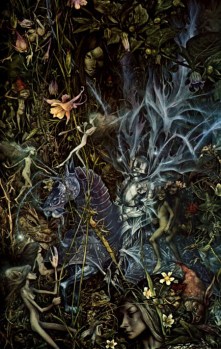
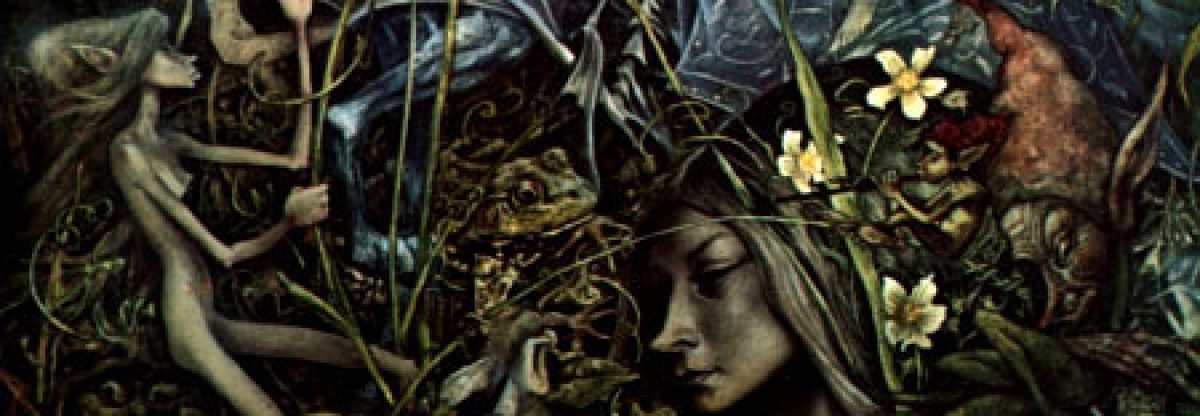
A version of this article was first published on the Ancient Origins website.
In his 1891 publication The Science of Fairy Tales, the folklorist Edwin Sidney Hartland devoted three chapters to ponder over ‘The Supernatural Lapse of Time in Fairyland.’ He makes it clear that this motif is deeply embedded in worldwide folklore and mythology from a wide variety of chronological periods. He suggests that the consistency of the story elements involving the strange relative movement of time in faerie folklore, must stem from a common mythological theme, although he usually stops short of discussing this theme in favour of telling the actual stories. Within these supernatural lapse of time tales there are essentially three ways that time can behave in contradistinction to normal reality: 1. Time stops in the outside world, while in faerieland many years can pass with the human participant living a life of enjoyment or suffering with the faeries. The protagonist usually breaks a taboo of some sort and finds themselves back in the real world, where no time has passed. These stories are in the small minority. More often the time dilation moves the other way. 2. This can be quite a drastic shift, so that a character spending minutes, days or weeks in faerieland comes back to consensus reality to find decades or even centuries have passed, or, 3. that a few minutes caroling with the faeries turns out to be any length of time up to a year and a day, once they return to the world they came from.
The Three Types of Time Distortion in Faerie Folklore
1. Hartland points out that the folkloric faeries of Wales, usually known as the Tylwyth Teg, were particularly prone to abducting humans, usually through the ruse of tempting them into a dancing circle where they become enmeshed in a time-distorted reality. One typical 19th-century tale has a lonely shepherd doing just that on a hillside in South Wales, after which he finds himself in a glittering palace with pleasure gardens, inhabited by the faeries. He lives there for years, even taking the chance to get involved in some romantic attachments with the beguiling black-eyed female faeries. But despite being warned off the fountain, which is filled with gold and silver fish, in the middle of the main garden, he can’t resist overturning the prohibition, and one day, inevitably, he plunges his hands into the water for a drink. Immediately he finds himself back on the cold Welsh hillside with his sheep, during which no time at all seems to have passed.
As mentioned, this sort of time relativity in folklore is the exception to the rule; it usually works the other way round as in 2 and 3 below. Such a story type might represent an adventure experienced while in an altered state of consciousness, turned into a folktale that attempts to convey this unusual state of consciousness through conventional ideas about faerieland. The altered state might represent a waking hallucinogenic state or a dream, both of which can allow seemingly long passages of subjective time to take place in seconds or minutes in the real world. But this is not the usual way time works in faerie folklore…
2. Hartland records an 18th-century version of the ancient Irish story of Oisín as typical of the second type of time-lapse folktales, recorded throughout Europe and Asia. Oisín is a poet of the Fianna, and falls asleep under an ash tree. He awakes to find Niamh, Queen of Tír na nÓg, the land of perpetual youth, summoning him to join her in her realm as her husband. Beguiled, he follows her, and finds himself living in a paradise of perpetual summer, where all good things abound, and where time and death hold no sway. But soon he breaks a taboo of standing on a broad flat stone, from where he is able to view the Ireland he left behind. It has changed for the worse, and he begs Niamh to give him leave to return. She reluctantly agrees, but asks that he return after only one day with the mortals. She supplies him with a black horse, which he is not to dismount, and ‘gifted him with wisdom and knowledge far surpassing that of men.’ Once back in Ireland he realises that decades have passed and that he is no longer recognised or known. Inevitably, he dismounts his horse and immediately his youth is gone and he becomes an enfeebled old man with nothing but his immortal wisdom. There is no returning to the faerieland of the Tír na nÓg. In other variations of the story, the hero turns to dust as soon as his feet touch the ground of consensus reality.
These type of folktales seem to suggest that faerieland is the world of the dead, immune from the passage of time, and that return to the world of the living is not possible as the mortal body has aged and decayed in line with the physical laws of this world. The embedded taboo in the story perhaps represents the idea that a disembodied consciousness cannot break codes in the realm of the Dead, and that if the taboo is broken, the lesson needs to be learnt that there can be no return to corporeality. In the Japanese tale of Urashima Taro, the hero, when returning home, is even given a casket by his faerie bride, in which his years are locked. When he opens it, his time is up.
These stories articulate a belief in an otherworld that is never heaven, but is apparently ruled over by a race of immortals who can exert control over the consciousness of an individual, who may believe themselves to still be in human form, but are actually already dead and existing in non-material form. It appears to be the place where the faeries come from; a place untouched by the passage of time and physical death. It could even represent the collective consciousness of humanity made into an understandable form in the stories, immortal in nature and containing all wisdom and knowledge, as suggested in the Oisín tale.
This might be explained by seeing folklore of this type as representing a surviving pagan belief system of the afterlife. This afterlife did not follow the strictures of Christianity or other world religions, and provided an alternative view of what happens to consciousness after death. It is a view that was (in the West) superseded by Christian theology, but that may be surfacing in these folktales as remnants of the previous system of belief (a belief system that remained partially intact but operated underground for fear of religious persecution). The presence of faeries in this otherworld, and their ability to materialise in standard reality, suggests that they were an essential element in pagan ideas about consciousness and that they had a role to play when it came to death. In this theory the characters in the story play the part of messengers, telling us about the true nature of a timeless reality that is distinct and separate from consensus reality, and showing us that human consciousness disassociates from the physical body to exist in a parallel reality such as Tir na n’Og.
The third type of time lapse usually has a less dramatic effect on the protagonist, as they return from an apparently short time in faerieland to a world advanced by either months, or more often by the magical time-span of a year and a day.
3. Hartland records a number of these types of tales from Britain. One was collected in the Scottish Highlands by the folklorist JF Campbell in the 1860s, and includes many of the typical elements. The story involves two men returning home from the town of Lairg, where one of them has just registered the birth of his child in the session books. They sit down to rest at the foot of the hill of Durcha, when music and merriment is heard from within a cavern in the hill. The new father can’t resist investigating and disappears into the hill. On returning home alone, his friend is accused of murder. But a ‘wise man’ suggests he should be able to clear his name by returning to the cavern a year and a day later. He does so, and when he sees a shadow in the cave entrance he grabs it, momentarily revealing his friend dancing in a circle with the music-making faeries. He pulls him out of the circle and the faeries are gone. ‘Could you not have let me finish my reel’ the former captive says, thinking he had only just started dancing with the faeries. He won’t believe that a year and a day have passed until he returns home to find his wife with their year-old child in her arms.
Faerie Folklore as an Encoded Belief System
Stories of this type rarely say much about the faeries doing the abducting, only that they seemed capable of drawing the participant out of their own world and into an alternative reality with a different space-time continuum. The year and a day motif is important and is a common time-frame appearing in medieval romances as the amount of time protagonists were given to succeed in quests. In The Golden Bough, Sir James George Frazer highlights the ancient global concept of the Divine King, who was to be ritually murdered after a period of time in charge, which was often a year and a day. The time period was also used in common law to substantiate the legal situation of unwed couples, and it was (in theory) the amount of time a person living under feudal serfdom needed to be absent from his lord’s manor to gain his freedom. Interestingly, a year and a day is also used in Wiccan and other neo-pagan traditions for the time of learning required before being initiated into the first degree. This may all suggest that the folklore of this type have the year and a day motif embedded within them as a message, conveying the idea that it is a magical time-frame. It was a symbolic time-marker for life quests, ruling over others, decisions being made, learning a tradition, securing a marriage, or gaining freedom as one year tips over into another. It was evidently deeply ingrained in both esoteric tradition and everyday life from an early date, rooted in the cycles of the natural world.
As is the case with Hartland’s tale from the Highlands, these stories usually include a ‘wise man’ who knows that a year and a day is the time needed to free the abductee from the clasps of the faeries. This sounds like the cunning man recorded in Early Modern witch trials, among other sources, a type of magical practitioner steeped in esoteric knowledge, who operated within the constraints of Christianity, but who was evidently practising a type of pagan magic. In her 2005 book Cunning Folk and Familiar Spirits, Emma Wilby convincingly puts these people (men and women) within an ancient shamanic visionary tradition, which had as its main remit an understanding of otherworldly spirits, including the faeries. Once again, we can see the folklore embedding these motifs into the stories, below the radar of religious censorship, so as to tell people the truth gleaned from gnostic shamanic beliefs that were evidently alive and well in pre-industrial societies. The repackaged 19th-century folktales were recording these traditions in coded language, perhaps not understood properly by their listeners, but hiding knowledge of metaphysical realities in plain sight, in the form of a good story.
The metaphysical realities these stories attempt to convey have formed a specific mythology that attempts to tell us about otherworlds beyond our own. These otherworlds may differ depending on the story but they are all, essentially, talking about transcendence beyond the physical world. And with transcendence the space-time continuum works in a different way, without the constraints of a world of matter, or with a linear time-flow. Among the inhabitants of this transcendent otherworld are the faeries, who seem to be able to make occasional appearances in our world, but whose own world is one of consciousness, whether a dream, an altered state, the collective human consciousness, or death. The message seems to be that consciousness has no real need of a dimension of time, and that once freed from the physical world, consciousness is able to transfer to an alternative non-physical universe; a universe that has sometimes been called faerieland. It is an ancient mythological concept pointing at a deeper reality, surviving in encoded form in faerie folklore.
References
Bentov, Itzhak, Stalking the Wild Pendulum: On the Mechanics of Consciousness (1977)
Briggs, Katherine, An Encyclopedia of Fairies (1978)
Frazer, James George, The Golden Bough: A Study of Magic and Religion (1922 ed.) https://sacred-texts.com/pag/frazer/
Hancock, Graham, Supernatural: Meetings with the Ancient Teachers of Mankind (2005)
Hartland, Edwin Sidney, The Science of Fairy Tales: An Inquiry into Fairy Mythology (1891) http://www.gutenberg.org/files/24614/24614-h/24614-h.htm
Rushton, Neil, ‘Going Round in Circles: The Faerie Dance’ (2016) https://deadbutdreaming.wordpress.com/2016/05/28/going-round-in-circles-the-faerie-dance/
Sugg, Richard, Fairies: A Dangerous History (2018)
Wilby, Emma, Cunning Folk and Familiar Spirits: Shamanistic Visionary Traditions in Early Modern British Witchcraft and Magic (2005)
Woodyard, Chris, ‘Dancing with the Fairies: 1820s-1840s’ (2018) https://mrsdaffodildigresses.wordpress.com/2018/07/27/dancing-with-the-fairies/
***
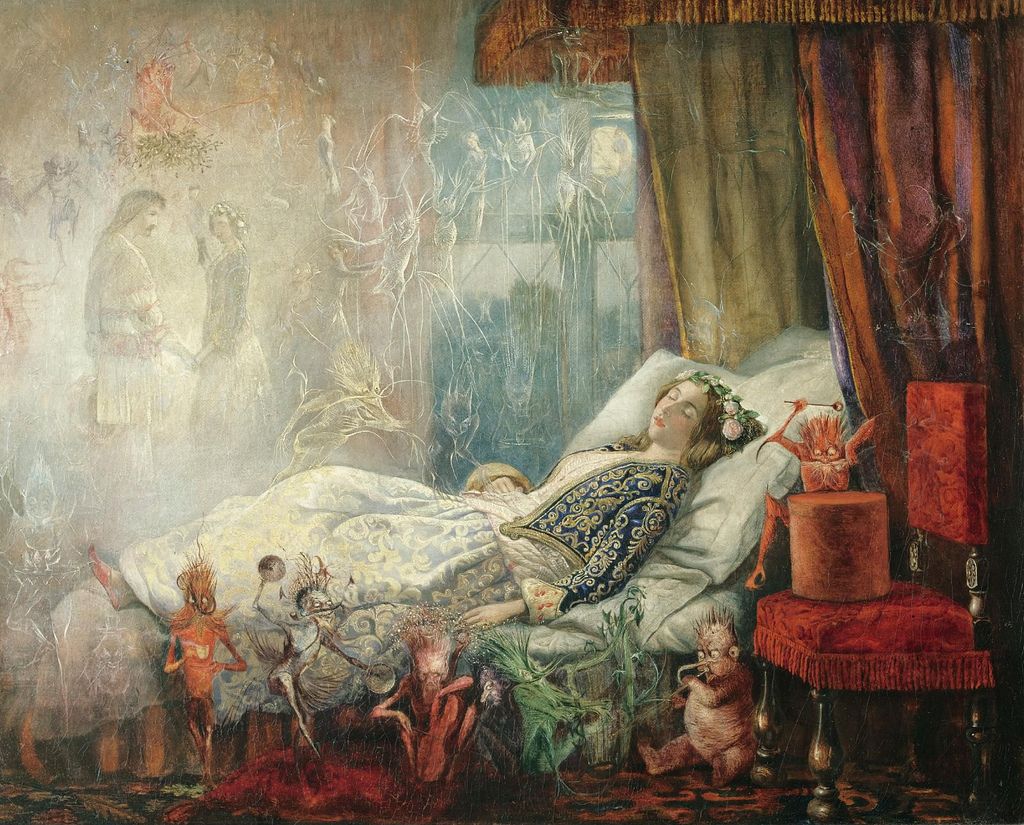
The cover image is ‘Dreams and Time’ by John Anster Fitzgerald (1819-1906).
***
Dead but Dreaming the novel is available now…

 deadbutdreaming
Fascinating! I liked the explanation of the year and a day motif. Excellent information, Neil. Thank you!
LikeLiked by 1 person
Thank you Colleen!
LikeLiked by 1 person
You’re most welcome.
LikeLiked by 1 person
Enjoyed this one very much. The inter dimensional aspect of fairy abduction with its accompanying time loss or gain has always called to mind alien abduction. Colonial America has its tale of Rip Van Winkle that includes weird passage of time. At this point in “reality”, I am so ready to be taken elsewhere.
LikeLiked by 3 people
I know the feeling Victoria!
LikeLiked by 1 person
Aww, yiss- Time! One of my favourite subjects. Curiously, there are several posts in my WP feed today about the mysterious nature of Time. The time is right to write about Time!
Firstly, I’d like to second Victoria’s comment there. There are so many parallels with Alien Abduction stories ( which I’m becoming more fascinated in by the day…but I also relate to her other sentiments there! ).
I’m also put in mind of something I heard about the experiences of people who’d been in long term comas. Apparently some have had the experience of living an entire life during the days ( sometimes weeks) while they were comatose. I recall that one man experienced growing up ( as a completely different person to the one he was known as in our particular consensus reality), having a career, getting married, having kids, then reaching the age of 40- only to be snapped back to his former reality when he awoke, completely disoriented, from the coma. Other experiences were utterly horrifying- like being trapped in a nightmare. (There’s a book about it- which I don’t yet have, but want: ” Coma and Near Death Experience” by Alan Pearce, which you’ve probably already heard of).
I’ll leave it there lest I get carried away, but I can’t help but be excited about this subject. Cheers for another fascinating post!
LikeLiked by 2 people
Thank you! Your anecdote reminds me of the Star Trek: The Next Generation episode ‘The Inner Light’, when Captain Picard is rendered unconscious by an alien probe, and then – in his mind – experiences an entire lifetime on the planet Kataan, before finally being brought round on the bridge of the USS Enterprise 25 minutes after being knocked out. Whoever wrote it must have been reading their faerie folklore…
LikeLiked by 2 people
Ha! They sure must have done!
LikeLiked by 1 person
Very fascinating. Time distortions are a topic of utmost fascination to me. Thank you for your efforts!
LikeLiked by 1 person