A version of this article appeared originally on the Ancient Origins website.
A common motif in British and Norse folklore is that of an otherworldly female, who is somehow captured or charmed by a mortal man to be his bride. The females are often therianthropes, that is shape-shifters, who seem to be part human and part animal, but their main attribute is always as an entity from a metaphysical otherworld, interacting with consensus reality in order to bridge the gap between the natural and the supernatural. These therianthropic females take many forms, such as Selkies (humanoids masquerading as seals), mermaids, and swan-maidens, and can also appear as magical women without any animal attributes, such as the lake faeries, but they are always found in bodies of water, a configuration that proves important in any attempt to interpret these folkloric motifs. The standard scheme of the stories is that the female is lured from her watery existence by a male, either through a ruse or by charm. They are married and will usually have children together. But at some point a taboo is broken or the female is mistreated, and she deserts her husband to return to the water, which always seems to represent the portal between the physical world and a non-material reality. As always with folklore, any deeply embedded motif such as this is designed to impart some timeless wisdom; allegorical, philosophical and psychological. The stories were always meant to be a good fireside yarn, but more importantly they were plugging into fundamental aspects of the human condition, as well as recording belief-systems that were disappearing into the past. The origins of these stories are usually medieval (although possibly even older), and sometimes appear in chronicles. But most were transmitted through an oral tradition and were not recorded in detail by folklorists until the 18th and 19th centuries.
Selkies
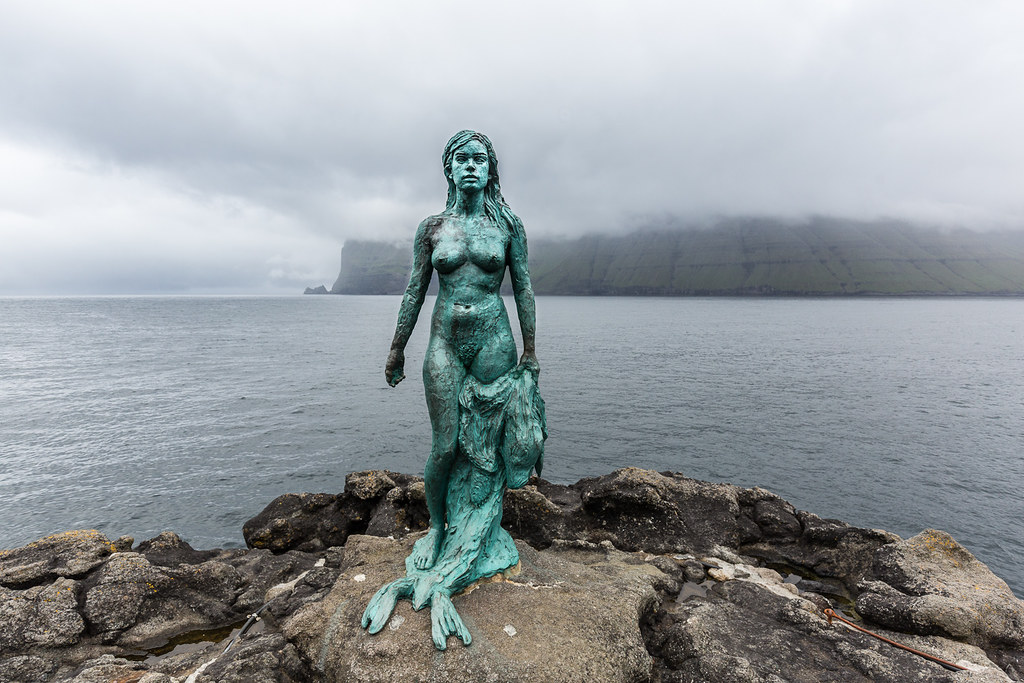
The folklore of Selkies comes mostly from northern Scotland, especially the islands of Shetland and Orkney, as well as the Faroe Islands, although the theme is also found in Ireland, Scandinavia and Germany. The name is derived from Selch, the Scots for grey seal, a species that is commonly found around the coastlines of these northern European countries. The Selkie therianthrope can be male or female, but the majority of the folklore involves a female creature, such as the typical example from the Faroe Islands: The legend of Kópakonan (‘seal woman’).This tale tells of a fisherman (in some versions a farmer) from Mikladalur on the Faroese island of Kalsoy who, after taking the advice of an island elder, sets up a watch on the shoreline on the thirteenth day of the month to catch sight of the Selkies, who it was said could only beach on this day. Sure enough, he witnesses a group of the creatures come ashore and shed their seal-skins to reveal their female human forms. He steals one of the skins, and puts fright to the females, who all return to the sea in Selkie form. All except the one denuded of her skin. She’s distraught but agrees to follow the fisherman back to his home, where she proceeds to become his wife, and they have children together. But she pines for the sea, and one day manages to find the key to the room where her husband has kept her Selkie skin. She skins up, shape shifts and returns to the sea. As with most Selkie folklore, the story has a grim denouement, when the fisherman (despite being warned not to in a dream) kills the Selkie husband of his estranged wife as well as their two sons. Kópakonan takes revenge by cursing the people of Kalsoy: “some shall be drowned, some shall fall from cliffs and slopes, and this shall continue, until so many men have been lost that they will be able to link arms around the whole island of Kalsoy.” A statue of Kópakonan was erected in Mikladalur in 2014 (cover image), demonstrating the continuing importance of the folktale to the Faroese people.
The entities known as mermaids (or merrows from Hiberno-English) seem to be closely related to the Selkie, and there are collections of stories from Scotland and Ireland including similar motifs contained in the Selkie tales, where the female mermaid is captured and made a wife, only to return to the sea when she is given the opportunity. However, mermaids more often than not retain their half-human half-fish form, and only a minority of the stories have them marrying mortals – they are more frequently portrayed in folktales as portents of disaster at sea, sometimes even provoking it. While there are a wide variety of mermaid folktale types from all parts of the world, their representation as harbingers of catastrophe at sea is more in line with the Sirens from Greek mythology than with folkloric otherworldly brides.
Swan Maidens
Closely related to the folktales of Selkies are the widely distributed stories about swan maidens. In his 1891 book, The Science of Fairy Tales, the folklorist Edwin Sidney Hartland devoted two chapters to discussing the global tales involving this motif. He recounts a typical tale of this type (updated from its medieval genesis to include shotguns) from Raineach, Scotland, where a young farmer travels away from his claustrophobic upbringing to seek his wealth. He soon reaches an inn and:
‘He rose early next morning, and went to a lake in the neighbourhood to have a shot. When he was approaching the lake, he saw three white swans swimming on its calm surface. He crept towards them, and with some trouble got within proper range. But when he lifted his gun to his shoulder and was going to take aim, they became the three most beautiful maidens he had ever seen.’
After several more adventures stalking the swan maidens, he manages to steal the off-cast feathers of the youngest, and refuses to return them until she marries him. She agrees, and through her otherworldly magic, conjures up a castle for them to live in, constructed on an island within the lake. They live happily, and have children, but in time he grows homesick and is allowed to return home under the proviso that he does not mention his metaphysical existence or his swan maiden wife. But he breaks the taboo, brags about his otherworldly wife, and when he returns to find his magical castle home, there is nothing but the lake, without island, castle or swan maidens.
Lake Faeries
The folktales about lake faeries can again be found all over the globe, but there is a concentration of these types of stories in Wales, where there are over a dozen tales including many of the same motifs. Unlike the Selkies and swan maidens, the faeries are not therianthropic shape-shifters, but they are certainly otherworldly beings who are able to exist below the waters of the lakes as well as on land in the material reality of mortals. These folktales are replete with symbolism, which underlies the themes of a male human courting and marrying the (exclusively) female faerie and then losing her through the breaking of a taboo. The most detailed of these folktales is The Lady of Llyn y Fan Fach (Llyn is Welsh for lake), which though only recorded in the 19th century contains named personages that appear to date the origin of the story to the 12th century.
In this tale a young farmer called Gwyn regularly frequents Llyn y Fan Fach, where he pastures his cattle. One day he sees a golden-haired woman, combing her locks and using the lake as a mirror. Immediately smitten, he offers her the bread he had brought with him, but it’s too hard for her taste and she disappears below the lake. The same happens again the next day, but this time the bread is too soft, and she once again submerges. The third day comes, and this time the bread is just right, and love is in the air. Gwyn knows what he wants: “Fair Lady of the Lake, I have no silver, no gold, no riches, just love. Please marry me and be my wife!” After some more passionate entreaties she warms up and decides to accept, but with conditions:
“Silver and gold cannot buy me. Your love is beyond price so I will marry you and live upon Earth with you until you give to me three causeless blows. The striking of the third blow will be the breaking of our marriage contract. I will leave earth and we shall be parted for ever. Do you accept?”
Of course, he does. But first he has to deal with the faerie’s father who is ‘of wild appearance’ and magically appears with an identical twin to the lady Gwyn has fallen in love with. He tests Gwyn to choose the right faerie, which he does (discovering her name is Nelferch) and so off they go to be married with a considerable dowry of cattle, horses and other animals provided by the father, who, nevertheless reminds him once again of the ‘three blows’ condition.
Their marriage prospered and they had three sons, but inevitably the three blows were dealt over time, all as accidents: a playful flick on the shoulder with a glove, a tap on the arm and then a third touch when Nelferch displays joy at the funeral of a neighbour’s infant. She explains that she still sees with the eyes of the Otherworld and that her joy was that the child had transcended the pain and suffering of mortality. But with the third blow struck Nelferch returns to the lake, with her dowry, and disappears below the surface. Distraught, Gwyn follows her, drowning himself in his grief. Despite the tragedy, the three sons were able to apply their half-faerie nature to positive ends and became great healers known as ‘The Physicians of Myddfai’.
Interpreting the Stories of Otherworldly Brides
These folktales contain a myriad of meanings, some hidden deeper than others. They are open to multiple interpretations, of which a few are:
The females are Pagan deities. They represent diminished ancient goddesses or spirits – Celtic deities dwelling in sacred bodies of water, and requiring some type of sacrifice as propitiation, which has become transformed over time as the interaction with mortals in the folktales. This would require the geneses of the stories to be prehistoric, passed on over millennia through an oral tradition.
A Warning about Desiring Otherworldly things. In all the stories the protagonist desires something that should be beyond the reach of mortals. However cunning or charming he is, his mortality eventually fails him and he is either outfoxed or he breaks a taboo leading to disappointment at best, and tragedy at worst. This may even find confluence with the Jungian psychoanalytical idea of water as a symbol of the subconscious. What arises out of it represents our deep-set desires, but the subconscious is an ‘Otherworld’ and what emerges from it cannot stay in waking reality, and at some point must return ‘beneath the water’.
The Therianthropes Represent Transcendence. The otherworldly entities exist in two forms – human females and spiritual beings, the latter represented by an animal or a faerie connected to water. Although the human versions can spend some time on Earth, living a conventional life, this is always fleeting and eventually their material presence will disappear as they transcend to an Otherworld. They are in effect metaphysical human souls that must at some point be released. This might be extended to seeing the therianthropes/faeries as a shamanic residue, where the animals or supernatural beings symbolise transcendent spirit guides connecting this world and a supernal universe. While this would involve a millennia-deep folk memory, there is much evidence from studies of the medieval and Early-Modern witch cults that a form of prehistoric shamanism continued under the radar in Christian Europe, with spirit animals, zoomorphism and faerie familiars as key components of the belief system.
Love and Marriage is a Faustian Pact. More prosaically (and cynically), the folktales may be suggesting that love and marriage are agreements between two people, and that the terms need to be upheld, otherwise disaster will ensue – it is a Faustian pact. The underlying tension in the stories do seem to imply the fragile nature of love; always undone by carelessness or the breaking of agreed-upon codes.
But as is so often the case with traditional folktales we will never be able to unravel completely the deeply entrenched meanings, which have evolved through people telling them over hundreds, perhaps thousands, of years. Stories using the otherworldly bride motifs evidently contain some specific and distinct significance as they attempt to convey fundamental ideas about the human condition as well as passing on an ancestral memory of previous cultures. However, the reason they have been so persistent and successful in doing this, is because at root they are extremely entertaining folktales that are able to grip the imagination, using the most potent of all human emotions as a trope: Love.
References
Briggs, K. 1976. An Encyclopaedia of Fairies. Pantheon Books, New York
Bruford, A. 1974. ‘The Grey Selkie’, Scottish Studies 18 (63–81)
Collinson, B. 2012. Jungian Therapy and the Meaning of Dreams: Water. Available at: https://www.briancollinson.ca/index.php/2012/11/jungian-therapy-the-meaning-of-dreams-5-water.html
Evans, Z.T. 2017. Folklore of the Welsh Lakes: Reflecting on Faerie Brides, Drowned Towns and the Otherworld. Available at: https://folklorethursday.com/folktales/folklore-welsh-lakes-reflecting-faerie-brides-drowned-towns-otherworld/
Evans, Z.T. 2017. Folklore of the Welsh Lakes: The Legend and the Legacy of the Lady of Llyn Y Fan Fach. Available at: https://folklorethursday.com/regional-folklore/folklore-welsh-lakes-legend-legacy-lady-llyn-y-fan-fach/#sthash.eaGh0p88.dpbs
Gilchrist, A.G. 1921. ‘Extra Note on Song No. 48, verse 7’, Journal of the Folk-Song Society. 6 (263–266)
Hartland, E.S. 1891. The Science of Fairy Tales. Scribner and Welford, New York. Available at: http://www.sacred-texts.com/neu/celt/sft/index.htm
Leavy, B.F. 1994. In Search of the Swan Maiden: A Narrative on Folklore and Gender. New York University Press. Available at: https://archive.org/details/oapen-20.500.12657-89312/page/n3/mode/1up
Rushton, N. 2025. Mermaid Imagery in British and Irish medieval Churches. Available at: https://deadbutdreaming.wordpress.com/2025/01/17/mermaid-imagery-in-british-and-irish-medieval-churches/
Rushton, N. 2017. Faerie Familiars and Zoomorphic Witches. Available at: https://deadbutdreaming.wordpress.com/2017/04/08/faerie-familiars-zoomorphic-witches/
Wilby, E. 2005. Cunning Folk and Familiar Spirits: Shamanistic Visionary Traditions in Early Modern British Witchcraft and Magic. Sussex Academic Press
Williamson, D. 1992. Tales of the Seal People: Scottish Folk Tales. Interlink Books, New York
Winters, R. 2016. Legends of the Selkies: Hidden Gems of Sea Mythology. Available at: https://www.ancient-origins.net/myths-legends/legends-selkies-hidden-germs-sea-mythology-006409
***
The cover image is a statue of the selkie Kópakonan in Mikladalur, Faroe.
***
Dead but Dreaming the novel is available now…

 deadbutdreaming
Fabulous information, Neil. I always enjoy learn more about the old myths.
LikeLiked by 1 person
Thank you so much Colleen.
LikeLike
Fascinating, thank you Neil. I always imagined selkies, mermaids, sirens and the like to be temptresses i.e. the other way round, luring lovelorn men beneath the waves to their doom – a la Draper’s painting of Ulysses and the Sirens. Now I can stop worrying.
LikeLiked by 1 person
Yes, you can relax Roy!
LikeLiked by 1 person
Another fine and informative essay, Neil. I lean toward the “Therianthropes Represent Transcendence” and perhaps the “ancient deities or Spirits” interpretation, as it aligns more with my own experience of a life-changing encounter with Mother Ayahuasca in the Amazon, who is, interestingly, associated with an important vision-producing plant rather than a body of water. The magic, however it may be interpreted, is real and not diminished by our mundane civilization, only invisible to or hidden from most, appearing sometimes to those who proactively seek those portals and encounters.
LikeLiked by 2 people
Thank you David, and very well articulated…
LikeLike