The Faerie Phenomenon in Folkloric and Modern Experience

This article was published originally on Graham Hancock’s website. It has been slightly modified for this post, although the section on DMT has been left as it initially appeared. A more recent discussion (including the latest clinical research into the DMT phenomenon) can be found in my article ‘Faerie-type Entities and and the DMT Experience: An Ontological Survey’.

Faeries have been an important part of the folkloric repertoire for hundreds (perhaps even thousands) of years, and while they are portrayed in the popular imagination through faerie tales, and have become disneyfied through the 20th century, their main presence is in the myriad of folklore from every part of the globe. They usually (though not always) take a humanoid form, and interact with human societies as amorphous supernatural entities, appearing in our world to both co-operate with people and as general arbiters of discord, while also living in their own Otherworld, sometimes accessible to humans either through accident or design. While the phenomenon is ancient, the belief in these metaphysical beings continues, and there are thousands of encounter reports from all over the world every year, as demonstrated in the recent surveys by The Fairy Investigation Society, which includes c.1000 testimonies.i

But folklorists are often ambivalent about the faeries; they are likely to keep their distance from them, so to speak. While happy to record and discuss the beliefs of people who tell stories and anecdotes about them, most folklorists speak the language (at least in official publications) of the reductionist, materialist worldview, and they’ll often be reticent about assessing the potential actual reality of supernatural beings. In the materialist’s world, faeries simply cannot exist. They must be reduced into a categorised cultural belief system, and any discussion of them will usually be couched in the accepted language of scientific rationalism. This creates a problem for any folklorist (or anybody else) who wants to look behind the stories and investigate the possibility that the faeries can be incorporated into our consensus reality as a genuine phenomenon.

But the reductionist scientific orthodoxy has been challenged recently by a range of philosophical hypotheses such as Panpsychism and Idealism, backed up by quantum theory and experiment, which reinstates consciousness (not matter) as the primary mover and creator of reality.ii When this is done, entities such as faeries are allowed back into the universe as a potentially authentic phenomenon.

The Origins of the Faeries in Altered States of Consciousness

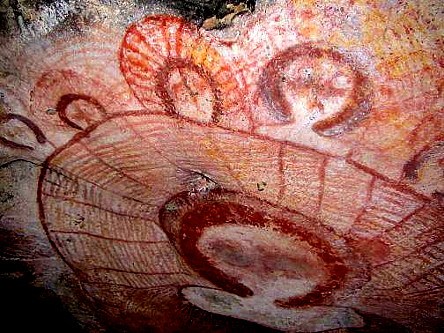
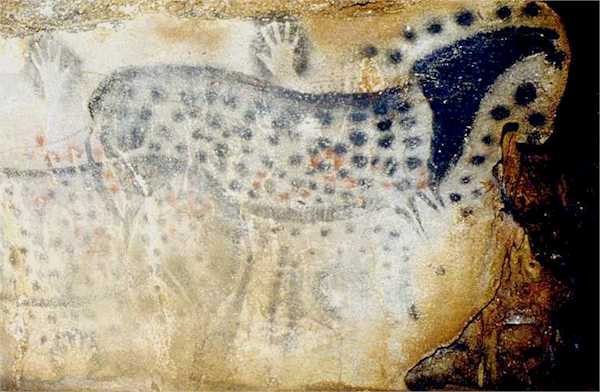
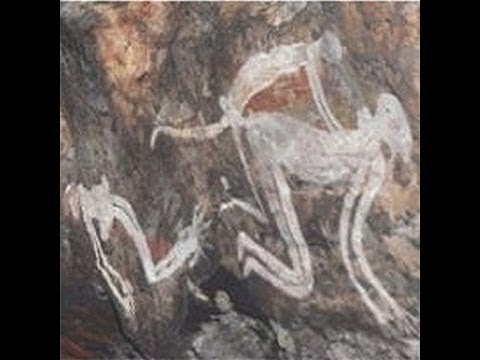
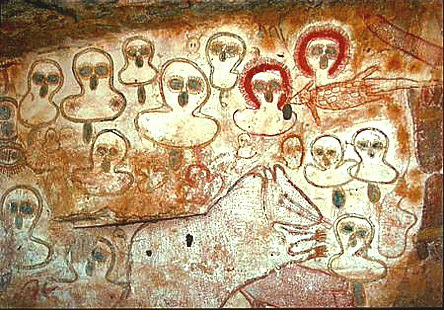
Our earliest known artistic portrayals of the world, and how human consciousness interacted with it, come in the form of cave paintings from all parts of the globe, starting c.40,000 BCE.iii Many of these cave paintings include humanoids and therianthropes; otherworldly entities that have been recorded alongside geometric imagery, stylised animals and landscapes. The paintings are in effect our earliest known folklore. But what state of mind were our Palaeolithic ancestors in when they were painting these strange entities in often difficult to access caves and shelters?

Parietal art in cave systems at Tassili n’Ajjer, Algeria, c. 7,000 BCE (PD0)

The anthropologist David Lewis-Williams has made the convincing argument that these cave and rock-shelter paintings were produced by shamanic cultures to represent reality as perceived in an altered state of consciousness.iv Thirty years ago this idea was anathema to anthropologists, but since the work of Lewis-Williams, and many others, the theory has tipped over to become more orthodox. There are hundreds of motifs in the cave paintings that correlate with the visionary states of people in an altered state of consciousness, brought about most especially by the ingestion of a psychotropic substance. The basic premise is that the shamans of these Palaeolithic cultures transported themselves into altered states of consciousness and then painted the results of their experiences on the walls of caves and rock shelters — experiences that frequently included therianthropic beings and supernatural humanoids that correlate in many ways with later faerie types.

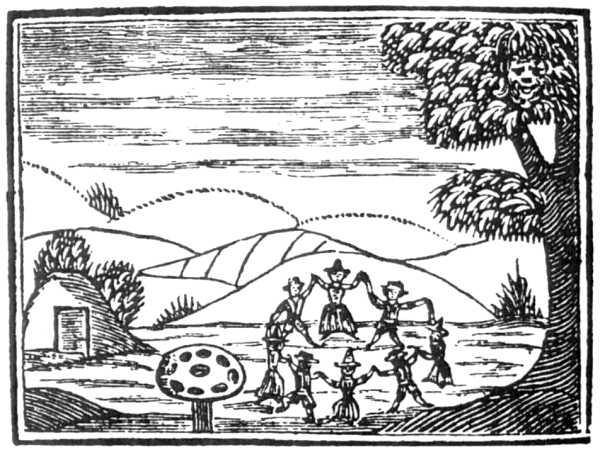
In his 2005 book Supernatural: Meetings with the Ancient Teachers of Mankind, Graham Hancock vividly utilises Lewis-Williams’ work to discuss the continuity through time of entities experienced in altered states of consciousness, coming to the conclusion that the faeries of our historic period are perhaps one and the same as those portrayed in prehistoric caves.v And writers such as Carlo Ginzburg and Emma Wilby have argued that there is a direct link between prehistoric shamanic storytelling and the folklore embodied in classical, medieval and later periods, that often incorporate entities such as nymphs and faeries; supernatural beings that interact with humanity when the conditions are right.vi Those conditions may well be reliant on the human participants undergoing an altered state of consciousness as a result of the ingestion of psychotropic compounds. There is certainly a preponderance of mushroom imagery associated to historic depictions of faeries, most especially the highly psychedelic red and white Amanita muscaria (fly agaric) mushroom, and the psilocybin mushroom, both prevalent in Europe and Asia. If these historic folkloric manifestations of interactions with supernatural entities can be linked to the cave art of prehistory and preliterate societies, then we have a continuation of relationship with an alternative reality, accessed through altered states of consciousness, over a very long period of time.
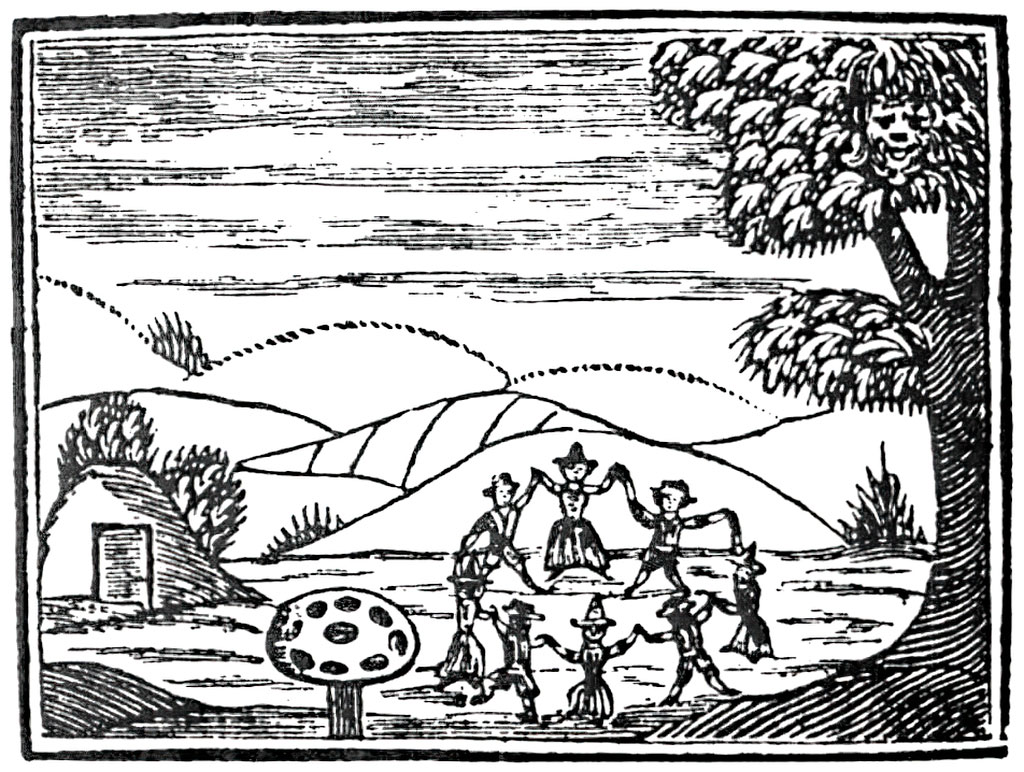
17th-century English woodcut for a chapbook, with dancing faeries, burial mound (hollow hill with door), fly agaric mushroom and the face of a ‘spirit’ in the tree (PD0)

Many of the European faerie motifs repeated in stories and anecdotes through the centuries to the present day were already in place during the medieval period. When folklorists began to collect these stories in earnest from the 19th century onwards, they found a belief in faeries amongst rural populations that was probably very close to the medieval belief and understanding of what faeries were and how they interacted with humanity. Many stories include situations where the protagonist(s) interacts with the faeries in what seems an altered state of consciousness; consistently inhabited by strange humanoids and therianthropes (the faeries), and there are lots of recurring story motifs that are highly suggestive of an autonomous reality being described. But this is not consensus reality, this is the folklore recording stories from people operating outside consensus reality. The folklore about faeries has been overlain with much allegorical storytelling, but at their root the realities they describe are of people in altered states of consciousness (facilitated by a range of agents), perhaps not too far from the realities experienced by the Palaeolithic cave painters and shamanic practitioners.

Clairvoyance and the Memory of Nature

When the folklorist WY Evans-Wentz travelled around the Celtic world at the beginning of the 20th century, collecting stories and anecdotal experiences about the faeries, it was clear that many of his interviewees rated clairvoyance as the best way of altering the conscious state to a position where it could interact with the faeries.vii Seership or second-sight was the method of entering, or at least viewing, an alternative reality inhabited by a relatively consistent cast of characters, usually recognised as the faeries. He met one such Irish clairvoyant (un-named in the text, but evidently George William Russell, often known by the pseudonym Æ) in Rosses Point, County Sligo. This seer talked about various types of faeries that inhabited the landscape of Sligo, ‘making them sound like a cross between nature spirits and mystical visions.’ But Evans-Wentz was just as interested in the mechanics of interacting with the faeries as he was with the stories themselves. How did the seer interface with them?

‘I have always made a distinction between pictures seen in the memory of nature and visions of actual beings now existing in the inner world. We can make the same distinction in our world: I may close my eyes and see you as a vivid picture in memory, or I may look at you with my physical eyes and see your actual image. In seeing these beings of which I speak, the physical eyes may be open or closed: mystical beings in their own world and nature are never seen with the physical eyes.’viii

The rural people interviewed by Evans-Wentz consistently affirmed that clairvoyant alteration of consciousness was the best sure-fire way to see the faeries. By the time Evans-Wentz visited these communities, there was a sense that the number of people gifted with second-sight was dwindling; cutting down on communication with the faeries. But at the same time as these rural communities were feeling the increasing pressures of modernism there was a reaction by organisations such as The Theosophical Society (first founded in 1875), which attempted to incorporate supernatural entities into an understanding of reality.ix And their prime metaphysical technology was clairvoyance. The Austrian Theosophist Rudolf Steiner attempted to explain the mechanics of clairvoyance, when a person must transform their usually passive thought forms into something more dynamic. In normal consciousness, thoughts:

‘… allow themselves to be connected and separated, to be formed and then dismissed. This life of thought must develop in the elemental world a step further. There a person is not in a position to deal with thoughts that are passive. If someone really succeeds in entering the world with his clairvoyant soul, it seems as though his thoughts were not things over which he has any command; they are living beings… You thrust your consciousness into a place, it seems, where you do not find thoughts that are like those in the physical world, but where they are living beings.’x
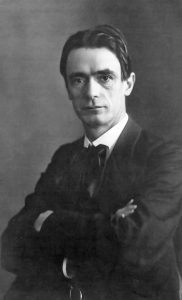

Rudolf Steiner in 1905 (PD0)

Steiner described the specific elemental animating forces at work in the natural world, when perceived clairvoyantly, in what he calls a Supersensible World. For Steiner the elementals in Supersensible World existed as a range of beings, from devas, which are responsible for entire autonomous landscapes, through to the smaller nature spirits charged with the growth of vegetation. Steiner (basing his epistemology on that originally developed by the 16th-century alchemist Paracelsus)xi divides these entities into four main types corresponding to earth (Gnomic), water (Undines), air (Sylphs) and heat/light (Salamanders). This is the faerie realm, existing as a non-material autonomous reality that crosses over with ours, and which can be accessed via a clairvoyant altered state of consciousness. Steiner thought everyone has this innate ability, but they had to be taught how to use it; it had somehow become almost forgotten amongst humanity.

This idea finds common ground with the recent work of biochemist Rupert Sheldrake, who proposes that morphogenetic fields are the formative causation allowing life on earth.xii Sheldrake’s description of this organising principle behind the natural world is issued in the language of biochemistry, but in effect, what he postulates is the same as Steiner’s vision of nature spirits in action. There are invisible forces that are as essential in ordering life on earth as accepted non-material forces such as gravity. Sheldrake calls these morphogenetic fields ‘the memory of nature’ (echoing Evans-Wentz’s Irish seer). In effect, Steiner saw nature spirits as anthropogenic representations of these morphogenetic fields, imposed upon them through the thought forms of the observer, who perceives them clairvoyantly.

The Faeries and DMT

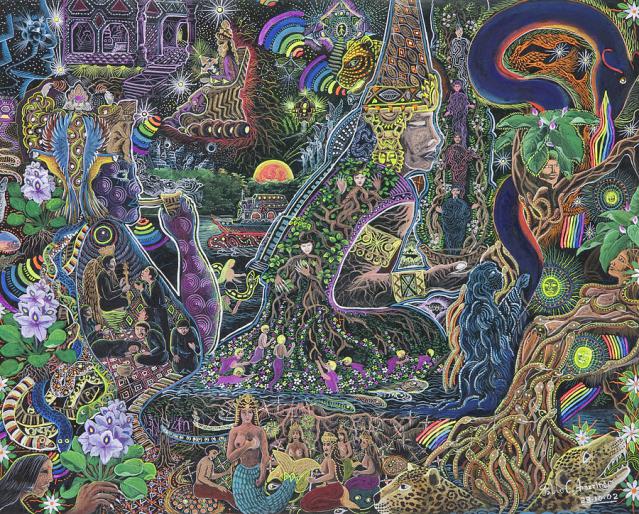
But what allows this access to otherworldly realms and the entities that seem to exist there? What causes clairvoyance, or second-sight? Many of Evans-Wentz’s respondents and Theosophists such as Steiner seem to suggest it is a natural attribute — a gift of consciousness. However, there may well also be a chemical component: N, N-dimethyltryptamine – DMT. This molecule is one of the main active ingredients utilised by Amazonian shamans: the Psychotria viridis and Diplopterys cabrerana plants, containing DMT, are used in conjunction with the Banisteriopsis caapi vine to produce the brew usually known as Ayahuasca, which invokes radically transformed states of consciousness, and often entity encounters.xiii But DMT is also produced endogenously in everyone’s brain, potentially in either the lungs or the pineal gland.xiv It seems that under certain circumstances, it can be released in higher quantities, causing an altered state of consciousness. This would require the DMT to be released in conjunction with Monoamine Oxidase Inhibitors (MAOI), which inhibit naturally occurring enzymes in the human body. This may allow a surge of DMT production to have full effect and create radically transformed states of consciousness.

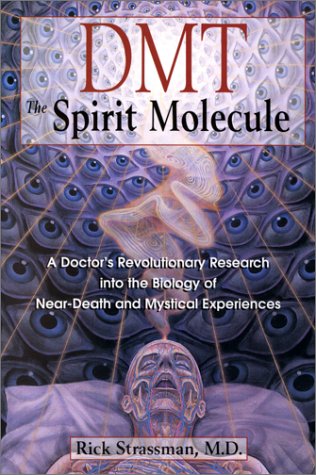
While there remains a lack of definitive evidence that endogenously produced DMT might be responsible for altering states of consciousness and potentially allowing experiences with non-human intelligence, there is no doubt that when DMT is insufflated or injected the results often invoke entry into non-physical realities inhabited by a range of entities, many of which adhere to a faerie taxonomy. The late Terence McKenna was an enthusiastic user of the synthesised form of DMT to access different realities, and coined the term ‘self-transforming machine elves’ for the creatures he regularly found there. As if to confirm Terence’s assertions, a research study conducted between 1990 and 1995 in the General Clinical Research Center of the University of New Mexico Hospital, by Dr Rick Strassman found that volunteers on the study injected with varying amounts of DMT underwent profound alterations of consciousness.xv This involved immediate cessation of normal consciousness and transportation to a different realm of reality with divergent metaphysical properties, and inhabited by a range of creatures described as elves, faeries, lizards, reptiles, insects, aliens, clowns and various therianthropic entities. One woman even describes a pulsating entity that she called ‘Tinkerbell-like’. The experiences, especially at higher doses, represented to the participants a parallel reality that was ‘super real’; not an hallucination, not a dream, but a substantial built reality with full sensory interaction and often telepathy with the resident entities.

The experience reports from the study are irrational, absurd, frightening, illogical and surreal. There is no question of any of the volunteers physically leaving the hospital bed during their experiences, but for all of them (without exception) the DMT-world was every bit as real as the one their minds left behind. After the injections participants frequently talked about ‘blasting through’ or ‘breaking through a barrier’ after which they found themselves in a realm with its own laws of physical space and movement, and its own inhabitants.

There are over a hundred recorded experiences from the study, where the participants all engage in a non-physical reality directly with their consciousness, seemingly separated from their physical selfs. There have been several more surveys (although no further clinical research) delineating the faerie-type entities experienced through DMT, most recently by Johns Hopkins School of Medicine, Baltimore, where 2561 testimonies were assessed.xvi Many of the experience reports do correlate closely to the folkloric faerie phenomenology. But what the research demonstrates is that under the right conditions, human consciousness can operate within a distinct and separate universe inhabited by a range of apparently autonomous entities. These entities may be one and the same as those recorded in prehistoric cave art and historic folklore, by people who were describing the beings encountered during various types of altered states of consciousness, brought on either actively or passively. The faeries may change superficially through time, adapting to the expectations of the culture they are part of, but if it is human consciousness they are interacting with, this is no surprise. Underneath the cultural masks, the faeries begin to reveal their true selfs.

Certain medical conditions also seem responsible for periodically transporting people into a non-material environment inhabited by entities. This is certainly the case with Temporal Lobe Epilepsy. This condition may be the root of the unusually well-documented 17th-century Cornish story of Anne Jefferies’ abduction by diminutive faeries when she suffered a ‘convulsion fit’ and was transported (at least in her mind) to a numinous world inhabited by the faeries.xvii The author Eve LaPlante has used historic and contemporary examples to demonstrate that Temporal Lobe Epilepsy can provide access to an altered state of consciousness where the human mind participates in a reality several steps removed from the consensus material world.xviii This often includes full immersion in alternative landscapes and contact with non-human intelligence.
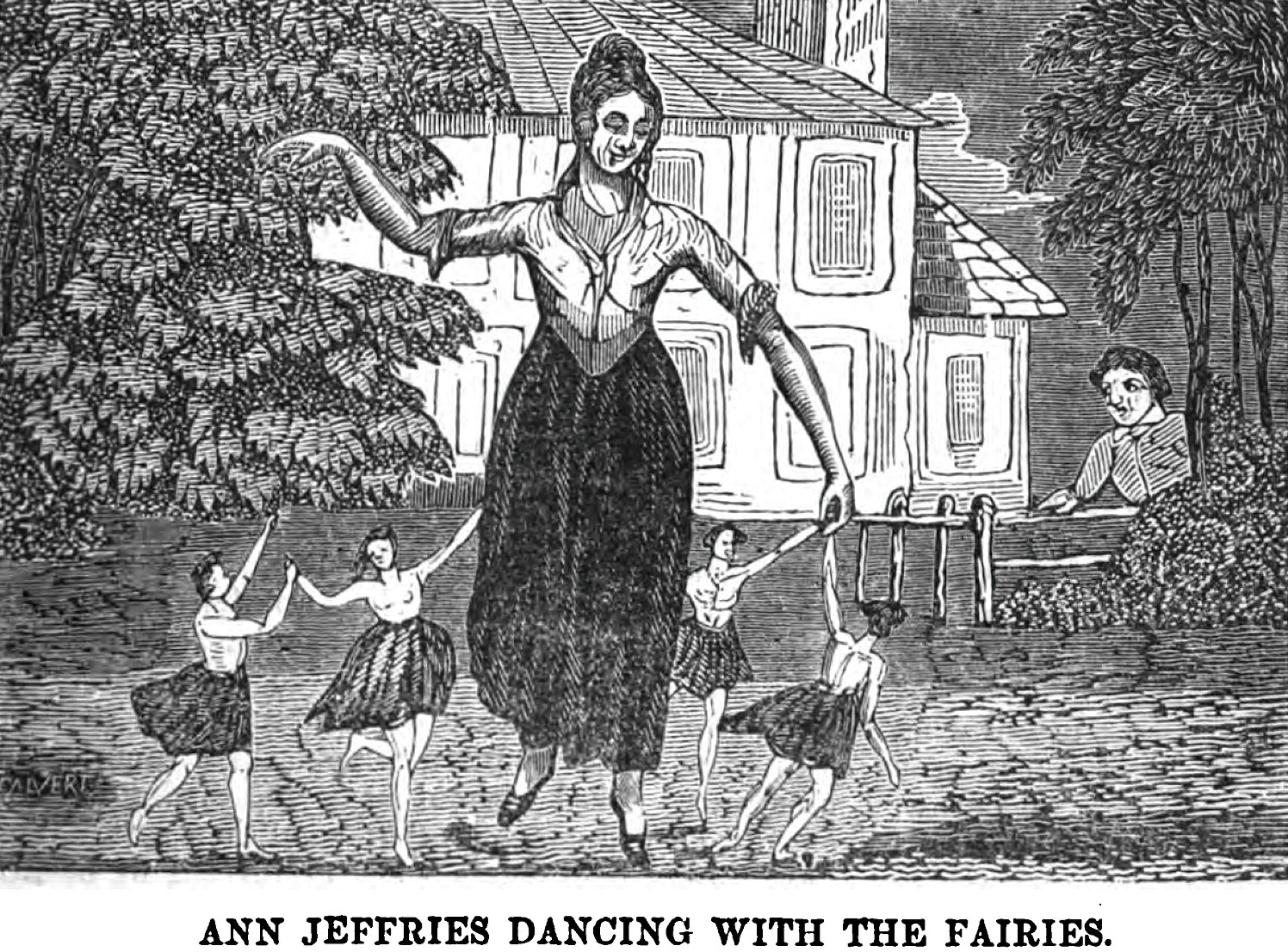
Illustration from Robert Hunt’s Popular Romances of the West of England (1865) (PD0)

Perception via the brain certainly gives us a very limited view of what is actually going on around us. Altering the usual transmission of consciousness through the brain (actively or passively) seems to allow non-material awareness more of a free rein. As in a dream, an altered consciousness is able to construct metaphysical realities. It is able to communicate with the entities it finds there, and bring back a report. The relative consistency of the inhabitants of this alternative reality may suggest that they live there all the time, non-physical, and only able to interact with our physical world when conditions are right for an individual’s consciousness. This is the crux: does consciousness create physical reality, or is consciousness an epiphenomenon of the brain? If the former, then the realities experienced in altered states of consciousness can be accepted as potentially real, with their own autonomous existence. If the latter, then while entities such as the faeries may be subjectively real, they do not exist objectively within the electromagnetic spectrum.

Faeries and Aliens

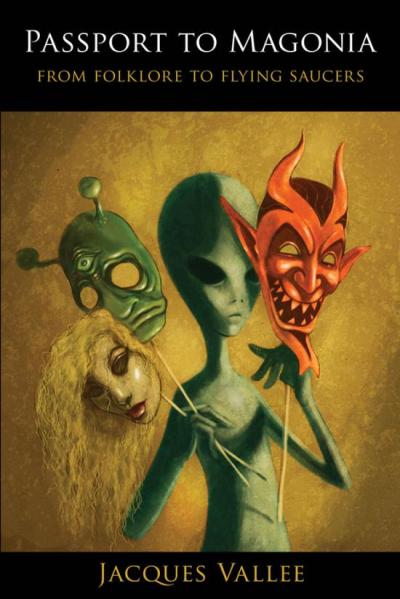
The ontological reality of faeries has in recent decades also become linked to other ‘paranormal’ activity types, primary of which is the intrusion into our consensus reality of entities usually known as aliens. The first person to suggest a definitive link between the the reports of folkloric faerie experiences and alien encounters was the astronomer and computer scientist Jacques Vallée. In his 1969 book Passport to Magonia he put forward the theory that the faeries were one and the same as the alien beings who had been purportedly abducting people around the world for a couple of decades by that date.xix His hypothesis is that there is a commonality to the experiences reported in alien abduction scenarios, and the reports of interactions with faeries in folklore. He suggests the aliens and the faeries are essentially the same phenomenon, tuned through the cultural receptors of the time and then interpreted accordingly. He makes special reference to the regular motifs in folklore of the abduction, by various means, of humans by faeries. There’s a lot of data here – it’s the commonest motif in faerie folklore. For a variety of reasons humans are taken to an alternative faerie reality, either as midwives or nurses for faerie children, as servants to the faeries, for sex, as punishment or reward, or just because the faeries feel like it. These motifs, of course, coincide with many aspects of the consistently strange phenomenon of alien abduction, reports of which have grown at an exponential rate since the early 1950s. Vallée uses a range of evidence to tie-up faerie abductions from folklore and alien abductions from modern reports, and goes as far to state:

‘… the modern, global belief in flying saucers and their occupants is identical to an earlier belief in the fairy-faith. The entities described as the pilots of the craft are indistinguishable from the elves, sylphs and lutins of the Middle Ages. Through the observations of unidentified flying objects, we are concerned with an agency our ancestors knew well and regarded with terror: we are prying into the affairs of The Secret Commonwealth.’xx

The Secret Commonwealth was the term coined for the faeries by the Reverend Robert Kirk in a manuscript of 1691, which includes a detailed description of their appearance, habits and exploits, gleaned from both his own experiences and those Scottish Highlanders purporting to have second-sight, or clairvoyance.xxi As Vallée points out, Kirk’s descriptions of the faeries and their modus operandi bear more than a passing resemblance to the alien visitors of the 20th and 21st centuries.
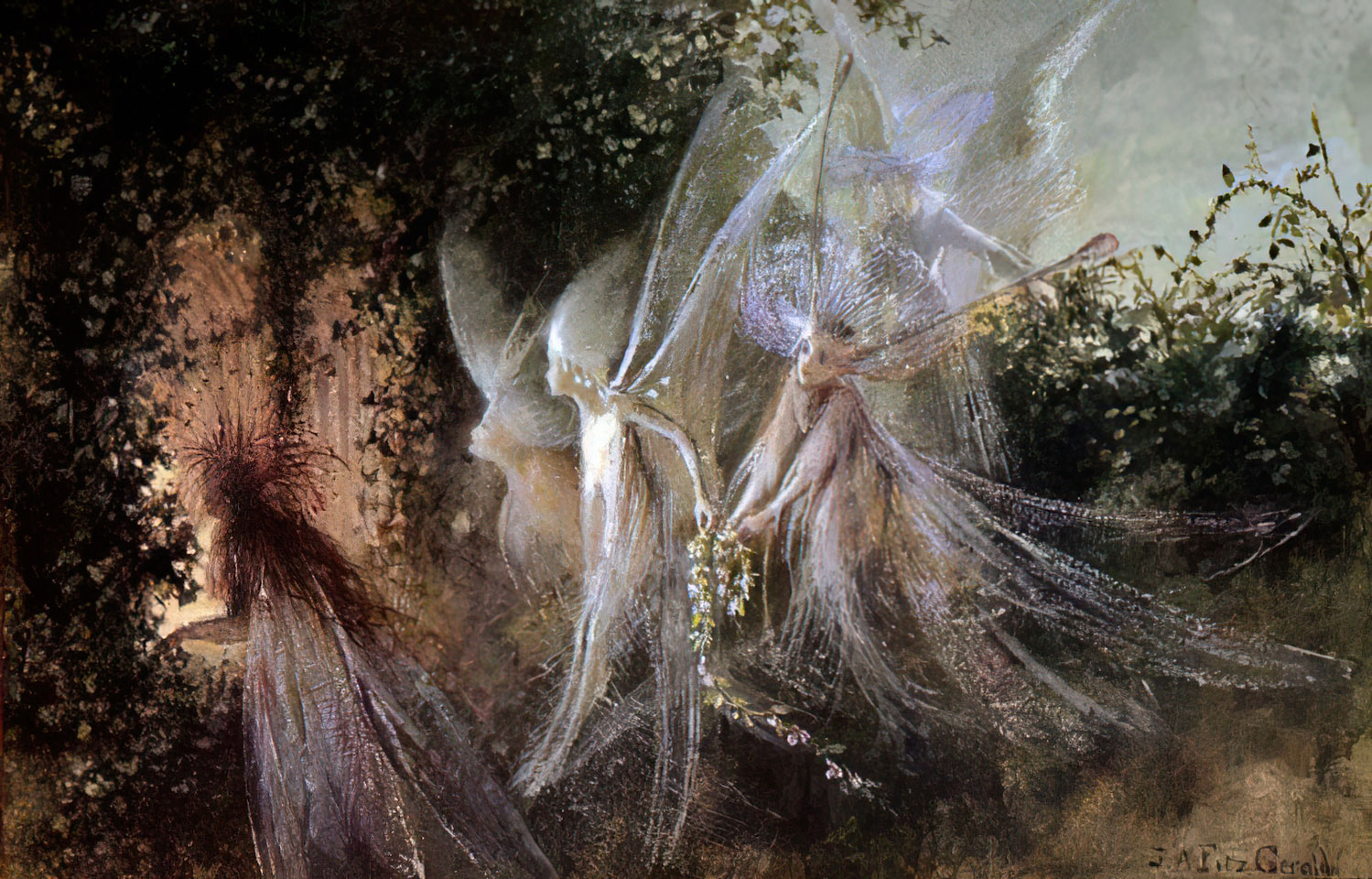
A Faerie Passage by John Anster Fitzgerald, 1864 (PD0)

Among their attributes was an ability to float through the air with insubstantial and fluid bodies, that they could make appear and disappear at will. This allowed them to ‘swim’ through the air and carry off mortals, usually to large circular abodes, that Kirk presumed were underground, and which were lit by a dim, unknown illumination. They even had ‘ætheriall vehicles’ to carry them around the sky. Kirk also asserted that the faeries had a nature intermediate between humans and angels. Their habit of abducting humans was usually for the purpose of wet-nursing faerie children or as midwives; a theme that fits in with the deluge of recent alien abduction reports (subsequent to Vallée’s investigations in 1969) that would suggest one of the main reasons for abduction is to obtain both parents and wet-nurses for hybrid human-alien offspring. Vallée quotes the 19th-century folklorist Edwin Hartland’s suggestion that such a programme of hybridisation was a primary reason for faerie abductions:

‘The motive assigned to fairies in northern stories is that of preserving and improving their race, on the one had by carrying off human children to be brought up among the elves and to become united with them, and on the other hand by obtaining the milk and fostering care of human mothers for their own offspring.’xxii

In 2005, Graham Hancock followed Vallée’s lead and took the comparison of faerie and alien abduction much further in his book Supernatural (after dealing with the elements of prehistoric shamanic cave-painting depictions of entities, discussed above). He compiled a range of faerie abduction reports from various time periods and geographical locations and set them against modern-day alien abduction events. He pays special attention to the faerie abduction of young women, such as Mrs Sheridan, an Irish woman, who seems to have spent much of the last decade of the 19th century being whisked off by the fairies for wet-nursing duties:

‘Where they brought me I don’t know, or how I got there, but I’d be in a very big house, and it was round, the walls far away that you’d hardly see them, and a great many faeries all about… but they wouldn’t speak to me nor I to them.’xxiii

These ‘long-faced’ faeries had a definite purpose for kidnapping her and weren’t too concerned with her tearful appeals to release her – she had a job to do, and that was feeding their faerie babies. The correlation between these types of folkloric encounters and the alien abductions of women is striking. Hancock surveys the work of the late Harvard psychiatrist John Mack and the cultural historian David Jacobs, who have made extensive studies of people who claim to have been abducted by aliens, often using hypnotic techniques to extract memories from amnesic events.xxiv It’s a minefield subject (mostly due to the vagaries of extracting memories from hypnosis), but John Mack in particular is a convincing advocate of the notion that whatever the experiences represent, they are genuinely real to the participant. A typical scenario might involve the abductee being floated or beamed aboard a UFO, and then taken to a part of the ship where there seem to be drawers or tanks of hybrid alien-human babies, which they are sometimes expected to nurse. There is a consistency to these experiences that provides a dataset of testimony that Mack insists must be taken seriously as a phenomenon. For the abductees, the experience is often highly traumatic (Mack states that the best psychiatric diagnosis for many abductees is post-traumatic stress disorder), and no wonder, when they are confronted with alien hybrids often described as more like foetuses than babies. One abductee described to Mack their appearance, which is fairly typical:

‘Their bodies were short for their heads. Their heads seemed oversized. They had very blue eyes. They had very thin, wispy hair… I would say they were probably three and a half feet tall, but they all looked the same age. ‘You’re our mother and we need you,’ they said.’xxv

The evidence presented by Jacques Vallée and Graham Hancock makes a convincing argument for the tight relation between faerie behaviour in folklore and alien abductions in the 20th/21st century. The experiences are culturally coded to time and place, but the correlations and similarities are intriguing, and suggest the possibility of a common source for the phenomena. But what is that source and where is the metaphysical intersect?
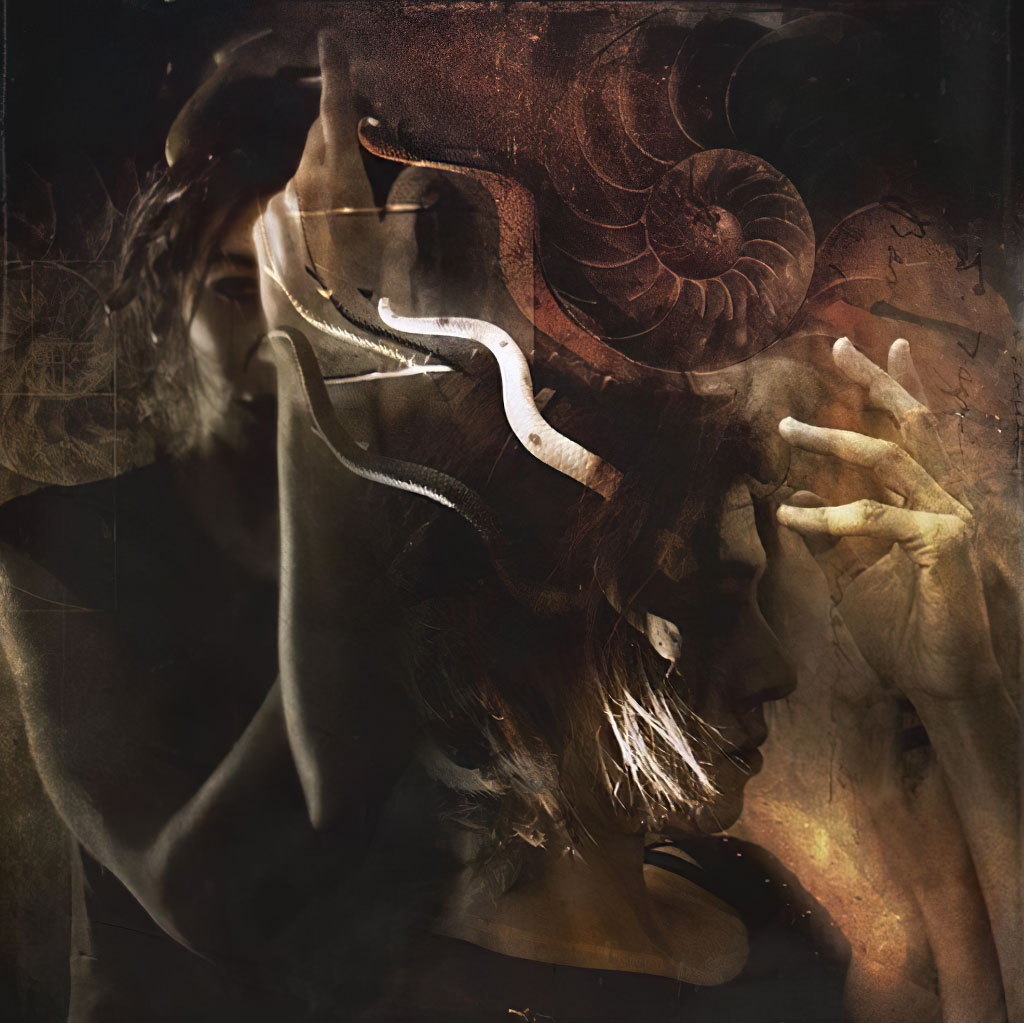
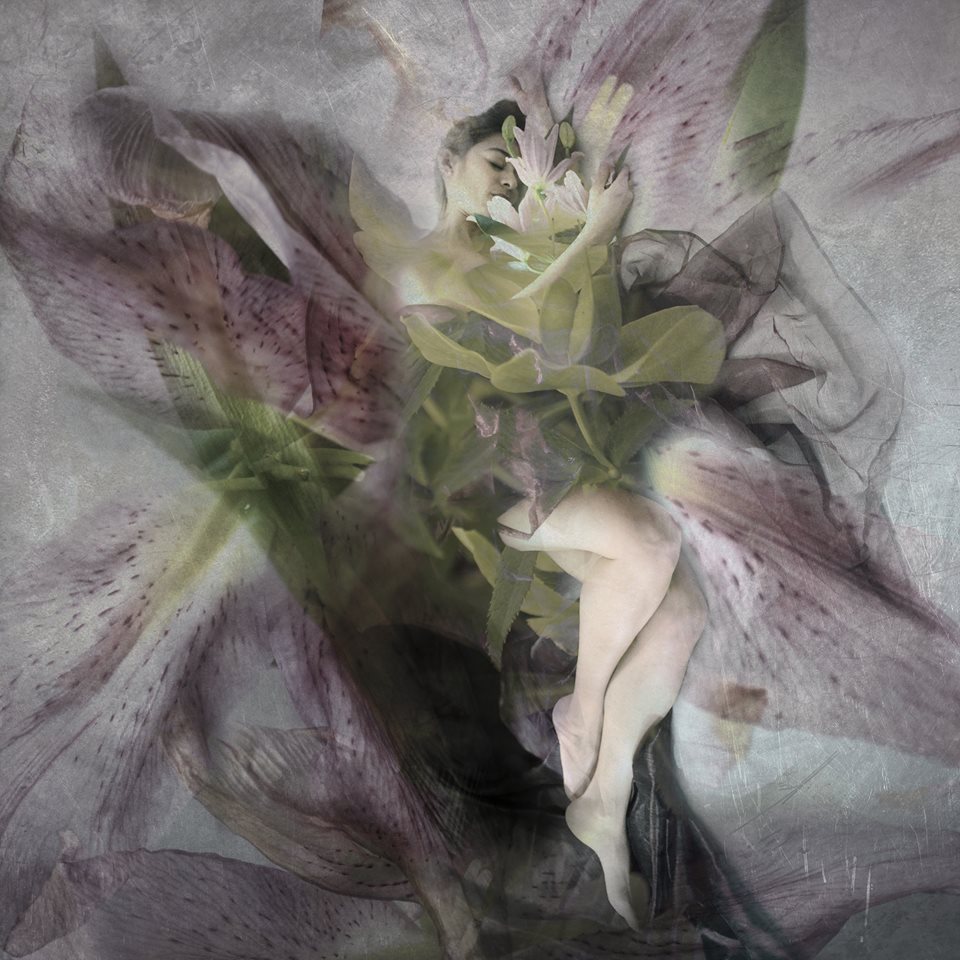
‘Walking on the Edge of Your Mind’ © Ylenia Viola, used with permission.

Ontological Faeries

This brings us back to the ontology of faerie experiences; what are these entities that have been a part of humanity for thousands of years, and where do they come from? They may be adapting to cultural codes, even evolving into new forms, but at what level of reality do they exist? An answer may be to utilise David Luke’s three-part interpretation for non-physical entity contact.xxvi He used it to assess a study into the otherworldly beings (many of which had faerie-attributes) encountered by people who had altered their states of consciousness with DMT, but it is also a valid tool to evaluate what may be happening to anyone who reports a numinous experience that includes interaction with non-human intelligent entities such as the faeries:

1.They are hallucinations. The entities are subjective hallucinations. Such a position is favoured by those taking a purely (materialist-reductionist) neuropsychological approach to the phenomena.

2. They are psychological/ transpersonal manifestations. The communicating entities appear alien but are actually unfamiliar aspects of ourselves, be they our reptilian brain or our cells, molecules or sub-atomic particles.

3. The entities exist in otherworlds and can interact with our physical reality. A numinous experience provides access to a true alternate dimension inhabited by independently existing intelligent entities in a stand-alone reality, which exists co-laterally with ours, and may interact with our world when certain conditions are met. The identity of the entities remains speculative.

Of course, all three interpretations may be true at different times and under various circumstances. From a materialist-reductionist standpoint, all faerie experiences could be reduced to hallucinatory events. There is no physical residue as an after-effect of the interactions, and the reports are all limited to visual and audio experiences. While the specific adjuncts allowing for the hallucinations to take place cannot be properly analysed, seeing them all as aberrations of visual and audial fields remains one legitimate interpretation.

This explanatory model is reliant on the theory that consciousness is an epiphenomenon of the brain. The implication is that the brain, for whatever reason, is simply misconstruing sensory input from a physical world where things like faeries simply do not exist. This is the hard and fast materialist-reductionist standpoint, which is deeply embedded in Western culture. But, as discussed above, it is a standpoint that is now challenged at a fundamental level not only by religious and mystical traditions, but also by the recently reinvented philosophy of Kantian Idealism and by a growing number of quantum physicists, who (using a wide range of methodologies) suggest that the brain is a reducer of consciousness, not a creator of it.xxvii This model sees consciousness (not matter) as primary; it is everywhere and it is everything, and individual human (and animal) brains are merely conveying it within the remit of what then becomes physical reality. For the most part, this physical reality has a closely defined rule-set, but under certain conditions the usual laws break down and supra-normal events can occur. These supernatural occurrences are thus as legitimate as any natural occurrence.

This helps us to perhaps understand preternatural faerie experiences as something non-material being allowed to ‘pop in’ to physical reality from either a greater, transcendent form of consciousness, or from an alternative reality to which humans do not usually have access. This would fit with either of David Luke’s second and third interpretations for supernatural entity contact. Simply put, a numinous zone has been entered and the participant is able to make contact with what usually resides external to their ordinary consciousness.

Experiences in numinous zones could be extended to a variety of preternatural encounters, from ghost apparitions through to Near Death Experiences and UFO abduction scenarios, but it would seem that the faeries, as an ontological taxonomic, remain a consistent, even persistent, form of entity that interact with our consensus reality. While reports of the faeries from history have often been turned into allegorical folkloric stories (frequently with a moral lesson inserted into the plot line), modern encounters usually take the form of simple anecdotal testimony. But the phenomenological types of faeries retain an adherence to their folkloric roots. They can receive an updated appearance, and cultural coding, but they remain recognisable as faeries. Graham Hancock has summed up what may be happening if we allow the faeries some type of metaphysical reality:

‘If we are prepared to set aside the automatic scepticism and reductionism of our age, and if we spell out the problem in plain language, then we find that we are contemplating the existence — and powerful intervention in our lives — of highly intelligent discarnate entities belonging to an order of creation fundamentally different than our own… it really is almost as though the beings we are dealing with have been changing and developing alongside us for thousands of years, and that they therefore cannot simply be mass delusions, but must have a definite, independent reality outside the human brain.’xxviii

Whatever their true nature, it seems that for the faeries to make contact with humanity they require our consciousness to become loosened from the usual restraints, and to enter an altered state — a numinous zone. If the model of reality affirmed by Idealism is correct, then this zone may be allowing us to access a greater Over-Mind, where exist entities that represent either a stand-alone autonomous class of their own, or perhaps aspects of the human collective unconsciousness (as explicated by Carl Jung), which is usually filtered out through the reducing valve of the brain.xxix Either way, it appears that the faeries are here to stay, functioning in some nebulous region where any interpretation of them is reliant on us finding a way to incorporate consciousness into physical reality. This is something that has eluded both philosophers and scientists for millennia, and so perhaps it is no surprise that faerie entities – whether nature spirits, inter-dimensional beings, aliens, or products of our collective imagination – for the moment, remain an intangible, but enduring, part of our cultural zeitgeist.

References

i Young, S. (2017). ‘The Fairy Investigation Society Census 2014-17 and 2017-23′. https://www.fairyist.com/survey/read-the-fairy-census-1-and-2/

ii See especially the work of the computer scientist and philosopher Bernardo Kastrup. His work with quantum physicists is summarised in: Kastrup, B, Stapp, HP and Kafatos, MC. (2018). ‘Coming to Grips with the Implications of Quantum Mechanics’, Scientific American.  https://blogs.scientificamerican.com/observations/coming-to-grips-with-the-implications-of-quantum-mechanics/

iii Clottes, J. et al. (2016). What Is Palaeolithic Art?: Cave Paintings and the Dawn of Human Creativity. University of Chicago Press.

iv Lewis-Williams, D and Dowson, T. (1988). ’The Signs of All Times: Entoptic Phenomena in Upper Palaeolithic Art’, Current Anthropology 29, 201-45.  http://psimg.jstor.org/fsi/img/pdf/t0/10.5555/al.ch.document.sip200035_final.pdf; Lewis-Williams, D. (2002). The Mind in the Cave. Thames & Hudson, London

v Hancock, G. (2005). Supernatural: Meetings with the Ancient Teachers of Mankind. Century, London

vi Ginzburg, C. (2004). Ecstasies: Deciphering the Witches’ Sabbath. University of Chicago Press; Wilby, E. (2005). Cunning Folk and Familiar Spirits: Shamanistic Visionary Traditions in Early Modern British Witchcraft and Magic. Sussex Academic Press.

vii Evans-Wentz, W.Y. (2004, first published 1911). The Fairy-Faith in Celtic Countries. New Page Books, Franklin Lakes, NJ. A version is available online at: https://sacred-texts.com/neu/celt/ffcc/; See also, Rushton, N. (2016). ‘Evan-Wentz’s Celtic Faeries’.   https://dead-but-dreaming.com/2016/11/27/evans-wentzs-celtic-faeries/

viii Evans-Wentz. Op. cit., p. 87

ix Lavole, J.D. (2012). The Theosophical Society: The History of a Spiritualist Movement. Brown Walker Press, Irvine, CA.

x Steiner, R. (1995) Nature Spirits, Rudolf Steiner Press, Forest Row, pp. 177-78. The quote is from Steiner’s 1913 lecture ‘Perception of the Elemental World.’

xi Rushton, N. (2019). ‘Paracelsus, Nature Spirits and Faeries’.  https://dead-but-dreaming.com/2019/11/17/paracelsus-nature-spirits-and-faeries/

xii Sheldrake, R. (2012, 4th ed.). The Presence of the Past: Morphic Resonance and the Memory of Nature, Park Street Press, Rochester, VT.

xiii Shanon, B. (2002). The Antipodes of the Mind: Charting the Phenomenology of the Ayahuasca Experience, Oxford University Press.

xiv Ask Erowid (2013) https://www.erowid.org/ask/ask.php?ID=3146

xv Strassman, R. (2001). DMT: The Spirit Molecule. Park Street Press, Rochester, VT.

xvi Davis, AK, et al. (2020). ‘Survey of Entity Encounter Experiences Occasioned by Inhaled N,N-dimethyltryptamine: Phenomenology, Interpretation, and Enduring Effects’.  https://journals.sagepub.com/doi/pdf/10.1177/0269881120916143 . See also: Rushton, N. (2020). ‘Faerie Entities and DMT’.  https://dead-but-dreaming.com/2020/07/05/faerie-entities-and-dmt/

xvii Rushton, N. (2017). ‘The Faerie Abduction of Anne Jefferies’.  https://dead-but-dreaming.com/2017/09/23/the-faerie-abduction-of-anne-jefferies/

xviii LaPlante, E. (1993). Seized: Temporal Lobe Epilepsy as a Medical, Historical, and Artistic Phenomenon, Harper Collins, London.

xix Vallée, J. (1993), first published 1969). Passport to Magonia: On UFOs, Folklore, and Parallel Worlds, Contemporary Books, Chicago.

xx Vallée, Op cit., p. 57.

xxi Rushton, N. (2016). ‘The Secret Commonwealth’.  https://dead-but-dreaming.com/2016/07/31/the-secret-commonwealth/

xxii Vallée, Op cit., p. 105.

xxiii Hancock, Op cit., p. 375.

xxiv Mack, J. (2000). Passport to the Cosmos: Human Transformation and Alien Encounters, Harper Collins, London.

xxv Mack, Op cit., p. 117.

xxvi Luke, D. (2011). ‘Discarnate Entities and Dimethyltryptamine (DMT): Psychopharmacology, Phenomenology and Ontology’, Journal of the Society for Psychical Research, 75, 26-42. https://dmttimes.com/david-luke-papers-and-articles/2020/1/2/discarnate-entities-and-dimethyltryptamine-dmt-psychopharmacology-phenomenology-and-ontology

xxvii See especially: Kastrup, B. (2019). The Idea of the World: A Multi-Disciplinary Argument for the Mental Nature of Reality, iff Books, Winchester.

xxviii Hancock, Op cit., pp. 398-99 & 412.

xxix Jung, C.G. (1991). The Archetypes and the Collective Unconscious, Routledge, London.

Bibliography

Briggs, K. (1978) An Encyclopedia of Fairies. Pantheon, London

Clottes, J. et al. (2016). What Is Palaeolithic Art?: Cave Paintings and the Dawn of Human Creativity. University of Chicago Press.

Cutchin, J. (2018). Thieves in the Night: A Brief History of Supernatural Child Abductions. Anomalist Books, Charlottesville, VA

 Davis, A.K, et al. (2020). ‘Survey of Entity Encounter Experiences Occasioned by Inhaled N,N-dimethyltryptamine: Phenomenology, Interpretation, and E nduring Effects’.  https://journals.sagepub.com/doi/pdf/10.1177/0269881120916143

Esbjörn-Hargens, S. (2020). ‘Our Wild Kosmos: An Exo Studies Exploration of the Ontological Status of Non-Human Intelligences’.  https://whatsupwithufos.com/wp-content/uploads/2020/06/Exo_Studies.pdf

Evans-Wentz, W.Y. (2004, first published 1911). The Fairy-Faith in Celtic Countries. New Page Books, Franklin Lakes, NJ. A version is available online at: https://sacred-texts.com/neu/celt/ffcc/

 Ginzburg, C. (2004). Ecstasies: Deciphering the Witches’ Sabbath. University of Chicago Press

 Hancock, G. (2005). Supernatural: Meetings with the Ancient Teachers of Mankind. Century, London

 Harpur, P. (2003). Daimonic Reality: A Field Guide to the Otherworld. Pine Winds Press, Enumclaw, WA

Hunt, R. (2013; first published 1865). Popular Romances of the West of England. Hardpress Publishing, Fairford

 Kastrup, B. (2019). The Idea of the World: A Multi-Disciplinary Argument for the Mental Nature of Reality, iff Books, Winchester

 Kastrup, B, Stapp, HP and Kafatos, MC. (2018). ‘Coming to Grips with the Implications of Quantum Mechanics’, Scientific Americanhttps://blogs.scientificamerican.com/observations/coming-to-grips-with-the-implications-of-quantum-mechanics/

 Jung, C.G. (1991). The Archetypes and the Collective Unconscious, Routledge, London.

 LaPlante, E. (1993). Seized: Temporal Lobe Epilepsy as a Medical, Historical, and Artistic Phenomenon, Harper Collins, London

 Lavole, J.D. (2012). The Theosophical Society: The History of a Spiritualist Movement. Brown Walker Press, Irvine, CA

 Lewis-Williams, D. (2002). The Mind in the Cave. Thames & Hudson, London

 Lewis-Williams, D and Dowson, T. (1988). ’The Signs of All Times: Entoptic Phenomena in Upper Palaeolithic Art’, Current Anthropology 29, 201-45.  http://psimg.jstor.org/fsi/img/pdf/t0/10.5555/al.ch.document.sip200035_final.pdf

 Luke, D. (2011). ‘Discarnate Entities and Dimethyltryptamine (DMT): Psychopharmacology, Phenomenology and Ontology’, Journal of the  Society for Psychical Research, 75, 26-42. https://dmttimes.com/david-luke-papers-and-articles/2020/1/2/discarnate-entities-and-dimethyltryptamine-dmt-psychopharmacology-phenomenology-and-ontology

 Luke, D. (2017). Otherworlds: Psychedelics and Exceptional Human Experience. Muswell Hill Press, London

 Luke, D. and Spowers, R. (eds). (2018). DMT Dialogues: Encounters with the Spirit Molecule. Park Street Press, Rochester, VT

 Mack, J. (2000). Passport to the Cosmos: Human Transformation and Alien Encounters, Harper Collins, London

 Peake, A. (2019). The Hidden Universe: An Investigation into Non-Human Intelligences. Watkins, London

 Rushton, N. (2016). ‘Evan-Wentz’s Celtic Faeries’.  https://dead-but-dreaming.com/2016/11/27/evans-wentzs-celtic-faeries/

 Rushton, N. (2016). ‘The Secret Commonwealth’.  https://dead-but-dreaming.com/2016/07/31/the-secret-commonwealth/

 Rushton, N. (2017). ‘The Faerie Abduction of Anne Jefferies’.  https://dead-but-dreaming.com/2017/09/23/the-faerie-abduction-of-anne-jefferies/

 Rushton, N. (2019). ‘Paracelsus, Nature Spirits and Faeries’.  https://dead-but-dreaming.com/2019/11/17/paracelsus-nature-spirits-and-faeries/

 Rushton, N. (2020). ‘Faerie Entities and DMT’.  https://dead-but-dreaming.com/2020/07/05/faerie-entities-and-dmt/

 Shanon, B. (2002). The Antipodes of the Mind: Charting the Phenomenology of the Ayahuasca Experience, Oxford University Press

 Sheldrake, R. (2012, 4th ed.). The Presence of the Past: Morphic Resonance and the Memory of Nature, Park Street Press, Rochester, VT

 Steiner, R. (1995) Nature Spirits, Rudolf Steiner Press, Forest Row

 Strassman, R. (2001). DMT: The Spirit Molecule. Park Street Press, Rochester, VT

 Vallée, J. (1993), first published 1969). Passport to Magonia: On UFOs, Folklore, and Parallel Worlds, Contemporary Books, Chicago

 Wilby, E. (2005). Cunning Folk and Familiar Spirits: Shamanistic Visionary Traditions in Early Modern British Witchcraft and Magic. Sussex Academic Press.

 Young, S. (2017 and 2023). ‘The Fairy Investigation Society Census 2014-17 and 2017-23’. https://www.fairyist.com/survey/read-the-fairy-census-1-and-2/

***

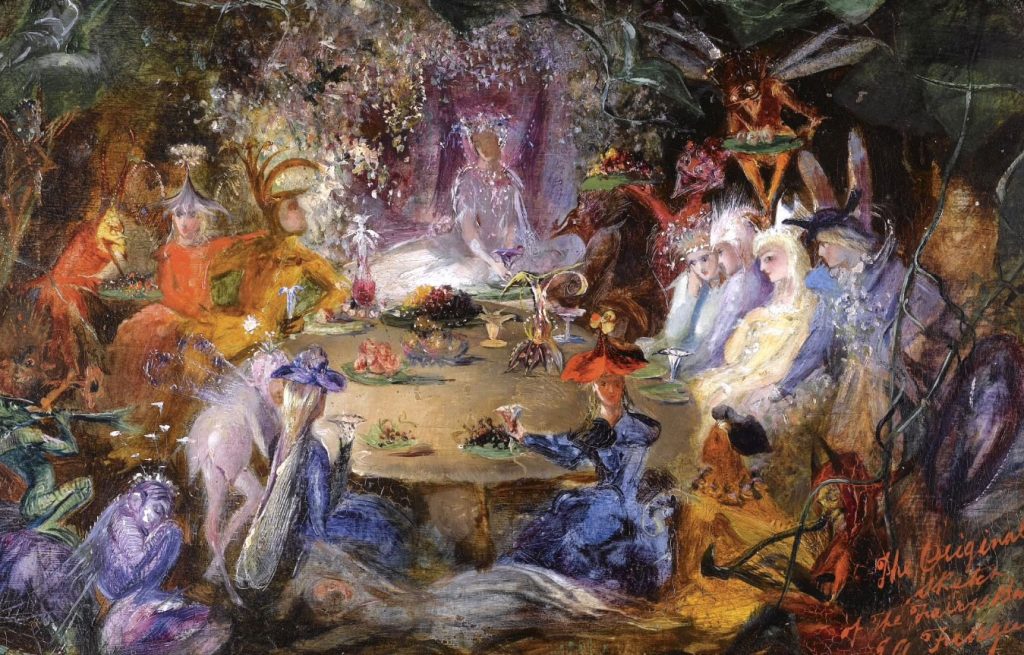
The cover image is ‘The Faerie Banquet’ by John Anster Fitzgerald, 1859 (PD0).

***

Dead but Dreaming the novel is available now…
***
Frightening and Enlightening: The Phenomenology of Modern Faeries

“If we are prepared to set aside the automatic scepticism and reductionism of our age, and if we spell out the problem in plain language, then we find that we are contemplating the existence of highly intelligent discarnate entities belonging to an order of creation fundamentally different than our own… By whatever name we know them – spirits, faeries, aliens – it really is almost as though the beings we are dealing with have been changing and developing alongside us for thousands of years, and that they therefore cannot simply be mass delusions, but must have a definite, independent reality outside the human brain.”

Graham Hancock, Supernatural (2005)

As Graham Hancock suggests, the faeries seem to have acculturated themselves alongside humans for a long period of time, adapting their phenomenology to our cultural creeds, but all the while maintaining their own specific metaphysical identity. They appear in folklore through cultural lenses that are distinguished by the worldview of the particular time. This might manifest through prehistoric cave paintings of hallucinogenic supernatural entities, Classical reliefs of human-like nymphs, Christianised medieval tales of marvels, the shapeshifting familiars of Early-Modern witches, or the array of liminal characters only slightly removed from consensus reality into a magical world recorded by 19th- and early 20th-century folklorists. But their presence is persistent. Despite concerted efforts to downgrade the folklore into tales for children during the late 19th and 20th centuries, belief in the ontological reality of faerie entities continues into the 21st century, albeit coded to modern sensibilities. And just as in the faerie folklore of the past, the modern phenomenology of these otherworldly beings is both diverse and elusive – frightening and enlightening.

Modern Faeries

Modern faerie sightings and experiences tend to pass under the mainstream cultural radar. The idea that there may be a parallel species of discarnate beings inhabiting our world and occasionally interacting with us is anathema to the dominant materialistic worldview. And as with anything outside the conventional reality-box, such phenomena are usually dealt with through disparagement – think of the final item on a TV news bulletin with the presenters smiling knowingly at the absurdity of a story. Faeries are particularly susceptible to such treatment due to their debasement into entities that simply do not exist except in the minds of children. However, in recent years – partly due to the internet enabling an exponential growth of alternative information – a new understanding of what the faeries are has begun to emerge, suggesting that their presence through history is not just the product of over-imaginative storytelling, but that rather they are deeply embedded within our collective consciousness, and are able to surface into consensus reality when certain conditions are met.

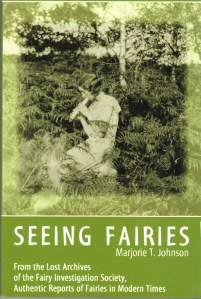
Part of the problem in tracing modern faeries is that the conditions of their appearances are not usually controllable, and so accounts of interactions with them tend to be anecdotal and unverifiable. Such is the case in what is probably the largest collection of Seeing-Fairies-A-687x1024-2faerie encounters in the 20th century: Marjorie Johnson’s Seeing Fairies, first published in English in 2014. Johnson (acting on behalf of the Fairy Investigation Society) collected over 500 anecdotal descriptions from people who claimed to have seen or interacted with faeries, and compiled them together with her own experiences. Some of her correspondents were Theosophists, with an avowed history of clairvoyance. But the majority were not, and their honest appraisals of seeing faeries are usually singular events in their otherwise non-clairvoyant lives. Their subjective anecdotes remain contentious as scientific evidence, but they are a fascinating collection of experience reports. The faeries described range from traditional folkloric types to metaphysical nature spirits, occasionally morphing into the delicate, genteel winged faeries of Victorian invention. Two examples give a flavour of the reports, both from the 1950s; the first (transposed into the third-person by Johnson) from Kent, England by Felicity Royds recounting an experience from when she was nine years old:
“Felicity found she had left some object – her coat or a toy – in the rose garden, and was sent back alone to fetch it. The rose garden was surrounded by thick yew hedges, and at the end of it was a cast-iron gate leading into a thicket of rhododendrons. The object, which she had gone to fetch, was on the grass near this gate, and she had just retrieved it and was turning away, fearful of what may come out of the bushes, when she saw coming through the gate a small man leading a light brown horse. The man was shorter than Felicity and appeared to be wearing a blue tunic with something white at the neck. His skin was very brown, browner than his hair. The pony was about the size of a Shetland but very slender. Although she did not feel frightened, Felicity did not look at the man directly, only out of the corner of her eye. He put his hand on her wrist, and his touch was cool, not cool like a fish or a lizard, but much cooler than a human touch. He led her out of the rose garden and onwards until they were within sight of the house, and then stood still while she went in. She said that she was not musical, but while he held her hand she seemed to be aware of a strain of music that was sweet and high but sounded rather unfinished.”

The second example (slightly abbreviated) is from a Mr Hugh Sheridan, whose encounter was in Ballyboughal, Co. Dublin, Ireland, in 1953. He was walking across fields between his workplace and home at dusk:

“… and when nearing the corner of one of the fields I heard a tittering noise. At first I thought it was some of the other men who had gone on before me and who might be intending to play some prank. However, I noticed immediately afterwards what looked like a large, greenish tarpaulin on the ground, with thousands of faeries on it. I then found there were a lot more around me. They were of two sizes, some about four feet high, and others about eighteen or twenty inches high. Except for size, both kinds were exactly alike. They wore dark, bluish-grey coats, tight at the waist and flared at the hips, with a sort of shoulder cape… the covering of their legs was tight, rather like puttees, and they appeared to be wearing shoes. I started on the path towards home, and the faeries went with me in front and all around. The largest faeries kept nearest to me. The ones in front kept skipping backwards as they went, and their feet appeared to be touching the ground. There were males and females, all seemingly in their early twenties. They had very pleasant faces, with plumper cheeks than those of humans, and the men’s faces were devoid of hair or whiskers… None of the faeries had wings. They tried to get me off the path towards a gateway leading from the field, but just before I reached it I realised they were trying to take me away, so I resisted and turned towards the path again. [After slipping into, and getting out of a dry a ditch, still surrounded by the faeries] I moved towards home with the faeries round me, and they kept the tittering noise all the time. In the end I got to a plank leading across a ditch from one field to another, and suddenly all the faeries went away. They seemed to go back with the noise gradually fading. At one time I had reached out my arms to try to catch them, but I cannot be sure whether they skipped back just out of reach, or whether my hands passed through them without feeling anything. They were smiling and pleasant all the time, and I could see their eyes watching me. When I got home, I found I was about three-quarters of an hour late, but I thought I had been delayed only a few minutes [my emphasis]. While the faeries were with me, I had the rather exciting feeling like being on a great height, but I was in no way afraid. I would very much like to meet them again.”

Most of Johnson’s accounts are from the mid 20th century, but the new incarnation of the Fairy Investigation Society (from 2013) has recently carried out a new survey into faerie sightings, using a standardised recording form. Whilst still reliant on anecdotal reports, and the honesty of participants, this census has currently compiled nearly 500 accounts of faerie encounters and the results will elucidate contemporary patterns of sightings in a searchable online format.

The Wollaton Park Gnomes

One of the more bizarre modern faerie encounters happened at Wollaton Park in Nottingham on 23 September 1979. It includes various traditional folkloric faerie motifs, but is overlain with some strange and anomalous features, which give it an edge of authenticity, especially as it was reported by a group of seven children between 8-10 years, who stuck rigorously to their story even when separated and questioned by their headmaster. The consistency of their testimonies is particularly impressive, despite some of the aberrant qualities of the account. Their testimonies were recorded on tape by the headmaster a few days after the event, and the transcriptions can be found here, recorded for posterity by Simon Young.

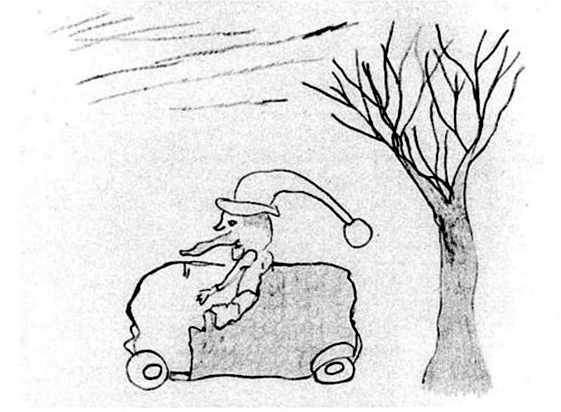
The incident happened during the early evening, just as it was getting dark. The children were playing close to a fenced-off marshy area of the park with ponds (how many children of this age would be allowed to wander around on their own in such a location at dusk today? But this was the 1970s). Without warning, there appeared about thirty small cars, each containing two gnome-like creatures, that is, with ‘bobbled nightcaps’, beards, wrinkly skin, and dressed in coloured jerkins. One of the older children described them as: ‘about half the size of me and they had long white beards with red at the bottom and they had little white and red cars and they were chasing us.’ The cars were silent and seemed able to defy the laws of physics by floating over logs on the ground. Although the gnomic cars chased the children they were consistently described as being friendly and the whole encounter seemed like a game with the gnomes laughing, although when the two youngest children fell over in the marsh they became frightened. One of the only discrepancies in the testimonies is that five of the children said the gnomes were, apart from laughing, consistently silent throughout, whereas two children described them as talking in some type of foreign language. The cars were described as having triangular lights and some sort of button instead of a steering wheel. After about fifteen minutes, soon after the two youngsters fell in the marsh, the children ran off and the gnomes disappeared back into the trees.

drawing
One of the children’s renditions of the Wollaton Park gnomes

The gnomes in this encounter seem to adhere to a fairly traditional folkloric appearance, but, of course, their levitating cars give them some modern cultural coding. If the incident is taken at face-value it could be seen as an updated version of many folklore anecdotes and stories that involve wizened gnomic faeries, behaving in a slightly irrational manner. Their manifestation in woodland and at dusk also locks in with the usual habitat and aphotic preferences of folkloric gnomes. Their materialisation to children is also important. The transcripts clearly demonstrate that the children, whilst startled by the encounter, were able to accept it without the rationalisation that might be expected of an adult. They viewed it as weird, but not unnatural. Perhaps this was simply a case of the children tuning into to the gloaming, woodland atmosphere and experiencing a non-material reality, acculturated for them by their watching (the very hallucinogenic) Big Ears and Noddy on the television.

Interestingly, Marjorie Johnson includes two more anecdotes of gnomic faeries (sans cars) in Wollaton Park in Seeing Fairies. The first detailed account is by Jean Dixon from the 1950s, where she explains how a group of gnomes led her around the park, showing her the natural features that they helped to maintain. This episode relates like an altered state of consciousness (see below) with the protagonist described as being ‘in a pensive mood’ prior to the experience, and perhaps liable to drift into a daydream state conducive to metaphysical visualisation. The second encounter happened in 1900 when a Mrs George “was passing Wollaton Park gates when she saw some little men dressed like policemen… They were smiling and looking very happy. They hadn’t any wings, and as far as I can remember they were between two and three feet in height.” It would seem that this particular park may be a significant place, where human consciousness interacts with something incorporeal if freed from the learned cultural constraints of reductionism.

Psychedelic Faeries

Such constraints can also be purposefully lifted by direct intervention into human states of consciousness – usually with the aid of a chemical agent. Most especially the psychedelic compounds tryptamines, phenethylamines and ergotamines reliably alter human consciousness and can enable it to interact with discarnate beings. There is a growing literature on this phenomenon, and it is clear that many of the psychedelically encountered entities can be classed ontologically as faeries. Terence McKenna was an enthusiastic advocate of these substances and wrote extensively about the landscapes and inhabitants of the otherworld invoked by mind-altering substances. He coined the term ‘self-transforming machine-elves’, to describe the entities that seemed to reside consistently in this chemically-induced world:

“Yes, first come the dancing mice, the little candies, the colored grids, and so-forth and so-on. But what eventually happens, quickly, like ten minutes later, is there is an entity in the trance, in the vision. There is a mind there, waiting, that speaks good English, and invites you up into its room… I come into a place. It’s hard to describe. It’s a feeling. And the content of the feeling is, ‘now the elves are near.’ But they won’t appear unless I invoke them… Trying to describe them isn’t easy. On one level I call them self-transforming machine elves; half machine, half elf. They are also like self-dribbling jeweled basketballs, about half that volume, and they move very quickly and change. And they are, somehow, awaiting. When you burst into this space, there’s a cheer! Pink Floyd has a song, The Gnomes Have Learned a New Way to Say Hooray. Then they come forward and tell you, ‘Do not give way to amazement. Do not abandon yourself.’ You’re amazingly astonished. The most conservative explanation for these elves, since these things are speaking English and are intelligent, is that they’re some kind of human beings. They’re obviously not like you and me, so they’re either the prenatal or postmortal phase of human existence, or maybe both.”

This quote is included in Jon Hanna‘s extensive 2012 survey of people who have contacted metaphysical entities while under the influence of a variety of psychedelics, most especially Lysergic acid diethylamide (LSD) and N,N-Dimethyltryptamine (DMT).

entities_2-2
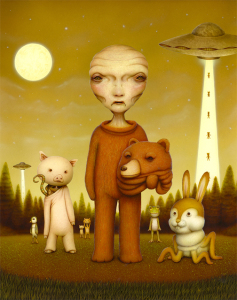
‘Invaders’ by Naoto Hattori

Hanna’s survey, using experience reports from the website Erowid, found that 1,159 of 22,640 reports included mention of contact with entities or beings. A large proportion of these entities are what might be termed, ontologically, as faeries. Some of the reports chime with McKenna’s description of machine-elves, creatures that, while matching some of the qualities of folkloric faeries, often appeared mechanical and artificial. This might be another example of the faeries updating themselves to our cultural expectations; transforming themselves into a new technologically revised version of their former selves.

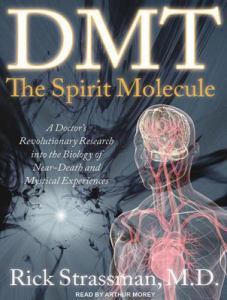
This certainly seems to have been the case in what remains the most rigorous study of entity contact by research participants injected with the potent psychoactive compound DMT. The research study was conducted between 1990 and 1995 in the General Clinical Dmt-The-Spirit-Molecule-Strassman-Rick-9781452601458Research Center of the University of New Mexico Hospital, by Dr Rick Strassman. It found that volunteers on the study injected with varying amounts of DMT underwent profound alterations of consciousness. This involved immediate cessation of normal consciousness and transportation to a different realm of reality with divergent physical properties, and inhabited by a range of creatures described as elves, faeries, lizards, reptiles, insects, aliens, clowns (yes, clowns) and various therianthropic entities. One woman even describes a pulsating entity that she described as ‘Tinkerbell-like’. The experiences, especially at higher doses, represented to the participants a parallel reality that was ‘super real’, not an hallucination, not a dream, but a substantial built reality with full sensory interaction + telepathy. Strassman published the results as DMT: The Spirit Molecule, and there is a 2010 documentary of the study, presented by Joe Rogan.
The experience reports from the study are irrational, absurd, frightening, illogical and surreal. It’s worth reading the book or watching the documentary to get the full range of what are incredible records of accessing very different realities. There is no question of any of the volunteers physically leaving the hospital bed during their experiences, but for all of them (without exception) the DMT-world was every bit as real as the one their minds left behind. After the injections participants frequently talked about ‘blasting through’ or ‘breaking through a barrier’ after which they found themselves in a realm with its own laws of physical space and movement, and its own inhabitants. Here is an abbreviated version of one of the volunteer’s description of his experience; 50 year old Jeremiah. After hurtling through a void he found himself:

“… in a nursery. A high-tech nursery with a single Gumby, three feet tall, attending me. I felt like an infant. Not a human infant, but an infant relative to the intelligence represented by the Gumby. It was aware of me but not particularly concerned… Then I heard two or three male voices talking. I heard one of them say “he’s arrived.” … I was in a big room… there was one big machine in the center, with round conduits, almost writhing – not like a snake, more in a technical manner. The machine felt as if it were rewiring me, reprogramming me… This is real. It’s totally unexpected, quite constant and objective… an independent, constant reality… I’m lucid and sober.”

In his 2011 review of the phenomenology and ontology of entities experienced on DMT, David Luke uses Strassman’s findings, but also expands the remit to include a wealth of other literature on the subject. Luke makes it clear that there seems to be an ubiquity of faerie-type creatures in the DMT-world: “Encounters with elves, gnomes, pixies, dwarfs, imps, goblins and other ‘little people’ (though clearly not human people), are extremely prevalent. Indeed on my first experience with DMT, unaware of virtually all lore associated with it, I found myself, eyes closed, being stuffed full of light by what I can only describe as little elves.”

But is it real? Building on a study carried out by Peter Meyer in 1994, Luke gets to the crux of the issue of psychedelically-induced faeries (and by extension all faerie encounters) and suggests there are three interpretations for what is happening:

  1. They are hallucinations. The entities are subjective hallucinations. Such a position is favoured by those taking a purely (materialist reductionist) neuropsychological approach to the phenomena.
  2. They are psychological/ transpersonal manifestations. The communicating entities appear alien but are actually unfamiliar aspects of ourselves, be they our reptilian brain or our cells, molecules or sub-atomic particles.
  3. The entities exist in otherworlds. DMT provides access to a true alternate dimension inhabited by independently existing intelligent entities in a stand-alone reality, which exists co-laterally with ours. The identity of the entities remains speculative.

Of course, all three interpretations may be true at different times, but whatever conclusions are drawn, there does appear to be a pantheon of faerie-types accessible to people who retune their consciousness with psychedelic compounds.

The Faeries as Aliens

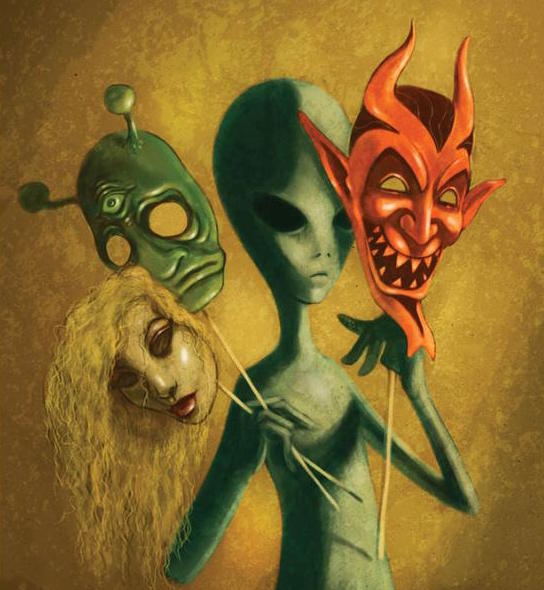
These three explanations may apply equally to the most extreme examples of potential faerie acculturation – the consistently bizarre phenomenon of alien abductions. Whilst abductees are seldom reported as having taken any psychoactive substance, one hypothesis is that their experiences are generated by an endogenous increase of DMT in their brains. David Luke explains that the production of DMT in the body is speculated to occur through the conversion of the simpler molecule tryptophan into tryptamine and then into DMT, the tryptophan being available from the diet as an essential amino acid. Such bio-synthesis has been observed in plants and is speculated to occur in humans, but it remains unknown where, for certain, this bio-synthesis occurs. One hypothesis holds that DMT manufacture occurs at the pineal gland, but this remains unproven. Wherever it comes from, if released in larger amounts than usual, it may be the natural psychedelic that allows the abduction scenarios, which often show marked similarities to folkloric faerie encounters (usually labelled under the Aarne-Thompson motifs F.324 and F.329). The alien greys may be simply high-tech faeries, updated for our modern sci-fi tastes, and accessed via an altered state of consciousness.

1magonijaIndeed, in his 1969 book Passport to Magonia, the astronomer and computer scientist Jacques Vallée – whilst holding back on any definitive conclusions about the objective/subjective nature of alien abductions – put forward the theory that the alien beings who had been purportedly abducting people around the world for a couple of decades by that date were one and the same as the faeries of European folklore. Vallée uses a range of evidence to tie-up faerie abductions from folklore and alien abductions from modern reports, and goes as far to state:

“… the modern, global belief in flying saucers and their occupants is identical to an earlier belief in the fairy-faith. The entities described as the pilots of the craft are indistinguishable from the elves, sylphs and lutins of the Middle Ages. Through the observations of unidentified flying objects, we are concerned with an agency our ancestors knew well and regarded with terror: we are prying into the affairs of the Secret Commonwealth.”

The Secret Commonwealth was the term coined for the faeries by the Reverend Robert Kirk in a manuscript of 1691. Vallée points out that Kirk’s descriptions of the faeries and their modus operandi bear more than a passing resemblance to the alien visitors of the 20th and 21st centuries. Amongst Kirk’s faerie attributes were an ability to float through the air with insubstantial and fluid bodies, that they could make appear and disappear at will. This allowed them to ‘swim’ through the air and carry off mortals, usually to large circular abodes, that Kirk presumed were underground, and which were lit by a dim, unknown illumination. They even had ‘ætheriall vehicles’ to carry them around the sky. Kirk also asserted that the faeries had a nature intermediate between humans and angels.

Their habit of abducting humans was usually for the purpose of wet-nursing faerie children or as midwives; a theme that fits in with the deluge of recent alien abduction reports (mostly unknown to Vallée in 1969) that would suggest one of the main reasons for abduction is to obtain wet-nurses for hybrid human-alien offspring. In 2005, Graham Hancock followed Vallée’s lead and took the comparison of faerie and alien abduction much further in his book Supernatural. He compiled a range of faerie folklore from various time periods and geographical locations and set them against modern-day alien abduction events. He pays special attention to the faerie abduction of young women, such as Mrs Sheridan, an Irish woman, who seems to have spent much of the last decade of the 19th century being whisked off by the fairies for wet-nursing duties:

“Where they brought me I don’t know, or how I got there, but I’d be in a very big house, and it was round, the walls far away that you’d hardly see them, and a great many faeries all about… but they wouldn’t speak to me nor I to them.”

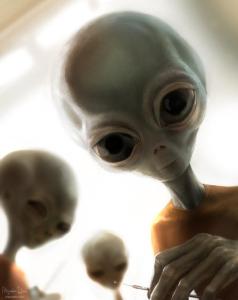
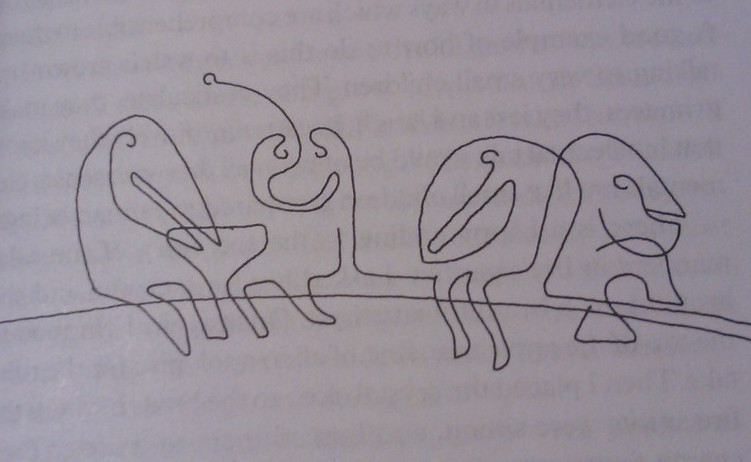
These ‘long-faced’ faeries had a definite purpose for kidnapping her and weren’t too concerned with her tearful appeals to release her – she had a job to do, and that was feeding their faerie babies. The correlation between these types of folkloric encounters and the modern alien abductions of women is striking. Hancock surveys the work of the late Harvard psychiatrist John Mack and the cultural historian David Jacobs, who have made extensive studies of people who claim to have been abducted by aliens, often using ALIEN-3hypnotic techniques to extract memories from amnesic events. It’s a minefield subject, but John Mack in particular is a convincing advocate of the notion that whatever the experiences represent, they are genuinely real to the participant. One common motif involves the abductee, after being floated or beamed aboard the UFO, being taken to a part of the ship where there seem to be drawers or tanks of hybrid alien-human babies, which they are expected to nurse. There is a consistency to these experiences (there are thousands of them) that provides a dataset of testimony that Mack and Jacobs insist must be taken seriously as a phenomenon. For the abductees, the experience is often highly traumatic (Mack states that the best psychiatric diagnosis for many abductees is post-traumatic stress disorder), and no wonder, when they are confronted with alien hybrids often described as more like foetuses than babies. One abductee described to Mack their appearance, which is fairly typical: “Their bodies were short for their heads. Their heads seemed oversized. They had very blue eyes. They had very thin, wispy hair… I would say they were probably three and a half feet tall, but they all looked the same age. ‘You’re our mother and we need you,’ they said.”
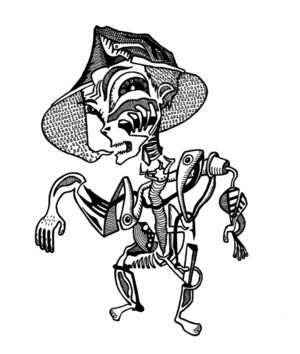
The evidence presented by Vallée and Hancock makes a convincing argument for the tight relation between faerie abductions in folklore and alien abductions in the 20th and 21st centuries. Once again, the encounters are culturally coded to time and place, but the correlations and similarities are intriguing, and suggest the possibility of a common source for the phenomena, however the participants arrive at their experience.

The Faeries as Nature Spirits

Alien abductions are most often terrifying experiences for the participants, and do correlate with some of the more malicious episodes in faerie folklore. But modern faerie contact can take an altogether more benign and constructive form when the faeries are engaged as nature spirits. There is a long tradition of the faeries representing non-material forces of nature, essential to the propagation of nature. The 15th-century alchemist Paracelsus developed an epistemology of these beings, but it was not until the incorporation of these ideas through the Theosophist movement in the late 19th century that the concept of a metaphysical realm responsible for the wellbeing of the natural world gained a wider understanding. One of the prime-disseminators of the nature spirit hypothesis was the Austrian Rudolf Steiner. In a series of lectures between 1908 and 1924 he outlined his hypothesis of how a range of supernatural entities (usually termed elementals) acted within nature and how a human observer might interact with them. Once again, this was dependent on altering consciousness. In this case the metaphysical technology was clairvoyance; an ability to perceive a non-material reality existing alongside, but in constant synergy with, the material world. Steiner attempted to explain the mechanics of clairvoyance, when a person must transform their usually passive thought forms into something more dynamic. In normal consciousness thoughts:

“… allow themselves to be connected and separated, to be formed and then dismissed. This life of thought must develop in the elemental world a step further. There a person is not in a position to deal with thoughts that are passive. If someone really succeeds in entering the world with his clairvoyant soul, it seems as though his thoughts were not things over which he has any command; they are living beings… You thrust your consciousness into a place, it seems, where you do not find thoughts that are like those in the physical world, but where they are living beings.” Rudolf Steiner, Perception of the Elemental World (1913).

Steiner goes on to describe the specific elemental animating forces at work in the natural world when perceived clairvoyantly in what he calls the Supersensible World. The elementals in the Supersensible World exist as a range of beings, from devas, which are responsible for entire autonomous landscapes, through to the smaller nature spirits charged with the growth of vegetation. Steiner (basing his epistemology on that of Paracelsus) divides these into four main types corresponding to earth (Gnomic), water (Undines), air (Sylphs) and heat/light (Salamanders). This is the faerie realm, existing as a non-material autonomous reality that crosses over with ours, and which can be accessed via a clairvoyant altered state of consciousness. Steiner thought everyone has this innate ability, but they had to be taught how to use it… it had somehow become almost forgotten amongst humanity.

24172584_10214251615554122_1706277749_n
Ylenia Viola – ‘Spring Awakening’ Fairytalesneverdie.com

But Steiner’s vision of the faeries as nature spirits has found many adherents in modern times, and a brief perusal of recent literature and websites devoted to the faeries seems to confirm that a majority of people interacting with these entities do so using some form of clairvoyant ability, and that when they do, the faeries are nature spirits. A good example is Marko Pogačnik, a Slovenian artist and ‘earth healer’, who travels the world to connect with the nature spirits, in order to communicate with them and heal damaged landscapes. His overview of how he works with the intelligence in nature is best found in his 1996 publication Nature Spirits and Elemental Beings, where he describes tuning into the morphogenetic fields surrounding landscapes and individual components within them. One of the ways he heals these landscapes is through what he calls lithopuncture, art installations of standing stones, meant to act upon the earth in the same way as acupuncture works on the human (or animal) body. This links us clearly to prehistoric morphological designs, such as stone circles and rows. Marko suggests that our prehistoric ancestors were full-time collaborators with the nature spirits, and were using their own lithopuncture partly to induce harmony and regulation to their surrounding environments. Post-industrial ignorance of the invisible intelligence in nature has created a disconnection with natural landscapes, much to the detriment of all life and the earth’s biosphere itself:

“The rational scientific paradigm has, during the last two centuries, imposed upon humanity a pattern of ignorance towards those beings and dimensions of life that do not know physical appearance and yet are inevitable for life processes to run and to evolve. My effort as an artist and a human being is to get intimate experience of those invisible dimensions and beings, and share the experience and knowledge about the invisible worlds of Earth and Universe with my fellow human beings to change that extremely dangerous pattern that ignores the sources of life itself.”

Pogačnik’s meditative clairvoyance penetrates the materiality of nature and sees what is happening at a metaphysical level; a level where the elementals appear in a vast variety of forms, but usually adhering to the general forms outlined by Steiner. Pogačnik’s incisive, easy and honest style of description allows for a deep insight into the cosmic reality of the mechanisms of interaction with these faerie nature spirits. He describes how seemingly innocuous changes to the natural environment can cause a potentially negative impact on the elementals who constitute the metaphysical aspect of that environment. His natural clairvoyant abilities enable him to contact the faeries and to resolve issues with them – even something as simple as moving a compost heap in a garden might force the elemental inhabiters of the compost to an unfamiliar environment, where they might cause mischief as a reaction to their perceived persecution. He suggests that these beings of a different order are unable to follow our rationalised thinking: “Their consciousness works on the emotional level. They think the way we feel, and the opposite is also true: our mental level is like a foreign language to them.”

WP_000473
Marko Pogačnik’s rendering of some unhappy fire spirit faeries (salamanders) displaced to the top of an apple tree from their compost heap

Like Steiner, Pogačnik suggests that all humans have the congenital ability to enter a state of consciousness that will allow interaction with the nature spirits, but that this requires a lowering of the mental threshold. If we want faerie interaction our ingrained reductionist belief system needs to be dissolved or suppressed, and we must enter a meditative state, free from the usual intrusions of normal rational thinking. Perhaps one reason why it is children who so often see and interact with faeries is that this rationality is as yet not fully formed and ingrained; their consciousness is simply more able and prone to slip into a daydream state, where there is less separation between the physical and the metaphysical.

Locating Modern Faeries

It would seem that modern faeries are potentially as diverse as their historic folkloric counterparts. They have survived the downgrading into harmless children’s fables and re-emerged in a variety of forms that continue to defy straightforward explanations or interpretations. Indeed, there is the possibility that there is a straight evolutionary line from the supernatural entities decorating prehistoric caves to the abstruse creatures that make up the modern folklore of alien abductions. This apparent acculturation of the faeries over time might be put down to the development of our own psychogenetic outlook, or it may be predicated on them adapting to us, if they constitute part of a stand-alone metaphysical reality.

This brings us back to Meyer and Luke’s three-part interpretation of what these discarnate entities might represent: subjective hallucinations, transpersonal psychological manifestations, or otherworldly beings interacting with our own material reality on their own terms. It would seem we are unlikely to come to a definitive conclusion about what they really are any time soon; the faeries continue to elude us, remaining, as they have always done, on the liminal bounds of human consciousness, sometimes frightening, sometimes enlightening, but never leaving us alone.

***

For discussion and dialogue on the phenomenology of modern faeries, readers might be interested in visiting the Facebook page Modern Fairy Sightings.

Machineelf
Terence McKenna’s ‘Self-Transforming Machine Elf’

The Origins of the Faeries

The website Ancient Origins have been kind enough to add me as a guest author. Below is a link to a new article The Origins of the Faeries.

The faeries appear in folklore from all over the world as metaphysical beings, who, given the right conditions, are able to interact with the physical world. They’re known by many names but there is a conformity to what they represent, and perhaps also to their origins. From the Huldufólk in Iceland to the Tuatha Dé Danann in Ireland, and the Manitou of Native Americans, these are apparently intelligent entities that live unseen beside us, until their occasional manifestations in this world become encoded into our cultures through folktales, anecdotes and testimonies. In his 1691 treatise on the faeries of Aberfoyle, Scotland, the Reverend Robert Kirk suggested they represented a Secret Commonwealth, living in a parallel reality to ours, with a civilization and morals of their own, only visible to seers and clairvoyants. His assessment fits well with both folktale motifs, and some modern theories about their ancient origins and how they have permeated the collective human consciousness. So who are the faeries, where do they come from, and what do they want?

Here are the article links:

Part 1 – The Origins of the Faeries: Encoded in Culture

Part 2 – The Origins of the Faeries: Changes in Perception

Author Profile

image5

Shamans, Faeries, Aliens and DMT

Who are the faeries? In 1969, the astronomer and computer scientist Jacques Vallee, in his book Passport to Magonia, put forward the theory that they were one and the same as the alien beings who had been purportedly abducting people around the world for a couple of decades by that date.

passport-to-magonia_0His hypothesis is that there is a commonality to the experiences reported in alien abduction scenarios, and the reports of interactions with faeries in folklore. He suggests the aliens and the faeries are essentially the same phenomenon, tuned through the cultural receptors of the time and then interpreted accordingly. He makes special reference to the regular motifs in faerie-tales of the abduction, by various means, of humans by faeries. There’s a lot of data here – it’s the commonest motif in faerie folklore. For a variety of reasons humans are taken to faerieland in the stories, either as midwives or nurses for faerie children, as servants to the faeries, for sex, as punishment or reward, or just because the faeries feel like it. They were also keen on abducting babies, and replacing them with changelings; wizened old faerie creatures who would usually die before the end of the story if a ruse to return the human baby wasn’t discovered. These motifs, of course, coincide with many aspects of the monumentally strange phenomenon of alien abductions, reports of which have grown at an exponential rate since the early 1950s. Vallee uses a range of evidence to tie-up faerie abductions from folklore and alien abductions from modern reports, and goes as far to state:

… the modern, global belief in flying saucers and their occupants is identical to an earlier belief in the fairy-faith. The entities described as the pilots of the craft are indistinguishable from the elves, sylphs and lutins of the Middle Ages. Through the observations of unidentified flying objects, we are concerned with an agency our ancestors knew well and regarded with terror: we are prying into the affairs of the Secret Commonwealth.

The Secret Commonwealth was the term coined for the faeries by the Reverend Robert Kirk in a manuscript of 1691. Rumour is that Kirk himself was taken by the faeries for revealing too many of their secrets, but not before leaving us with a detailed description of their appearance, habits and exploits. It’s a remarkable and deeply strange (in a good way) book that was evidently produced by a man either psychologically disturbed or psychically enhanced… or both. A full version of the book with an introduction is here: The Secret Commonwealth, and there is a fuller investigation of Kirk and his writings in another blog post here. But, as Vallee points out, Kirk’s descriptions of the faeries and their modus operandi bear more than a passing resemblance to the alien visitors of the 20th and 21st centuries.

Cu Martel Satyr

Amongst their attributes were an ability to float through the air with insubstantial and fluid bodies, that they could make appear and disappear at will. This allowed them to ‘swim’ through the air and carry off mortals, usually to large circular abodes, that Kirk presumed were underground, and which were lit by a dim, unknown illumination. They even had ‘ætheriall vehicles’ to carry them around the sky. Kirk also asserted that the faeries had a nature intermediate between humans and angels.

Their habit of abducting humans was usually for the purpose of wet-nursing faerie children or as midwives; a theme that fits in with the deluge of recent alien abduction reports (mostly unknown to Vallee in 1969) that would suggest one of the main reasons for abduction is to obtain wet-nurses for hybrid human-alien offspring. Vallee quotes the 19th-century folklorist Edwin Hartland’s suggestion that such a programme of hybridisation was right up the faerie’s street:

The motive assigned to fairies in northern stories is that of preserving and improving their race, on the one had by carrying off human children to be brought up among the elves and to become united with them, and on the other hand by obtaining the milk and fostering care of human mothers for their own offspring.

In 2005, Graham Hancock followed Vallee’s lead and took the comparison of faerie and alien abduction much further in his book Supernatural. He compiled a range of faerie-tales from various time periods and geographical locations and set them against modern-day alien abduction events. He pays special attention to the faerie abduction of young women, such as Mrs Sheridan, an Irish woman, who seems to have spent much of the last decade of the 19th century being whisked off by the fairies for wet-nursing duties.

Where they brought me I don’t know, or how I got there, but I’d be in a very big house, and it was round, the walls far away that you’d hardly see them, and a great many faeries all about… but they wouldn’t speak to me nor I to them.

These ‘long-faced’ faeries had a definite purpose for kidnapping her and weren’t too concerned with her tearful appeals to release her – she had a job to do, and that was feeding their faerie babies. The correlation between these types of folkloric encounters and the alien abductions of women is striking. Hancock surveys the work of the late Harvard psychiatrist John Mack and David Jacobs, a cultural historian, who have made extensive studies of people who claim to have been abducted by aliens, often using hypnotic techniques to extract memories from amnesic events. It’s a minefield subject, but John Mack in particular is a convincing advocate of the notion that whatever the experiences represent, they are genuinely real to the participant (this is a good overview presentation of the phenomenon: John Mack on alien abduction). The abductee, after being floated or beamed aboard the UFO is taken to a part of the ship where there seem to be drawers or tanks of hybrid alien-human babies, which they are expected to nurse. There is a consistency to these experiences (there are thousands of them) that provides a dataset of testimony that Mack and Jacobs insist must be taken seriously as a phenomenon. For the abductees, the experience is often highly traumatic (Mack states that the best psychiatric diagnosis for many abductees is post-traumatic stress disorder), and no wonder, when they are confronted with alien hybrids often described as more like foetuses than babies. One abductee described to Mack their appearance, which is fairly typical:

“Their bodies were short for their heads. Their heads seemed oversized. They had very blue eyes. They had very thin, wispy hair… I would say they were probably three and a half feet tall, but they all looked the same age. ‘You’re our mother and we need you,’ they said.”
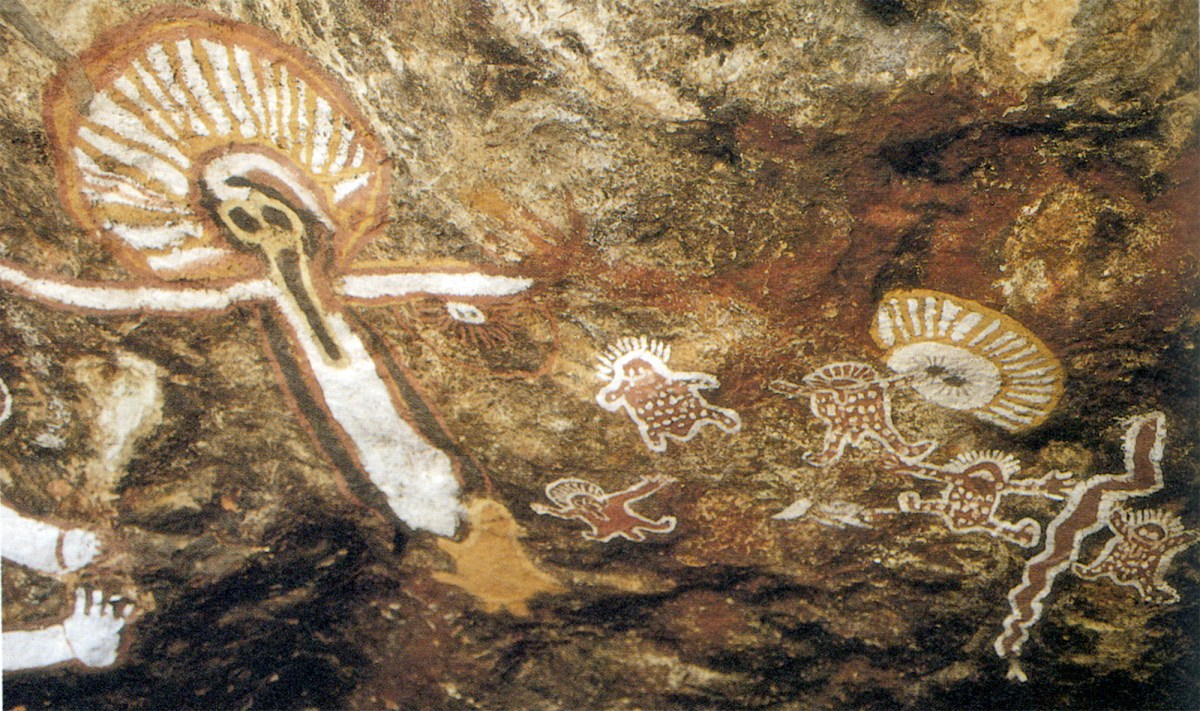
The evidence presented by Jacques Vallee and Graham Hancock makes a convincing argument for the tight relation between faerie abductions in folklore and alien abductions in the 21st century. The experiences are culturally coded to time and place, but the correlations and similarities are intriguing, and suggest a common source for the phenomena. But what is that source? Are there really faeries and aliens who are able to abduct humans at will? And if there are, where do they hang out when they’re not on abduction duty? This is where things need to get deeper… much deeper.

Alien-Cave-art-
Cave paintings from Hunan Province, China, c.10,000 BCE

Not content with suggesting that alien abductions are modern folkloric faerie-tales for our technological age, Graham Hancock puts forward the hypothesis that the shamanistic cultures of the Stone Age were also interacting with these beings. Around 50,000 years ago there was an explosion of symbolism in human culture, primarily represented by cave art. This cave art is usually located in hard to access underground spaces that must have had significant meaning for the artists and those who would have been experiencing these strange images by torchlight. And strange they are. Much of the cave art represents therianthropic beings, that is half human, half animal shape-shifters. There are also many beings that seem to be distorted humans, sometimes even suggesting the ‘Greys’ of alien abduction reports. And this gets to the core of the subject. Hancock makes the convincing argument that these cave paintings were produced to represent reality as perceived in an altered state of consciousness. Twenty years ago this idea was anathema to anthropologists, but since the work of the anthropologists David Lewis-Williams, Thomas Dowson and many others, the theory has tipped over to become an accepted orthodoxy. There are motifs by the hundred in the cave paintings that correlate with the visionary states of people in an altered state of consciousness, brought about most especially by the ingestion of a psychotropic substance. Lewis-Williams’ exhaustive study of this phenomenon is nicely summarised here: Art, Shamanism and Entoptic Images. The basic premise is that the shamans of these stone age cultures transported themselves into altered states of consciousness and then painted the results of their experiences — experiences that frequently included therianthropic beings.

IMG0027_600
Cave painting showing entoptic imagery from Pech Merle cave, France, c.25,000 BCE

hqdefault
Rock shelter art from Nawarla Gabarnmung, Australia, c.30,000 BCE

These works of art are manifest throughout the world over a vast prehistoric time period and demonstrate a universality of experience, from the entoptic images (dots, spirals and geometric patterns) frequently seen by trippers, through to the imagery of time-lapse perception, often called tracers. It is convincing evidence that our prehistoric ancestors were dabbling with psychotropic plants and mushrooms in order to gain a state of consciousness that was fundamentally important to them. The cave paintings could be seen as the earliest folklore, told in pictures. Further investigation into the cultures of modern indigenous tribes confirms the importance of induced changes in conscious perception, to what are still shamanistic peoples. The best example is the extensive use of the substance Ayahausca by Amazonian tribes. Here is a brew that might make you projectile vomit and clean out your bowels, but which also reveals a reality that includes many non-human intelligences (usually called simply ‘spirits’ by the shamans), that can be interacted with directly. There is usually a highly-charged feminine element to the Ayahausca experience, but reports will also consistently describe therianthropic beings, reptiles, the ability to fly and yes, even grey humanoids with big black almond eyes.

This brings us back to the source of all these experiences. If shaman spirits, faeries and aliens are all part of the same phenomenon, what is that phenomenon? The evidence from modern and archaic shamanistic cultures confirms that an altered state of consciousness was/is required to access the places where the ‘spirits’ lived. It’s more difficult to prove that faerie-tales were generated from information gathered in an altered state, but there is a predominance of mushroom imagery historically associated with the faeries, most especially the highly psychedelic red and white Amanita Muscaria (fly agaric) mushroom, and the psilocybin mushroom, both prevalent in Europe and Asia. These may have been responsible for purposeful or accidental psychedelic trips, but there are a range of other triggers for altering states of consciousness (such as sleep deprivation, trauma, illness etc.) that may also have contributed to people travelling to faerieland and bringing back the experiences as faerie-tales.

Fairies_dancing_in_a_ring_woodcut
17th-century woodcut showing faeries dancing outside their dwelling to the tune of the fly agaric mushroom

As discussed in a previous post The Deeper Meaning of Faerie-tales, most faerie-tales contain dream-like situations, where the laws of physics are suspended and the experienced reality is different than the usual five-sense reality. It’s no accident that the tales are often described as trippy. They can be seen as  basically describing events from a participatory altered state of consciousness, that have then gestated and formed into oral faerie-tales until fossilized into literature by folklorists at various times in the 19th and 20th centuries. So what about alien abductions? They represent an outrageous transformation of reality, but what is causing them?

The answer may lie with a substance called N,N-Dimethyltryptamine – DMT. This molecule is one of the main active ingredients in the Amazonian Ayahausca brew, but it is also produced endogenously in everyone’s brain, probably (but not definitely) in the pineal gland. It’s usually safely dispersed around the brain and body for functional duties, but it seems that under certain circumstances, it can be released in higher quantities, causing an altered state of consciousness. There is some evidence that this can happen during a frontal lobe epileptic seizure. So are abductees thrown into their experiences through a flood of DMT in their brain, which takes them into an altered state of consciousness, where reside alien beings, not altogether unlike the faeries and shaman ‘spirits’? The late and great Terence McKenna was an enthusiastic user of the synthesized form of DMT to access different realities, and coined the term self-transforming machine elves for the creatures he regularly found there. He can be heard talking about them here: Terence McKenna and the self-transforming machine elves.

As if to confirm Terence’s assertions, a research study conducted between 1990 and 1995 in the General Clinical Research Center of the University of New Mexico Hospital, by Dr Rick Strassman found that volunteers on the study injected with varying amounts of DMT underwent profound alterations of consciousness. This involved immediate cessation of normal consciousness and transportation to a different realm of reality inhabited by a range of creatures described as elves, faeries, lizards, reptiles, insects, aliens, clowns (yes, clowns) and various therianthropic entities. One woman even describes a pulsating entity that she described as ‘Tinkerbell-like’. The experiences, especially at higher doses, represented to the participants a parallel reality that was ‘super real’, not an hallucination, not a dream, but a substantial built reality with full sensory interaction + telepathy. Strassman published the results as DMT: The Spirit Molecule, which has been made into a documentary here: DMT – The Spirit Molecule.

BC_dmt_spirit_molecule_0

The experience reports from the study are irrational, absurd, frightening, illogical and surreal… much like alien abductions and (sometimes) faerie-tales. It’s worth reading the book or watching the documentary to get the full range of what are incredible records of accessing very different realities. Unlike the alien abductions, there is no question of any of the volunteers physically leaving the hospital bed during their experiences, but for all of them (without exception) the DMT-world was every bit as real as the one their minds left behind. After the injections participants frequently talked about ‘blasting through’ or ‘breaking through a barrier’ after which they found themselves in a realm with its own laws of physical space and movement, and its own inhabitants. Here is an abbreviated version of one of the volunteer’s description of his experience; 50 year old Jeremiah. After hurtling through a void he found himself:

… in a nursery. A high-tech nursery with a single Gumby, three feet tall, attending me. I felt like an infant. Not a human infant, but an infant relative to the intelligence represented by the Gumby. It was aware of me but not particularly concerned… Then I heard two or three male voices talking. I heard one of them say “he’s arrived.” … I was in a big room… there was one big machine in the center, with round conduits, almost writhing – not like a snake, more in a technical manner. The machine felt as if it were rewiring me, reprogramming me… This is real. It’s totally unexpected, quite constant and objective… an independent, constant reality… I’m lucid and sober.

This brings us finally to the crux of the matter. If there is a common source for these experiences of shaman ‘spirits’, faeries, aliens and the creatures in DMT-world, that can be accessed via an altered state of consciousness, are the experiences real? The crux is; what is consciousness? A reductionist materialist would tell us that consciousness is an epiphenomenon of the brain, and so whilst they might accept that all these experiences happened subjectively, due to an altered state of consciousness, they can all simply be reduced to the brain making it up. Brain chemistry changes, experience is imagined in the brain, stories are told about that imagined experience. Simples. But to dismiss the subjective experience is to dismiss consciousness itself. There is a reason reductionist materialists call consciousness the hard problem – it’s because consciousness is all we have and nobody has ever captured it. It exists purely as a subjective experience in a closed system. As the old metaphor goes; looking for consciousness inside the brain is like looking for the radio announcer inside the radio. S/he isn’t there, s/he is an electro-magnetic projection being tuned into by the receiver.

Aldous Huxley called the brain a ‘reducing valve for Mind at large’. We are transceiving consciousness not producing it. This corresponds with the philosophy of Idealism, beautifully articulated in recent times by Bernardo Kastrup, and just about every Oriental spiritual movement for the last several thousand years. Put shamanism and Gnosticism into the mix and we find a cohesive hypothesis for consciousness creating reality, not the other way round. But what trumps everything is direct, personal experience. This is the only true route to understanding existence – what Zen masters call direct pointing at reality. And that’s exactly what is happening in shaman journeys to the spiritworld, faerie-tales, alien abductions and DMT trips. They are experiences, accessed through altered states of consciousness, that are direct participations in Huxley’s Mind at large, a reality that exists to the consciousness of the observer but which is at the same time greater than the observer. But only by experiencing these realities through direct encounter can they be understood to be real. Nobody can tell you about them, you have to know them. Perhaps, for our benefit as a species, we need to take more notice of the stories that are brought back.

Graham Hancock summarises many of the ideas expressed here at: Graham Hancock – ancients and altered states of consciousness. Well worth a watch.

Ongoing consciousness research by Rick Strassman can be found at Cottonwood Research Foundation.

Alien-cave-painting-2
Aboriginal cave painting from Kimberley, Australia, c.5000 BCE

The cover image is Pablo Amaringo, ‘Ayahuasca Vision’