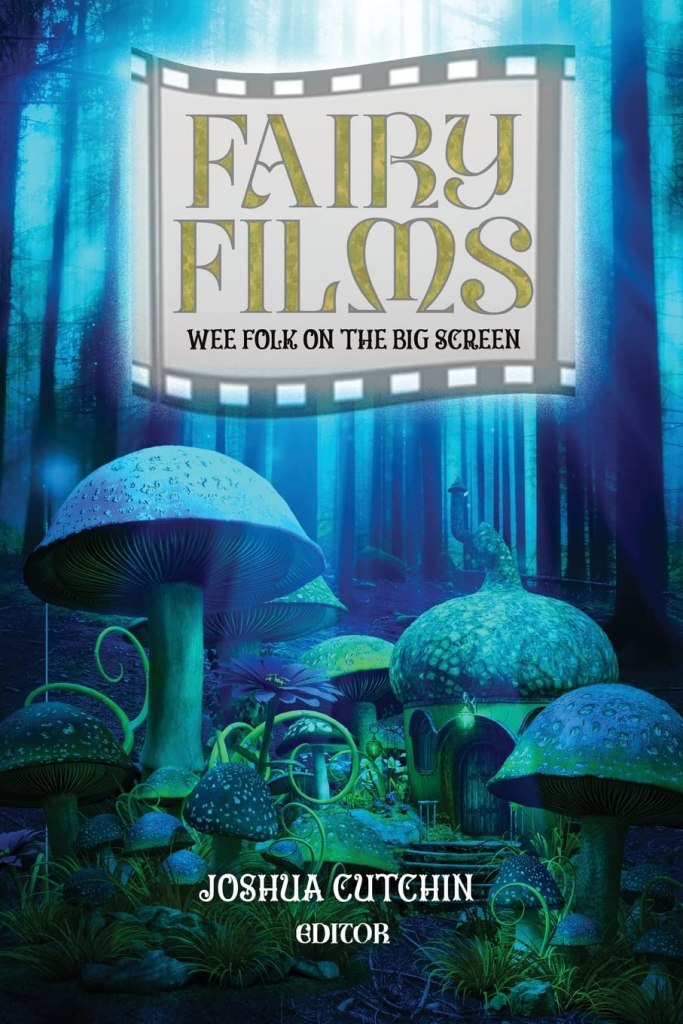
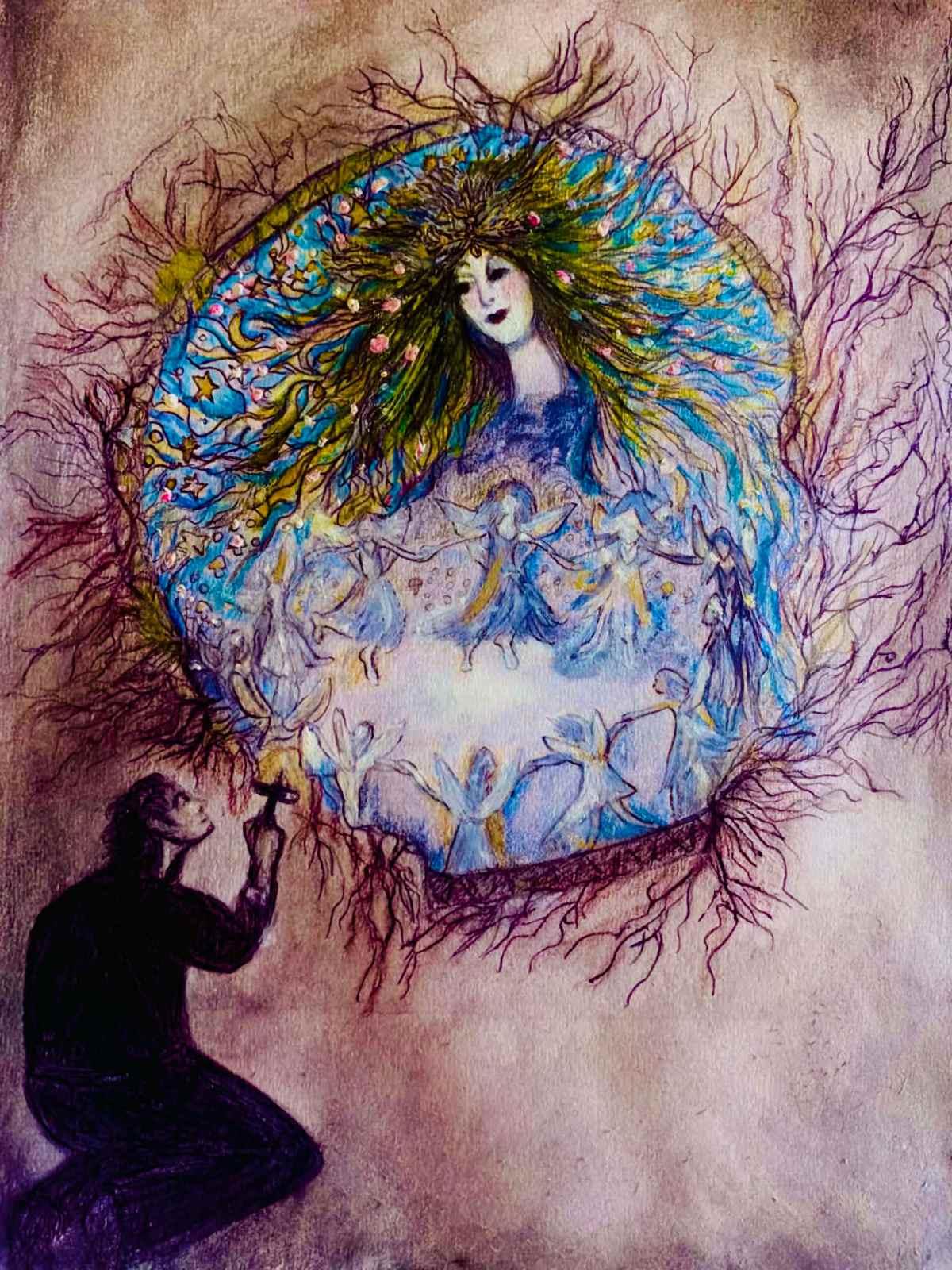
The Faerie Mural

I’m sorry that you died and that I did not,
You have your yesterdays, but only I have tomorrows.
And you will never know what I found,
In the house where love drew us down.
Old stone walls and frigid flagstone floors,
The rugs you laid, they’re all still here,
As is a part of you, the part of you that lives
In the haze of memory; the ghost of you in me.
So, shall I tell you what I found,
Beneath the deadening grey plaster walls?
We never coloured them, only endured them,
But there was always a secret there,
A secret you will never know of where you are,
So let me whisper it to you now across the breach.
The rupture can only be bridged in dreams;
Dreams where you still abide it seems.

You always loved the blossom on the cherry tree,
Herald of Spring, courier of new life.
But this year it blossomed without your touch;
Do you remember your hands upon the bark,
Summoning what lived within, with your cornflower eyes?
Its flowering now seems dulled, morose,
As if it grieves its human confidant, and what you sensed within
Has withdrawn, shuns the light, and resides alone.
But one singular April dawn, I sat beneath it,
Unstaunched tears hazing my view; despondent, lost.
When — as the mourning sun touched its boughs —
What lives in its confines spoke to me,
A voice that sounded like yours; lineaments of you,
But tempered and formed by something new.
This is what it told me, void of emotion,
Beyond and transcendent, the words unbroken.

‘Go dream tonight, go dream of her,
Dream hard and fast to the echoless shore,
Where, all knowing in the seventh heaven,
She will hear your tears and see your words.
And when you return from that formless realm,
That place where you are clothed in your real self,
Come once more to us at dawn of day,
And take the clue that comes your way.’
I went that night and dreamt as instructed,
A serene reverie where you and I were one,
And held each other under a cherry tree
That was and was not the one of reality,
Formed almost into a dulcimer melody,
Where sound, sight and touch were of a piece.
Next day I rose with the sun and went
To find the promised clue that was to be sent.

I touched the bark, but now there was no voice,
Just a listless lull; a mitigated silence of choice.
Cast down I sank to the roots, which overground resided,
Whereupon my hand grazed a nestled stone,
Cold to touch, but flat and chalky, I took it in my palm,
And found it was a piece of plaster, deadened grey.
At once I knew that fragment was from our wall,
And first thought in my mind was that you had heard the call,
That you had escaped the dream and put it there,
A sign for me to act upon, deposited with care.
Heart flickering, head swimming, I took myself into the house
To scan the walls, to find and choose the hollow
Amidst the pallid extent, that matched my fragment,
A puzzle piece awaiting your empyrean attachment.
And there it was, before unseen, a fracture in the hall;
Sure what I was to do, I found a cross-blade and rent the wall.

Dead grey gave way to living blue; an azure luminance,
On a hidden plaster, till now obscured from view.
And then amidst the cobalt mural some figures did appear;
A ring of dancing faeries, vibrant, animated, and clear,
As they circled round, swaying and swirling with abandon,
As if their liberation into light, made them live before my eyes.
I continued my work apace, and as the plaster crumbled away,
Light from without met light from within, where blue held sway,
And thus, inch by inch, She showed herself and was revealed;
The Faerie Queen, surveying all, with oceanic eyes.
With hair like wind captured in the branches of trees,
And on her peerless head a diadem of golden leaves,
She smiled elusive, and seemed to look inside my mind;
Penetrating all that love and death had wrought.
And she was you, and you were her, amidst a golden numinous glow;
Then voices from the deep abyss revealed a marvel and a secret. Be it so.

***

Victoria Darcy worked with me to produce the wonderful cover image for the poem.

***

Dead but Dreaming the novel is available now…
‘Fairy Encounters of the Third Kind’ by Dr Simon Young

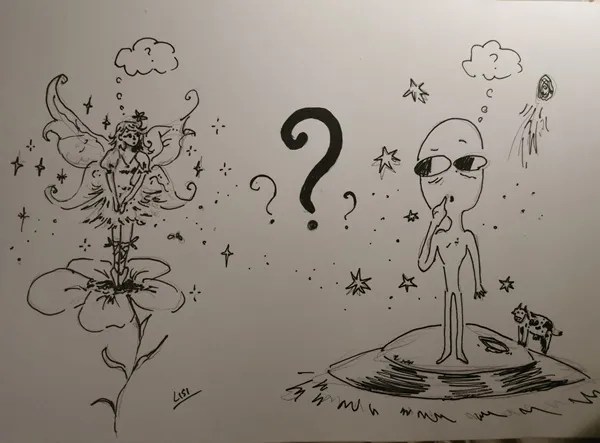
This is a recent post by Dr Simon Young on his excellent Simon’s British Mythology Substack. He is currently compiling the posts on this site in to a book project, which will be something to look out for. ‘Fairy Encounters of the Third Kind’, is a concise assessment of the connection between faeries and aliens, which attempts to introduce a three-point system of faerie encounters based on that traditionally used in UFOlogy. Thanks to Simon for allowing the piece to be republished on deadbutdreaming.

*

I have spent a good deal of time in the last decade, trying to understand mutating human-fairy relations in our historical sources. It is, after all, extraordinary how fairies have changed in human eyes. In Anglo-Saxon England they were lithe daemones of human dimensions who were likely to kill you: in modern times, they are SWFs (small winged fairies) that hover over rosebushes like butterflies.

How can we best measure that change? It would be comical to try and be empirical with the supernatural: ‘Chase myths like moths, and fight them with a pin.’ But, if you promise not to laugh, reader, I have a confession. For a number of years I have tinkered with a fairy scale, that ranges from 1-3.1 This is a shameless borrowing from UFOlogy. J. Allen Hynek laid out his famous three point system in The UFO Experience: A Scientific Inquiry in 1972.2 Those interested in UFO-lore will remember:

First kind (CE1): close visual sighting of a ‘craft’.
Second kind (CE2): physical effects or traces. For instance, the car’s engine cuts out when the ‘craft’ passes over; there are burn marks on the ground where the ‘craft’ landed.
Third kind (CE3): an actual entity is present. The ‘craft’ drops into my garden and then the little folk start to stream out and I see them/talk to them etc.

Hynek’s system broke down because in the mid late 1970s the energy in UFO experiences shifted to CE3. From then on any classification really needed to look at different forms of interaction with ‘entities’. And this brings us to fairies…

Close Encounters in Fairy Lore

For fairies we require a division based on the level of interaction:

FCE1: There is a sensorial encounter. People see, hear or (in one memorable case from Yorkshire) smell fairies, but there is no interaction.
FCE2: There is light interaction between fairies and humans with no long-lasting effects: fairies, for example, plait your horse’s mane; or perhaps they pixy-lead you in the marshes.
FCE3: There is strong interaction, with serious consequences. This might include marrying a fairy (and/or having kids); using a fairy as a familiar to get magic powers; or fairies killing or changing human neighbours who annoyed or intrigued them.

In the nineteenth century there was a strong regional basis to these three. Let’s limit ourselves to what was then the United Kingdom. In areas with weak fairy traditions, for example, south-eastern England, only FCE1 experiences were reported; and there were not many of them. In areas with intermediate fairy traditions, like, say, Devon in the 1800s, FCE1 and FCE2 featured. Then, in areas with strong fairy traditions all three levels appeared. In County Cork or County Galway or, perhaps best of all, County Tipperary in Ireland nineteenth-century men and women were stolen by the fairies, killed by the fairies, and family members were changed by the fairies.

Today’s Close Encounters of the Fairy Kind

And today? The intensity of encounters has generally gone off the boil. Fairy Census 1 and Fairy Census 2, collections of modern fairy experiences, are overwhelmingly centred on FCE 1 and FCE 2 experiences. But there are some people who claim to have or to have had FCE3-style relationships with fairies, including sexual relationships.3 These speak, I think, more to the psychological proclivities or gifts of these people rather than local traditions. There are, as is the case with UFO-lore, no local traditions to speak of in contemporary fairylore: and only weak national traditions.

Here we return to daemones vs SWFs. Perhaps we need to acknowledge that these modern experiences are not meaningfully ‘fairies’. At least they are not fairies in the way that these were understood in British or Irish rural communities two hundred years ago. Are modern fairy sightings significant events for those who see them? Yes, they often change lives. Are they worth studying? Yes, they are absolutely fascinating. Do they have anything to do with the social, virile and often scary fairies of, say, nineteenth-century Tipperary? Not much. In fact, and this bit you have to say really quietly, aliens are, by that definition, far closer to traditional fairies than the butterfly SWFs glimpsed in the gloaming.

Notes

  1. Chicago: Henry Regnery Company.
  2. I wrote about this in my column in Fortean Times in 2016. I then went further in a chapter on Canadian fairies: Simon Young, ‘Atlantic Canada: Fairy Bread and Fairy Squalls’, Magical Folk: British and Irish Fairies at Home and Overseas, Simon Young and Dr. Ceri Houlbrook (London: Gibson Square, 2017), 210-222 at 220-222. No one cared…
  3. E.g. §594, §677, §771, §783 in the Fairy Census.

Simon runs a monthly supernatural-themed podcast, Boggart and Banshee, with Chris Woodyard: the first episode of 2026 has just gone out and may be of interest.

***

Dead but Dreaming the novel is available now…
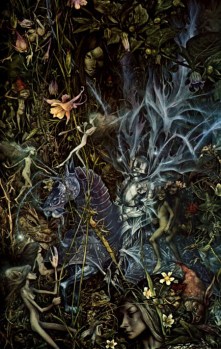
    Lineaments

    She was like me in lineaments — her eyes
    Her hair, her features, all, to the very tone
    Even of her voice, they said were like to mine;
    But soften’d all, and temper’d into beauty;
    She had the same lone thoughts and wanderings,
    The quest of hidden knowledge, and a mind
    To comprehend the universe: nor these
    Alone, but with them gentler powers than mine,
    Pity, and smiles, and tears — which I had not;
    And tenderness — but that I had for her;
    Humility — and that I never had.
    Her faults were mine — her virtues were her own —
    I loved her, and destroy’d her!

    Lord Byron, Manfred, Act II, Scene II.

    ***

    It is the hardest thing to watch your child die. The doctor had instructed me to ensure that in her final days she was able to look out upon God’s bounty (the doctor, despite the usual leanings of his profession, was first and foremost a Baptist), and so I had set up a bed in the upstairs study with the large sash window, where Medora could look out across fields and hills to the distant canopy of the orchard. The orchard. I wish I had never known of its existence; or that it had always remained as nothing but a distant, detached arboreal view. I would always sit with my back to the window when abiding with Medora. I could not bear the sight of it — its loathsome September opulence infecting the air, and coaxing disaster from my memory. 

    In the final days Medora began coughing up more blood. I did not want to wash the handkerchiefs — they were to be saved so that I would have a part of her when she was gone. Instead, I ripped up some of my linen shirts for the purpose. Each tear felt like the cleaving of a life-force; existence coming apart at the seams. But for her I always smiled and hid my tears. And mostly she slept, sedated by the doctor’s potions, which allowed me to leave her for periods and cry my tears and rue what I had done; the destruction I had brought upon her, and upon another.

    One gloom-filled dusk, close to the end, I returned from the well, brought a pitcher to her bedside, and found her more lucid than she had been for days. She even had the equanimity to hide one of the bloodied linen cloths beneath the pillows. I sat with her and listened to her babble for a while, stroking her hair and attempting to be present. After a lull she settled down, eased herself back in to the pillow and brought her blue-eyed gaze to mine.

    ‘Tell me about mama,’ she said, her voice suddenly older, manoeuvring the air between us.

    ‘Mama?’

    ‘You never talk of her. Why was she called Astarte?’

    ‘This might not be the time my sweet,’ I said, trying to suppress the shake in my voice.

    ‘Please papa… pleeease.’

    I kissed her forehead and pulled the blanket up to her chin. Soon her eyelids flickered close and her breathing began to sink in to the rhythm of sleep. 

    ‘Please papa,’ she murmured, as her head lolled.

    I got up gently, lit a candle, placed it in the holder and put it on the table next to the bed. The room transformed from dusk grey to softened arylide yellow. I sat back on the bed and assured myself she was asleep. Why should she not know? The words would live only in her dream world, but I needed to tell myself what had happened, what I had done, and what had been wrought. I had occulted it, but now it needed to be revealed. Be it so.

    *

    I found the orchard one midsummer day as the Earth turned and became a darker green. And yet I always remember the arboreal presence as cornflower blue — a cyan haze in the sweetened air transformed the grove in to a sacred space, its colour marking it out as separate from its surroundings. It was strange that I had not discovered the orchard before. I thought I knew the land hereabouts; its folds and combes were the setting of my youth, and it should have been visible from the much-travelled track to my house. From there, it could be discerned, but only as a distant tenebrous blur, partly obscured by treeless hills. Perhaps an enchantment kept me from its confines until the fatal days came, or maybe it was never really there, at least not as it should have been.

    I always felt the presence of something in the orchard; some mind, or minds, inhabiting the trees and watching me. It attracted and repelled me in equal measures, but I never saw anything apart from fleeting movements amidst the gnarled branches and shadows slithering up and down the twisted trunks. The summer heat usually made me feel the pull of sleep as I sat beneath the cover of the largest tree in the orchard, but I never succumbed to it completely, and would manage to haul myself from slumber for fear of being left vulnerable. Vulnerable to what I knew not, but the undisclosed existence in that space became more tangible and minacious when drowsiness brought on its unreal vistas and sounds, so I always managed to remain awake and aware within its bounds.

    And then, one day, she found me there. The lineaments of our blood drew her to me I suppose. I watched her glide through the grass, hitching up her long chiffon dress and being sure to touch each tree she passed. She never wore a bonnet, and this day her hair had been let down, so that it shimmered gold in the dappled sunlight. I made a token effort to conceal myself in the longer grass under my tree, but I wanted her to find me, and she did. She sat down beside me as if in a huff, just as she had always done, and began to talk away as if both of us being in that strange and formerly unknown refuge was the most natural thing in the world. But it was not natural — there had been a passing of something, and we were changed by the place. It had cast its spell.

    As the days passed we became closer. We began to talk about things we had never talked about before. Like me, she had the quest of hidden knowledge, and in that place we speculated on universal unknowns and ghosts of ages past. My lone thoughts became spoken words for the first time; her ruminations found a willing host, where none had previously been. I spoke of lights in the sky and angels, she told of the fair folk hidden in mysterious otherworlds. Our secret chatter made its mark there — the orchard heard us and soaked up our confidences in to its occult memory. And closer still we became. But she recognised the limits more than I. Her love was different than mine. Her tenderness was refined by our blood, mine was explicit. 

    One day she did not come, and I became irritable and despondent at her absence under the tree. My thoughts seemed purposeless and they drifted, without her to unlock their code. It was the hottest day of summer and I began to succumb to a sultry daze. The undisclosed presence of the orchard bristled over me, but I could not stave it off with wakefulness, and within minutes I slept, allowing my subdued mind to be opened up to the company of another. 

    *

    I had a dream, which was not all a dream. The tree became animate, not of its own accord but from that which lived within it. Skulking from out of the bark, whilst retaining its gnarly aspect, came a creature who lured me in to a slithering embrace, filling my mind with his memories and scenting the air with the moss of years. His was an existence dictated by the seasons and his responsibility for fertility, and midsummer was his enchanted time. This allowed him to offer me what I wanted more than anything. I wanted her, despite the proscription. He held on to me in his lascivious way and took me somewhere with stars in the sky and bathed in the smell of fermentation. I was made promises, but the result of those promises would have a price to pay. He instilled in me a sense of dread but the transaction was made. I accepted it thinking the pact might mean a quietus for me, but for her I was willing to take the Apple-Tree Man’s nebulous offer. Then a change came over the spirit of my dream, and voices from the deep abyss revealed a marvel and a secret — be it so.

    *

    The secret end of the dream was only dimly remembered, but the contract with my strange being was instilled within me and I was fated to use it to parlay what was implicate into something real. Despite the lingering disquiet about my reverie I knew it was in some way a true vision, and the dread of the vanished shadow became dispelled in the face of me gaining her… gaining her completely.

    The next day she came again. I held her and she shied away. But then she saw the single apple hanging at head height from the tree. Absinthe green it was — unnatural in both its midsummer ripeness and its colour, but alluring beyond measure. We glanced at each other, I plucked it from the tree, and we both ate it in turns. Then a summer storm glistened over the orchard and we fell together, and remained together in our recondite love.

    *

    ‘She died when you came in to the world my sweet,’ I whispered. But Medora was gone — her mind resided elsewhere. However, for a few glimmering moments her essence accompanied my trembling body to the window, where we stared out towards the orchard in the last remnants of twilight. The bare landscape stretched away. The orchard was gone, and so were they. I had loved them and destroyed them.

    ***

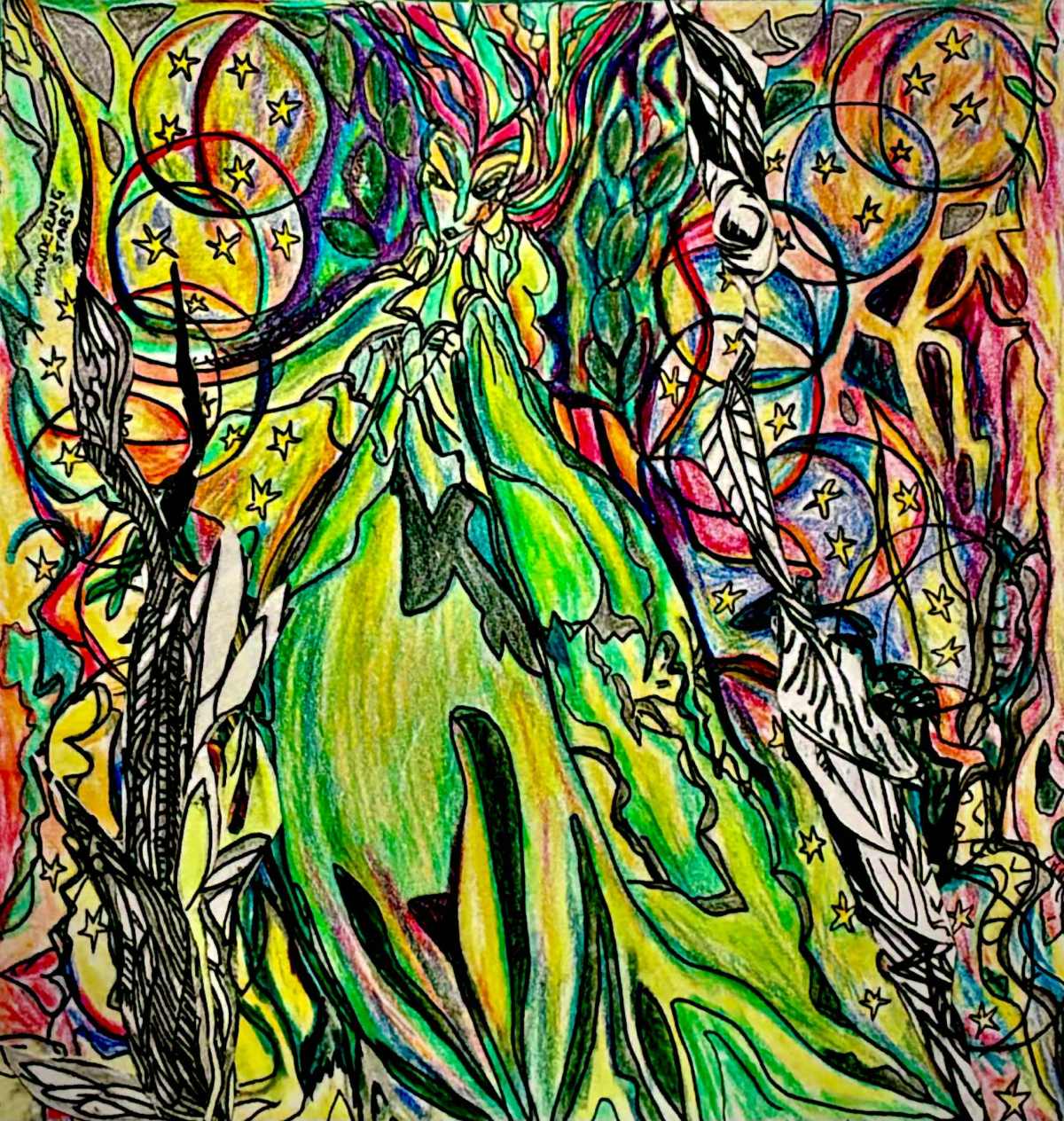
    The cover image is ‘Wandering Stars’ by Victoria Darcy.

    *

    Dead but Dreaming the novel is available now…
    ***

    Arboreal

    My new short story about a tree, the nature spirits who inhabit it and death.

    Arboreal

    Before I died I spent most of my days with the oak tree. It was in a park by a river, which I could walk to most days when my illness allowed. Obviously, the seasons modulated the experience. In winter I huddled at the trunk until freezing rain drove me away, in spring I still huddled but warmed myself at the sight of crocuses and bluebells emerging beneath the boughs and leafing branches, in summer I luxuriated in the dappled heat while pretending to read a book, and in autumn… in autumn my mind always turned towards death amidst the mouldering leaves.

    After a couple of years I’d got to know the tree. It was old and seemed to tell me things I couldn’t know. It whispered them through its bark, infiltrating me as I sat with my back to the trunk. I began to talk to it and to see the shapes of its being in the gnarled trunk — faces and bodies; humanoid in quality, but arboreal in nature. Pareidolia I supposed, but they changed with the shifting light and sometimes when I stood up too quickly they would morph before my eyes until the head-rush subsided. It was a kind tree, of that I was sure. It stood removed from its compatriots and its apparent loneliness touched me. I was lonely, and ill, whereas its solitary disposition seemed to give it strength and vitality. I would always sense it attempting to pass this on to me, and when I left after spending time with it I would be stronger and less afraid of what was coming. I began to love the oak tree, as I had never loved anyone or anything before. I told it so, and it returned the love in a deep patterned resonance that I have only truly understood since my passing.

    One warm late-August day, I put on a summer dress and took my walk to the park. Some boys on bikes stopped to mock me — my heavy limp and awkward gait were always exaggerated when I wore a dress — and I reached the park agitated and shaking. My tree comforted me but I was disorientated and teary. I asked the tree to help me, to take me away from all brutality and wretchedness, to show me something meaningful and beautiful. It answered with a lulling as the heat of the day melded me to the trunk and sleep came quickly and decisively, and a dream turned the past into the present. 

    I am facing the oak, hands aloft as if in a prayer to a god. And the oak is alive with a thousand beings pulsating through its trunk, running up and down it like a stream of vitality. They speak to me somehow, though the words are more like a breath in the wind:

    ‘We are here. You are in a dream that is not all a dream.’

    I move to the trunk and hug it. They swarm over me and and change my ideas; they go through and through me, like wine through water, and alter the colour of my mind.

    ‘Who are you?’

    ‘We are this tree. We are its life. We care for it and it cares for us. We have watched you and waited. Now you are with us. You are important to us. We have come to love you. We feed from your own love. Others do not love us as you do. We will suffer when you leave us. But this is as it should be. We must suffer to free our pain.’

    ‘How? Why?’

    But there is no answer. I feel myself meld into the trunk and hold my arms out to mimic the branches of the tree, as lifeforms immeasurably different to me probe my memories and bring them to the fore. The pain, regret, joy, grief, dullness, hope, betrayal, realisation… all manifested in a singular moment. I am overwhelmed and fall to the ground. One of the beings comes to me and sidles up. His mossy hand touches my face and wipes away the tears. And voices from the deep abyss reveal a marvel and a secret. Be it so.

    I awoke and the present became the past. I walked home and ruminated for days on the dream. My tree was alive, in ways I had never imagined, and had spoken to me via its intermediaries through my dream consciousness. The arboreals had tried to talk to me but I was not able to understand the cosmic import of the message. However, I did know it was a message of death. A transcendence was imminent. I accepted this, even though at the time it scared me to the core. 

    The last time I visited the park was a grey November day, with drizzling rain marking the onset of another dismal winter. Since my dream I had often attempted to fall asleep at the tree to reproduce the numinous experience, but was always unable to do so. The arboreals were close to me though, making contact in subtle, subdued ways. They used bird song, wind, the rustle of the oak leaves and even the distant voices of humans to speak to me, and in the ever-changing contours of the gnarled bark I could see what they might be, as if they wanted to show themselves again but were unable. On that final November day I touched my face to the wet trunk and breathed in the benign mustiness. It was the tree’s smell and theirs. I began to cry. I watched the tears drop to the ground and dissolve into the ground with the rain, feeding the oak’s roots and leaving a part of me with the very essence of its being underground, where all its secrets were kept. I knew this was an ending. I took off my necklace with a small Apophyllite crystal that my mother had given me as a child and buried it in the soil at the base of the oak. Then I kissed the tree, turned and walked away, never once looking back. I still sobbed, and in an echo of stillness I heard the sobs returned to me from the tree as if in apology and in consolation.

    *

    The park-keeper had become aware of the girl a few years previous, watching from his lodge-house at the entrance to the park. She always sat with the old oak tree, in a secluded part of the park, but out of respect he had never disturbed her or talked to her once, not even to say hello. Before she came the tree was ailing, and he suspected it was near the end of its life. But after she came it rallied — the canopy freshened and its tired limbs seemed invigorated. He’d always held the oak in reverence and was delighted to witness its new spurt of life. He was a practical man, but he became sure that she had brought some magic to bear. 

    But she came no more since the previous November. He watched for her but she was gone. And from that time the tree, once again, began to fail. Its autumn leaves were riddled with fungi, the bark became cankerous and bled sap. Some boughs weakened and fell during the winter storms. When spring came it was evidently dead. Its gaunt boughs and leafless branches contrasted with the teeming greenery that had transformed the rest of the park. By summer it had been deemed a safety risk, and in November it was felled on the very day the park-keeper had last seen the girl the year before. He kept some of the wood and carved it into faerie-like characters, which he installed outside the lodge-house, to the delight of children visiting the park.

    On Christmas Eve the park-keeper walked down to the oak stump at dusk as he always had since it was felled. Glistening in the reflected light from the lodge-house lantern he found a crystal necklace on the stump. Something moved in the air beside him — a whispered breeze, a voice without words. It was a presence that was there but not there… dead but dreaming. Be it so.

    ***

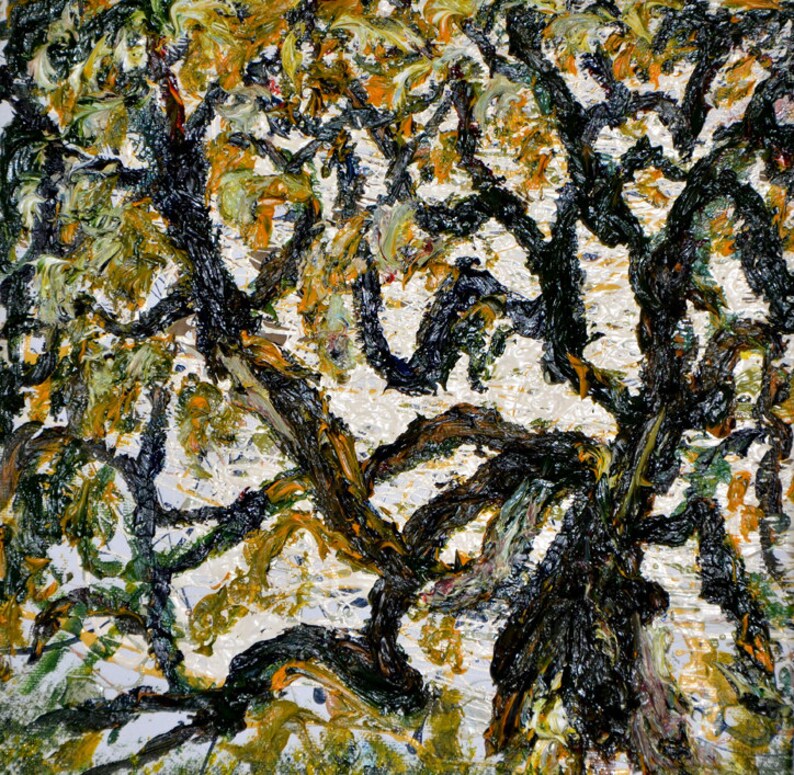
    The cover image is ‘The Mighty Oak Tree’ by noshiahmad.

    ***

    Dead but Dreaming the novel is available now…
    The Otherworldly Bride Motif in British and Norse Folklore

    British and Norse folklore often features otherworldly females, such as Selkies, mermaids, and swan-maidens, who become brides of mortal men. These shape-shifting beings usually dwell in water, embodying a connection between the natural and supernatural. Their stories typically involve a man charming or tricking the female away from her aquatic home, leading to marriage and children. Yet, a broken taboo or mistreatment forces her to return to the sea, symbolizing deeper themes of desire, loss, and the complexities of human relationships.

    A version of this article appeared originally on the Ancient Origins website.

    A common motif in British and Norse folklore is that of an otherworldly female, who is somehow captured or charmed by a mortal man to be his bride. The females are often therianthropes, that is shape-shifters, who seem to be part human and part animal, but their main attribute is always as an entity from a metaphysical otherworld, interacting with consensus reality in order to bridge the gap between the natural and the supernatural. These therianthropic females take many forms, such as Selkies (humanoids masquerading as seals), mermaids, and swan-maidens, and can also appear as magical women without any animal attributes, such as the lake faeries, but they are always found in bodies of water, a configuration that proves important in any attempt to interpret these folkloric motifs. The standard scheme of the stories is that the female is lured from her watery existence by a male, either through a ruse or by charm. They are married and will usually have children together. But at some point a taboo is broken or the female is mistreated, and she deserts her husband to return to the water, which always seems to represent the portal between the physical world and a non-material reality. As always with folklore, any deeply embedded motif such as this is designed to impart some timeless wisdom; allegorical, philosophical and psychological. The stories were always meant to be a good fireside yarn, but more importantly they were plugging into fundamental aspects of the human condition, as well as recording belief-systems that were disappearing into the past. The origins of these stories are usually medieval (although possibly even older), and sometimes appear in chronicles. But most were transmitted through an oral tradition and were not recorded in detail by folklorists until the 18th and 19th centuries.

    Selkies

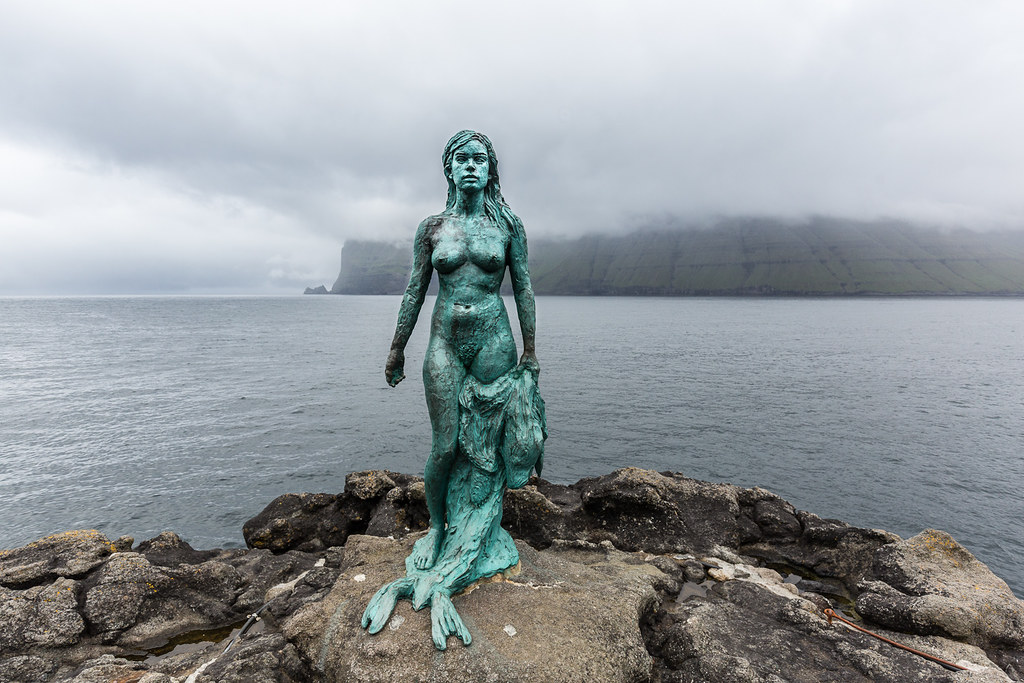
    The folklore of Selkies comes mostly from northern Scotland, especially the islands of Shetland and Orkney, as well as the Faroe Islands, although the theme is also found in Ireland, Scandinavia and Germany. The name is derived from Selch, the Scots for grey seal, a species that is commonly found around the coastlines of these northern European countries. The Selkie therianthrope can be male or female, but the majority of the folklore involves a female creature, such as the typical example from the Faroe Islands: The legend of Kópakonan (‘seal woman’).This tale tells of a fisherman (in some versions a farmer) from Mikladalur on the Faroese island of Kalsoy who, after taking the advice of an island elder, sets up a watch on the shoreline on the thirteenth day of the month to catch sight of the Selkies, who it was said could only beach on this day. Sure enough, he witnesses a group of the creatures come ashore and shed their seal-skins to reveal their female human forms. He steals one of the skins, and puts fright to the females, who all return to the sea in Selkie form. All except the one denuded of her skin. She’s distraught but agrees to follow the fisherman back to his home, where she proceeds to become his wife, and they have children together. But she pines for the sea, and one day manages to find the key to the room where her husband has kept her Selkie skin. She skins up, shape shifts and returns to the sea. As with most Selkie folklore, the story has a grim denouement, when the fisherman (despite being warned not to in a dream) kills the Selkie husband of his estranged wife as well as their two sons. Kópakonan takes revenge by cursing the people of Kalsoy: “some shall be drowned, some shall fall from cliffs and slopes, and this shall continue, until so many men have been lost that they will be able to link arms around the whole island of Kalsoy.” A statue of Kópakonan was erected in Mikladalur in 2014 (cover image), demonstrating the continuing importance of the folktale to the Faroese people.

    The entities known as mermaids (or merrows from Hiberno-English) seem to be closely related to the Selkie, and there are collections of stories from Scotland and Ireland including similar motifs contained in the Selkie tales, where the female mermaid is captured and made a wife, only to return to the sea when she is given the opportunity. However, mermaids more often than not retain their half-human half-fish form, and only a minority of the stories have them marrying mortals – they are more frequently portrayed in folktales as portents of disaster at sea, sometimes even provoking it. While there are a wide variety of mermaid folktale types from all parts of the world, their representation as  harbingers of catastrophe at sea is more in line with the Sirens from Greek mythology than with folkloric otherworldly brides.

    Swan Maidens

    Closely related to the folktales of Selkies are the widely distributed stories about swan maidens. In his 1891 book, The Science of Fairy Tales, the folklorist Edwin Sidney Hartland devoted two chapters to discussing the global tales involving this motif. He recounts a typical tale of this type (updated from its medieval genesis to include shotguns) from Raineach, Scotland, where a young farmer travels away from his claustrophobic upbringing to seek his wealth. He soon reaches an inn and:

    ‘He rose early next morning, and went to a lake in the neighbourhood to have a shot. When he was approaching the lake, he saw three white swans swimming on its calm surface. He crept towards them, and with some trouble got within proper range. But when he lifted his gun to his shoulder  and was going to take aim, they became the three most beautiful maidens he had ever seen.’

    After several more adventures stalking the swan maidens, he manages to steal the off-cast feathers of the youngest, and refuses to return them until she marries him. She agrees, and through her otherworldly magic, conjures up a castle for them to live in, constructed on an island within the lake. They live happily, and have children, but in time he grows homesick and is allowed to return home under the proviso that he does not mention his metaphysical existence or his swan maiden wife. But he breaks the taboo, brags about his otherworldly wife, and when he returns to find his magical castle home, there is nothing but the lake, without island, castle or swan maidens.

    Lake Faeries

    The folktales about lake faeries can again be found all over the globe, but there is a concentration of these types of stories in Wales, where there are over a dozen tales including many of the same motifs. Unlike the Selkies and swan maidens, the faeries are not therianthropic shape-shifters, but they are certainly otherworldly beings who are able to exist below the waters of the lakes as well as on land in the material reality of mortals. These folktales are replete with symbolism, which underlies the themes of a male human courting and marrying the (exclusively) female faerie and then losing her through the breaking of a taboo. The most detailed of these folktales is The Lady of Llyn y Fan Fach (Llyn is Welsh for lake), which though only recorded in the 19th century contains named personages that appear to date the origin of the story to the 12th century.

    In this tale a young farmer called Gwyn regularly frequents Llyn y Fan Fach, where he pastures his cattle. One day he sees a golden-haired woman, combing her locks and using the lake as a mirror. Immediately smitten, he offers her the bread he had brought with him, but it’s too hard for her taste and she disappears below the lake. The same happens again the next day, but this time the bread is too soft, and she once again submerges. The third day comes, and this time the bread is just right, and love is in the air. Gwyn knows what he wants: “Fair Lady of the Lake, I have no silver, no gold, no riches, just love. Please marry me and be my wife!” After some more passionate entreaties she warms up and decides to accept, but with conditions: 

    “Silver and gold cannot buy me. Your love is beyond price so I will marry you and live upon Earth with you until you give to me three causeless blows. The striking of the third blow will be the breaking of our marriage contract. I will leave earth and we shall be parted for ever. Do you accept?”

    Of course, he does. But first he has to deal with the faerie’s father who is ‘of wild appearance’ and magically appears with an identical twin to the lady Gwyn has fallen in love with. He tests Gwyn to choose the right faerie, which he does (discovering her name is Nelferch) and so off they go to be married with a considerable dowry of cattle, horses and other animals provided by the father, who, nevertheless reminds him once again of the ‘three blows’ condition. 

    Their marriage prospered and they had three sons, but inevitably the three blows were dealt over time, all as accidents: a playful flick on the shoulder with a glove, a tap on the arm and then a third touch when Nelferch displays joy at the funeral of a neighbour’s infant. She explains that she still sees with the eyes of the Otherworld and that her joy was that the child had transcended the pain and suffering of mortality. But with the third blow struck Nelferch returns to the lake, with her dowry, and disappears below the surface. Distraught, Gwyn follows her, drowning himself in his grief. Despite the tragedy, the three sons were able to apply their half-faerie nature to positive ends and became great healers known as ‘The Physicians of Myddfai’.

    Interpreting the Stories of Otherworldly Brides

    These folktales contain a myriad of meanings, some hidden deeper than others. They are open to multiple interpretations, of which a few are:

    The females are Pagan deities. They represent diminished ancient goddesses or spirits – Celtic deities dwelling in sacred bodies of water, and requiring some type of sacrifice as propitiation, which has become transformed over time as the interaction with mortals in the folktales. This would require the geneses of the stories to be prehistoric, passed on over millennia through an oral tradition.

    A Warning about Desiring Otherworldly things. In all the stories the protagonist desires something that should be beyond the reach of mortals. However cunning or charming he is, his mortality eventually fails him and he is either outfoxed or he breaks a taboo leading to disappointment at best, and tragedy at worst. This may even find confluence with the Jungian psychoanalytical idea of water as a symbol of the subconscious. What arises out of it represents our deep-set desires, but the subconscious is an ‘Otherworld’ and what emerges from it cannot stay in waking reality, and at some point must return ‘beneath the water’.

    The Therianthropes Represent Transcendence. The otherworldly entities exist in two forms – human females and spiritual beings, the latter represented by an animal or a faerie connected to water. Although the human versions can spend some time on Earth, living a conventional life, this is always fleeting and eventually their material presence will disappear as they transcend to an Otherworld. They are in effect metaphysical human souls that must at some point be released. This might be extended to seeing the therianthropes/faeries as a shamanic residue, where the animals or supernatural beings symbolise transcendent spirit guides connecting this world and a supernal universe. While this would involve a millennia-deep folk memory, there is much evidence from studies of the medieval and Early-Modern witch cults that a form of prehistoric shamanism continued under the radar in Christian Europe, with spirit animals, zoomorphism and faerie familiars as key components of the belief system. 

    Love and Marriage is a Faustian Pact. More prosaically (and cynically), the folktales may be suggesting that love and marriage are agreements between two people, and that the terms need to be upheld, otherwise disaster will ensue – it is a Faustian pact. The underlying tension in the stories do seem to imply the fragile nature of love; always undone by carelessness or the breaking of agreed-upon codes.

    But as is so often the case with traditional folktales we will never be able to unravel completely the deeply entrenched meanings, which have evolved through people telling them over hundreds, perhaps thousands, of years. Stories using the otherworldly bride motifs evidently contain some specific and distinct significance as they attempt to convey fundamental ideas about the human condition as well as passing on an ancestral memory of previous cultures. However, the reason they have been so persistent and successful in doing this, is because at root they are extremely entertaining folktales that are able to grip the imagination, using the most potent of all human emotions as a trope: Love.

    References

    Briggs, K. 1976. An Encyclopaedia of Fairies. Pantheon Books, New York

    Bruford, A. 1974. ‘The Grey Selkie’, Scottish Studies 18 (63–81)

    Collinson, B. 2012. Jungian Therapy and the Meaning of Dreams: Water. Available at: https://www.briancollinson.ca/index.php/2012/11/jungian-therapy-the-meaning-of-dreams-5-water.html 

    Evans, Z.T. 2017. Folklore of the Welsh Lakes: Reflecting on Faerie Brides, Drowned Towns and the Otherworld. Available at: https://folklorethursday.com/folktales/folklore-welsh-lakes-reflecting-faerie-brides-drowned-towns-otherworld/ 

    Evans, Z.T. 2017. Folklore of the Welsh Lakes: The Legend and the Legacy of the Lady of Llyn Y Fan Fach. Available at: https://folklorethursday.com/regional-folklore/folklore-welsh-lakes-legend-legacy-lady-llyn-y-fan-fach/#sthash.eaGh0p88.dpbs 

    Gilchrist, A.G. 1921. ‘Extra Note on Song No. 48, verse 7’, Journal of the Folk-Song Society. 6 (263–266)

    Hartland, E.S. 1891. The Science of Fairy Tales. Scribner and Welford, New York. Available at: http://www.sacred-texts.com/neu/celt/sft/index.htm 

    Leavy, B.F. 1994. In Search of the Swan Maiden: A Narrative on Folklore and Gender. New York University Press. Available at: https://archive.org/details/oapen-20.500.12657-89312/page/n3/mode/1up

    Rushton, N. 2025. Mermaid Imagery in British and Irish medieval Churches. Available at: https://deadbutdreaming.wordpress.com/2025/01/17/mermaid-imagery-in-british-and-irish-medieval-churches/

    Rushton, N. 2017. Faerie Familiars and Zoomorphic Witches. Available at: https://deadbutdreaming.wordpress.com/2017/04/08/faerie-familiars-zoomorphic-witches/ 

    Wilby, E. 2005. Cunning Folk and Familiar Spirits: Shamanistic Visionary Traditions in Early Modern British Witchcraft and Magic. Sussex Academic Press

    Williamson, D. 1992. Tales of the Seal People: Scottish Folk Tales. Interlink Books, New York

    Winters, R. 2016. Legends of the Selkies: Hidden Gems of Sea Mythology. Available at: https://www.ancient-origins.net/myths-legends/legends-selkies-hidden-germs-sea-mythology-006409 

    ***

    The cover image is a statue of the selkie Kópakonan in Mikladalur, Faroe.

    ***

    Dead but Dreaming the novel is available now…
    Exploring Time Distortion in Faerie Folklore

    Edwin Sidney Hartland’s exploration of time in faerie folklore highlights three primary types of time distortion. These tales illustrate a timeless realm where characters often face abduction, leading to significant time lapses upon their return. The narratives reveal deeper beliefs about consciousness, the afterlife, and mythological themes embedded within folklore.

    A version of this article was first published on the Ancient Origins website.

    In his 1891 publication The Science of Fairy Tales, the folklorist Edwin Sidney Hartland devoted three chapters to ponder over ‘The Supernatural Lapse of Time in Fairyland.’ He makes it clear that this motif is deeply embedded in worldwide folklore and mythology from a wide variety of chronological periods. He suggests that the consistency of the story elements involving the strange relative movement of time in faerie folklore, must stem from a common mythological theme, although he usually stops short of discussing this theme in favour of telling the actual stories. Within these supernatural lapse of time tales there are essentially three ways that time can behave in contradistinction to normal reality: 1. Time stops in the outside world, while in faerieland many years can pass with the human participant living a life of enjoyment or suffering with the faeries. The protagonist usually breaks a taboo of some sort and finds themselves back in the real world, where no time has passed. These stories are in the small minority. More often the time dilation moves the other way. 2. This can be quite a drastic shift, so that a character spending minutes, days or weeks in faerieland comes back to consensus reality to find decades or even centuries have passed, or, 3. that a few minutes caroling with the faeries turns out to be any length of time up to a year and a day, once they return to the world they came from.

    The Three Types of Time Distortion in Faerie Folklore

    1. Hartland points out that the folkloric faeries of Wales, usually known as the Tylwyth Teg, were particularly prone to abducting humans, usually through the ruse of tempting them into a dancing circle where they become enmeshed in a time-distorted reality. One typical 19th-century tale has a lonely shepherd doing just that on a hillside in South Wales, after which he finds himself in a glittering palace with pleasure gardens, inhabited by the faeries. He lives there for years, even taking the chance to get involved in some romantic attachments with the beguiling black-eyed female faeries. But despite being warned off the fountain, which is filled with gold and silver fish, in the middle of the main garden, he can’t resist overturning the prohibition, and one day, inevitably, he plunges his hands into the water for a drink. Immediately he finds himself back on the cold Welsh hillside with his sheep, during which no time at all seems to have passed.

    As mentioned, this sort of time relativity in folklore is the exception to the rule; it usually works the other way round as in 2 and 3 below. Such a story type might represent an adventure experienced while in an altered state of consciousness, turned into a folktale that attempts to convey this unusual state of consciousness through conventional ideas about faerieland. The altered state might represent a waking hallucinogenic state or a dream, both of which can allow seemingly long passages of subjective time to take place in seconds or minutes in the real world. But this is not the usual way time works in faerie folklore…

    2. Hartland records an 18th-century version of the ancient Irish story of Oisín as typical of the second type of time-lapse folktales, recorded throughout Europe and Asia. Oisín is a poet of the Fianna, and falls asleep under an ash tree. He awakes to find Niamh, Queen of Tír na nÓg, the land of perpetual youth, summoning him to join her in her realm as her husband. Beguiled, he follows her, and finds himself living in a paradise of perpetual summer, where all good things abound, and where time and death hold no sway. But soon he breaks a taboo of standing on a broad flat stone, from where he is able to view the Ireland he left behind. It has changed for the worse, and he begs Niamh to give him leave to return. She reluctantly agrees, but asks that he return after only one day with the mortals. She supplies him with a black horse, which he is not to dismount, and ‘gifted him with wisdom and knowledge far surpassing that of men.’ Once back in Ireland he realises that decades have passed and that he is no longer recognised or known. Inevitably, he dismounts his horse and immediately his youth is gone and he becomes an enfeebled old man with nothing but his immortal wisdom. There is no returning to the faerieland of the Tír na nÓg. In other variations of the story, the hero turns to dust as soon as his feet touch the ground of consensus reality.

    These type of folktales seem to suggest that faerieland is the world of the dead, immune from the passage of time, and that return to the world of the living is not possible as the mortal body has aged and decayed in line with the physical laws of this world. The embedded taboo in the story perhaps represents the idea that a disembodied consciousness cannot break codes in the realm of the Dead, and that if the taboo is broken, the lesson needs to be learnt that there can be no return to corporeality. In the Japanese tale of Urashima Taro, the hero, when returning home, is even given a casket by his faerie bride, in which his years are locked. When he opens it, his time is up.

    These stories articulate a belief in an otherworld that is never heaven, but is apparently ruled over by a race of immortals who can exert control over the consciousness of an individual, who may believe themselves to still be in human form, but are actually already dead and existing in non-material form. It appears to be the place where the faeries come from; a place untouched by the passage of time and physical death. It could even represent the collective consciousness of humanity made into an understandable form in the stories, immortal in nature and containing all wisdom and knowledge, as suggested in the Oisín tale.

    This might be explained by seeing folklore of this type as representing a surviving pagan belief system of the afterlife. This afterlife did not follow the strictures of Christianity or other world religions, and provided an alternative view of what happens to consciousness after death. It is a view that was (in the West) superseded by Christian theology, but that may be surfacing in these folktales as remnants of the previous system of belief (a belief system that remained partially intact but operated underground for fear of religious persecution). The presence of faeries in this otherworld, and their ability to materialise in standard reality, suggests that they were an essential element in pagan ideas about consciousness and that they had a role to play when it came to death. In this theory the characters in the story play the part of messengers, telling us about the true nature of a timeless reality that is distinct and separate from consensus reality, and showing us that human consciousness disassociates from the physical body to exist in a parallel reality such as Tir na n’Og. 

    The third type of time lapse usually has a less dramatic effect on the protagonist, as they return from an apparently short time in faerieland to a world advanced by either months, or more often by the magical time-span of a year and a day.

    3. Hartland records a number of these types of tales from Britain. One was collected in the Scottish Highlands by the folklorist JF Campbell in the 1860s, and includes many of the typical elements. The story involves two men returning home from the town of Lairg, where one of them has just registered the birth of his child in the session books. They sit down to rest at the foot of the hill of Durcha, when music and merriment is heard from within a cavern in the hill. The new father can’t resist investigating and disappears into the hill. On returning home alone, his friend is accused of murder. But a ‘wise man’ suggests he should be able to clear his name by returning to the cavern a year and a day later. He does so, and when he sees a shadow in the cave entrance he grabs it, momentarily revealing his friend dancing in a circle with the music-making faeries. He pulls him out of the circle and the faeries are gone. ‘Could you not have let me finish my reel’ the former captive says, thinking he had only just started dancing with the faeries. He won’t believe that a year and a day have passed until he returns home to find his wife with their year-old child in her arms.

    Faerie Folklore as an Encoded Belief System

    Stories of this type rarely say much about the faeries doing the abducting, only that they seemed capable of drawing the participant out of their own world and into an alternative reality with a different space-time continuum. The year and a day motif is important and is a common time-frame appearing in medieval romances as the amount of time protagonists were given to succeed in quests. In The Golden Bough, Sir James George Frazer highlights the ancient global concept of the Divine King, who was to be ritually murdered after a period of time in charge, which was often a year and a day. The time period was also used in common law to substantiate the legal situation of unwed couples, and it was (in theory) the amount of time a person living under feudal serfdom needed to be absent from his lord’s manor to gain his freedom. Interestingly, a year and a day is also used in Wiccan and other neo-pagan traditions for the time of learning required before being initiated into the first degree. This may all suggest that the folklore of this type have the year and a day motif embedded within them as a message, conveying the idea that it is a magical time-frame. It was a symbolic time-marker for life quests, ruling over others, decisions being made, learning a tradition, securing a marriage, or gaining freedom as one year tips over into another. It was evidently deeply ingrained in both esoteric tradition and everyday life from an early date, rooted in the cycles of the natural world.

    As is the case with Hartland’s tale from the Highlands, these stories usually include a ‘wise man’ who knows that a year and a day is the time needed to free the abductee from the clasps of the faeries. This sounds like the cunning man recorded in Early Modern witch trials, among other sources, a type of magical practitioner steeped in esoteric  knowledge, who operated within the constraints of Christianity, but who was evidently practising a type of pagan magic. In her 2005 book Cunning Folk and Familiar Spirits, Emma Wilby convincingly puts these people (men and women) within an ancient shamanic visionary tradition, which had as its main remit an understanding of otherworldly spirits, including the faeries. Once again, we can see the folklore embedding these motifs into the stories, below the radar of religious censorship, so as to tell people the truth gleaned from gnostic shamanic beliefs that were evidently alive and well in pre-industrial societies. The repackaged 19th-century folktales were recording these traditions in coded language, perhaps not understood properly by their listeners, but hiding knowledge of metaphysical realities in plain sight, in the form of a good story.

    The metaphysical realities these stories attempt to convey have formed a specific mythology that attempts to tell us about otherworlds beyond our own. These otherworlds may differ depending on the story but they are all, essentially, talking about transcendence beyond the physical world. And with transcendence the space-time continuum works in a different way, without the constraints of a world of matter, or with a linear time-flow. Among the inhabitants of this transcendent otherworld are the faeries, who seem to be able to make occasional appearances in our world, but whose own world is one of consciousness, whether a dream, an altered state, the collective human consciousness, or death. The message seems to be that consciousness has no real need of a dimension of time, and that once freed from the physical world, consciousness is able to transfer to an alternative non-physical universe; a universe that has sometimes been called faerieland. It is an ancient mythological concept pointing at a deeper reality, surviving in encoded form in faerie folklore.

    References

    Bentov, Itzhak, Stalking the Wild Pendulum: On the Mechanics of Consciousness (1977)

    Briggs, Katherine, An Encyclopedia of Fairies (1978)

    Frazer, James George, The Golden Bough: A Study of Magic and Religion (1922 ed.) https://sacred-texts.com/pag/frazer/

    Hancock, Graham, Supernatural: Meetings with the Ancient Teachers of Mankind (2005)

    Hartland, Edwin Sidney, The Science of Fairy Tales: An Inquiry into Fairy Mythology (1891) http://www.gutenberg.org/files/24614/24614-h/24614-h.htm 

    Rushton, Neil, ‘Going Round in Circles: The Faerie Dance’ (2016) https://deadbutdreaming.wordpress.com/2016/05/28/going-round-in-circles-the-faerie-dance/ 

    Sugg, Richard, Fairies: A Dangerous History (2018)

    Wilby, Emma, Cunning Folk and Familiar Spirits: Shamanistic Visionary Traditions in Early Modern British Witchcraft and Magic (2005)

    Woodyard, Chris, ‘Dancing with the Fairies: 1820s-1840s’  (2018) https://mrsdaffodildigresses.wordpress.com/2018/07/27/dancing-with-the-fairies/ 

    ***

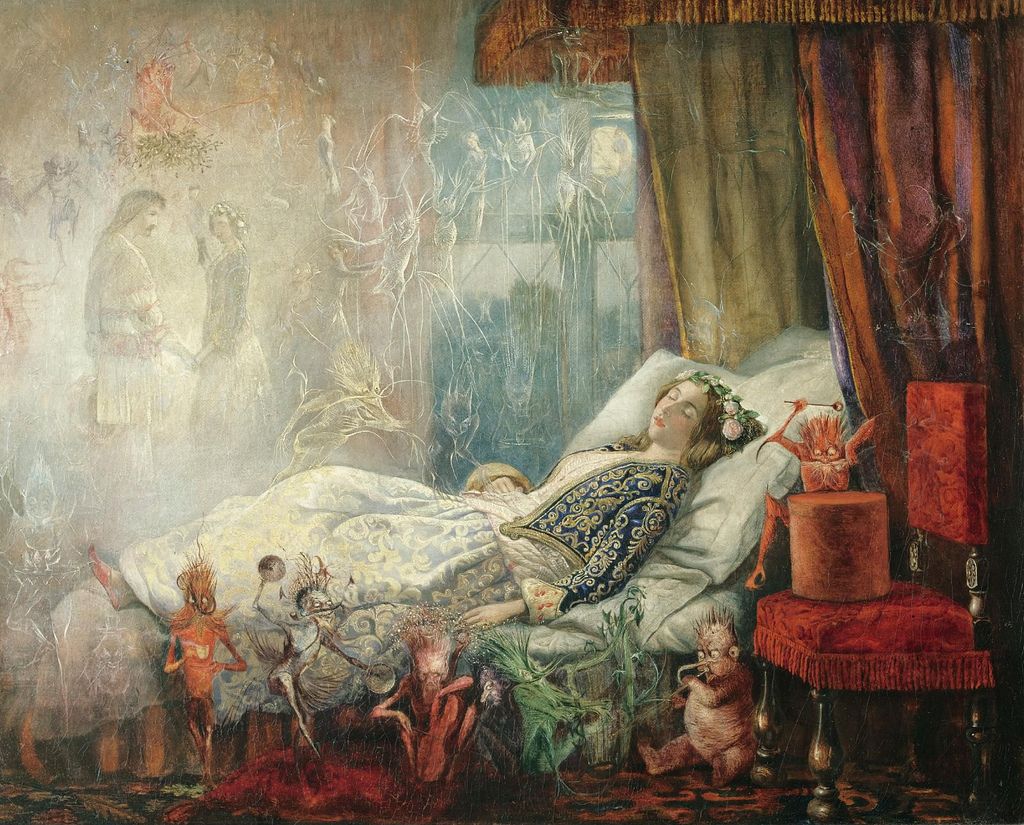
    The cover image is ‘Dreams and Time’ by John Anster Fitzgerald (1819-1906).

    ***

    Dead but Dreaming the novel is available now…
    Mermaid Imagery in British and Irish Medieval Churches

    A version of this article appeared originally in the online magazine Ancient Origins.

    There are numerous stone sculptures and wood carvings in European medieval churches that depict what may appear to be non-Christian imagery. Most discussed are those of the Green Man and the Sheela na gig, which have found various interpretations, from pagan symbols existing surreptitiously within Christian sacred spaces, to simple decorative adornments, created by masons and carpenters with the implicit approval of the Church. Unlike many of the more straightforward carved images of animals and therianthropes in churches, the Green Man and Sheela na gig portrayals are not drawn from passages in biblical texts, strengthening the hypothesis that they are derived from naturalistic pagan belief systems and folkloric ideas, which continued to operate at some level below the radar of Christian orthodoxy throughout the Middle Ages. It appears as if there were a certain ecclesiastical allowance to tolerate these coded populist images, even if they were evoking (especially in the case of the sexually explicit Sheela na gigs) a potentially heretical cosmology. But there is another popular non-Biblical image regularly found in churches of all status, especially prevalent in Britain and Ireland: mermaids. They can be found in stone reliefs, bench-ends, misericords, roof bosses, and occasionally in wallpaintings in almost a hundred medieval churches, usually prominent, sometimes hidden but most often following a similar design, which remained largely unchanged between the 11th and 15th centuries. Why would an ancient, folkloric, but non-Biblical, character such as the mermaid find its way into so many medieval churches? And can such mermaid imagery and symbology be correlated with the more overt pagan symbols of the Green Man and Sheela na gig?

    Mermaids in Mythology and Folklore

    Mermaids have been a part of the global mythological ontology for thousands of years. They make their first literary appearance in Assyria in c.1000 BCE, when the goddess Atargatis turns herself into a mermaid as a self-imposed punishment after accidentally killing her human lover. But this rendering of a mermaid creature may be based on the even earlier tradition of the Babylonian God Ea, who was portrayed as a fish with a human head. This idea of a half human, half fish creature continued to pervade mythological story cycles from this time, finding their way into Greek and Roman cosmologies and then into north-west European traditions. They were often the harbingers, and sometimes the cause, of disasters at sea, but there is also a tradition of mermaids being lured onto land to become the wives of men who have tricked them into such a relation, stories that usually end badly for the enticing male.

    By the time the concept of the mermaid reached Britain and Ireland at the end of the first millennium, it had made the subtle transition from mythology to folklore; the mermaids were no longer deities to be revered but were supernatural aspects of the material world, to be feared and propitiated in equal measure. Most British and Irish folklore about mermaids (usually termed merrows) included motifs that included both warnings to seafarers and cautionary tales about desiring metaphysical beings. In the Faroe Isles the mermaid morphed into a creature known as the kelpie, half seal, half human, who could be captured by any amorous male when she beached and shed her seal skin. The most famous story is of Kópakonan (‘seal woman’) who was lured onto land to marry a fisherman, only for him to abuse her and her kelpie family, resulting in disaster for the inhabitants of Faroe. This theme of mermaids (and their analogues) as creatures of retribution became a mainstay of folklore – they were desirable and supernally beautiful, but they were also dangerous, and contact with them led (almost invariably) to calamity. 

    Examples of Mermaids in Medieval Churches

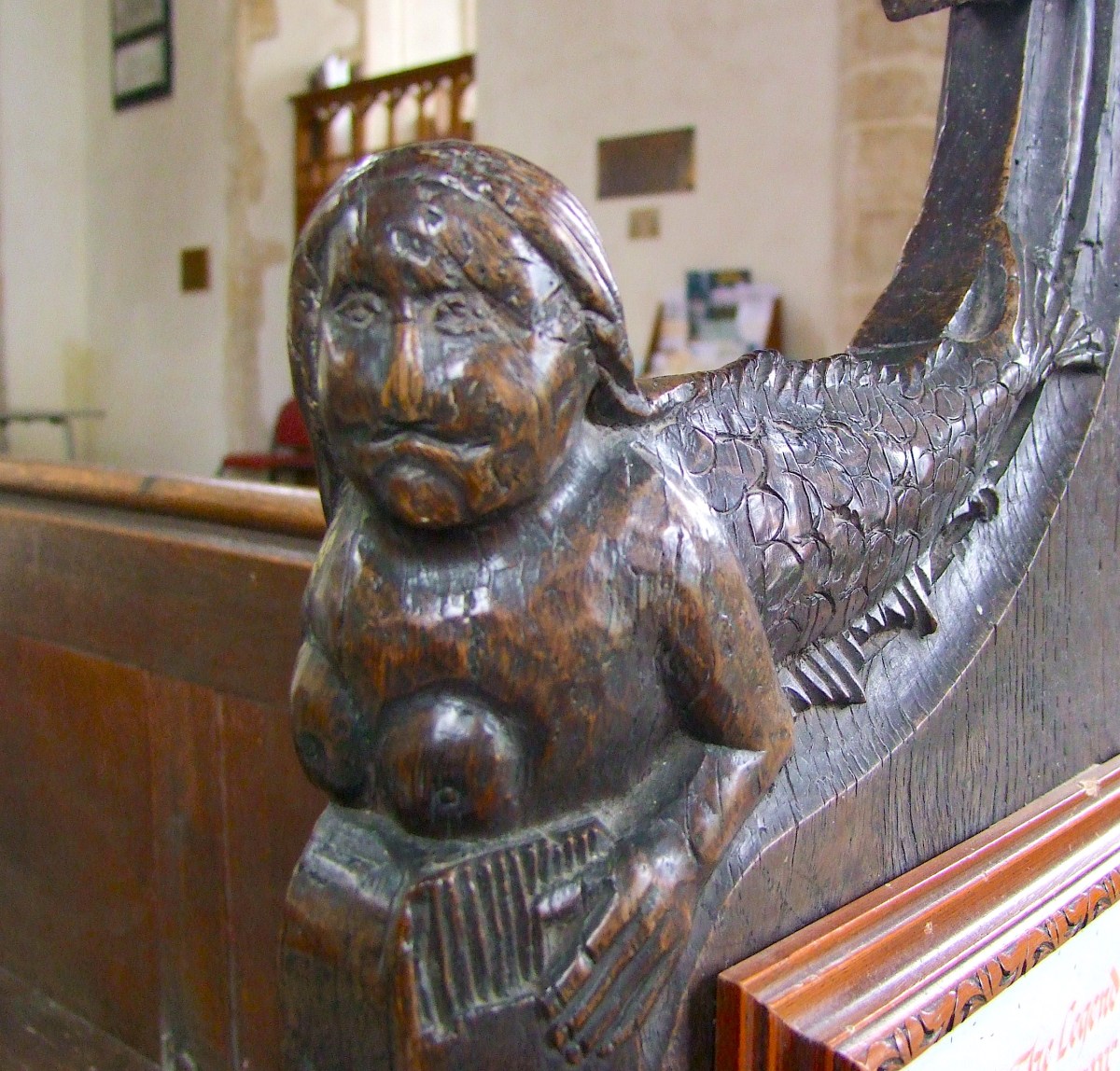
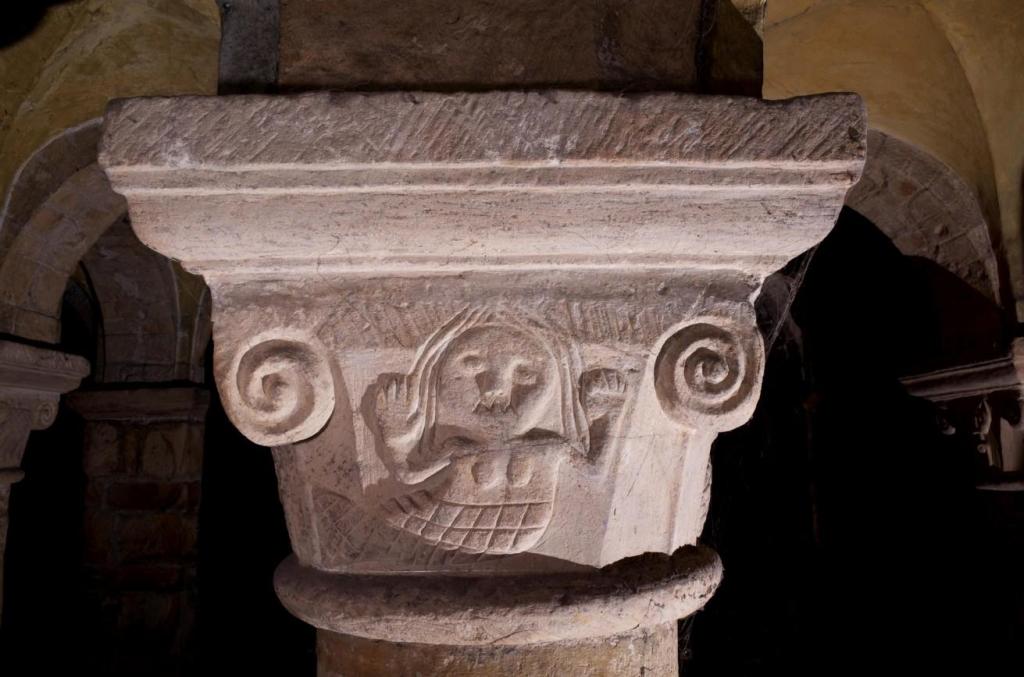
    Images of mermaids abound in British and Irish medieval churches. There are a range of stylistic types, from the Romanesque stone relief at the chapel of Durham Castle (dated to 1078 and thought to be the earliest depiction of a mermaid in an ecclesiastical context) through to the late medieval carved bench ends in churches such as at All Saints church, Upper Sheringham (Norfolk), St Mary’s church, Ivinghoe (Buckinghamshire) and Holy Trinity church, Great Hockham (Norfolk).

    Mermaid on a column capital at the chapel of Durham Castle, c. 1078 (Howarth Litchfield)
    15th-century mermaid bench-end at Holy Trinity church, Great Hockham, Norfolk (John Vigar)

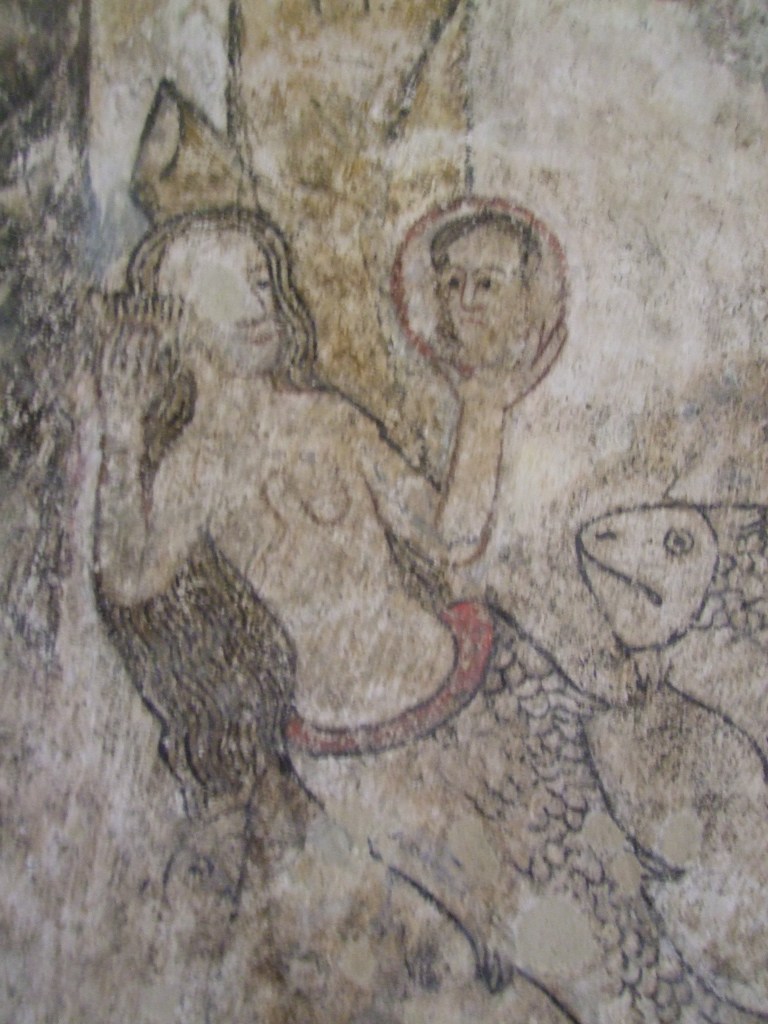
    There are also a small number of mermaids shown in wallpaintings, such as at St Botolph’s church, Slapton (Northamptonshire). But despite the stylistic changes through the course of the Middle Ages the mermaids are always portrayed as distinctive characters, with fish tails (usually double-tails), naked upper human bodies, and with long flowing hair.

    Late medieval mermaid shown in a wallpainting at St Botolph’s church, Slapton, Northamptonshire (John Vigar)

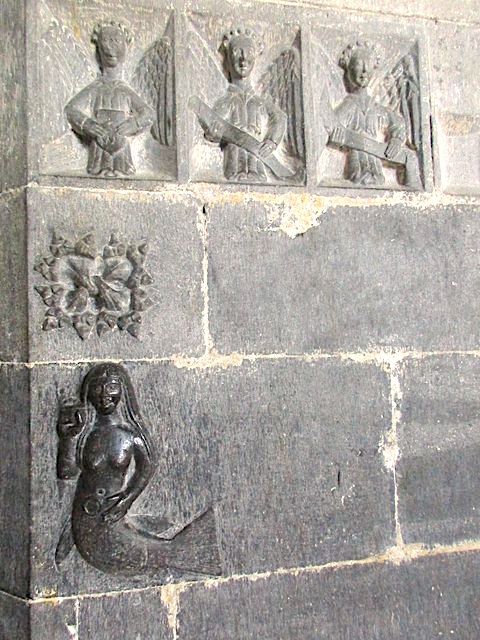
    There are a few depictions of mermen (the male equivalent of mermaids), as at St Buryan church in Cornwall, but the vast majority are of the female form. Those carved on the underside of misericords in church choirs, such as at St Mary’s church in Edlesborough (Buckinghamshire), would have been largely unseen by the majority of people frequenting the church, but most of the sculptures, carvings and wallpaintings are in prominent positions, in full view of the congregations, such as at St. Brendan’s Cathedral at Clonfert, Co. Galway, Ireland, where the image of a foot-high mermaid is located at eye level on a soffit facing the nave from a pier of the chancel, and would have appeared directly to the left of a priest as he addressed the congregation.

    15th-century stone relief mermaid, knotwork and angels at St. Brendan’s Cathedral, Clonfert, Co. Galway, Ireland (Neil Rushton)

    The stone sculpted mermaid at All Saints church in Thornham, Norfolk, is also a prominent feature in the nave and must have been located there by design, in order to convey a message to the (mostly illiterate) congregation. Indeed, most stone reliefs of mermaids are found in the communal areas of medieval churches, intrinsic parts of the experience of attending church for generations of medieval people. Even more common were bench-end mermaids, wooden carvings that would have been both visible and touchable to everyone attending the church. These are exclusively late medieval in date, making it clear that the mermaid had continued as a defined symbol through to the Reformation.

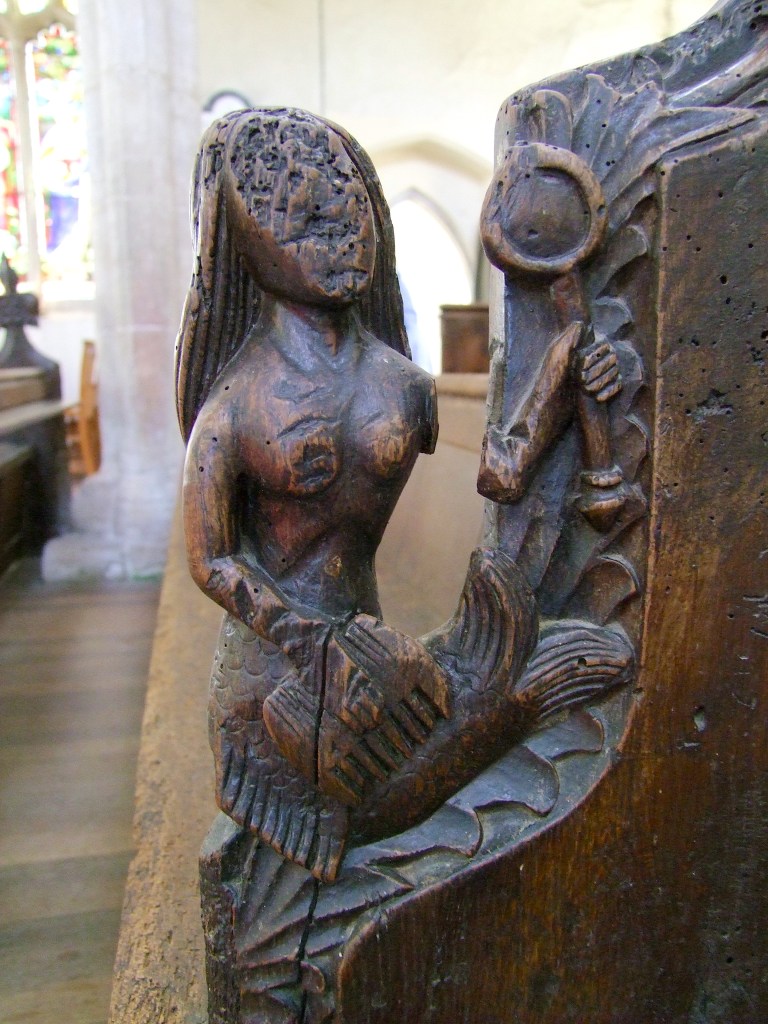
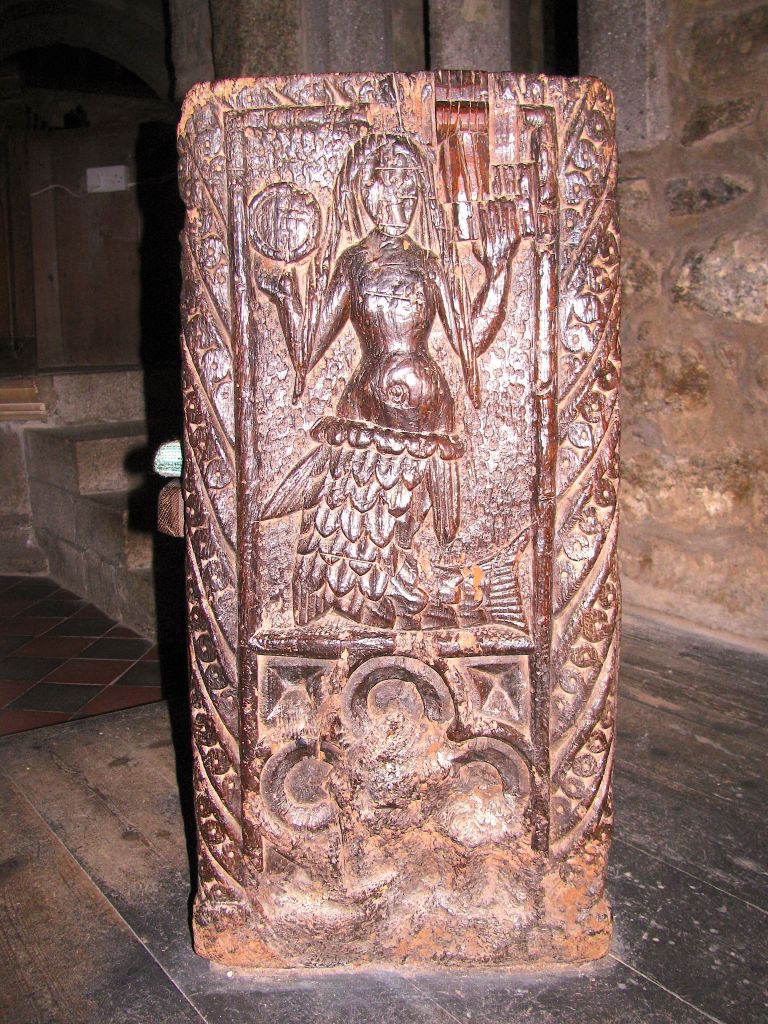
    One of the best known representations of a mermaid from a medieval church is at St Senara’s church, Zennor in Cornwall. Carved into the side of a bench-chair in the 15th century, it depicts a typical mermaid figure, naked to her fish tail, and holding aloft a mirror and comb. The image seems to relate to a piece of local folklore, where a mermaid, in the form of a woman, came to church each Sunday and charmed the parishioners with her beautiful singing before returning to the sea. A local man called Mathey Trewella was enticed to return with her to the sea one day, and neither was seen again. Although not recorded in literary form until 1873 by the folklorist William Bottrell, this folktale had evidently been doing the rounds as an oral tradition long before. Although it is possible that it was the bench-end carving that gave rise to the story, it is equally likely that the medieval image of the mermaid was commemorating a folktale in circulation in the 15th century. This is unusual; mermaid images in churches do not normally come packaged with an associated folktale. They were more likely timeless symbols, which despite their pagan connotations, were allowed to be displayed in churches by the ecclesiastical authorities as a didactic tool; visual symbols to persuade the faithful towards virtue.

    15th-century bench-chair mermaid at St Senara’s church, Zennor, Cornwall (John Vigar)

    The Symbology of Mermaids in Medieval Churches

    One interpretation of the symbolic meaning of church mermaids is that they were warnings against the sin of lust, possibly in the same way as the Sheela na gig sculptures. The mermaids were portrayed as young women with flowing hair, whose folkloric attributes were often those of temptation – they were designed with negative connotations. Patricia Radford describes how this was offset at St Brendan’s Cathedral, Clonfert:

    ‘Directly above the mermaid at Clonfert, and at many other locations including Clontuskert, is a beautifully carved, symmetrical knot. Knot-work in Irish and Celtic art has protective associations, so it seems the purpose of this motif is to protect the viewer from the mermaid’s dangerous pull since merely gazing upon the creature might incite lust. At Clonfert, on the pier opposite the mermaid, at the priest’s right, are three carved angels. It is typical of Irish churches that images associated with good are placed so that they can be seen to balance the potential evil of images of warning, such as mermaids. It is the nature of medieval art that an image may have multiple layers of meaning.’

    This insightful observation may have been true at some Irish churches, but most British church mermaids exist in isolation, without any potentially protective symbols or angels. However, the majority of these British mermaids are portrayed with symbols that would have been understood as displaying attributes of the sins of pride and vanity – as per the Zennor carving, the mermaids often held combs and mirrors. Not only were the mermaids sexual temptresses, they were made explicit in their vanity. This may have allowed for a dual meaning in their symbology, where the mermaids known tendency to draw men to their destruction was coupled with a warning to women to guard against excessive vanity. The depiction of the mermaids with long flowing hair also fed into this; medieval women of good virtue were expected to wear their hair ‘tamed’ and concealed beneath a covering – loose hair was for pre-pubescent girls and virtueless women. It might be wondered whether such portrayals of alluring femininity in churches may have had the opposite effect of that intended, but it seems as if the ecclesiastical authorities were able to use effectively the symbology of the mermaid, known for destruction and misfortune, to inculcate Christian virtues. It is unlikely that mermaid iconography would have been so regularly displayed in such prominent positions in churches if this were not the case.

    In this respect mermaid imagery in medieval churches differs from that of the Green Man and the Sheela na gig images, despite all having pagan connotations. They served different purposes. Green Men and Sheela na gigs were, and remain, amorphous in their symbolic meaning. They represent liminal aspects of medieval belief systems, that were likely interpreted by medieval congregations (as well as modern commentators) as unexplained aspects of a subversive cosmology, allowed into ecclesiastical precincts through custom and convention, almost as a propitiation to underlying non-Christian phenomenology. Their liminal nature meant they rarely found significant locations in churches, but were rather subsumed in vaults and side-chapels, tolerated but not generally exposed to general view. In contrast, mermaid sculptures and carvings were usually in full prospect, allowed into the nave and communal areas, often within touching distance of the congregation. It is likely that people were well aware of the folkloric properties of the mermaids, and the Church was able to appropriate this knowledge to expound core Christian values in a dynamically visual way. But at the same time, the mermaids were skilfully rendered works of art, which may not always have served a symbolic purpose. The medieval churchgoers who would have viewed such accomplished carpentry and stonework throughout their lives may, like their modern counterparts, have simply enjoyed the mermaid imagery as something that enhanced the church space, while invoking a supernatural being and the stories that accumulated around it.

    References

    Alexander, S. 2012. Mermaids: The Myths, Legends and Lore. Adams Media, Avon, US

    Andrews, T. 1998. Dictionary of Nature Myths: Legends of the Earth, Sea, and Sky. Oxford University Press

    Bottrell, W. 1873. ‘The Mermaid of Zennor’, in Traditions and Hearthside Stories of West Cornwall. Available at: https://www.sacred-texts.com/neu/celt/swc2/swc274.htm 

    Briggs, K. 1976. An Encyclopaedia of Fairies. Pantheon Books, New York 

    Kemble, M.J. 1992. ‘Mermaids in Folk Literature’, in Ichioka, C.S. (ed.), Stories from around the World: An Annotated Bibliography of Folk Literature. Honolulu: University of Hawaii at Manoa, 67–82 

    Platt, C. 1995, The Parish Churches of Medieval England. Chancellor Press, London

    Radford, P. 2003. Lusty Ladies: Mermaids in the Medieval Irish Church. Available at: http://homepage.eircom.net/~archaeology/three/mermaid.htm 

    Rushton, N. 2019. Selkies, Sirens, Swan Maidens and Otherworldly Brides. Available at: https://www.ancient-origins.net/history/selkies-sirens-swan-0011483 

    Weir, A., 2017. Satan in the Groin: Exhibitionist Figures on Mediæval Churches. Available at: http://www.beyond-the-pale.org.uk/ 

    Wingren, W. 2017. Why Are There Carvings of Women Flashing Their Genitals on Churches Across Europe? Available at: https://www.ancient-origins.net/artifacts-other-artifacts/why-are-there-carvings-women-flashing-their-genitals-churches-across-021737 

    Winters, R. 2015. Unraveling the Nature and Identity of the Green Man. Available at: https://www.ancient-origins.net/myths-legends/unraveling-nature-and-identity-green-man-002620 

    Winters, R. 2015. Unraveling the Nature and Identity of the Green Man, part 2. Available at: https://www.ancient-origins.net/myths-legends/unraveling-nature-green-man-part-2-how-pre-christian-icon-020186 

    ***

    Thanks to my friend and church historian John Vigar for all the images, apart from the Durham Castle Chapel mermaid, which comes from a conservation assessment of the chapel by Howarth Litchfield. The cover image (by John Vigar) is a 15th-century mermaid bench-end at All Saints church, Upper Sheringham, Norfolk.

    ***

    Dead but Dreaming the novel is available now

    ***

    Seeing the Unseeable: The Role of Clairvoyance in the Cottingley Story

    This is my article from a new publication The Cottingley Fairy Photographs: New Approaches to Fairies, Fakes and Folklore, edited by Dr Simon Young. This volume contains fifteen essays by faerie researchers and is accompanied by a separate volume The Cottingley Fairies: A Source Book compiled by Simon. My article below does take some familiarity with the story for granted (Simon Young’s Introduction in the volume of essays provides an invaluable overview) and is an attempt to dig below the faked photographs to excavate the more numinous aspects of the story of what happened in Cottingley Beck. Thanks to Simon for permission to republish.

    Photographing Fairies

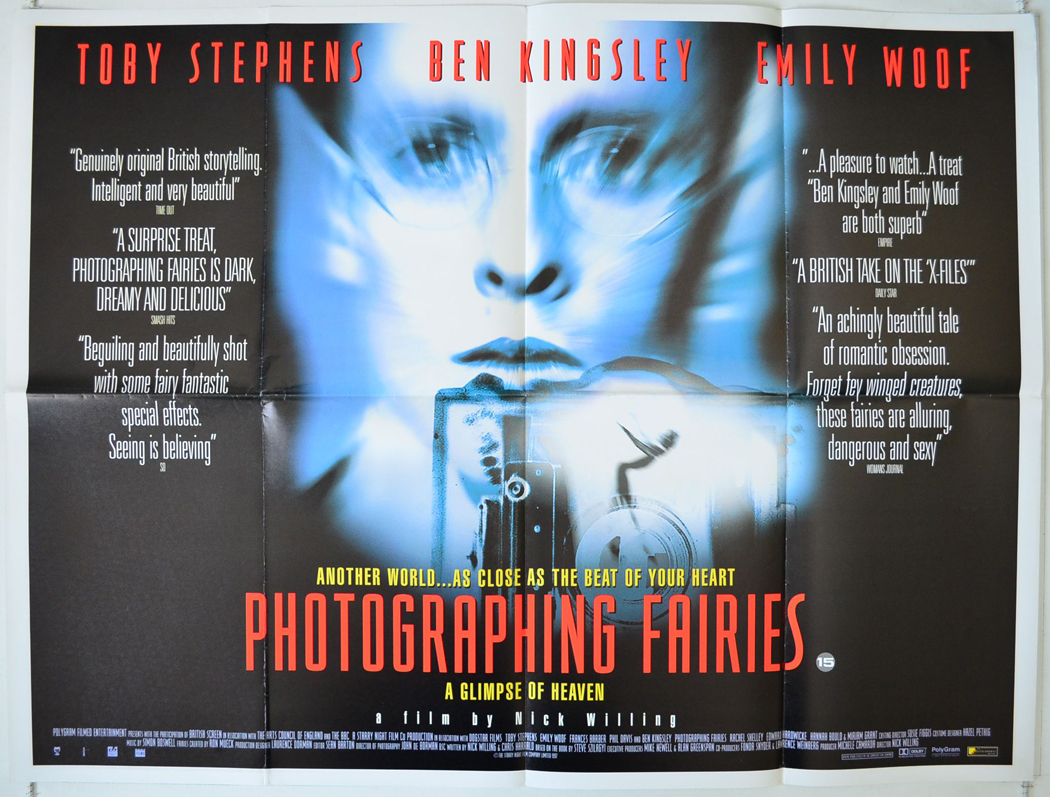
    In the 1997 film Photographing Fairies (based on the 1992 novel by Steve Szilagyi1, and set shortly after WWI), there is a scene where the main protagonist, Charles Castle (played by Toby Stephens), bursts in to a meeting of the Theosophical Society where Edward Gardner (Clive Merrison) is showing a slide of one of the Cottingley photographs as proof of the existence of faeries.2 Castle proceeds to demonstrate that the image is a fallacy, and that the faeries are quite evidently cardboard cut-outs. His intervention breaks up the meeting and we are introduced to Sir Arthur Conan Doyle (Edward Hardwicke), a member of the society, who extends some words of solace to Gardner and the audience: ‘We’re travelling in the dark. We must expect to bark our shins now and again. We are pioneers exploring the borderland between this world and a better one.’ In this three-minute scene the Cottingley story, and the involvement of Gardner and Doyle, is distilled and made to seem preposterous. The photographs are quite evidently fake and, seen from the rationalist perspective of Charles Castle, the Theosophist belief in such supernatural entities is deemed ridiculous – a refuge of naive superstition. The rest of the film is concerned with overturning this viewpoint, as Castle discovers that photographs taken by two other girls appear to show real humanoid — faerie — entities. He travels to their village and proceeds in an attempt to photograph the faeries, but only succeeds in encountering them whilst in an altered state of consciousness brought about by the consumption of a mysterious white flower. 

    While the film is not about the Cottingley faeries, it is quite evidently using the trope of the story (as was Szilagyl’s novel) to create the narrative. When Castle travels to the village he encounters the girls Ana and Clara — patently representatives of Elsie and Frances (although they are sisters in the book and film); they are several years apart and seem to spend much of their time communing with nature (in the film a woodland rather than the beck at Cottingley). What the film so skilfully depicts is the nature of interaction with the faeries — they can only be perceived during an altered state of consciousness, brought about by the consumption of the white flower. The photographic equipment Castle brings to the woodland to capture images of the faeries never really works — they can only be truly seen once the consciousnesses of the girls and Castle are in the correct state for it to happen. Whilst the relationship of photographic images depicting faeries in the film is very different to what happened at Cottingley, there is, in the film, an intuitive (explicate or implicate) portrayal of human consciousness being able, under certain circumstances, to see the unseeable, and that capturing the unseeable on photographic plates may or may not be possible. The white flower is a proxy for this to happen, an artistic device to render altered states of consciousness. But in the early 20th century the ability to discern non-human intelligent entities such as the faeries was known simply as clairvoyance. It has become an unfashionable word, but its intrinsic meaning was well understood at the time of the events at Cottingley, and there seem to have been at least two people engaged in clairvoyant activity in the beck. 

    Frances Griffiths

    Frances Griffiths was nine years old when she arrived in Cottingley in the Spring of 1917, after spending most of her life in South Africa. In her memoirs, written over sixty years later, she makes light of what must have been a dramatic, and potentially traumatic, change in her life.3 But she was an outsider in a strange environment, suddenly finding herself lodged in a bedroom with her older cousin Elsie and having to adjust to a cold, extended Yorkshire Winter. Whilst the contents of a memoir written so long after the events it describes needs to be treated with caution, it does seem to have been compiled from earlier written reminiscences, and there is a consistency in Frances’ description of events that seem relatively authentic. Within fourteen pages she is already describing how she first saw a faerie-type entity in Cottingley Beck:

    I suppose I must have been day dreaming one day when I looked across the beck and saw a willow leaf twirling around rapidly, moving as it were, on its own… I had never seen a leaf do that before, but then everything here was new to me… That was the beginning, although at the time I didn’t realise it. The leaf was being held by a little man. The first time I saw the little man – he was about eighteen inches high – he was walking purposefully down the bank on the willow side of the beck, holding a willow leaf in his hand, twiddling it very fast as he crossed the water to the other side.4

    The day dreaming element of Frances’ description is important in relation to the nature of clairvoyance, and how this type of altered state of consciousness may be an access-point to potentially numinous experiences. Frances was in a new environment, and the beck probably seemed quite magical as Spring broke through it. For a few weeks she had it mostly to herself as Elsie was working during the days, and it seems that she continued to see faerie-type entities. Frances suggests they would notice her, and look at her, but there was never any audial communication. The only sound she describes is ‘a high-pitched sound, similar to a ringing in one’s ear.’ Other than this the encounters were visual only and seem to describe the same entities over a period of time. The original ‘little man’ was soon joined by a number of compatriots:

    Once I saw him leading three or four little men who were dressed as he was, in green jerkin and darker-coloured green loose-fitting tights – rather like our young people wear their Levis today! They all walked very purposefully and when they had crossed the beck they turned towards the right. I watched them until they went behind a clump of willow herb and were lost from sight.5

    Apart from the little men, Frances also described ‘conventional faeries’, although she never explained exactly what these were. The insinuation is that they were the winged faeries depicted in the photographs. Interestingly, Frances never describes seeing the faeries with Elsie. Her language about this is often ambiguous, such as when she talks of the adults teasing both of them about seeing faeries, suggesting that Elsie was also seeing Frances’ entities. But there is no explicit reference in Frances’ memoirs or later interviews that she and Elsie saw the faeries together. In a letter to Gardner, Elsie repeats a line she had used in several interviews, that the images were ‘photographs of figments of our imagination’ — a cleverly worded sidestep in itself that could be interpreted several ways.6 But in the same letter she writes that Frances was angry with the phrase, and had castigated Elsie, asking: ‘What did you say that for? You know very well they [the faeries] were real.’ If Elsie had not seen the faeries with Frances, why would Frances be so annoyed at Elsie’s ambiguous words? Perhaps Frances simply expected Elsie to accept her own encounters with the faeries. But it does seem that Elsie was at least with Frances in the beck when the younger girl saw faeries. 

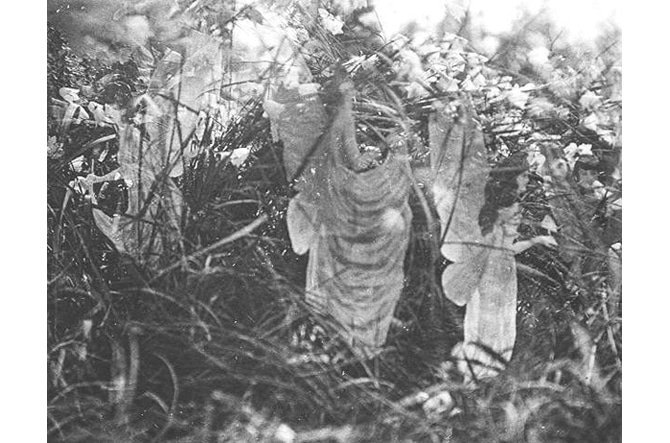
    They were certainly together to take all the photographs in 1917 and 1920, including the final fifth photograph, which is perhaps the most interesting of the set, as it wasn’t contrived by Elsie, and seems to have been taken by Frances at the end of a wet day wandering around the beck, with both girls worrying about the responses of Gardner and Conan Doyle to the previous photographs. Frances describes seeing a bird’s nest on the ground:

    My camera was loaded  and the plate ready for taking, and on an impulse I pointed the lens towards the bird’s nest, pulled out the bellows and took a 5 second — I think — shot. It was done without a thought… That was the fifth photograph.7

    This photograph is very different than the other four and does seem to show amorphous humanoid entities, although this might be put down to pareidolia, or even a double exposure with blurred images from Elsie’s cut outs. Either way, the fifth photograph may be seen as a better representation of the types of entities Frances described as seeing in the beck between 1917 and 1920. But, in Frances’ own words, she thought the photographs — and what they may or not prove, and whether they were faked or not — less important than her own real psychic experiences:

    This is where I feel angry with Sir Arthur Conan Doyle and Edward Gardner. They never sought for any explanation of fairy life. It was enough that they could get the copyright for the photographs we took, and later use them on world tours lecturing on something neither they — nor I — knew anything about. If they had only suggested some ways of finding out more about ‘my’ little men and the fairies, who knows what might have been discovered!8

    Geoffrey Hodson

    In the Summer of 1921 the girls were redrafted in to a new investigation at the beck as Edward Gardner turned up in Cottingley with a new camera and plates. Shortly after, on 6 August, Geoffrey Hodson (along with his wife) came to the village in order to undertake further psychic appraisals.9 Hodson had been chosen by Conan Doyle for the task, and seems to have been, at that time, an upcoming member of the Theosophical Society, with clairvoyant abilities.10 Hodson was thirty-five and had been involved in action as a Tank Commander in the Tank Corps during the final days of WWI, just three years previously in 1918.11 Hodson spent two weeks at Cottingley with the girls and reported back to Conan Doyle on his experiences, which were then edited in to chapter five of The Coming of the Fairies, the following year.12 It is quite clear that Hodson believed he was encountering an array of non-human intelligent entities in the beck, and that both girls were also seeing them. The chapter is a simple explanation of where they saw the faeries and the different types of entities that seemed to inhabit the beck. It needs to be read in full for a true understanding of how full-on Hodson was, but an example from 12 August gives an impression of the whole:

    Two tiny wood elves came racing over the ground past us as we sat on a fallen tree trunk. Seeing us, they pulled up short about five feet away, and stood regarding us with considerable amusement but no fear. They appeared as if completely covered in a tight fitting one-piece skin, which shone slightly as if wet. They had hands and feet large and out of proportion to their bodies… There were a large number of these figures racing about the ground. Their noses appeared almost pointed and their mouths wide. No teeth and no structure inside the mouth… It was as if the whole were made up of a piece of jelly. Surrounding them, as an etheric double surrounds a physical form, is a greenish light, something like chemical vapour.13

    The entities then sank below the ground. This particular incident seems to have been witnessed by only Hodson and Frances, but many of the other sightings involve both girls, and it is clear that the three of them spent a lot of time together in the beck attempting to discern the faerie-type entities that would manifest there. Hodson wrote further about his expedition to Cottingley in two books, The Kingdom of the Gods and The Fairies at Work and Play, and his thoughts were again recorded in an interview just before he died; he was always consistent in what he saw with the girls at Cottingley.14 But Elsie and Frances were not complimentary about Hodson, when interviewed many years later in 1976. Frances went as far as to call him ‘a phoney.’ However, in the same interview they also suggested they all did see faeries during Hodson’s stay.15 In fact, in both girls’ dispositions on Hodson and his visit, on the rare occasions they mentioned it, seem rather nervy. They did not seem to know what to make of him, and it may be that his Theosophical outlook was a philosophical mindset that was simply beyond them. Frances saw faeries, Elsie may have seen them, but the quest for an ontological reality of the entities never seemed to have entered their minds, whereas for Hodson (as well as Gardner and Conan Doyle) this was the primary interest. Elsie even suggested (in a 1983 conversation with Marjorie Johnson, honorary secretary of the Fairy Investigation Society, and author of Seeing Fairies) that they had only spent three days with Hodson in the beck, whereas it is quite evident from Hodson’s report, and Gardner’s notes, that he was with the girls for two weeks, and spent almost every day with them in the beck.16 

    Hodson appears to have been a man with genuine psychic abilities — he was what Bill Keidan (Hodson’s online biographer) terms an ‘illumined occultist.’ He spent the rest of his long life producing a prodigious amount of books and articles on a wide-range of esoteric subjects from reincarnation to the Angelic Kingdom, which were well thought of in Theosophical and esoteric circles. He also collaborated with scientists on a spectrum of surprising subject matter from sub-atomic physics to anthropology, gaining genuine respect for his (non-scientific) insights into quantum mechanics and the potential consciousnesses of early hominids.17 Hodson does not seem to have been a fraud. He would appear to have been a genuine clairvoyant, who simply reported what he perceived. But what does clairvoyance mean, and were Frances’ and Hodson’s clairvoyant experiences with faeries at Cottingley Beck the same thing?

    Clairvoyance and Faerie-Type Entities

    In his later writings, Hodson would often describe clairvoyance as ‘thought forms’, which manifested during certain states of consciousness that were either inherent to an individual or which could be learnt. These forms could often take the aspect of non-human intelligent entities, such as faeries. This does not mean they are figments of imagination, but rather that they are, at some level, real and able to be seen and encountered whilst a person is in the appropriate state of consciousness. Hodson’s extensive writings describe the different types of faerie-type entities he experienced throughout his life. His prose-style can seem a little opaque at times, but his sincerity and dedication to investigating what he would often term the occult realms are indisputable. In one of his most wide-ranging books, The Kingdom of the Gods (first published in 1952), he succinctly — albeit in his usual, gnomic (pun intended) language — describes the clairvoyance, or seership, that allowed him to interact with non-material intelligent entities:

    As part of the unfoldment of the human intellect into omniscience, the development occurs at certain stages of human evolution of the faculty of fully-conscious, positive clairvoyance. This implies an extension, which can be hastened by means of self-training, of the normal range of visual response to include both visual rays beyond the violet and, beyond them again, the light of the superphysical worlds…It is important to differentiate between the passive psychism of the medium, and even the extra sensory perception of parapsychology, and the positive clairvoyance of the student of Occultism. This latter, completely under the control of the will and used in full waking consciousness, is the instrument of research with which during the past thirty years I have endeavoured to enter and explore the Kingdom of the Gods.18 

    Hodson’s language for describing clairvoyance correlated closely with another Theosophist (albeit dissident to the established structure of the organisation), and contemporary to the Cottingley story, Rudolf Steiner, who most often described faerie-type entities as nature spirits or elementals, basing his taxonomy of them on the 16th-century alchemist Paracelsus.19 Steiner describes how a clairvoyant can enter the world of the elementals — in normal consciousness thoughts:

    … allow  themselves to be connected and separated, to be formed and then dismissed. This life of thought must develop in the elemental world a step further. There, a person is not in a position to deal with thoughts that are passive. If someone really succeeds in entering the world with his clairvoyant soul, it seems as though his thoughts were not things over which he has any command; they are living beings… You thrust your consciousness into a place, it seems, where you do not find thoughts that are like those in the physical world, but where they are living beings.20 

    This became a mainstay in Theosophical ideology — clairvoyance is, in part, simply a methodology for interacting with elementals, nature spirits, faeries (or whatever desired terminology is used to describe these beings), and it allows a person to see entities that are not normally available to everyday consciousness. Hodson’s testimony from his time at Cottingley is certainly an example of someone who was using his apparent clairvoyant abilities to interact with, or at least view, incarnate entities.21 

    A few years earlier WY Evans-Wentz, in his 1913 publication The Fairy-Faith in Celtic Countries, was recording similar testimonies from people in the Celtic nations, who were not aligned with the Theosophical movement, but seem the have had much the same mindset when it came to the faeries.22 These people were usually called seers (as Hodson himself often described clairvoyants). Evans-Wentz met one such (anonymous in the text, but evidently George William Russell, aka “AE”) Irish seer in Rosses Point, County Sligo. He talked about various types of faeries that inhabited the landscape of Sligo, making them sound like a cross between nature spirits and mystical visions. But Evans-Wentz was just as interested in the mechanics of interacting with the faeries as he was with the stories themselves. How did the seer interface with them?

    I have always made a distinction between pictures seen in the memory of nature and visions of actual beings now existing in the inner world. We can make the same distinction in our world: I may close my eyes and see you as a vivid picture in memory, or I may look at you with my physical eyes and see your actual image. In seeing these beings of which speak, the physical eyes may be open or closed: mystical beings in their own world and nature are never seen with the physical eyes… I usually find it possible to throw myself into the mood of seeing; but sometimes visions have forced themselves upon me.23

    Over two centuries earlier, Robert Kirk was describing much the same form of seership amongst certain inhabitants in and around Aberfoyle in Scotland, usually described as the second sight.24 The Theosophists of the early 20th century appear to have been unaware of Kirk’s Secret Commonwealth, but the basic mechanics of seeing and encountering faerie-type entities through clairvoyant attributes were much the same. Were the Cottingley girls clairvoyant, in the way described by Kirk, Steiner, Russell and Hodson? It would be easier to think of Frances as a clairvoyant than Elsie, but even then this might be stretching the credentials of a young girl who simply saw faeries that should not have been part of the material world. Frances certainly never described herself as having any special psychic abilities, and her later scepticism of Hodson may have been, in part, to distance herself from the rubrics of Theosophy and the Fortean qualities of clairvoyance. But there are a few clues that might suggest Frances was able to enter an altered state of consciousness, which enabled her to engage with supernatural entities. Her describing being in a day dream state when she first saw the faerie man in the beck indicates a meditative state, and in the addenda to her memoirs, her daughter Christine states: ‘Strangely, she told me later that she didn’t see them straight on, but obliquely.’25 Christine also suggests that Frances may have had certain telepathic abilities from a young age, when: ‘she had got into the habit of closing her mind to stop others from hearing what she was thinking.’26 The insinuation is that Frances may have been more of a clairvoyant in the mold of Hodson than she realised. Or perhaps she was just another person who occasionally slipped into an altered state of consciousness and saw faeries.

    The connection between encountering faerie-type entities and being in an altered, or non-ordinary state of consciousness is well attested in both historic and modern accounts. The folklore is replete with protagonists being agitated, depressed, blissful, confused, anxious, meditative, ecstatic or ill before they become embroiled in a faerie encounter.27 And modern faerie encounters are similarly most often accompanied by descriptions of the experiencer feeling different in some way from their everyday state of consciousness, as can be seen, for example, in the two censuses carried out by Simon Young for the Fairy Investigation Society.28 These altered states become greatly magnified when they have been induced through the consumption or injection of psychedelic drugs. N,N-Dimethyltryptamine (DMT), especially, is almost guaranteed to throw the participant’s consciousness in to an entirely parallel reality where there will be entities awaiting, frequently faerie-type entities.29 Clairvoyance is just one special type of altered state — defined by the likes of Steiner, Russell and Hodson — but perhaps accessible to everyone, and certainly to sensitive types such as Frances (and perhaps Elsie) when environmental and psychological conditions are conducive. 

    In the film Photographing Fairies,  the altered state/clairvoyant trope was enabled by the consumption of the psychotropic white flower. This allowed a cinematographic shortcut to describe how the faeries were perceived — it was a code for clairvoyance that would otherwise have been too cumbersome to detail in the limited time the film had to tell the story. In the Cottingley story (mirrored by the film) clairvoyance was central; not brought about suddenly by a magical flower, but rather the constant background radiation to the sensation and hype caused by the photographic images. While Hodson termed his experiences in Theosophical language, Frances was more straightforward, and yet they were ultimately describing the same clairvoyant encounters with non-corporeal, faerie-type entities in the beck over the course of four years. Of course, if we accept, at some level, the reality of clairvoyance in perceiving these entities, we are then obliged to ask what the entities are at an ontological level. This is a vast, and perhaps an unanswerable question, but a recent three-point descriptor in a paper by David Luke30 manages to encapsulate what clairvoyant experiences with faeries might be (as long as deception is ruled out), even though he was attempting to understand the nature of the entities encountered under the influence of DMT:

    1. They are hallucinations. The entities are subjective hallucinations. Such a position is favoured by those taking a purely (materialist-reductionist) neuropsychological approach to the phenomena.
    2. They are psychological/transpersonal manifestations. The communicating entities appear alien but are actually unfamiliar aspects of ourselves, be they our reptilian brain or our cells, molecules or sub-atomic particles.
    3. The entities exist in otherworlds and can interact with our physical reality. A numinous experience provides access to a true alternate dimension inhabited by independently existing intelligent entities in a stand-alone reality, which exists co-laterally with ours, and may interact with our world when certain conditions are met. The identity of the entities remains speculative.

    Points 2 and 3 do sound like Theosophy in updated language. They certainly might explain the experiences of Frances Griffiths and Geoffrey Hodson at Cottingley, whilst at the same time allowing for the possibility of point 1. While the (first four) photographs were a deceit perpetrated by Elsie and Frances, the apparent interactions with faerie-type entities described by Frances and Hodson seem genuine. Their clairvoyance (or altered states of consciousness) sanctioned encounters with these entities in Cottingley Beck. Perhaps if we can put to one side the exquisite deception of the photographs, we might understand that the real Cottingley story involved a young girl and a thirty-five year old man tapping into the numinous and seeing the unseeable. 

    Footnotes

    1. Steve Szilagyi, Photographing Fairies, (New York: Ballantine Books, 1992). ↩︎
    2. A detailed analysis of the film can be found in: Neil Rushton, ‘Handmaidens of the Eternal: Consciousness and Death in Photographing Fairies’, in Fairy Films: Wee Folk on the Big Screen, ed. Joshua Cutchin (Educated Dragon Publishing, 2023). ↩︎
    3. Frances Griffiths and Christine Lynch, Reflections on the Cottingley Fairies (Belfast: JMJ, 2009). ↩︎
    4. Griffiths, Reflections, 14. ↩︎
    5. Griffiths, Reflections, 15. ↩︎
    6. Joe Cooper, The Case of the Cottingley Fairies (London: Pocket Books, 1997), 196. ↩︎
    7. Griffiths, Reflections, 58. ↩︎
    8. Griffiths, Reflections, 16. ↩︎
    9. Cooper, Case of the Cottingley Fairies, 84-85. ↩︎
    10. Toshio Akai, ‘The Cottingley Fairies Photographs and Spirit Photography’, Proceedings of the Faculty of Humanities and Sciences, Kobe Gakuin University 19 (1999), 48. Available at https://www.academia.edu/9089443/The_Cottingley_Fairies_Photographs_and_Spirit_Photography ↩︎
    11. Bill Keidan (2013), ’An Esoteric Resource on the Life and Work of Geoffrey Hodson’
       http://www.geoffreyhodson.com/Appendices.html ↩︎
    12. Arthur Conan Doyle, The Coming of the Fairies (New York: Doran, 1922), 108-22. ↩︎
    13. Doyle, Coming of the Fairies, 110-11. ↩︎
    14. Geoffrey Hodson, The Kingdom of the Gods (Adyar: The Theosopohical Publishing House, 1999, 1st pub. 1952), 123-24; Geoffrey Hodson, The Fairies at Work and Play (Adyar: The Theosophical Publishing House, 1976, 1st pub. 1925), 74-75; Cooper, Case of the Cottingley Fairies, 92-94. ↩︎
    15. Cooper, Case of the Cottingley Fairies, 87. ↩︎
    16. Marjorie Johnson was very indignant at the girls for misrepresenting Hodson in this respect and their general assassination of his character in later life. Her view on the Cottingley story is an interesting addition to the mythology — Marjorie T Johnson, Seeing Fairies (San Antonia: Anomalist Books, 2014), 279-85. ↩︎
    17. Keidan, ‘Geoffrey Hodson’ http://www.geoffreyhodson.com/Clairvoyant-Investigations-2.html ↩︎
    18. Hodson, Kingdom of the Gods, 10-11. ↩︎
    19. Neil Rushton (2019), ‘Paracelsus, Nature Spirits and Faeries’ https://deadbutdreaming.wordpress.com/2019/11/17/paracelsus-nature-spirits-and-faeries/ Steiner was always content to classify nature spirits and elementals as within the same taxonomy of incorporeal entities, but some other Theosophists, such as Charles Leadbetter, made a distinction that further codifies them between material and non-material beings… ‘Elementals are ‘the thought-forms of the Great Beings or angels who are in charge of the evolution of the vegetable kingdom’. Nature spirits are ‘real’ living creatures, but in a different line of evolution from humans.’ Kaori Inuma, in this volume. ↩︎
    20. Rudolf Steiner, ‘Perception of the Elemental World (1913)’, in Nature Spirits (Forest Row: Rudolf Steiner Press, 1995), 177-78. ↩︎
    21. An illuminating update to the Theosophical concept of clairvoyance and communication with non-material entities can be found in: Marko Pogaćnik, Nature Spirits and Elemental Beings: Working with the Intelligence in Nature (Findhorn: Findhorn Press, 1996). ↩︎
    22. WY Evans-Wentz, The Fairy-Faith in Celtic Countries (Franklin Lakes, NJ: New Page Books, 2004, 1st published 1913). ↩︎
    23. Evans-Wentz, The Fairy-Faith, 87-88. ↩︎
    24. Neil Rushton (2016) ‘The Secret Commonwealth’ https://deadbutdreaming.wordpress.com/2016/07/31/the-secret-commonwealth/ ↩︎
    25. Griffiths, Reflections, 89. ↩︎
    26. Griffiths, Reflections, 114. ↩︎
    27. The 17th-century story of Ann Jefferies is particularly instructive on this point. See, Simon Young, Ann Jefferies and the Fairies: A Source Book for a Seventeenth-Century Cornish Fairy Witch (Pwca Books and Pamphlets, 2023). ↩︎
    28. Simon Young, Fairy Census 1 and 2 (2017 and 2024): https://www.fairyist.com/survey/read-the-fairy-census-1-and-2/ ↩︎
    29. Neil Rushton, ‘Faerie-Type Entities and the DMT Experience: An Ontological Survey,’ Psychedelic Press 40 (2023), 51-63. ↩︎
    30. David Luke, ‘Discarnate Entities and Dimethyltryptamine (DMT): Psychopharmacology, Phenomenology and Ontology’, Journal of the Society for Psychical Research 75 (2011), 26-42. Available at: https://dmttimes.com/david-luke-papers-and-articles/2020/1/2/discarnate-entities-and-dimethyltryptamine-dmt-psychopharmacology-phenomenology-and-ontology ↩︎

    Bibliography

    Akai, Toshio, ‘The Cottingley Fairies Photographs and Spirit Photography’, Proceedings of the Faculty of Humanities and Sciences, Kobe Gakuin University 19 (1999), 37-53. Available at https://www.academia.edu/9089443/The_Cottingley_Fairies_Photographs_and_Spirit_Photography

    Conan Doyle, Arthur. The Coming of the Fairies (New York: Doran, 1922).

    Cooper, Joe. The Case of the Cottingley Fairies (London: Pocket Books, 1997).

    Evans-Wentz, WY. The Fairy-Faith in Celtic Countries (Franklin Lakes, NJ: New Page Books, 2004, 1st published 1913).

    Griffiths, Frances and Christine Lynch, Reflections on the Cottingley Fairies (Belfast: JMJ, 2009).

    Hodson, Geoffrey. The Fairies at Work and Play (Adyar: The Theosophical Publishing House, 1976, 1st pub. 1925).

    Hodson, Geoffrey. The Kingdom of the Gods (Adyar: The Theosopohical Publishing House, 1999, 1st pub. 1952).

    Johnson, Marjorie T. Seeing Fairies (San Antonia: Anomalist Books, 2014), 279-85.

    Keidan, Bill (2013), ’An Esoteric Resource on the Life and Work of Geoffrey Hodson’. Available at: http://www.geoffreyhodson.com

    Luke, David. ’Discarnate Entities and Dimethyltryptamine (DMT): Psychopharmacology, Phenomenology and Ontology’, Journal of the Society for Psychical Research 75 (2011), 26-42. Available at: https://dmttimes.com/david-luke-papers-and-articles/2020/1/2/discarnate-entities-and-dimethyltryptamine-dmt-psychopharmacology-phenomenology-and-ontology (Accessed December 2023).

    Pogaćnik, Marko. Nature Spirits and Elemental Beings: Working with the Intelligence in Nature (Findhorn: Findhorn Press, 1996).

    Rushton, Neil (2016) ‘The Secret Commonwealth’ https://deadbutdreaming.wordpress.com/2016/07/31/the-secret-commonwealth/

    Rushton, Neil (2019), ‘Paracelsus, Nature Spirits and Faeries’ https://deadbutdreaming.wordpress.com/2019/11/17/paracelsus-nature-spirits-and-faeries/

    Rushton, Neil. ‘Faerie-Type Entities and the DMT Experience: An Ontological Survey,’ Psychedelic Press 40 (2023), 51-63.

    Rushton, Neil. ’Handmaidens of the Eternal: Consciousness and Death in Photographing Fairies’, in Fairy Films: Wee Folk on the Big Screen, ed. Joshua Cutchin (Educated Dragon Publishing, 2023).

    Steiner, Rudolf. ’Perception of the Elemental World (1913)’, in Nature Spirits (Forest Row: Rudolf Steiner Press, 1995).

    Szilagyi, Steve. Photographing Fairies, (New York: Ballantine Books, 1992).

    Young, Simon. Ann Jefferies and the Fairies: A Source Book for a Seventeenth-Century Cornish Fairy Witch (Pwca Books and Pamphlets, 2023).

    Young, Simon. Fairy Census 1 and 2 (2017 and 2024): https://www.fairyist.com/survey/read-the-fairy-census-1-and-2/

    ***

    The cover image is Frances’ fifth photograph, as discussed in the text.

    ***

    The two volumes of essays and sources, edited by Dr Simon Young, are available now:

    ***

    Dead but Dreaming the novel is available now…
    The Entoptic Model: Bridging Ancient Art and Consciousness

    A version of this article appeared previously on Ancient Origins. While slightly peripheral to the faerie phenomenon, it does seem that the study of prehistoric rock art may provide some evidence that our ancient ancestors were interacting with faerie-type entities, and were doing so by altering their states of consciousness.

    Throughout the world, prehistoric and pre-industrial shamanic cultures have rendered painted imagery onto rock faces; often in deep cave systems but also in above-ground shelters. This ‘rock art’ ranges in date from Palaeolithic designs in Europe, Australia and Asia through to the near-contemporary images of the San culture in southern Africa and the designs of indigenous cultures of North America and the Amazon basin. Until the mid-20th century the consensus anthropological view was that the rock art — while probably having magical meaning to the people who painted it — represented scenes from the natural environment, such as people, animals and landscapes. But as a greater anthropological understanding of indigenous shamanism developed, most especially through the work of Mircea Eliade and his 1951 publication Shamanism: Archaic Techniques of Ecstasy, a new awareness evolved that the rock art produced by indigenous cultures might be the artistic result of shamanic processes, preeminently those brought about by inducing altered states of consciousness. This was mainstreamed in 1988 by the anthropologists David Lewis-Williams and Thomas Dowson in their paper for Current Anthropology: ‘The Signs of all Times: Entoptic Phenomena in Upper Palaeolithic Rock Art’, where they advance a neuropsychological model for analysing the motifs of parietal art of this period, proposing that the geometric images are in fact artistic representations of universal optical patterns, intrinsic to the human visual system, once perceived by our shamanic ancestors during altered states of consciousness. The most important element of this model is the entoptic imagery displayed in the rock art and how it matches closely the geometric patterns seen by people in modern clinical conditions who have altered their state of consciousness.    

    The Entoptic Model

    The word ‘entoptic’ derives from the Greek ἐντός ‘within’ and ὀπτικός ‘visual’. Entoptics usually consist of geometric patterns seen as overlays in the visual horizon. These patterns may be an array of dots, parallel lines, labyrinths, zig-zags, waving lines, etc. Sometimes they appear detached from the visual surroundings while at other times more integrated. Entoptics are usually experienced during altered states of consciousness, which may be achieved through a variety of means. The best evidence for the consistency of visual entoptics comes from clinical trials (from the 1950s onward), which analysed subjective narratives of people administered a variety of psychedelic substances. Many of these narratives described the geometric entoptics as antecedents to deeper experiences, as if they were a geometric gateway to the main substance of the experience. The entoptics were, in effect, neuropsychological codes for signalling change in the state of consciousness. 

    Lewis-Williams and Dowson’s model took sketches made by people experiencing consciousness modification via psychedelic drugs in clinical trials and applied the imagery to the rock art produced by indigenous tribal communities in modern day South Africa, the Amazon and by the Native American Shoshonean Coso culture of the California Great Basin. The geometric images demonstrated extensive similarities. The rock art contained many of the geometric motifs recorded by modern trial results. These entoptics appeared to be some universal code, experienced and recorded by both modern-day psychonauts and people in indigenous communities experiencing altered states of consciousness through a variety of methods. Because the San and Coso indigenous peoples are verifiable shamanistic cultures, able to describe the meaning of the rock art of their immediate ancestors from personal viewpoints, Lewis-Williams and Dowson took their descriptions of entoptics at face value. Whether through the consumption of psychedelic compounds or dancing in a ring for hours (the San’s primary way of entering an altered state of consciousness), people in these cultures were entering a divergent reality and sometimes they recorded this reality in rock art. A lot of this was composed of entoptic imagery. 

    An intensive study of this rock art by Lewis-Williams and Dowson suggested that comparisons might be made to Palaeolithic parietal art in Europe. In their 1988 paper they compared rock art (primarily in caves) from Upper Palaeolithic Europe to the San and Coso examples, as well as against the data from modern clinical trials where entoptics were reported. Using a large dataset, they found a tight correlation between the styles of entoptic designs in their African and American examples and those from the caves of Europe dating between 20 and 30,000 BCE. The rock art contained all six of the coded entoptic patterns, as designated from the clinical studies. While not universal in Palaeolithic parietal art, entoptic designs do form part of a majority of the imagery. This allowed Lewis Williams and Dowson to profile their neuropsychological model as an interdisciplinary explanation for entoptics, whether recorded as experiential reports from a modern clinical trial or in Palaeolithic rock art. With the oral testimonies and relatively recent rock art from the San and Coso cultures, both of which are shamanic and use various techniques to alter states of consciousness, the dataset allowed a testable model, which might help bridge a gap of tens of thousands of years.

    Lewis-Williams and Dowson assumed four main elements to their model: 1. Entoptic phenomena occur universally in altered states of consciousness; 2. The people producing rock art used one or more techniques for altering states of consciousness; 3. A quantity of Upper Palaeolithic rock art represents the entoptic phenomena experienced during altered states of consciousness; 4. The visual content during an altered state of consciousness may vary with the cultural context but the basic features of the experience, such as entoptics, are a universal and have been repeated through time. 

    This model does sit well with the evidence presented by Lewis-Williams and Dowson. But introducing the known phenomenon of entoptic visuals in an attempt to explain the previously indecipherable geometric painted patterns from distant prehistory represents a radical reinterpretation of the rock art data. It appeared as if there were a genuine link between shamanic cultures separated by tens of thousands of years and altered states of consciousness, which might be experienced by anyone, at any time, if conditions are met. But as with any model that challenges the mainstream orthodoxy it has been challenged.

    The Kickback to the Entoptic Model

    Using ethnographic techniques to attempt building a new model to breach the gap between Palaeolithic culture and ours was always going to cause controversy. Two of the academics who have criticised the Lewis-Williams/Dowson model are Paul Bahn (archaeologist) and Patricia Helvenston (psychologist). Their main contention is that we cannot know what sort of shamanism was practiced in the Palaeolithic period and that projecting ethnographic data back tens of thousands of years is invalid. They also contend that there is no evidence of psychotropic plants in the European Upper Palaeolithic, and that therefore there was no recognisable substance that could be used as a means for altering consciousness states, as would be necessary to adhere to Lewis-Williams and Dowson’s model. Their former point has some substance. Any attempt to explain Palaeolithic consciousness states in terms of recent ethnographical studies and modern clinical trials will invoke legitimate sceptical reactions, even when proposed by respected anthropologists and backed up by a mass of convincing data. There will always be an interpretative leap required to move away from a consensual orthodoxy to a new hypothesis, especially when dealing with such ancient cultures with no written record. 

    But their second contention is inaccurate. Bahn and Helvenston contend that the neuropsychological model is dependent on entoptics produced by altered states of consciousness facilitated by LSD, Mescaline or psilocybin, and that these compounds would not have been available to European Palaeolithic artists. This is true for LSD and Mescaline but not for psilocybin. The clearest example is the psilocybin-producing mushroom Psilocybe semilanceata (commonly known as the Liberty Cap), which is native to Europe and  thrives as far north as the Arctic Circle. This would have been available as an entheogenic substance to the Palaeolithic cave painters. The mycologist Roy Watling (recently backed up by recent research by Froese, Guzmán, and Guzmán-Dávaloshas) also suggested there may have been up to thirty further species of psilocybin-producing mushrooms available in Upper Palaeolithic Europe as well as the Amanita muscaria (fly agaric) mushroom, which has also been demonstrated to induce entoptic visuals. It seems as if shamanistic cultures of Palaeolithic Europe did indeed have access to psychotropic substances, which would have produced the exact entoptic visuals we find recreated in their parietal art. They may have also been using other techniques to alter their state of consciousness, such as the rhythmic dancing of the San people. 

    So, although we cannot know how Palaeolithic people were altering their states of consciousness, it is clear they certainly had the opportunity, and if they behaved as every other shamanistic culture in the anthropological record, they would have been doing so. The entoptics catalogued by Lewis-Williams and Dowson are, in effect, a code that links shaman-visions painted on cave walls from distant prehistory to the experience of indigenous cultures in Africa and the Americas, and the first stages of modern psychedelic trips by people experiencing a peripheral shamanic episode.

    Reality or Illusion? Taking the Entoptic Model Further

    The debate continues among anthropologists as to whether we can warrant the ethnographic-stretch that joins the experiences of altered state of consciousness across tens of thousands of years. Lewis-Williams and Dowson’s model has gained relatively wide academic acceptance, but this is mostly from the perspective of a reductionist worldview, where altered states of consciousness — whether Palaeolithic or 20th/21st century — are simply delusions produced by chemical alterations in the brain. From this viewpoint, even if the entoptic model is accurate, it is simply a model of delusional thinking carried out over a very long time-span, effected by substances (or activities) that cause hallucinatory images. This viewpoint is a standard Western academic position. Fortunately, there is a new wave of academic thinking that looks to go beyond such reductionism in an attempt to get a closer epistemological view as to what the neuropsychological model might mean to the human condition.

    A foundation of the neuropsychological model is Lewis-Williams’ assertion that entoptic phenomena are: ‘visual sensations derived from within the optic system anywhere from the eyeball to the cortex.’ So while the entoptics are produced by altered states of consciousness, the model relies on them being purely the result of neurochemical changes in the brain. It is a reductionist approach, which gives no credence to the potential reality of the phenomenon. The psychologist David Luke (who specialises in the psychology of altered states of consciousness), while accepting the general remit of the entoptic, neuropsychological model and its temporal/geographical universality, has attempted to demonstrate that viewing the entoptic phenomenon as something that happens in the brain, fooling both us and our Palaeolithic ancestors by way of a simple hallucination, is not necessarily valid. Luke uses a large dataset of people who have experienced entoptics during altered states of consciousness, either through the consumption of psychedelics or through a range of other triggers. Many describe the omni-directional and trans-optic nature of the visuals, and a large minority of the testimonies are from people who have undergone an out of the body experience. For them the entoptic experience is more than a hallucination — it is a manifestation of a reality that conjoins with our usual state of consciousness and expresses itself in a manner that suggests the visuals are part of an autonomous reality. The cosmic multidimensionality of the experience means that its reality is ineffable — for modern participants this means they cannot articulate the experience, whilst Palaeolithic (and more recent) shamans were reduced to attempting to capture their enlightenment by producing 2-D rock art.   

    This interpretation also brings in to play the ‘next stage’ of an experience brought about by altered states of consciousness. The entoptics were/are just primers for the more sublime experiences brought on during an altered state. Many modern testimonies describe the entoptic phase of a numinous episode as the precursor to a more intense experience that includes strange and non-human intelligent entities, some of which may be described as faerie-type entities. Likewise, much of the rock art that has entoptic designs also includes images of entities that are humanoid but evidently not human. This suggests there is an intimate connection between people experiencing altered states of consciousness, moving from entoptics to entity encounters, in time periods separated by millennia. The rock art produced by Palaeolithic shamanic cultures would appear to be a template for the future. Subsequent cultures have worked out the importance of the message — we can experience different realities under certain circumstances — but the message is subtle; the experience is dependent upon a subjective view of reality. Whatever that view is, it seems as if our Palaeolithic ancestors may have had the same route into it as we do, and that their art should be considered as an expression of the numinous (however that may be interpreted), common to all humanity through to our own time.

    References

    Eliade, M. 1972. Shamanism: Archaic Techniques of Ecstasy. Princeton University Press (first published in French in 1951)

    Froese, T., Guzmán, G. & Guzmán-Dávalos, L. 2016. ‘On the Origin of the Genus Psilocybe and Its Potential Ritual Use in Ancient Africa and Europe’ . Economic Botany 70, 103–114

    Hancock, G. 2005. Supernatural: Meetings with the Ancient Teachers of Mankind. Century, London

    Helvenston, P and Bahn, P, et al. 2003. ‘Testing the Three Stages of Trance Model.’ Cambridge Archaeological Journal 13, 213-24

    Lewis-Williams, D. 2002. The Mind in the Cave. Thames & Hudson, London

    Lewis-Williams, D and Dowson, T. 1988. ’The Signs of All Times:Entoptic Phenomena in Upper Palaeolithic Art’, Current Anthropology 29, 201-45.

    Luke, D. 2010. ‘Rock Art or Rorschach: Is there more to Entoptics than meets the Eye’, Time and Mind: The Journal of Archaeology, Consciousness and Culture 3, 9-28.  

    Luke, D. 2017. Otherworlds: Psychedelics and Exceptional Human Experience. Muswell Hill Press, London

    ***

    Dead but Dreaming the novel, is available now.

    Handmaidens of the Eternal: Consciousness and Death in the Film ‘Photographing Fairies’

    This article is from Fairy Films: Wee Folk on the Big Screen, edited by Joshua Cutchin (published in 2023). The book contains a wide range of discussions on filmic representations of the faeries by some acclaimed authors. Thanks to Joshua and the publisher for permission to republish my piece here.

    Handmaidens of the Eternal: Consciousness and Death in Photographing Fairies

    Neil Rushton

    Introduction

    “We humans are not alone. We share our planet with a quite different order of life. Fairies. They are spoken of in every culture of the world from New Zealand to the New Hebrides. Handmaidens of nature according to some, assisting in propagation and growth. Another theory: Exiles from heaven, God’s orphans straddling this world and the next; messengers between the two worlds.”

    Photographing Fairies is a 1997 British film based on the 1992 novel by Steve Szilagyi.1 It was directed by Nick Willing, who also co-wrote the screenplay with Chris Harrald, and was Willing’s first outing as a film director, after previously directing music videos through the 1980s and 1990s. This background is apparent in the aura and mood of the film, which relies much on the musical backdrop to create its metaphysical atmosphere, from Simon Boswell’s original score to the frequent interjections of the Allegretto from Beethoven’s 7th Symphony.

    The film also benefits from the acting acumen of Toby Stephens, Ben Kingsley, Emily Woof, Frances Barber, and Philip Davis, as well as the two child actors Hannah Bould and Miriam Grant, who seem preternaturally disposed to their roles. The exquisite cinematography of John de Borman adds much impressionistic ambience, and while the visual effects may seem somewhat primitive from the perspective of the 2020s, they retain an authenticity in line with the tenor of the film. The production company was PolyGram Filmed Entertainment (mooted as a European equivalent to Hollywood, but which folded in 1999), which joined forces with BBC Films and The Arts Council of England to fund, produce, and distribute the film. Its budget was c. $1.1 million and it made c. $4.7 million at the box office, despite receiving only limited release in cinemas.2

    It is a film operating on many levels, rooted in the effects of the World War I yet managing to incorporate a myriad of cultural and supernatural tropes: the British class system, Theosophy, regional identity, religious faith, familial affiliations, the relatively new profession of photography, altered states of consciousness, and, of course, the fairies. While its love story is also a central theme, the main emphasis of the film is death. Death has long been an important province of fairy folklore, and a study of Photographing Fairies gives an opportunity to bring this into relief; to understand the relationship between the fairies, consciousness, and death.

    Photographing Fairies

    The standard spoiler alerts apply, but the film goes something like this (although such a brief summary cannot convey the existential magic that only watching it can transmit): Charles Castle (Toby Stephens) marries Anna-Marie (Rachel Shelley) in the Alps just prior to WWI. While taking an ill-advised walk along a high peak, the couple are trapped in a storm, sucking Anna-Marie into a crevice in the ice. She dies, leaving Castle with nothing more than a pocket-watch containing her image and a lamellophone that plays a Strauss-like musical tune. This segues into Castle in the trenches of the war, evidently not valuing his life as a bomb falls close to him while he carries out his photography of dead soldiers, heedless of the ticking explosive. Within a few minutes we have been introduced to death, both at a very personal level and also at the industrial level of WWI casualties.

    In London after the war, Castle runs a photography business with his partner Roy (Philip Davis). One moving scene shows the parents of a dead soldier coming to the studio to have their photo taken with Roy, whose face is afterwards photomontaged with that of the son. As he carries out the procedure, Castle recites John 11:25: ‘I am the resurrection and the life.’ This portrays him as a somewhat hard and cynical character, magnified when he visits the headquarters of the Theosophical Society. There, Castle turns his nose up at glimpsed séances taking place in side rooms before castigating the gullibility of Gardner (Clive Merrison) as he delivers a lecture showing one of the infamous (and fake) Cottingley Fairy photos, which he proclaimed as evidence of inter-dimensional beings.

    Things are about to change for Castle, however. An attendee at the lecture, Beatrice Templeton (Frances Barber), turns up at his studio with a photograph of her daughter, which seems to show an entity balancing on the palm of her hand. Castle dismisses it, but concedes to magnify the image for closer examination. When he does, he sees the image of the entity in the girl’s hand reflected laterally in her eye. It is the turning point in the film; the dissolving of his scepticism. Off he goes to the village of Birkenwell, where Beatrice lives, to find out some truths.

    He meets Beatrice’s daughters (Hannah Bould and Miriam Grant) who evade his questioning, but then he agrees to meet Beatrice at what they have dubbed ‘The Great Tree’ in the local woods. She is there already, and we get our first glimpse of the unnamed white flower, which Beatrice eats to alter her state of consciousness. In her altered state, she climbs the tree and falls to her death—Castle arrives to find her body beneath the tree. This brings Anglican minister and Beatrice’s husband Reverend Templeton (Ben Kingsley) into the story, immediately rendered with Kingsley’s characteristic style: sinister, overlain with an air of compassion.

    There follows an amazing five-minute scene, starting at the inn where Castle is staying. He procured one of the flowers from Beatrice’s dead hand, and after reading her description of its effects in her notebook, pops it into his mouth. The next few minutes are a portrayal of a psychedelic experience: tracers, time dilation, changes in colour, a skewed musical backdrop, and, after Castle runs to The Great Tree, a numinous episode where the fairies appear as luminous, small humanoids flying around the tree, able to penetrate matter. They are evidently only partly within physical reality.

    Castle climbs the tree to get closer to them and falls, transporting him to a white-out bedroom with his deceased wife. The non-linear frames end with them making love, before she rolls over in the bed and whispers (albeit rendered with enhanced volume): “This is not a dream.” The power of this scene is difficult to convey (as is a real psychedelic experience), but changes the tenor of the film from ‘period drama’ to ‘supernatural magical realism’ in an instant.

    From this moment forward, Castle knows the fairies are real. After regaining consciousness from his fall and attending Beatrice’s funeral (with a bloodied head and not all his wits), he directs Roy to bring a load of photographic equipment to Birkenwell in an attempt to capture them on film. The girls’ governess/nanny, Linda (Emily Woof) enters the story and is soon falling in love with Castle. Both she and Roy provide the grounded rational counterpoint to Castle’s new evangelical belief in the existence of the fairies… but, then again, they haven’t taken the flower.

    The film quickens its pace from here: Linda falls deeper in love with Castle (unrequited, as he is still in love with his dead wife); the girls perform a very risqué pseudo-mass beneath the tree; the Reverend Templeton shows his true colours by threatening to kill Castle, whom he believes had designs on his wife; and Castle ends up taking another flower beneath the tree as Roy and Linda operate cameras to capture an image of the fairies—the results are ambiguous. Amidst this, the youngest girl, Clara, takes the flower, climbs the tree and enters ‘slow time’ (as announced by her sister Ana). She falls, but survives.

    This finally leads to Templeton appearing at the tree in a disordered state, destroying the photographic equipment Castle had set up on timers to capture the fairies and cutting down and burning the tree itself. Castle arrives and once more enters an altered state of consciousness by swallowing another of flower. He sees some of the fairies on fire, attacks Templeton and accidentally pushes him onto a sharpened spike from the equipment. Templeton dies. Yet more death; but there is, of course, even more to come.

    The film’s denouement comes with Castle’s trial for Templeton’s murder. He pleads guilty and delivers a speech in which he suggests that death is not what it seems: “There is another world, as close to this one as I am to you. I have seen it and I have felt its force… death is a small thing. Death is merely a change of state. The soul is a fresh expression of the self.”

    Castle is convicted, and the final scene shows him being led to the prison gallows and hanged (where the minister repeats the line Castle uttered from John 11:25: “I am the resurrection and the life.”). It is a brutal end to the film (set to Beethoven’s Allegretto), but as he drops through the trap-door to his death there is one last hallucinogenic treat: a luminous fairy appears again and his consciousness is ushered back to the mountaintop with his wife. This time, he manages to save her from the fall into the crevice and they are together again in the last frame. Death is, after all, an illusion, and the fairies are arbiters between this world and the Otherworld.

    Tropes, Themes and Sources

    There is much to unpack from this film. The fairies themselves appear only fleetingly, and the main emphasis is on the concept of death and how it came to be perceived in the aftermath of the First World War. The counterpoints are primarily between secular rationalism, a traditional religious view (represented by Reverend Templeton), and a more animistic idea of consciousness, reliant on supernatural entities to ease the passage from life to death and back to a new transcendence. This is achieved in a number of ways. Perhaps the best starting point is to assess how the secular reductionism prevalent in the years after the war conflicted with the revived Theosophical movement, which sought to give hope of a supernatural reality to the millions of people who had lost loved ones in the carnage of the Great War.

    The Theosophical Society was founded in 1875 in the United States by Russian immigrant Helena Petrovna Blavatsky along with Americans Henry Olcott and William Quan Judge.3 They described the Theosophy movement as an occult esoteric philosophy, which taught that a secretive order of adepts, or masters, existed throughout the world, with access to supernatural wisdom which they were able to disseminate via Blavatsky. In the decades following its founding the society underwent numerous schisms as differing belief systems diluted the original vision into factions, and as Theosophy spread to other countries, it became sometimes unrecognisable from its initial incarnation. Rudolf Steiner was one prominent adherent to Theosophy in the early 20th century who became disillusioned with the constant manoeuvring of precepts, and so founded his own (Theosophy-based) Anthroposophical Society in 1913.4 His ideas about how to interact with the fairies (‘elementals’ or ‘nature spirits’ as he termed them, following the 16th-century alchemist Paracelsus) were an important influence on later occult groups.5

    But in Britain, after the First World War, the Theosophical Society had quickly integrated many aspects of Spiritualism, most especially mediumship (relying on psychics able to directly contact the dead) and the concept of supernatural entities existing alongside physical reality, who were sometimes able to interact with it. With so many grieving in the aftermath of the war, the movement gained popular traction as people sought to reassure themselves of a transcendent supernatural reality in the face of the mass death brought about by the conflict. For over a decade after the end of the war, Theosophically-tinged Spiritualism threatened to overtake traditional religion as the default belief system.

    And so we find Charles Castle making his visit to the Theosophical Society headquarters in 1920 London. As with so much in the film, there is a subtlety of approach: the inscribed brass plaque outside the society’s HQ is only glimpsed in a few frames as he enters, and to the uninitiated, it would be missed or mean nothing. He passes a couple of rooms where séances are in progress, with the distinct insinuation they are fraudulent. He curls his lip and proceeds to the main event: a lecture where the audience is being assured that a final proof of the existence of fairies has been discovered.

    Here is another subtlety. While the film is not about the Cottingley Fairies—although it does hold many similarities to the story, and the two young girls, Ana and Clara, are evidently based in part on the Cottingley children Elsie Wright and Frances Griffiths—the lecture shows Gardner presenting one of the Cottingley photographs as proof of inter-dimensional beings in our midst: “We humans are not alone. We share our planet with a quite different order of life. Fairies… the handmaidens of nature… messengers between the worlds” (Gardner is based on Edward Gardner, a member of the executive committee of the Theosophical Society).

    Castle interrupts proceedings and demonstrates the fallacy of the image from a photographic perspective. His intervention breaks up the meeting and we are introduced to Sir Arthur Conan Doyle (Edward Hardwicke), a member of the society, who extends some words of solace to Gardner and his audience: “We’re travelling in the dark. We must expect to bark our shins now and again. We are pioneers exploring the borderland between this world and a better one.”

    The trope of Theosophy/Spiritualism seems to have been discredited as a deluded belief system on par with Castle’s customers, the parents who were happy to have a photomontaged fake photo of their son from the earlier scene. But there is evidently an undercurrent to the phenomenon; the balance of rational scepticism against supernatural belief is about to be tipped. It’s easy to mock gullible people believing in ghosts and fairies, but one of the most important elements of the film is how it draws us into that reductionist mindset before pulling it apart to reveal something more dynamic. This is achieved, in part, through the trope of distillation through the photographic record. The theme of photography is core to the film’s narrative. The first scene shows Castle setting up a camera to capture his own wedding, he is evidently employed in WWI’s trenches to photograph the dead, he runs a photography studio after the war, and the Cottingley incident itself was based on the photos of Elsie Wright and Frances Griffiths with their fairies.6

    These scenes all suggest that photography—still a relatively new technology in the first decades of the 20th century—provides an absolute, impartial record of reality, and that when events are faked (as per the Cottingley fairies) photographs offer confirmation, provided photographic expertise is deployed. The photographic record is unimpeachable. Therefore, when Castle blows up the image of Templeton’s daughter holding the blurred fairy on her palm and notices its presence in a reflection on her eye, we immediately realise that, due to its physicality captured on film, there may be something supernatural which is nonetheless real.

    This is brought to fruition when Castle brings a full kit of photographic equipment to The Great Tree in order to photograph the fairies, which he has already seen. The technical details for the job are described by Castle to a suspicious and sceptical Roy. Something fast-moving needs to be captured: “Hence the special emulsions and lenses. We’ll be using fast shutter speeds and flashes throughout.” The scientific method is employed to record something beyond physical reality. Photography, already demonstrated as a means of capturing the mundane, is to be used as the ultimate method of proving the supernatural’s existence. By the time Castle gets Roy and Linda to take photographs of him communing with the fairies at The Great Tree (after taking the consciousness-altering flower), we are in no doubt that the absolutism of photography is the means through which the truth will be told. If a photographic image shows something, it must be true.

    But, of course, the resulting images, while intriguing, are indecisive. Even Sir Arthur Conan Doyle, when shown the photographs of Castle surrounded by light-emitting fairies, is unconvinced. It turns out that photographs are not definitive arbiters of truth after all. By the time Reverend Templeton destroys Castle’s photographic equipment beside the tree, we are confronted by a complex dichotomy. Photography is scientific; it is a means to capture an absolute record. But here it is used to give testimony to something outside physical reality. This highlights another important trope in the film: faith.

    In some ways Castle has put his faith in the photographic testimony. Throughout the film he uses photography to arbitrate reality. It is the means with which he understands the world and records it. By the time he comes up against Reverend Templeton, he has already shifted his faith, so that instead of using his photographic knowledge to debunk fraudulence—as in the Cottingley images—he utilises it in an attempt to prove the existence of supernatural entities. This brings him into direct conflict with Templeton’s absolute Christian faith. The friction between the two can be seen as that between a pagan animism and a faith-based Christianity. Templeton makes several pronouncements on the need for faith and has no time for any investigation of anything outside of doctrine.

    A pivotal example of his attitude appears during an exchange between the two while sacking up flour, milled from the recent harvest in the village. Templeton throws down sacks of flour from the upper loading door of the storage barn to Castle, and they exchange a terse dialogue, ending with Castle being floored by a full flour sack:

    TEMPLETON: Are you going to turn our woods into a laboratory? You can’t capture God with a camera.
    CASTLE: It’s not God I’m looking for.
    TEMPLETON: It’s not proof you need, it’s faith.
    CASTE: Tell me about your faith reverend.
    TEMPLETON: Faith? It’s what a man must live by.
    CASTLE: Sometimes a man can hide behind it.

    When Templeton destroys the photographic equipment, chops down the tree and is accidentally impaled after his fight with Castle, he still refuses to accept any belief-system not built on faith in God, even as he takes his last breath. Castle implores him to swallow the flower, but he does not want any type of gnosis. Templeton represents an ingrained Christian worldview built on faith, which cannot allow any intrusion from a metaphysics outside its system, even when offered the opportunity to embrace it directly. This theme of faith in the film finds a counterpoint in the gnosticism of explicit experience—experience presenting the fairies as its primary element.

    The fairies (despite only making fleeting appearances in the film, totalling less than four minutes) are the primary movers in the plot-line. A bona-fide folklorist might criticise their representation as winged beings, and point out that folkloric fairies, while often able to fly, were never described as having wings in the traditional record. While there are instances of winged fairies from as early as the 17th century, their portrayal as aileron creatures dates mostly to 19th century artists such as John Atkinson Grimshaw and Richard Doyle (uncle of Sir Arthur Conan Doyle), further popularised by J.M. Barrie’s Tinkerbell in the early 20th century.7 This type of fairy has, of course, been mainstreamed by the Disney version of Peter Pan and the subsequent morphing of folkloric fairies into the winged entities of popular culture.

    But while the film’s depiction of the fairies does show them buzzing through the air in the manner of dragonflies (the buzz itself is a clever and sensual auditory addition), they are evidently sourced from more legitimate folkloric roots. On the few occasions they are seen in close-up, the fairies appear more like Brian Froud-designed entities than Tinkerbell.8 They are mostly amorphous, naked females (although there is also a portly, bald male) with a sinister edge. They have no compunction about dealing Castle some blows as they penetrate his material body and even climb out of his mouth. Although they never speak, they seem suspicious of his motives and don’t mind harm coming to him. They predicate Beatrice’s death, and even allow her young daughter, Clara, to fall from the tree during her communion with them.

    These are the fairies of folklore; interested in humanity but mad, bad, and dangerous to know. They are rendered as winged fairies, recognisable to a modern audience, but they are based upon the supernatural characters found in thousands of folkloric stories and testimonies of people who have interacted with the fairies over centuries. Most of these people were terrified of the fairies and did what they could to propitiate them. They were alluring, but best avoided. And as in many of those stories and testimonies, the fairies make their appearance when the protagonists, by whatever means, alter their states of consciousness.

    Altered States of Consciousness and the Fairies

    There are three episodes in the film where an altered state of consciousness is portrayed. All are seen from Castle’s perspective after he has consumed the white flower, which seems to grow in and around The Great Tree. We also see the youngest Templeton daughter, Clara, enter ‘slow time’ after taking the flower, but her experience is implicit and viewed only by her sister and Linda as she climbs the tree, carries out a communion with the unseen fairies, then falls from a high bough. This is quite a bold move by the filmmakers, particularly in 1997—showing a young girl taking a psychedelic compound and experiencing the results, for better and worse. And the flower is certainly a psychedelic. Its provenance and attributes are never explained, but it might be seen as a discursive way to render a known psychedelic such as psilocybin or Amanita muscaria mushrooms.

    The first time Castle ingests the flower we are dipped into an altered state of consciousness with him, which, in many ways, mimics a psychedelic experience. Apart from the well-constructed visual and audio gymnastics, the main design of this episode is to introduce viewers to the fairies. It is made explicit that they can only be interacted with via altered states of consciousness. Castle sees them, is knocked around by them, and then climbs The Great Tree before falling to the ground and experiencing a numinous interlude with his dead wife. When she whispers in his ear, “This is not a dream,” Castle (and we) are convinced there is a supernatural reality, which appears accessible by altering consciousness with a prescribed compound. This taps into a deep vein of both folkloric and modern testimonies of people who have encountered fairylike entities while under the influence of either a mind-altering aggregate or through more spontaneous means.9

    This can be taken back a very long way. Graham Hancock has called Palaeolithic cave art “the earliest folklore,” and recent anthropological studies convincingly suggest that many of these ancient depictions of entoptic geometric patterns and humanoid entities were created by people under the influence of mind-altering substances.10 As a greater anthropological understanding of indigenous shamanism developed, most especially through the work of Mircea Eliade and his 1951 publication Shamanism: Archaic Techniques of Ecstasy,11 a new awareness evolved that the rock art produced by Palaeolithic cultures might be the artistic result of shamanic processes, preeminently those brought about by inducing altered states of consciousness.

    This was mainstreamed in the 1980s by anthropologists David Lewis-Williams and Thomas Dowson, when they advanced a neuropsychological model for analysing the motifs of parietal art of this period, proposing that the geometric images are in fact artistic representations of universal optical patterns, intrinsic to the human visual system, once perceived by our shamanic ancestors during altered states of consciousness.12 An important element of this model is the entoptic imagery displayed in the rock art and how it matches closely the geometric patterns seen by people in modern clinical conditions who have altered their state of consciousness. But the cave art also includes copious examples of therianthropes, humanoid/animal creatures often bearing a striking resemblance to the fairies of historic folklore, as well as entities encountered in the modern era by people who have undergone a transformation of consciousness.13

    There is a growing body of evidence that suggests much historic folklore can be related intimately to the type of stories told in cave art by Palaeolithic shamans, with which the descriptions are often remarkably similar. Writers such as Carlo Ginzburg and Emma Wilby have argued a direct link exists between prehistoric shamanism and the folklore embodied in classical, medieval and later periods, often incorporating entities such as nymphs and fairies: supernatural beings who interact with humanity when the conditions are right.14

    Those conditions may well be reliant on the human participants undergoing an altered state of consciousness as a result of the ingestion of psychedelic compounds. There is certainly a preponderance of mushroom imagery present in historic depictions of fairies, most especially the highly psychedelic red and white Amanita muscaria (fly agaric) mushroom and the psilocybin mushroom, both prevalent throughout Europe and Asia. If these historic folkloric manifestations of interactions with supernatural entities can be linked to the cave art of prehistory and preliterate societies, then we see a continuous relationship with an alternative reality over a very long period of time. Katherine Briggs pointed out in The Fairies in Tradition and Literature that many British fairy motifs repeated in stories and anecdotes through the centuries through the present day were already in place during the medieval period.15 When folklorists began collecting these stories in earnest from the 19th century onwards, they found a belief in fairies amongst the rural population that was probably very close to the medieval belief and understanding of what fairies were, and how they interacted with humanity.

    Many of the stories include situations where the protagonist interacts with the fairies in what seems an altered state of consciousness: Fairyland doesn’t comply with Newtonian physics, it is consistently inhabited by strange humanoids and therianthropes (the fairies), and there are mountains of recurring story motifs that are highly suggestive of an autonomous reality being described. But this is not consensus reality; this is folklore recording stories from people operating outside consensus reality. They may have arrived there through a variety of means apart from the ingestion of psychotropic plants or mushrooms, many of which are part of the plot device in these stories: dancing in circles, sitting out on cold hillsides, crying emotional tears, becoming panicked whilst lost… there are many ways these stories drop clues as to what is really taking place. The folktales about fairies have been overlain with much allegorical storytelling, but at their root the realities they describe are of people entering altered states of consciousness, perhaps not too far from the realities experienced by the Palaeolithic cave painters.

    One folkloric story, in particular, describes an interaction with diminutive fairies following an episode that sounds like Temporal Lobe Epilepsy. This is the 17th century story of Anne Jefferies, who apparently suffered from this neurological condition and ended up consorting with the fairies during her altered state.16 It is an unusually well-documented story perhaps lending weight to the hypothesis that altered states of consciousness were responsible for many of the testimonies and stories collected from more nebulous folklore.

    However, alongside the folkloric record there is the archive of European witch trials, which exist from the 16th to 18th century.17 With caveats as to the genuine nature of confessions obtained during intimidation and torture, many of the accused witches described meeting with familiars, sometimes animals, but just as often fairies, who assumed humanoid shape. This was often achieved through the use of salves, unctions and potions. Although rarely described in detail during the trials, Early-Modern authors were able to define the ingredients consumed by witches in order to alter their state of consciousness: belladonna, henbane bell, jimson weed, black henbane, mandrake, hemlock, and wolfsbane, all of which contain atropine, hyoscyamine, and scopolamine, which can cause psychotropic effects when absorbed orally or transdermally. The accused witches seem to have taken these psychotropic substances and were then able to commune with supernatural entities, some of which were recognised as fairies. While historic records of these communions can be subjected to the usual critical analyses, modern testimonies—although always anecdotal—are more immediate. People continue to witness the fairies.

    This can happen spontaneously, as demonstrated by the c. 500 testimonies from the 2017 ‘census’ conducted by The Fairy Investigation Society.18 But there is an ever-burgeoning amount of evidence indicating people who have altered their states of consciousness with a wide-range of psychedelic compounds are likely to encounter fairy-like entities during their trips.19 There appears to be a clear correlation between the fairy-like creatures turning up during psychedelic episodes (most especially those instigated by the compound N,N-dimethyltryptamine [DMT]) and the beings reported in folkloric and modern fairy encounters.

    Some of the best clinical evidence for these correlations is the research study conducted between 1990 and 1995 in the General Clinical Research Center of the University of New Mexico Hospital by Dr Rick Strassman, which found that volunteers injected with varying amounts of DMT underwent profound alterations of consciousness.20 This involved immediate cessation of normal consciousness and perceived transportation to a different realm of reality with divergent physical properties, inhabited by a range of creatures described as elves, fairies, lizards, reptiles, insects, aliens, clowns (yes, clowns) and various therianthropic entities. One woman even described a pulsating entity she called ‘Tinkerbell-like.’ The experiences, especially at higher doses, represented to the participants a parallel reality that was ‘super real’, i.e. not a hallucination, not a dream, but a substantially-built reality with full sensory interaction and telepathy.

    The experiences reported from the study are irrational, absurd, frightening, illogical and surreal. There is no question of any of the volunteers physically leaving the hospital bed during their experiences, but for all of them (without exception) the DMT-world was every bit as real as the one their minds left behind. After the injections participants frequently talked about ‘blasting through’ or ‘breaking through a barrier,’ after which they found themselves in a realm with its own laws of physical space, movement, and its own inhabitants. There are dozens of recorded experiences from the study, and the participants all engaged in a non-physical reality directly via their consciousness, seemingly separated from their physical selves. Some of the experiences agree in type to certain aspects of the fairy phenomenon, but what the research demonstrates is that—under the right conditions—human consciousness can operate within a distinct and separate universe inhabited by a range of apparently autonomous entities. These entities may be one-and-the-same: the metaphysical beings recorded in folklore and modern fairy encounters and the beings met during various types of altered states of consciousness, brought on either actively or passively.

    Since c. 2010 there has been a quickly-growing literature devoted to the fairy-types appearing in the DMT-world, and however uncomfortable it may be for people who have not taken psychedelics to accept any authenticity in these accounts, the consistency of the experiences should make us take notice and accept them as a dataset worthy of analysis.21 While it may seem a stretch to equate ‘real world’ fairy encounters with the entities turning up in a chemically-induced reality, the data insinuates very strongly that there is a parallel equivalence demanding to be taken seriously.

    The producers of Photographing Fairies would have likely been unaware of Strassman’s study, but they evidently tapped into the folklore that suggests the fairies can be encountered during altered states of consciousness. The unidentified white flower is clearly a surrogate for a psychedelic substance, and the scenes where Castle consumes it (and even when Clara takes it — snaking her fingers and staring at invisible entities) demonstrate his altered state is a psychedelic episode. The scenes in which he witnesses the fairies beneath The Great Tree are replete with motifs recognisable as psychedelic: tracers, slowed-time, enhanced colours, and, of course, the appearance of supernatural entities.

    Director Nick Willing and his compatriots knew what they were doing. They understood the psychedelic state and they appreciated and appropriated the folklore, which included it. The fairies exist, but consciousness needs to be tweaked to see them and interact with them. The genius of the film is to incorporate all of this into a narrative that allows anyone (whether they have experienced psychedelics or not) to be subsumed into the intimacy of the numinosity. This is brought to denouement during the final scenes, where the theme of death—ever present in the film—is incorporated into the altered state of consciousness trope. Death is, after all, the ultimate altered state, and here we understand that the fairies are the arbiters between physical reality and what lays beyond.

    The Fairies and Death

    When Castle clicks open his pocket watch with its Straussian tune to attract Ana and Clara, they notice the portrait of his dead wife inside. “She’s alright you know,” says Ana. The girls have taken the flower (implicitly many times) and seem aware that their communions with the fairies overlap with the world of the dead. They even set up an altar beneath The Great Tree and hold their own mass for their dead mother — the flower is centrepiece to the altar.

    Apart from the death of Castle’s wife in the opening scenes, the fairies have a role in all other fatalities in the film. This is made most explicit in Castle’s own death at the end. It is unequivocal: he is executed by hanging, he enters a tunnel of light (filmed from his perspective), and a fairy appears with an expression suggesting he should have known what to expect. The fairy disintegrates, and Castle returns to the Alpine mountain—evidently now a post-mortem Otherworld—to be reunited with his wife. The film sets up the fairies as psychopomps, facilitators between this world and the next, perhaps suggesting they are in league with the dead, or even the dead themselves, manifesting as luminous entities in physical reality when certain conditions are met, or when someone’s life ends. Just as with the altered state of consciousness motif, the fairies have a deep connection with the dead in folklore, which is repurposed by the film, creating another layer of authenticity.

    The relationship in folklore between the fairies and death, and/or the land of the dead, is illustrated in a variety of ways. In fact, many of the folktales and anecdotes involving fairies invoke some kind of transcendence from consensual reality—one of the most typical motifs is the dilation or expansion of time in Fairyland, rendered in the film as ‘slow time’—even if death is not an explicit part of the story. It would seem as if the fairies are with us but not with us at the same time… much like the dead.

    One rooted tradition is that the fairies are the Pagan dead (or perhaps post-Purgatory Christians not good enough for heaven but too good for hell, a concept explained by Conan Doyle to Castle in the film). They live in a world of limbo occasionally coinciding with our own. A story capturing this idea well was collected by the folklorist William Bottrell in Cornwall in the early 1870s.22 In The Fairy Dwelling on Selena Moor, we find Mr. Noy, a farmer in the district of Buryan, lost and bewildered on the moors at night, a common motif in fairy folklore and perhaps an embedded code or metaphor in the story for the protagonist entering an altered state of consciousness. Noy is missing for three days before a search-party on Selena Moor finds him with his horse and dogs tied up nearby. Incredulous at the passage of time—he was convinced he had spent no more than a few hours sleeping—Noy tells the story of what happened to him after becoming disorientated on the moor. This involved meeting an old-flame, Grace, who had died three years previously. Noy recounts what she told him about her existence with the fairies:

    Their mode of life seemed somewhat unnatural to her, for all among them is mere illusion or acting and sham. They have no hearts, she believed, and but little sense or feeling; what serves them, in a way, as such, is merely the remembrance of whatever pleased them when they lived as mortals—maybe thousands of years ago… “For you must remember they are not of our religion, but star-worshippers. They don’t always live together like Christians; considering their long existence such constancy would be tiresome for them.”

    When Noy returns to consensus reality he explains that many of the fairies he saw:

    “… bore a sort of family-likeness to people he knew, and he had no doubt but some of them were changelings of recent date, and others their forefathers who died in days of yore, when they were not good enough to be admitted into heaven, nor so wicked as to be doomed to the worst of all places. Over a while, it is supposed they cease to exist as living beings, for which reason fewer of them are now beheld than were seen in old times.

    This idea was encountered many times by W.Y. Evans-Wentz as he travelled throughout Britain, Ireland, and Brittany between 1907-1911, collecting the fairy traditions that he would ultimately publish as The Fairy-Faith in Celtic Countries.23 The belief that the fairies were intimately connected to the dead seemed to be especially prevalent in Ireland and Brittany, where Evans-Wentz repeatedly encountered the view that they were one-and-the-same, summed up by an unnamed Dublin engineer talking about the folk traditions in his home county: “The old people in County Armagh seriously believe that the fairies are the spirits of the dead; and they say that if you have many friends deceased you have many friendly fairies, or if you have many enemies deceased you have many fairies looking out to do you harm.”

    In Brittany, the fairies were known as fées or corrigans, and were usually understood as ancestral spirits, often appearing to warn of, or predict, death. Evans-Wentz found many folktales about the fées and the dead in and around the village of Carnac, where there are extensive remains of prehistoric megalithic stone rows and burial chambers. One M. Goulven Le Scour was a source of many traditions:

    My grandmother, Marie Le Bras, had related to me that one evening an old fée arrived in my village, Kerouledic (Finistère), and asked for hospitality. It was about the year 1830. The fée was received; and before going to bed she predicted that the little daughter whom the mother was dressing in night-clothes would be found dead in the cradle the next day. This prediction was only laughed at; but in the morning the little one was dead in her cradle, her eyes raised toward Heaven. The fée, who had slept in the stable, was gone.24

    There are many more testimonies along these lines in all the regions visited by Evans-Wentz. They are often confused and ambiguous, and some of his interviewees deny any connection between the fairies and the dead. But there is an underlying consistency in the belief, allowing Evans-Wentz to summarize: “The animistic character of the Celtic Legend of the Dead is apparent; and the striking likenesses constantly appearing in our evidence between the ordinary apparitional fairies and the ghosts of the dead show that there is often no essential and sometimes no distinguishable difference between these two orders of beings, nor between the world of the dead and fairyland.”25

    This links the folklore to the psychogenesis that created it; the stories, anecdotes and testimonies are embedded with meaning. This meaning is our culture’s attempt to understand what death is and who might be around to help us, be with us, or warn us, when death is close or upon us. Folklore sends us messages which seem to infer that there are metaphysical entities more familiar with the land of the dead than we are, and that death is simply an alternative form of consciousness, available to everyone given the right circumstances, and perhaps not something to fear. Folklore portraying the fairies as inhabiting the land of the dead, and occasionally showing up in our living reality, shows them as representatives of the past and what is gone. In the same way as a memory of someone dead can be conjured up in consciousness before disappearing into the subconscious, so the fairies are able to make appearances in our collective stories that attempt to understand death and its connection with life. Their somewhat wacky behaviour perhaps exemplifies our fear of the unknown—they live in an undiscovered country, and have their own customs and rules. But it’s a place that can be accessed and brought into our comprehension of reality—physically and metaphysically—so as to come to terms with death, both our own and of others.

    The folkloric relationship between the fairies and the dead are filtered throughout Photographing Fairies. Its filmic artistic licence transforms all this into a watchable piece of cinema, where the fairies become representatives of not only the supernatural but also purveyors of death. They become ‘the in-betweeners,’ partly based on the folklore but transformed into something new, which can be understood by a modern audience who may have no knowledge of fairy folklore.

    But in many ways, the fairies are peripheral characters in the film. The main emphases in the story are upon death and grief, dealt with at a level that does not require supernatural entities. Castle’s attempt to come to terms with the death of his wife is the primary running theme, but the movie presents many other takes on death and grief: Castle’s ambivalence to the dead soldiers in the trenches, the parents’ stoic attempt at understanding their son’s death in the photographic studio, Templeton’s confused and wavering reaction to his wife’s death, the young girls’ apparent nonchalance to both their parents’ deaths, and Linda’s and Roy’s uncomprehending distress at Castle’s unnecessary death at the hands of the State executioner. It is only when we see the fairy usher Castle into an after life that we finally understand the necessity for supernatural arbiters between the physical and the metaphysical.

    This is one of the accomplishments of Photographing Fairies—the presence of the fairies is fundamental and yet the emotional resonance of the storyline is achieved not through their appearances, but rather through a study on how various characters deal with death. The insinuation is that consciousness survives physical death and that the fairies are messengers of this fact. “We stand on the boundary,” Castle tells Doyle. “Touch them and that’s what you feel. The physical reality of the next world. A taste of heaven; a place where all wounds are healed and fractures mended. Where people are made complete.” He proposes that “the next world is as real as Clacton-on-Sea.”

    This is always grounded in the everyday throughout the film, which, of course, makes the idea more persuasive. Linda sums it up as she visits Castle in his cell prior to his trial: “Out there’s the real world. With trams, and tea dances, and bills the pay, and children to raise. Where real live people fall in love with other real live people. It’s my world and I want you in it.” Linda is, indeed, the lightning rod in the film, giving a materialistic, yet sympathetic view on proceedings. She witnesses all the death (albeit second hand) and is always a conduit through which the viewer can associate, whether or not they want to believe in the fairies. Castle’s comeback to her speech in the cell is the parting of the ways between the everyday reality of Linda and the metaphysics of death: “But it isn’t the only world.”

    Pulling Together the Threads — Can We Photograph Fairies?

    But can the fairies be photographed? Castle’s attempts to do so are inconclusive, yet his early 20th century equipment is able to record something. This brings us to the most important question: what are these entities that have been a part of humanity for thousands of years, and where do they come from? They may be adapting to cultural codes, even evolving into new forms, but at what level of reality do they exist?

    An answer may be to utilise the three-part interpretation for metaphysical entity contact proposed by David Luke, Senior Lecturer for Psychology at the University of Greenwich (based on Peter Meyer’s 2006 study).26 Luke used this rubric to assess a study into the otherworldly beings (many of which had fairy attributes) encountered by people who entered altered their states of consciousness with DMT. However, it is also a valid tool to evaluate what may be happening to anyone reporting a numinous experience that includes interaction with non-ordinary entities such as the fairies:

    1. They are subjective hallucinations without any objective reality. Such a position is favoured by those taking a purely materialist (i.e. physicalist), reductionist, neuropsychological approach to the phenomena.
    2. They are psychological/transpersonal manifestations. The communicating entities appear alien but are actually unfamiliar aspects of ourselves, be they our ‘reptilian brain’ or our cells, molecules or sub-atomic particles’.
    3. The entities objectively exist in Otherworlds and can interact with our physical reality. A numinous experience provides access to a true alternate dimension inhabited by independently existing intelligent entities in a stand-alone reality, which exists co-laterally with ours, perhaps interacting with our world when certain conditions are met. The identity of these entities remains speculative.

    Of course, all three interpretations may be true at different times and under various circumstances. From a materialist-reductionist standpoint, all fairy experiences could be reduced to hallucinatory events. There is no physical residue as an after-effect of the interactions, and the reports are all limited to visual and aural experiences. While the specific adjuncts allowing for these hallucinations to take place cannot be properly analysed, seeing them all as sensory aberrations remains one legitimate interpretation. The film allows this interpretative model to any viewer unable to make the conceptual leap into accepting the existence of fairies. This explanatory model is reliant on the theory that consciousness is an epiphenomenon of the brain. The implication is that the brain, for whatever reason, is simply misconstruing sensory input from a physical world where things like fairies simply do not exist. This is the hard and fast materialist-reductionist standpoint, which is deeply embedded in Western culture.

    It is also a standpoint that is now challenged at a fundamental level not only by religious and mystical traditions, but also by the recently reinvented philosophy of Kantian Idealism, panpsychism, and by a growing number of quantum physicists, who—using a wide range of methodologies—suggest that the brain is a reducer of consciousness, not a creator of it.27 This model sees consciousness, not matter, as primary; it is everywhere and it is everything, and individual human (and animal) brains are merely conveying it within the remit of what then becomes physical reality. For the most part, this physical reality has a closely defined rule-set, but under certain conditions the usual laws break down and metaphysical events can occur. These supernatural occurrences are thus as legitimate as any natural occurrence. The philosopher Jeffrey Kripal describes this in relation to traumatic episodes that cause apparently non-ordinary experiences, which include entity contact:

    The body-brain crafts consciousness into a human form through a vast network of highly evolved biology, neurology, culture, language, family, and social interactions until a more or less stable ego or ‘I’ emerges, rather like the way the software and hardware of your laptop can pick up a Wi-Fi signal and translate the Internet into the specificities of your screen and social media. The analogy is a rough and imperfect one, but it gets the basic point across. Sometimes, however, the reducer is compromised or temporarily suppressed. The filtering or reduction of consciousness does not quite work, and other forms of mind or dimensions of consciousness, perhaps even other species or forms of life, that are normally shut out now ‘pop in.’ In extreme cases, it may seem that the cosmos itself has suddenly come alive and is all there. Perhaps it is.28

    While most fairy encounters are not the result of trauma, this perspective helps us perhaps understand preternatural fairy experiences as something metaphysical being allowed to ‘pop in’ from either a greater, transcendent form of consciousness, or from an alternative reality to which humans do not typically have access. This would fit with either of David Luke’s second and third interpretations for supernatural entity contact. Simply put, a numinous zone has been entered and the participant is able to make contact with what usually resides external to their ordinary consciousness.

    One of the achievements of Photographing Fairies is to tie much of this together and present us with a layered and nuanced view of what role metaphysical creatures like the fairies might play in our world. By using folkloric and Theosophical tropes as manifested in the immediate post-WWI period, we are opened up to the possibility of the fairies existing at some level. Photography is the means with which they may be brought into view in physical reality, but it is only through an altered state of consciousness that this actually occurs, thus plugging into the plausible concept that this is how non-physical entities have been experienced from prehistory through to the present day.

    This is accomplished with much artistic licence, relying on a skilful screenplay and outstanding acting, but is always rooted in an understanding of the cultural role of the fairies. Perhaps most importantly, Photographing Fairies integrates the idea that the fairies are handmaidens of the eternal; they are arbiters between physical existence and what is usually thought of as death, with the ultimate cosmic message that there is no death… only a continuance of consciousness.

    References

    1. Szilagyi, S. (1992). Photographing fairies, Ballantine Books. ↩︎
    2. IMBd. (n.d.). Photographing fairies. https://www.imdb.com/title/tt0119893/?ref_=ttfc_fc_tt ↩︎
    3. Lavole, J.D. (2012). The Theosophical Society: The history of a spiritualist movement. Brown Walker Press. ↩︎
    4. Lachman, G. (2007). Rudolf Steiner: An introduction to his life and work. Floris Books. ↩︎
    5. Rushton, N. (2019). ‘Paracelsus, nature spirits and faeries’ https://deadbutdreaming.wordpress.com/2019/11/17/paracelsus-nature-spirits-and-faeries/ ↩︎
    6. Simaneck, D. (n.d.). ‘The case of the Cottingley fairies’ https://www.lockhaven.edu/~dsimanek/cooper.htm ↩︎
    7. Beach Combing. (2017). ‘In search of the earliest fairy wings’ http://www.strangehistory.net/2016/12/17/search-earliest-fairy-wings/ ; Rushton, N. (2017). ‘The art of faerie’ https://deadbutdreaming.wordpress.com/2017/06/22/the-art-of-faerie/ ; Lancelyn Green, R. (1954) Fifty years of Peter Pan. Peter Davies Publishing. ↩︎
    8. Froud, B. and Lee, A. (1978) Faeries. Pan Books. ↩︎
    9. Rushton, N. (2017). ‘Altered states of consciousness and the faeries’ https://deadbutdreaming.wordpress.com/2017/02/03/altered-states-of-consciousness-and-the-faeries/ ↩︎
    10. Hancock, G. (2005). Supernatural: Meetings with the ancient teachers of mankind. Century. ↩︎
    11. Eliade, M. (2004, first published 1951). Shamanism: Archaic techniques of ecstasy. Princeton University Press. ↩︎
    12. Lewis-Williams, D and Dowson, T. (1988). ‘The signs of all times: Entoptic phenomena in upper Palaeolithic art’ Current Anthropology, 29, 201-45. http://psimg.jstor.org/fsi/img/pdf/t0/10.5555/al.ch.document.sip200035_final.pdf ↩︎
    13. Peake, A. (2019). The hidden universe: An investigation into non-human intelligences. Watkins. ↩︎
    14. Ginzburg, C. (2004). Ecstasies: Deciphering the witches’ sabbath. University of Chicago Press; Wilby, E. (2005). Cunning folk and familiar spirits: Shamanistic visionary traditions in Early Modern British witchcraft and magic. Sussex Academic Press. ↩︎
    15. Briggs, K. (1967). The fairies in tradition and literature. Routledge & Kegan Paul Ltd. ↩︎
    16. Rushton, N. (2017). ‘The faerie abduction of Anne Jefferies’ https://deadbutdreaming.wordpress.com/2017/09/23/the-faerie-abduction-of-anne-jefferies/ ↩︎
    17. Ginzburg; Wilby. Op. cit. ↩︎
    18. Young, S. The Fairy Investigation Society. (2017). ‘Fairy census 2014-2017’ http://www.fairyist.com/wp-content/uploads/2014/10/The-Fairy-Census-2014-2017-1.pdf ↩︎
    19. Hanna, J. (2012). ‘Aliens, insectoids, and elves! oh, my!’ https://www.erowid.org/chemicals/dmt/dmt_article3.shtml ↩︎
    20. Strassman, R. (2001). DMT: The spirit molecule. Park Street Press. ↩︎
    21. Luke, D. (2017). Otherworlds: Psychedelics and exceptional human experience. Muswell Hill Press. See also Rushton, N. (2023). ‘Faerie-Type Entities and the DMT Experience: An Ontological Survey,’ Psychedelic Press 40, 51-63. This article is republished here. ↩︎
    22. Bottrell, W. (1873). Traditions and hearthside stories of West Cornwall, Vol. 2. (pp. 94-102). Beare and Son. https://www.sacred-texts.com/neu/celt/swc2/swc216.htm ↩︎
    23. Evans-Wentz, W.Y. (2004, first published 1911). The fairy-faith in celtic countries. New Page Books. A version is also available online at: https://sacred-texts.com/neu/celt/ffcc/ ↩︎
    24. Evans-Wentz. Op. cit., pp. 197-98. ↩︎
    25. Evans-Wentz. Op. cit., pp. 277-78. ↩︎
    26. Luke, D. (2011). ‘Discarnate entities and dimethyltryptamine (DMT): Psychopharmacology, phenomenology and ontology’ Journal of the Society for Psychical Research, 75, 26-42. https://dmttimes.com/david-luke-papers-and-articles/2020/1/2/discarnate-entities-and-dimethyltryptamine-dmt-psychopharmacology-phenomenology-and-ontology ↩︎
    27. Kastrup, B., Stapp, H.P., & Kafatos, M.C. (2018). ‘Coming to grips with the implications of quantum mechanics’ https://blogs.scientificamerican.com/observations/coming-to-grips-with-the-implications-of-quantum-mechanics/ ↩︎
    28. Strieber, W., & Kripal, J.J. (2017). The super natural: Why the unexplained is real (p. 219). Tarcherperigee. ↩︎

    ***

    Unfortunately, Photographing Fairies was never released officially on DVD (DVD copies are pirated but seemingly impossible to find second hand online). But it is available to stream at VUDU/JustWatch (available in the US, Canada, Australia and New Zealand) or for free at Internet Archive.

    ***

    Featuring essays by Wren Collier, Joshua Cutchin, Susan Demeter, Patrick Dugan, David Floyd, Jack Hunter, Allison Jornlin, James P. Nettles, Neil Rushton, Mark Anthony Wyatt, and Simon Young.

    ***

    Dead but Dreaming the novel is available now…