This is a blog site about the otherworldly creatures most often known as faeries. They have taken many forms over the centuries, and interact with humanity in a myriad of ways. Are they nothing but…
Source: About Dead but Dreaming
This is a blog site about the otherworldly creatures most often known as faeries. They have taken many forms over the centuries, and interact with humanity in a myriad of ways. Are they nothing but…
Source: About Dead but Dreaming
‘Myth is a story that implies a certain way of interpreting consensus reality so to derive meaning and effective charge from its images and interactions. As such, it can take many forms: fabl…
My little sister, I lost her when she was just a child. One day we were together the next she was gone, suddenly and definitively. Her physical memory has become blurred into an arbitrary, flickeri…
Source: My Sister and her Faeries
‘Myth is a story that implies a certain way of interpreting consensus reality so to derive meaning and effective charge from its images and interactions. As such, it can take many forms: fables, religion and folklore, but also formal philosophical systems and scientific theories.’ Bernardo Kastrup, More Than Allegory: On religious myth, truth and belief (2016).
Faerie-tales are a type of mythology. They have spent much time debased to the level of children’s stories; just amusing tales pulled up from an archaic folkloric past that bear little relevance to a modern society saturated with every imaginable storytelling media, from IMAX to Xbox. But if we just give them a chance and scratch the surface a little, they begin to offer up and to demonstrate something much deeper: meaning. And anything that offers to demonstrate a deeper meaning to existence should probably be valued, in a world where meaninglessness seems to have become endemic.
The best faerie-tales are never one-offs, but seem to cluster as a single form from many sources, which are dispersed geographically and chronologically. In Europe and America they were mostly collected by folklorists in the 19th and early-20th centuries, from both oral and written sources, and then disseminated from there. But where did they come from, and more importantly, why were they there in the first place?
The Aarne-Thompson catalogues of folktale types and motifs were first put together in 1910 by the Finnish folklorist Antti Aarne and completed by Stith Thompson in 1958. They consist of several doorstop volumes, which index every conceivable story type and motif from around the world. It’s been suggested that the catalogues actually codify every human experience, distilled into story. Anyone brave enough to venture into this multi-volume information overload soon realises that they are capturing something special; an index of our collective memory as a species, realised through the medium of mythology. And after all, what is our collective memory apart from the storytelling of mythology? Amidst the catalogues are the story types classed as faerie-tales, each containing hundreds of separate motifs; they are the descriptors of a vast array of myth. And once we head off to find the actual stories outlined in the catalogues we soon discover that they are packed with meaning at many levels. These are not simple tales told to pass the long winter nights (although that was always one use for them), but rather, they are sophisticated tools that can be used to interpret human experience and to help understand the reality we find ourselves in.
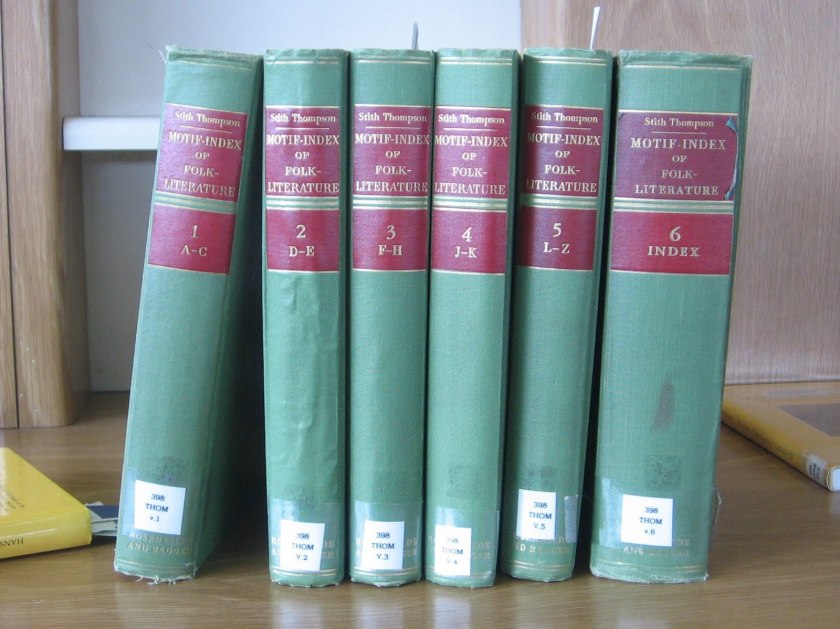
So if we hone down to pick up a folktale type with its motifs from the Aarne-Thompson catalogue, we can find a story and use it as an example — a case study to explain what a faerie-tale might tell us about ourselves and our beliefs. Type ML-4075 is ‘Visits to faerie dwellings.’ Add some motifs such as ‘Faeries made visible through use of ointment’ (F235.4.1) and ‘Faeries take human nurse to care for faerie child’ (F372), then we can narrow things down to a distinct group of folktales containing these elements, from India, Russia, Scandinavia, Lithuania, Britain, France and Ireland; all with their own idiosyncrasies but quite clearly from the same story-stock. The narratives suggest a relatively short gestation period before being collected in the 19th century and catalogued in 1910, although many of the story elements do seem to incorporate much older themes (Gervase of Tilbury records some of the motifs in a 13th-century French story). And the stories wide geographical dispersal suggests the messages they hold have a universal quality — their geneses seem to be local and organic, but tapping into an unknown non-local source. My favourite is one of the Cornish versions collected by the folklorist Robert Hunt in 1865: Cherry of Zennor. It goes something like this:
The time-setting is mid 19th century. Cherry is sixteen and lives in the village of Zennor on the north Cornish coast with her family in respectable poverty. She heads off to seek a job in service, but lethargy and a certain work-shyness get the better of her and she sits down for a mope on the moors, next to an ancient stone cross. Out of nowhere a well-dressed gent appears, flatters her, flirts with her, and tells her he’s a widower and wants her to come to his home, where there is a child to look after. She agrees enthusiastically. There is an interesting sequence where they walk what seems to be miles, but always downwards and through sunken lanes where the overhanging trees formed a tunnel-like descent. The house and gardens are beautiful and so is the little boy, who is to be Cherry’s charge. Unfortunately, for Cherry, the ex-mother in law is still hanging around and she’s a surly sort, who goes out of her way to make Cherry’s life difficult.
Here we are introduced to the magic ointment, which Cherry has to balm the child’s eyes with each morning. She is advised by the mother in law to never apply it to her own eyes (I think you’ll guess what might happen later with that loaded concept). The old woman then takes Cherry through dark corridors in the house (another tunnel-like journey) into a forbidden room, where there are (bizarrely) a group of human statues, some complete, others not. The insinuation is that they’re real humans turned to stone. When Cherry is ordered to polish a ‘coffin-like box’ containing one of the statues, they start to come to life. Quite reasonably, Cherry faints, a ruckus is caused and the master turns up. He kicks out the mother in law, forbids Cherry to enter the room again, and then turns on the charm for a few days, kissing and flirting with Cherry in the garden.
All’s well for a while — Cherry looks after the child, gets her romance-lite and is generally enamoured with her new life. But when she — inevitably — decides to use the ointment on her own eyes things take a change for the weird: “Everything now looked different about the place. Small people were everywhere, hiding in the flowers sparkling with diamonds, swinging in the trees, and running and leaping under and over the blades of grass.” She sees the master playing with some of the little ladies in a well, and then the following evening spies him in a surreal musical communion with the stone statues through the keyhole of the forbidden room, where sure enough they had all come to life.
So the next day, when he comes on hot with some hanky-panky, she slaps his face and tells him what she saw and how jealous she’s been. That’s the end of the road for Cherry — her use of the ointment and her betrayal of trust means she has to go home. The master takes her back (uphill through the tunnel-like sunken road) to the downs and cross where she first encountered him and leaves her there. She wails for a bit and then returns home (more time has passed here than in her faerie home) with a story no-one believes. Her remaining life consists mostly of depression and hanging out on the downs hoping to see the master again. But he never comes.
Full text from Robert Hunt, Popular Romances of the West of England
In some of the other variations of this story, the girl encounters the master (or the mother in law) again, usually at a market or fair, and when she is asked which eye she sees him with he blinds her in that eye, and she sees faeries no more.
But what can be made of this strange story? What does it mean? Time to apply some interpretations…
So what do we conclude? There is probably much truth in all five interpretations, and certainly much overlap. We could also greatly expand the interpretations here and add further theories (how about the theory from Solipsism that suggests that the story does not exist at all until you the observer come across it and allow its subsequent creation in your own conscious awareness). But hopefully, it is clear that faerie-tales such as Cherry of Zennor hold depths of meaning within them; coded meaning that just needs unscrambling to reveal some secrets direct from faerieland. It’s a strange place… but then reality is strange.
To finish, you might like to try this very trippy faerie cartoon from the 1970s. It’s highly odd, but made by people who demonstrate great attention to faerie detail.
My little sister, I lost her when she was just a child. One day we were together the next she was gone, suddenly and definitively. Her physical memory has become blurred into an arbitrary, flickering collection of blue-eyed glances, soft tones, touches and laughter. But underneath the dulled remembrance rests the sense and perception of an overwhelming loss; at least a loss that has overwhelmed me. She usually comes to me in dreams, but not always.

There is a place at the end of an overgrown garden, down a bank and through some alders to a small, dirty brook. I presume it’s still there. We used to spend endless summer days in that gloomy refuge; reading, talking, ruminating, napping. Our secret chatter should have made its mark there. But everything else rests only with me, in my memory. Her memory is gone; it has become something other than memory.
She was always seeing faeries there. When she was a little girl she’d play games with them but when she was a bigger girl she just talked with them. I was only allowed peripheral glimpses of them amidst the leaves and their voices were never more than the drone of the brook made fleetingly real during drifts into and out of sleep. But I believed in her belief. She’d always start with the invocation: We must not look at faerie men; we must not eat their fruits, who knows upon what soil they fed their hungry, thirsty roots. And then she would laugh and skip down to her special places within the overhanging trees where she would begin her communions.
She was twelve the last time we went there. It was damp and the brook smelled. She came back from one of her spots amidst the trees, pale and tearful. The faeries had sung her a Requiem and promised her that she would be able to come back to me as a blackbird for a short while. But only for a short while, then she would have to disappear completely from the world. She cried as we made our way through the garden. There were no words, just tears. I cannot think further on what happened after this. It is not something I have learned to contemplate without despair.
It was a month or so after her death that I finally allowed myself to visit her grave in the churchyard. The thought of her lifeless, decomposing corpse only a few feet away from me became too much and I retreated to a bench by the church porch. I sobbed, clutching the bench beneath me. Through the tear-mist I saw a female blackbird skip from the branch of a yew tree above me to within a pace of my foot, chirping vigorously. She cocked her head and looked at me with one dark eye.
“I love you,” I whispered.
She briefly preened her wing, cocked her head again and then darted away to a high branch.
“I love you,” I said again. I rested my head and closed my wet eyes, knowing that she was dead but dreaming, and would always be so.
This is a blog site about the otherworldly creatures most often known as faeries. They have taken many forms over the centuries, and interact with humanity in a myriad of ways. Are they nothing but…
Source: About Dead but Dreaming