Syd Barrett has always been a major influence for me; a lost genius amidst the tumultuous cultural times of the late 1960s. I even managed to slip him into my novel Set the Controls for the Heart of the Sun, as an oracle of wisdom to my deranged protagonist. It’s no secret that he was an enthusiastic user of LSD, but probably less well-known (apart from amongst his fan-base) that his very irregular head often interacted with the world of the faeries.
Probably the best biography of Syd is Rob Chapman’s Syd Barrett – A Very Irregular Head,published in 2010. Chapman goes to some length in analysing Syd’s early influences, and how they translated into the first Pink Floyd album Piper at the Gates of Dawn in 1967. The very name of the album is taken from a chapter in Kenneth Graham’s Wind in the Willows, where Rat and Mole take a distinctly mystical journey downriver, and encounter the god Pan playing his pipes in tune with the natural world around him: “in that utter clearness of the imminent dawn, while Nature, flushed with fullness of incredible colour, seemed to hold her breath for the event, Mole looked in the very eyes of the Friend and Helper; saw the backward sweep of the curved horns, gleaming in the growing daylight.” Chapman suggests that Graham’s influence ran deep with Syd, whose ideas about transcendentalism and pantheism came largely from the author’s works. This is confirmed by Syd’s compatriot Emily Young (potentially the inspiration for the Floyd song See Emily Play), who suggested that Syd brought the faerie-tale influences from his childhood into his adult songwriting: “That English Robin and Puck and Goodfellow thing. The slightly whimsical faerie quality that he had, always reading Wind in the Willows. He thought the trees have secrets… I think he was absolutely in touch with that.”
Syd also tapped into other influences, most notably Lewis Carroll and Hilaire Belloc. These were authors who were reacting against the somewhat puritanical children’s literature of the 19th century, by creating subversive stories, deeply entrenched in traditional faerie-tale motifs, but then adding surreal tones on top. This was just in keeping with what Syd was attempting to do with Pink Floyd in 1967, when the cultural zeitgeist was flipping its lid. He was at the forefront of the British psychedelic revolution, but much of his outlook and lyrics were informed by the whimsical longing for an extended childhood, where the influences of Graham, Carroll, Belloc et al. were pervasive. His on-off girlfriend at the time, Libby Gausden, suggested that he got all of his lyrical ideas from these authors and a few pocket books of English nursery rhymes. She also talks about him recreating scenes from his favourite stories when they went for excursions into the country. Whether Syd’s increasing use of LSD informed his interaction with the natural world and the faerie entities he transformed into song, is not known, but is certainly a possibility. There is little doubt that much of the musical and lyrical content of Piper at the Gates of Dawn evolved from psychedelic states, imbuing the record with an otherworldy enchantment, punctuated by the arcane whimsy of Syd’s influences. Outside of the cosmic rock-outs of Astronomy Domine and Interstellar Overdrive, the album is overwhelmingly Syd’s vision of a faerie-tale world, in the English tradition. This is not all fey whimsy though. Matilda Mother is a good example of a faerie-tale laced with hints of darkness:
There was a king who ruled the land.
His majesty was in command.
With silver eyes the scarlet eagle
Showers silver on the people.
Oh Mother, tell me more.
Why’d’ya have to leave me there
Hanging in my infant air
Waiting?
You only have to read the lines
They’re scribbly black and everything shines.
Across the stream with wooden shoes
With bells to tell the king the news
A thousand misty riders climb up
Higher once upon a time.
Wandering and dreaming
The words have different meaning.
Yes they did.
For all the time spent in that room
The doll’s house, darkness, old perfume
And fairy stories held me high on
Clouds of sunlight floating by.
Oh Mother, tell me more
Tell me more.
In Flaming, Syd explicitly takes on the persona of the faerie ‘mad with joy’:
Alone in the clouds all blue
Lying on an eiderdown.
Yippee! You can’t see me
But I can you.
Lazing in the foggy dew
Sitting on a unicorn.
No fair, you can’t hear me
But I can you.
Watching buttercups cup the light
Sleeping on a dandelion.
Too much, I won’t touch you
But then I might.
Screaming through the starlit sky
Traveling by telephone.
Hey ho, here we go
Ever so high.
Alone in the clouds all blue
Lying on an eiderdown.
Yippee! You can’t see me
But I can you.
And in The Gnome, we’re left in no doubt about the subject matter. The other members of the band wanted it left off the album, but Syd was having none of it. It’s quirky and childlike, and will always raise a smile:
I want to tell you a story
About a little man
If I can.
A gnome named Grimble Crumble.
And little gnomes stay in their homes.
Eating, sleeping, drinking their wine.
He wore a scarlet tunic,
A blue green hood,
It looked quite good.
He had a big adventure
Amidst the grass
Fresh air at last.
Wining, dining, biding his time.
And then one day – hooray!
Another way for gnomes to say
Oooooooooomray.
Look at the sky, look at the river
Isn’t it good?
Look at the sky, look at the river
Isn’t it good?
Winding, finding places to go.
And then one day – hooray!
Another way for gnomes to say
Oooooooooomray.
Ooooooooooooooomray.
After Syd left Pink Floyd in 1968, his solo work became more oblique, and less obviously influenced by faerie-tale motifs. Effervescing Elephant (from the 1970 album Barrett) retained the animation of a Belloc pastiche, but Syd’s ever-increasing use of LSD took him into more obscure musical and lyrical territory. In fact, his lovely 1970 song Golden Hair (from the album The Madcap Laughs) might be seen as a book-end to his fascination with faerie-tales, English whimsy and nursery rhymes. He used the words of James Joyce (from his 1907 Chamber Music) to close a door on his past: “My book is closed, I read no more.” Tom Stoppard used this at the beginning of his 2006 play Rock ‘n’ Rollto great effect:
Lean out your window, golden hair
I heard you singing in the midnight air
my book is closed, I read no more
watching the fire dance, on the floor
I’ve left my book, I’ve left my room. For I heard you singing through the gloom
singing and singing, a merry air
lean out the window, golden hair…
Syd Barrett died in 2006, a crazy diamond, who has left a considerable cultural legacy, not least in his English psychedelic faerie-tales, which shone brightly for a brief but beautiful period at the end of the 1960s.
Here’s something a little different. Dr Dinah Roe is a Senior Lecturer in 19th-century literature at Oxford Brookes University. She has just produced this truly insightful introduction to Christina Rossetti’s 1859 mind-bending poem Goblin Market. Is it just the wild imagining of a drugged-up Pre-Raphaelite, a treatise on lesbian incest, a feminist tract, or a vision of the more sinister aspects of the faeries? Maybe all of the above. Rossetti certainly captures the maleficent essence that is often prevalent in faerie-tales. Evidently, she seems quite familiar with the metaphysical realities of these supernatural entities, and weaves them into a dark, dreamlike poem that is both revolutionary for the time and deeply personal. It remains one of the most authentic poetic manifestations of the Otherworld. Dinah Roe’s text is reproduced here (it is freely available through the Creative Commons License), followed by the full text of the poem.
***
Poem Summary
Set in a fairytale world and exploring themes of temptation, sacrifice and salvation, ‘Goblin Market’ tells the story of a fraught encounter between sisters Laura and Lizzie and evil goblin merchants. When Laura exchanges a lock of her golden hair for the chance to taste the goblins’ enchanted ‘fruit forbidden’, she deteriorates until she is ‘knocking at Death’s door’. Her sister Lizzie offers to pay the goblins ‘a silver penny’ for more of their wares, which she hopes will act as an antidote to Laura’s malady. The goblins violently attack Lizzie, smearing their fruits ‘against her mouth’ in a vain attempt ‘to make her eat’. After the goblins are ‘worn out by her resistance’, Lizzie returns home, and Laura kisses the juices from her sister’s face and is restored.
Form and genre
On first reading ‘Goblin Market’, eminent Victorian critic John Ruskin declared that Rossetti’s ‘irregular measures’ were the ‘calamity of modern poetry’ and that she ‘should exercise herself in the severest commonplace of metre until she can write as the public like’.[1] Ruskin’s tin-eared critique unwittingly identifies one of ‘Goblin Market’s’ greatest strengths: its experimental form. A poem whose compelling narrative is animated by a surprising lyric energy, it never conforms to a set rhyme scheme or metrical pattern. For instance, the goblin merchants’ cries in the opening lines tempt not through lavish verbal description, but through form.
Apples and quinces,
Lemons and oranges,
Plump unpeck’d cherries,
Melons and raspberries,
Bloom-down-cheek’d peaches,
Swart-headed mulberries,
Wild free-born cranberries,
Crab-apples, dewberries,
Pine-apples, blackberries,
Apricots, strawberries;-
James McPartlin
The sing-song rhythm of alternating dactylic and trochaic feet mimics the sound of street vendors hawking their wares, while the rhyme scheme eschews traditional corresponding rhyme words in favour of the incantatory repetition of ‘berries’ and a seductive sibilance that hints at the fruits’ dark properties. What is essentially a shopping list is transformed by the musical qualities of Rossetti’s technique, anticipating Walter Pater’s Aesthetic creed that ‘all art constantly aspires towards the condition of music’.[2] Drawing on the conventions of a variety of literary genres including the gothic, fantasy, biblical, children’s literature and fable, Rossetti creates a disorienting fairytale atmosphere that is simultaneously seductive and alienating.
Context
Rossetti wrote this poem in 1859 while volunteering at the St Mary Magdalene Penitentiary for ‘fallen women’ in Highgate. Dedicated to the reform and rehabilitation of prostitutes, this Anglo-Catholic institution was remarkable in the period for its conviction that women who had transgressed sexually could be redeemed. Biographers and critics have argued that the themes of temptation, sexual exchange and sisterly redemption in this poem are influenced by its poet’s experience working as an ‘Associate Sister’ at Highgate.
The poem first appeared in Goblin Market and Other Poems (1862). Rossetti’s skilful and original blend of sound and sense delighted critics and readers alike, although critical plaudits initially exceeded commercial sales. Its fairytale cadences led the Spectator to declare it ‘a true children’s poem’, yet the paper also noted that its adult themes of
Arthur Rackham
temptation, transgression and redemption also appealed to a mature readership.[3] The poem was greeted with rapturous applause when the publisher Alexander Macmillan read a manuscript version out loud to a working men’s society in Cambridge. Rossetti herself was not writing for children during this period, emphatically declining to contribute to a children’s book on the grounds that ‘children are not among my suggestive subjects’.[4] Literary admirers included Algernon Charles Swinburne, Alfred Tennyson and Lewis Carroll, whose Alice’s Adventures In Wonderland (1865) was partially inspired by the poem. Rossetti returned the compliment in 1874, writing a book of children’s stories entitled Speaking Likenesses, which she hoped would imitate Carroll’s success in the booming children’s market.
Heidi Burton
Illustrations and design
The manuscript version is dedicated to Rossetti’s older sister Maria, but the influence of Christina’s painter-poet brother Dante Gabriel is more obvious in the published text. He convinced his sister to abandon her somewhat cloying original title, ‘A Peep at the Goblins’, provided illustrations from ‘Goblin Market’ for the volume’s frontispiece and title page, designed the binding and advised her on page size and the type of paper to be used. He was also involved in the design of the second edition in 1865, correcting the jawline of one of the sleeping sisters in the title page illustration.
A founding member of the Pre-Raphaelite Brotherhood, a group of artists who were particularly interested in the interactions of words and images in general and of poetry and art in particular, Dante Gabriel had previously illustrated William Allingham’s The Music Master and an edition of Tennyson’s poems published by Moxon in 1857. Christina was aware that her brother’s commercial savvy and artistic skill contributed to the success of her first volume of poetry, writing that she preferred her brother as illustrator of her works ‘to the world in general’.[5] As Lorraine Janzen Kooistra has persuasively argued, ‘Goblin Market’ is a landmark publication in the history of English illustration, influencing book design and illustration from the mid-19th century to the present day. The poem has been illustrated upwards of 20 times, ranging from the more traditional Laurence Housman (1893) and Arthur Rackham (1933) gift-book editions to the Pacific Comics version by John Bolton (1984). The detailed surviving correspondence between both Rossetti siblings and Alexander Macmillan about the production of Goblin Market and Other Poems reveals the extent to which the Rossettis shared an artistic vision and exercised control over their work. This Pre-Raphaelite collaborative spirit is also evident in Arthur Hughes’s illustrations for Christina’s later book of children’s verse, Sing-Song (1872), some of which were based on the poet’s own pencil drawings.
Interpretations
Initially received as a moral allegory about the dangers of giving in to temptation, the poem was recast by feminist classic The Madwoman in the Attic (1979) as a parable of female resistance and solidarity. By contrast, in 1973 Playboy Magazine presented the poem as unambiguously pornographic; the text was accompanied by a Kinuko Craft illustration of the goblin attack on Lizzie that left little to the imagination. ‘Goblin Market’ continues to appeal to a popular audience; it has been set to music many times and adapted as a play by Polly Pen and Peggy Harmon in New York (1986) and Nick Hedges in London (1995).
The 20th-century revival of interest in the poem opened the floodgates for Feminist, Marxist, Freudian, Queer Theory and New Historicist critiques which variously interpreted the poem as a warning about the dangers of a free-market economy, a protest against hazardous practices in 19th-century food-adulteration, a Christian tale of sacrifice and salvation, a parable of lesbian empowerment, a fable about anorexia, an expression of incestuous yearning and a tribute to the delicious oral and aural pleasures of poetry itself. ‘Goblin Market’ has continued to thrive in the academic marketplace. The poem continues to attract critical interpretations and artistic adaptations as colourful and diverse as the goblin merchants’ wares, challenging Christina Rossetti’s surely disingenuous claim that she ‘did not mean anything profound by this fairytale’.[6]
Footnotes
[1] John Ruskin to Dante Gabriel Rossetti, 24 January, 1861, Letters of Dante Gabriel Rossetti, ed. by Oswald Doughty and John Robert Wahl, vol. 2 (Oxford: The Clarendon Press, 1965), p. 391.
[2] Walter Pater, The Renaissance: Studies in Art and Literature (London: Macmilllan, [1873] 1913), p.140.
[3] Spectator 12 April 1862, 414-15, quoted in Jan Marsh, Christina Rossetti: A Literary Biography (London: Jonathan Cape, 1994), p.282.
[4] Christina Rossetti to Unknown Recipient, 7 March 1862 in The Letters of Christina Rossetti, ed. by Antony H Harrison, vol. 1 (Carolottesville: University Press of Virginia), p.159.
[5] Ibid., p. 232.
[6] William Michael Rossetti, ‘Notes’ from The Poetical Works of Christina Georgina Rossetti (London: Macmillan, 1904), p.459.
Ravven78’s Goblin Market
Goblin Market by Christina Rossetti (1859)
Morning and evening
Maids heard the goblins cry:
“Come buy our orchard fruits,
Come buy, come buy:
Apples and quinces,
Lemons and oranges,
Plump unpecked cherries,
Melons and raspberries,
Bloom-down-cheeked peaches,
Swart-headed mulberries,
Wild free-born cranberries,
Crab-apples, dewberries,
Pine-apples, blackberries,
Apricots, strawberries; –
All ripe together
In summer weather, –
Morns that pass by,
Fair eves that fly;
Come buy, come buy:
Our grapes fresh from the vine,
Pomegranates full and fine,
Dates and sharp bullaces,
Rare pears and greengages,
Damsons and bilberries,
Taste them and try:
Currants and gooseberries,
Bright-fire-like barberries,
Figs to fill your mouth,
Citrons from the South,
Sweet to tongue and sound to eye;
Come buy, come buy.”
Evening by evening
Among the brookside rushes,
Laura bowed her head to hear,
Lizzie veiled her blushes:
Crouching close together
In the cooling weather,
With clasping arms and cautioning lips,
With tingling cheeks and finger-tips.
“Lie close,” Laura said,
Pricking up her golden head:
“We must not look at goblin men,
We must not buy their fruits:
Who knows upon what soil they fed
Their hungry thirsty roots?”
“Come buy,” call the goblins
Hobbling down the glen.
“Oh,” cried Lizzie, “Laura, Laura,
You should not peep at goblin men.”
Lizzie covered up her eyes,
Covered close lest they should look;
Laura reared her glossy head,
And whispered like the restless brook:
“Look, Lizzie, look, Lizzie,
Down the glen tramp little men.
One hauls a basket,
One bears a plate,
One lugs a golden dish
Of many pounds’ weight.
How fair the vine must grow
Whose grapes are so luscious;
How warm the wind must blow
Through those fruit bushes.”
“No,” said Lizzie: “No, no, no;
Their offers should not charm us,
Their evil gifts would harm us.’
She thrust a dimpled finger
In each ear, shut eyes and ran:
Curious Laura chose to linger
Wondering at each merchant man.
One had a cat’s face,
One whisked a tail,
One tramped at a rat’s pace,
One crawled like a snail,
One like a wombat prowled obtuse and furry,
One like a ratel tumbled hurry scurry.
She heard a voice like voice of doves
Cooing all together:
They sounded kind and full of loves
In the pleasant weather.
Laura stretched her gleaming neck
Like a rush-imbedded swan,
Like a lily from the beck,
Like a moonlit poplar branch,
Like a vessel at the launch
When its last restraint is gone.
Backwards up the mossy glen
Turned and trooped the goblin men,
With their shrill repeated cry,
‘Come buy, come buy.’
When they reached where Laura was
They stood stock still upon the moss,
Leering at each other,
Brother with queer brother;
Signalling each other,
Brother with sly brother.
One set his basket down,
One reared his plate;
One began to weave a crown
Of tendrils, leaves, and rough nuts brown
(Men sell not such in any town);
One heaved the golden weight
Of dish and fruit to offer her:
“Come buy, come buy,” was still their cry.
Laura stared but did not stir,
Longed but had no money.
The whisk-tailed merchant bade her taste
In tones as smooth as honey,
The cat-faced purr’d,
The rat-paced spoke a word
Of welcome, and the snail-paced even was heard;
One parrot-voiced and jolly
Cried “Pretty Goblin” still for “Pretty Polly”;
One whistled like a bird.
But sweet-tooth Laura spoke in haste:
“Good folk, I have no coin;
To take were to purloin:
I have no copper in my purse,
I have no silver either,
And all my gold is on the furze
That shakes in windy weather
Above the rusty heather.”
“You have much gold upon your head,”
They answered all together:
“Buy from us with a golden curl.”
She clipped a precious golden lock,
She dropped a tear more rare than pearl,
Then sucked their fruit globes fair or red.
Sweeter than honey from the rock,
Stronger than man-rejoicing wine,
Clearer than water flowed that juice;
She never tasted such before,
How should it cloy with length of use?
She sucked and sucked and sucked the more
Fruits which that unknown orchard bore;
She sucked until her lips were sore;
Then flung the emptied rinds away
But gathered up one kernel stone,
And knew not was it night or day
As she turned home alone.
Lizzie met her at the gate
Full of wise upbraidings:
‘Dear, you should not stay so late,
Twilight is not good for maidens;
Should not loiter in the glen
In the haunts of goblin men.
Do you not remember Jeanie,
How she met them in the moonlight,
Took their gifts both choice and many,
Ate their fruits and wore their flowers
Plucked from bowers
Where summer ripens at all hours?
But ever in the moonlight
She pined and pined away;
Sought them by night and day,
Found them no more, but dwindled and grew gray;
Then fell with the first snow,
While to this day no grass will grow
Where she lies low:
I planted daisies there a year ago
That never blow.
You should not loiter so.”
“Nay, hush,” said Laura:
“Nay, hush, my sister:
I ate and ate my fill,
Yet my mouth waters still:
Tomorrow night I will
Buy more;’ and kissed her:
“Have done with sorrow;
I’ll bring you plums tomorrow
Fresh on their mother twigs,
Cherries worth getting;
You cannot think what figs
My teeth have met in,
What melons icy-cold
Piled on a dish of gold
Too huge for me to hold,
What peaches with a velvet nap,
Pellucid grapes without one seed:
Odorous indeed must be the mead
Whereon they grow, and pure the wave they drink
With lilies at the brink,
And sugar-sweet their sap.”
Golden head by golden head,
Like two pigeons in one nest
Folded in each other’s wings,
They lay down in their curtained bed:
Like two blossoms on one stem,
Like two flakes of new-fall’n snow,
Like two wands of ivory
Tipped with gold for awful kings.
Moon and stars gazed in at them,
Wind sang to them lullaby,
Lumbering owls forebore to fly,
Not a bat flapped to and fro
Round their rest:
Cheek to cheek and breast to breast
Locked together in one rest.
Early in the morning
When the first cock crowed his warning,
Neat like bees, as sweet and busy,
Laura rose with Lizzie:
Fetched in honey, milked the cows,
Aired and set to rights the house,
Kneaded cakes of whitest wheat,
Cakes for dainty mouths to eat,
Next churned butter, whipped up cream,
Fed their poultry, sat and sewed;
Talked as modest maidens should:
Lizzie with an open heart,
Laura in an absent dream,
One content, one sick in part;
One warbling for the mere bright day’s delight,
One longing for the night.
At length slow evening came:
They went with pitchers to the reedy brook;
Lizzie most placid in her look,
Laura most like a leaping flame.
They drew the gurgling water from its deep.
Lizzie plucked purple and rich golden flags,
Then turning homeward said: “The sunset flushes
Those furthest loftiest crags;
Come, Laura, not another maiden lags.
No wilful squirrel wags,
The beasts and birds are fast asleep.’
But Laura loitered still among the rushes,
And said the bank was steep.
And said the hour was early still,
The dew not fall’n, the wind not chill;
Listening ever, but not catching
The customary cry,
“Come buy, come buy,”
With its iterated jingle
Of sugar-baited words:
Not for all her watching
Once discerning even one goblin
Racing, whisking, tumbling, hobbling –
Let alone the herds
That used to tramp along the glen,
In groups or single,
Of brisk fruit-merchant men.
Till Lizzie urged, “O Laura, come;
I hear the fruit-call, but I dare not look:
You should not loiter longer at this brook:
Come with me home.
The stars rise, the moon bends her arc,
Each glow-worm winks her spark,
Let us get home before the night grows dark:
For clouds may gather
Though this is summer weather,
Put out the lights and drench us through;
Then if we lost our way what should we do?”
Laura turned cold as stone
To find her sister heard that cry alone,
That goblin cry,
“Come buy our fruits, come buy.”
Must she then buy no more such dainty fruit?
Must she no more such succous pasture find,
Gone deaf and blind?
Her tree of life drooped from the root:
She said not one word in her heart’s sore ache:
But peering thro’ the dimness, nought discerning,
Trudged home, her pitcher dripping all the way;
So crept to bed, and lay
Silent till Lizzie slept;
Then sat up in a passionate yearning,
And gnashed her teeth for baulked desire, and wept
As if her heart would break.
Day after day, night after night,
Laura kept watch in vain
In sullen silence of exceeding pain.
She never caught again the goblin cry,
“Come buy, come buy”; –
She never spied the goblin men
Hawking their fruits along the glen:
But when the noon waxed bright
Her hair grew thin and gray;
She dwindled, as the fair full moon doth turn
To swift decay and burn
Her fire away.
One day remembering her kernel-stone
She set it by a wall that faced the south;
Dewed it with tears, hoped for a root,
Watched for a waxing shoot,
But there came none.
It never saw the sun,
It never felt the trickling moisture run:
While with sunk eyes and faded mouth
She dreamed of melons, as a traveller sees
False waves in desert drouth
With shade of leaf-crowned trees,
And burns the thirstier in the sandful breeze.
She no more swept the house,
Tended the fowls or cows,
Fetched honey, kneaded cakes of wheat,
Brought water from the brook:
But sat down listless in the chimney-nook
And would not eat.
Tender Lizzie could not bear
To watch her sister’s cankerous care,
Yet not to share.
She night and morning
Caught the goblins’ cry:
“Come buy our orchard fruits,
Come buy, come buy:” –
Beside the brook, along the glen,
She heard the tramp of goblin men,
The voice and stir
Poor Laura could not hear;
Longed to buy fruit to comfort her,
But feared to pay too dear.
She thought of Jeanie in her grave,
Who should have been a bride;
But who for joys brides hope to have
Fell sick and died
In her gay prime,
In earliest winter time,
With the first glazing rime,
With the first snow-fall of crisp winter time.
Till Laura dwindling
Seemed knocking at Death’s door.
Then Lizzie weighed no more
Better and worse;
But put a silver penny in her purse,
Kissed Laura, crossed the heath with clumps of furze
At twilight, halted by the brook:
And for the first time in her life
Began to listen and look.
Laughed every goblin
When they spied her peeping:
Came towards her hobbling,
Flying, running, leaping,
Puffing and blowing,
Chuckling, clapping, crowing,
Clucking and gobbling,
Mopping and mowing,
Full of airs and graces,
Pulling wry faces,
Demure grimaces,
Cat-like and rat-like,
Ratel- and wombat-like,
Snail-paced in a hurry,
Parrot-voiced and whistler,
Helter-skelter, hurry skurry,
Chattering like magpies,
Fluttering like pigeons,
Gliding like fishes, –
Hugged her and kissed her:
Squeezed and caressed her:
Stretched up their dishes,
Panniers, and plates:
“Look at our apples
Russet and dun,
Bob at our cherries,
Bite at our peaches,
Citrons and dates,
Grapes for the asking,
Pears red with basking
Out in the sun,
Plums on their twigs;
Pluck them and suck them,
Pomegranates, figs.” –
“Good folk,” said Lizzie,
Mindful of Jeanie:
“Give me much and many:” –
Held out her apron,
Tossed them her penny.
“Nay, take a seat with us,
Honour and eat with us,”
They answered grinning:
“Our feast is but beginning.
Night yet is early,
Warm and dew-pearly,
Wakeful and starry:
Such fruits as these
No man can carry;
Half their bloom would fly,
Half their dew would dry,
Half their flavour would pass by.
Sit down and feast with us,
Be welcome guest with us,
Cheer you and rest with us.” –
“Thank you,” said Lizzie: “But one waits
At home alone for me:
So without further parleying,
If you will not sell me any
Of your fruits though much and many,
Give me back my silver penny
I tossed you for a fee.” –
They began to scratch their pates,
No longer wagging, purring,
But visibly demurring,
Grunting and snarling.
One called her proud,
Cross-grained, uncivil;
Their tones waxed loud,
Their looks were evil.
Lashing their tails
They trod and hustled her,
Elbowed and jostled her,
Clawed with their nails,
Barking, mewing, hissing, mocking,
Tore her gown and soiled her stocking,
Twitched her hair out by the roots,
Stamped upon her tender feet,
Held her hands and squeezed their fruits
Against her mouth to make her eat.
White and golden Lizzie stood,
Like a lily in a flood, –
Like a rock of blue-veined stone
Lashed by tides obstreperously, –
Like a beacon left alone
In a hoary roaring sea,
Sending up a golden fire, –
Like a fruit-crowned orange-tree
White with blossoms honey-sweet
Sore beset by wasp and bee, –
Like a royal virgin town
Topped with gilded dome and spire
Close beleaguered by a fleet
Mad to tug her standard down.
One may lead a horse to water,
Twenty cannot make him drink.
Though the goblins cuffed and caught her,
Coaxed and fought her,
Bullied and besought her,
Scratched her, pinched her black as ink,
Kicked and knocked her,
Mauled and mocked her,
Lizzie uttered not a word;
Would not open lip from lip
Lest they should cram a mouthful in:
But laughed in heart to feel the drip
Of juice that syruped all her face,
And lodged in dimples of her chin,
And streaked her neck which quaked like curd.
At last the evil people,
Worn out by her resistance,
Flung back her penny, kicked their fruit
Along whichever road they took,
Not leaving root or stone or shoot;
Some writhed into the ground,
Some dived into the brook
With ring and ripple,
Some scudded on the gale without a sound,
Some vanished in the distance.
In a smart, ache, tingle,
Lizzie went her way;
Knew not was it night or day;
Sprang up the bank, tore thro’ the furze,
Threaded copse and dingle,
And heard her penny jingle
Bouncing in her purse, –
Its bounce was music to her ear.
She ran and ran
As if she feared some goblin man
Dogged her with gibe or curse
Or something worse:
But not one goblin skurried after,
Nor was she pricked by fear;
The kind heart made her windy-paced
That urged her home quite out of breath with haste
And inward laughter.
She cried, “Laura,” up the garden.
“Did you miss me?
Come and kiss me.
Never mind my bruises,
Hug me, kiss me, suck my juices
Squeezed from goblin fruits for you,
Goblin pulp and goblin dew.
Eat me, drink me, love me;
Laura, make much of me;
For your sake I have braved the glen
And had to do with goblin merchant men.”
Laura started from her chair,
Flung her arms up in the air,
Clutched her hair:
“Lizzie, Lizzie, have you tasted
For my sake the fruit forbidden?
Must your light like mine be hidden,
Your young life like mine be wasted,
Undone in mine undoing,
And ruined in my ruin,
Thirsty, cankered, goblin-ridden?” –
She clung about her sister,
Kissed and kissed and kissed her:
Tears once again
Refreshed her shrunken eyes,
Dropping like rain
After long sultry drouth;
Shaking with aguish fear, and pain,
She kissed and kissed her with a hungry mouth.
Her lips began to scorch,
That juice was wormwood to her tongue,
She loathed the feast:
Writhing as one possessed she leaped and sung,
Rent all her robe, and wrung
Her hands in lamentable haste,
And beat her breast.
Her locks streamed like the torch
Borne by a racer at full speed,
Or like the mane of horses in their flight,
Or like an eagle when she stems the light
Straight toward the sun,
Or like a caged thing freed,
Or like a flying flag when armies run.
Swift fire spread through her veins,
knocked at her heart
Met the fire smouldering there
And overbore its lesser flame;
She gorged on bitterness without a name:
Ah! fool, to choose such part
Of soul-consuming care!
Sense failed in the mortal strife:
Like the watch-tower of a town
Which an earthquake shatters down,
Like a lightning-stricken mast,
Like a wind-uprooted tree
Spun about,
Like a foam-topped waterspout
Cast down headlong in the sea,
She fell at last;
Pleasure past and anguish past,
Is it death or is it life?
Life out of death.
That night long Lizzie watched by her,
Counted her pulse’s flagging stir,
Felt for her breath,
Held water to her lips, and cooled her face
With tears and fanning leaves:
But when the first birds chirped about their eaves,
And early reapers plodded to the place
Of golden sheaves,
And dew-wet grass
Bowed in the morning winds so brisk to pass,
And new buds with new day
Opened of cup-like lilies on the stream,
Laura awoke as from a dream,
Laughed in the innocent old way,
Hugged Lizzie but not twice or thrice;
Her gleaming locks showed not one thread of grey,
Her breath was sweet as May,
And light danced in her eyes.
Days, weeks, months, years
Afterwards, when both were wives
With children of their own;
Their mother-hearts beset with fears,
Their lives bound up in tender lives;
Laura would call the little ones
And tell them of her early prime,
Those pleasant days long gone
Of not-returning time:
Would talk about the haunted glen,
The wicked, quaint fruit-merchant men,
Their fruits like honey to the throat
But poison in the blood;
(Men sell not such in any town):
Would tell them how her sister stood
In deadly peril to do her good,
And win the fiery antidote:
Then joining hands to little hands
Would bid them cling together, –
“For there is no friend like a sister
In calm or stormy weather;
To cheer one on the tedious way,
To fetch one if one goes astray,
To lift one if one totters down,
To strengthen whilst one stands.”
Here’s another short excerpt from the tale I’m writing about a folklorist’s visit to a psychiatric hospital in England during the summer of 1970. It is the next scene with my Chilean exile Fernanda, following on from Fernanda, Faeries and Ravens…
I was alone again. Albe, Moore and Scrope had disappeared up-country somewhere leaving me in my quarters with nothing but the sound of the ticking clock, marking out the minutes and hours; creating time to reflect on the deficiencies of my life to date. What was I doing here? I’d swapped the intolerable isolation of my university research for the unendurable confinement of this lunatic asylum. As the days had dripped by, I recognised the old symptoms re-emerging: dulled vision, stomach cramps, endemic procrastination, and a growing fear of going outside and interacting with people. I was even beginning to suspect that the hospital orderlies had all been infected with the insanity that they dealt with on a daily basis. It was usually the timbre of their voices; the merest hint of derangement that spoke of exposure to madness over a prolonged period. It was worse in the male staff. They all seemed to exhibit a disquieting emptiness in their tone, as if they were reading from a script, like bad actors. Maybe it was because they were suspicious of me. Maybe they wondered what I was doing here as well, and were acting accordingly. I went over each conversation with them since I’d been here, further instilling the the shaky paranoia that had made itself at home with me. This was not good. I had to break out from this cycle of thought before I went to meet Fernanda, otherwise I might have one of my flip-outs. Christ, they might even put me on a ward if that happened.
I pulled myself up to the desk and poised my fingers over the Olympia that Moore had loaned me, to put my notes in order. I knew I wasn’t going to manage to do anything, but the act of intention distracted me from incessantly thinking the worst of everything. I rolled the sheet of paper up and locked it in position. I stared at it for a few moments, then typed: My sister… I’m so sorry. Please come back… . My breathing shallowed and the usual tears welled up. I yanked out the paper, screwed it up and flung it over the room. One thing was for sure, she wasn’t coming back.
***
I made my way out to the vegetable gardens in the late afternoon. The sun was shining for once, but the wind took the heat out of it. In my head I went over some of the faerie motifs from the Aarne-Thompson index, agitated, and wondering if Fernanda would come up with anything beyond her neurotic imaginings about nature spirits. I stopped for a moment behind the laundry building, closed my eyes and pictured her. My hands shook a little. I steadied my breathing and walked on.
She was sitting on the tree stump where she fed the ravens, eyes closed, head bowed, her hands clasped together as if in prayer. I coughed before I reached her, so as to not startle her. She waited until I was a few feet away and slowly raised her head. She kept her eyes closed for a moment, then opened them; black and watery.
‘Hola,’ she said, continuing to stare ahead.
‘Hey Fernanda. Nice day… bit windy.’
God, what did I sound like? Why did I always make personal contact so uncomfortable? She didn’t seem to notice, but when she turned to look at me the curve of her lips suggested that she was reading my awkwardness perfectly.
‘It’s not a good day my friend. There is some bad news.’
I tensed up, shoulders and stomach. She observed me for a few seconds, and her words began to echo inside my head somehow. At that moment I was quite sure she was putting them there herself, negating the need to say anything else by reinforcing what she had already said by direct, wordless communication.
‘Telepatía,’ she whispered, standing up, close to me, her black eyes still pooled with tears. ‘I know you don’t believe, but it’s true anyway.’
‘I’m not quite sure what to believe Fernanda. Why is there bad news?’
‘There has been a suicide.’
‘Really? In the hospital?’
‘No, here. In the cobertizo.’
She motioned to the tool shed on the edge of the gardens. My pulse quickened.
‘A faerie has ended her life there… she did it for you.’
I stared at her, looking for something that would abbreviate her words in her face. There was nothing there.
‘Fernanda, please don’t play games with me. I can’t deal with this sort of thing right now.’
She moved closer to me and stroked back some hair that had fallen over my eyes.
‘We know you’ve been thinking about ending your life my friend. We know how sad you’ve been. She did it so you do not have to. It was a selfless act. Las Hadas have no ego. This one soaked up your sorrow and and ended her existence so that you can continue. She knew your life must carry on, but there had to be a sacrifice. The sacrifice was her life.’
A head-rush dulled my vision for a moment. My hands were shaking so much I put them behind my back instinctively.
‘Fernanda, I… I… .’
‘You must come and see. It is tragic but it is beautiful. You must come and see… come.’
She reached round, took my hand from behind me and led me, unresisting to the shed.
***
We walked back slowly to the main building of the hospital hand in hand. We didn’t speak, but I could hear her lilting voice in my head, sometimes in English, sometimes in Spanish: it’s ok… you’ll be ok. It was meant to be… mantener la calma. In between her words I tried desperately to rationalise what I’d just seen. But every attempt failed. What I’d seen was not rational, it was absurdly irrational, but as real as the neo-gothic walls of the hospital in front of us. I was going to have to overhaul my understanding of the nuts and bolts of this world. It had just been forced upon me. There was no choice. The only choice was acceptance.
She left me at the door with a kiss on the cheek but no words. I wondered why it was she who was going back to the ward instead of me. If I told Dr Dawkins what I’d just experienced, he’d probably commit me on the spot.
In my head I heard Fernanda’s voice again: she is dead but dreaming. Soñando.
‘My sister or the faerie?’ I said out loud. There was no response. I walked, unseeing, back to my quarters.
The website Ancient Originshave been kind enough to add me as a guest author. Below is a link to a new article The Origins of the Faeries.
The faeries appear in folklore from all over the world as metaphysical beings, who, given the right conditions, are able to interact with the physical world. They’re known by many names but there is a conformity to what they represent, and perhaps also to their origins. From the Huldufólk in Iceland to the Tuatha Dé Danann in Ireland, and the Manitou of Native Americans, these are apparently intelligent entities that live unseen beside us, until their occasional manifestations in this world become encoded into our cultures through folktales, anecdotes and testimonies. In his 1691 treatise on the faeries of Aberfoyle, Scotland, the Reverend Robert Kirk suggested they represented a Secret Commonwealth, living in a parallel reality to ours, with a civilization and morals of their own, only visible to seers and clairvoyants. His assessment fits well with both folktale motifs, and some modern theories about their ancient origins and how they have permeated the collective human consciousness. So who are the faeries, where do they come from, and what do they want?
Here is a recent article by David Halpin, a colleague of mine who writes extensively, and excellently about esoteric subject matter, including the faeries. It is published on the Ancient Originswebsite, where he is a guest author.
“… the realm of fairy or the crypto-terrestrial is more often encountered through places considered sacred or having an alignment of some kind in relation to auspicious days in the yearly cycle, such as solstices, equinoxes and new moons. In many legends passed down from oral traditions the liminal moments at dusk, between sunset and moonrise, are when the ethereal forms of these beings are best seen.”
“We see that the threshold that sharply divides the sense world from the supersensible world must be respected absolutely… one has to understand how to conduct oneself in both worlds; one may not carry over into one world the method of observation that is right for the other.” Rudolf Steiner, Perception of the Elemental World (1913).
The faeries can seem quite insane. In folklore they frequently kidnap people, abduct children, mesmerise night wanderers by drawing them into dancing circles, blind those who can see them, and generally adhere to a different set of morals to humans. In psychiatric terms, the faeries might be seen as suffering from a mass psychosis. But there is much more to their reality than their representation in folklore, which is usually burdened with the need to tell a story. In fact, it might be suggested that what underlies the folktale perception of the faeries is a deeper metaphysical authenticity. This is their existence as nature spirits.
In a series of lectures between 1908 and 1924, the Austrian spiritual philosopher Rudolf Steiner outlined his concept of these nature spirits (sometimes calling them elementals) and their fundamental role in ensuring the propagation of the natural world. Steiner took clairvoyance as a given reality, and his language is sometimes difficult and obtuse, but his descriptions of the inter-penetrating of the physical world with the spiritual world is compelling, and points towards a deeper, cosmic understanding of the nuts and bolts of how the world really works. He terms consensus reality as the sense world, and the spiritual realm as the supersensible world. For Steiner, the supersensible world exists as a field of energy devoid of matter, but which constantly interacts with the physical sense world. What exists in the supersensible world is in effect a fifth dimension of reality upon which our own four dimensions rely, and which is essential to the well-being of all life, but can only be perceived by clairvoyance. It is this special faculty that allows people to recognise how the worlds of matter and spirit intertwine.
Steiner saw the supersensible as indispensable to the material world in the same way as consciousness is the necessary animating force to the physical bodies of humans. And he saw consciousness as the key to crossing the boundary between our world of the five senses and that of the nature spirits. He insists that ‘thought forms’ are the only way we are able to perceive the elementals and to understand what they are doing in nature, which he likens to unseen electricity bringing life to dormant machinery. To do this, a person must transform their usually passive thought forms into something more dynamic. In normal consciousness thoughts:
“… allow themselves to be connected and separated, to be formed and then dismissed. This life of thought must develop in the elemental world a step further. There a person is not in a position to deal with thoughts that are passive. If someone really succeeds in entering the world with his clairvoyant soul, it seems as though his thoughts were not things over which he has any command; they are living beings… You thrust your consciousness into a place, it seems, where you do not find thoughts that are like those in the physical world, but where they are living beings.” Rudolf Steiner,Perception of the Elemental World(1913).
This sounds much like a meditative state. It is certainly an altered state of consciousness, where thought forms take over from the five senses. Steiner insists that this is the only way to enter into the metaphysical world of the nature spirits. It’s a concept explored in more detail in my previous post, which links perception of faeries to shamanic trance and states induced by psychedelic substances: Shamans, Faeries, Aliens and DMT. But Steiner goes on to describe the specific elemental animating forces at work in the natural world when perceived clairvoyantly.
The elementals in the supersensible world exist as a range of beings, from devas, which are responsible for entire autonomous landscapes, through to the smaller nature spirits charged with the growth of vegetation. Steiner divides these into four main types corresponding to earth, water, air and heat/light. The gnomes are the earth spirits,
A Brian Froud Gnome
manipulating the plant genes from seed and root in the ground. Steiner describes them as pure intellect, simply knowing what is needed for the propagation of each genus, and wholly devoted to the process of new life and regeneration. Their modern representation as painted suburban statues is a mutation of their real form as chthonic entities, constantly working and moving the primal forces of metamorphosis in the earth.
Above ground the watery Undines look after the chemistry of growth, existing as amorphous beings in every drop of moisture, and clinging to leaf and bark to nurture
Undines
the vegetation in its proper form. Steiner asks us to look at a drop of water on a leaf and to put our thoughts into it completely, to the exclusion of all else. It moves, is absorbed, and reflects light, until its chemical compounds are integrated into the physical body of the plant. Within it are the Undines, visible if you are able to think them into existence.
A Sylph
The Sylphs are the nature spirits of the air, most familiar as aerial faeries, accompanying the pollinating insects and ensuring the transmission of life from male to female. They exist purely as agents of transference, without intellect or intent, but with an absolute commitment to bringing the life-force of nature from one place to the other by way of the air.
Finally, the Salamanders are the metaphysical components of light and heat. It might be suggested that their supernatural status has been compromised by modern quantum physics, which has made them into sub-atomic photons, which will only exist when they are observed by a conscious observer. They are the simplest of the nature spirits, corresponding to the photon as the most reduced life-force upon which all else is dependent.
Photons or Salamanders?
Heady stuff? Well maybe, but Steiner’s metaphysics finds common ground with the compelling theory of Morphogenetic Fields propounded by the biochemist Rupert Sheldrake. This is a theory of formative causation in nature:
“Over the course of fifteen years of research on plant development, I came to the conclusion that for understanding the development of plants, their morphogenesis, genes and gene products are not enough. Morphogenesis also depends on organising fields. The same arguments apply to the development of animals. Since the 1920s many developmental biologists have proposed that biological organisation depends on fields, variously called biological fields, or developmental fields, or positional fields, or morphogenetic fields.” Rupert Sheldrake’s Morphic Fields.
Sheldrake’s description of this organising principle behind the natural world is issued in the language of biochemistry, but in effect, what he postulates is the same as Steiner’s vision of nature spirits in action. There are invisible forces that are essential in ordering life on earth, something that conventional science accepts in the case of gravitational waves or magnetism, but has a hard time with when it comes to life itself. Steiner’s thesis is that the nature spirits are anthropogenic representations of these morphogenetic fields, imposed upon them through the thought forms of the observer, who perceives them clairvoyantly. Call them what you will, but they exist, and are essential in maintaining reproductive life; they are a form of consciousness responsible for the creation and sustenance of matter. They are the memory of nature.
As a concrete example of the nature spirits (or morphogenetic fields) in action, we might take the example of the Findhorn Community in Scotland. This remarkable experiment was started in 1962 by an ex-RAF Squadron Leader, Peter Caddy, his wife Eileen and a colleague Dorothy MacClean. Due to straightened circumstances they moved to Findhorn near the Moray Firth, a barren, sandy piece of land, in a caravan, and attempted to begin cultivation. Although unknown to her at this point, Dorothy (who was a committed Presbyterian Christian) evidently had psychic clairvoyant abilities, and was soon communicating with the elementals, including the devas responsible for
The original Findhorn caravan
entire species of plants within the landscape. She passed on her communications to the Caddys, instructions and advice from the nature spirits, and within a year the dunes were transformed into lush vitality. Findhorn became famous for 40-pound cabbages, and within two harvests they had created a sustainable smallholding, even selling surplus produce in the local neighbourhood. Dorothy described the supernatural beings as energy forms, working behind the seen material state of the vegetation. She described the devas as holding:
“… the archetypal pattern and plan for all forms around us, and they direct the energy needed for materialising them. While the devas might be considered the ‘architects’ of plant forms, the nature spirits or elementals, such as gnomes or faeries, may be seen as the ‘craftsmen’, using the blueprint of energy channeled to them by the devas.”
Findhorn continued to flourish, and today exists as the Findhorn Foundation, a spiritual community that still relies on the precept of working with the nature spirits to ensure a sustainable organic environment in harmony with the fields of energy that have made it such a special place. It features in the 2013 documentary film The Fairy Trail: A Documentary about Nature Spirits by Till Gerhard and Britta Schmidtke, where Dorothy MacClean talks about the early days of the community, and how she was able to plug into the elemental world to the mutual benefit of humans and nature spirits.
Also featured in this documentary is Marko Pogačnik, a Slovenian artist and ‘earth healer’, who travels the world to connect with the nature spirits, in order to communicate with them and heal damaged landscapes. His overview of how he works with the intelligence in nature is best found in his 1996 publication Nature Spirits and Elemental Beings, where he describes tuning into the morphogenetic fields surrounding landscapes and individual components within them. One of the ways he heals these landscapes is through what he calls lithopuncture, art installations of standing stones, meant to act upon the earth in the same way as acupuncture works on the human (or animal) body. This links us clearly to prehistoric morphological designs, such as stone circles and rows. Marko suggests that our prehistoric ancestors were full-time collaborators with the nature spirits, and were using their own lithopuncture partly to induce harmony and regulation to their surrounding environments. Post-industrial ignorance of the invisible intelligence in nature has created a disconnection with natural landscapes, much to the detriment of all life and the earth’s biosphere itself:
“Rational scientific paradigm has, during the last two centuries, imposed upon humanity a pattern of ignorance towards those beings and dimensions of life that do not know physical appearance and yet are inevitable for life processes to run and to evolve. My effort as an artist and a human being is to get intimate experience of those invisible dimensions and beings, and share the experience and knowledge about the invisible worlds of Earth and Universe with my fellow human beings to change that extremely dangerous pattern that ignores the sources of life itself.” Marko Pogačnik’s website.
Marko with a lithopuncture stone
So where does this leave us with the faeries? In some ways much of their representation in folklore is at odds with this discussion of them as nature spirits and elementals. Their folkloric mischievous immorality does not seem to correspond with the perception of them as energy fields feeding the vital life-force of nature. But this misses the point somewhat. The faeries of folklore and the nature spirits do fit in to a single phenomenon of supernatural beings that need to be observed, understood and propitiated by humans. If we don’t, an imbalance is created in nature; the energy of the elementals will die, or the faeries will cause us problems. They are two sides of the same coin. They are also usually invisible, ultra-dimensional beings only perceptible when the human brain re-tunes itself to an altered state of consciousness. Rudolf Steiner suggested that it is thought itself that makes them manifest, and that clairvoyance is the method for allowing our consciousness to cross the barrier between the sense world and the supersensible world. The faeries and the nature spirits live in the collective consciousness of humanity, only interacting with the material world when we fully accept them for what they really are.
***
Rudolf Steiner
NB: Rudolf Steiner was prescient on many levels. When the proto-Nazi National Socialist German Workers Party gained strength in Germany after the First World War, he warned about the potential disastrous effects on Europe if they ever got into power. Hitler attacked Steiner on many fronts, including his unorthodox views, and accused him of being a tool of the Jews, while other nationalists in Germany called for a ‘war against Steiner’. In 1922 a group of National Socialists invaded a lecture he was delivering in Munich, in an attempt to physically attack him on stage, but Steiner gave them the slip through a rear entrance. He continued his warnings about their agenda until his death in 1924.
Who are the faeries? In 1969, the astrologer and computer scientist Jacques Vallee, in his book Passport to Magonia, put forward the theory that they were one and the same as the alien beings who had been purportedly abducting people around the world for a couple of decades by that date.
His hypothesis is that there is a commonality to the experiences reported in alien abduction scenarios, and the reports of interactions with faeries in folklore. He suggests the aliens and the faeries are essentially the same phenomena, tuned through the cultural receptors of the time and then interpreted accordingly. He makes special reference to the regular motifs in faerie-tales of the abduction, by various means, of humans by faeries. There’s a lot of data here – it’s the commonest motif in faerie folklore. For a variety of reasons humans are taken to faerieland in the stories, either as…
Faeries are difficult to portray through the medium of film and documentary. They are too amorphous and difficult to pin down – a bit like in real life. They’re happier living in the consciousness of humans than being captured on celluloid. But some have tried, and so whilst not pretending to be an exhaustive list of filmic faeries, I thought I’d put together a list of some of my favourites, both dramatic and documentary. I hope you might find something new here, with all links embedded…
Photographing Fairies (1997)
Photographing Fairies is a 1997 film directed by Nick Willing, based on the book by Steve Szilagyi. It’s also absolutely bloody marvellous. The plot (without spoilers) revolves around a photographer, Charles Castle (played by Toby Stephens) who is beset by grief and guilt after his new wife is killed in an Alpine accident just before the First World War. Hardened against any type of religion or spirituality, he returns from the trenches to his photography business in London. When a woman turns up at his studio with a photo of her daughter with a faerie, he becomes obsessed to find out the truth behind it, taking him on a journey right down the rabbit hole.
The main plot device rests on the faeries becoming manifest during altered states of consciousness, brought about by the consumption of a small white flower. This alters the perception of time and allows interaction with the faeries, who exist as luminous humanoids. The scene when Castle first takes one of the flowers is a cinematographic treat; unsettling, trippy, beautiful and moving all at the same time. He never manages to photograph the faeries, but he does come to the realisation that they are arbiters between the material world and transcendence from this world. In the words of Arthur Conan Doyle (who makes an appearance in the film) they are the handmaidens of the eternal.
Fairytale: a true story (1997)
Also made in 1997, but less dark and hallucinogenic, is Fairytale: a true story, directed by Charles Sturridge. It’s loosely based on the story of the Cottingley faeries, and is viewed from the perspective of the two little girls, Elsie and Polly, who discover and photograph the faeries living in the backwoods of their Yorkshire home during the First World War. The premise is that you have to believe in the faeries to see them, and that this is much more likely to happen if you’re a child. It’s pretty sentimental, but the faerie scenes are well executed, and there is a stellar cast, including Harvey Keitel as Houdini (yes, that Houdini) and Peter O’Toole as Arthur Conan Doyle. The final scene when the whole tribe of winged faeries turn up at the girls’ house (initially seen from the faeries’ perspective) is joyous and magical.
Kirk (2009)
A different approach is taken in Kirk, a 2009 film by the (then) teenage director Michael Ferns. It won the Best Independent Feature Film at the Manchester Festival of Fantastic Films and is reviewed in depth by MJ Simpson here. It’s set in the Scottish Highlands in the late 17th century, and tells the story of the Reverend Robert Kirk, who wrote The Secret Commonwealth of Elves, Fauns and Fairies (see The Secret Commonwealth for my take on the story). It takes a reductionist view of the story, where Kirk’s belief in faeries is wholly instigated by the parish femme fatale, Mary, who lures the married vicar with sweet talk of the faerie folk, much to the chagrin of his wife Abigail. Kirk’s acceptance of the faeries is made to seem delusional, but there is enough ambiguity to keep us wondering about what’s really going on, heightened by the subdued lighting and colour, which lends an ethereal tone to each scene. The faeries themselves never show up, but there are luminous dream sequences where Mary takes the part of the alluring faerie queen, intent on ravishing Kirk. If you know the story, you’ll know it ends badly, and if you have half a heart you’ll be wiping away a tear after a beautifully told tale with sensitive acting and a dynamic screenplay.
Icelandic faeries
Bringing us up to the 21st century are two documentaries that investigate the belief in faeries in Iceland. Huldufólk 102(Hidden People) is a 2006 film, atmospherically underscored by indigenous musical luminaries Sigur Rós, Amina and Múm. One of the talking heads, historian Magnus Skarphedinsson, sets the tone right from the start when he states: ‘There is no doubt in my mind that there are two nations living in this country; the Icelandic nation and the invisible nation.’ This concept is maintained throughout the documentary, which films Icelanders from a range of backgrounds talking about the hidden folk and how they are an intrinsic part of Icelandic culture. It’s an excellent insight into how modern belief in the faeries pervades the society, and affects everyday life, from where to build roads (always avoiding the rock homes of the Huldufólk) through to the faeries incorporation into Christianity. Star of the show is the grizzled and wizened farmer þórleifur Hjalfason, who tells a story about the hidden folk burnishing and sharpening his knife – a common faerie-helper motif in folklore, made real at his remote Icelandic farm.
A bit more out there is the 2002 documentary Elves, Ghosts, Sea Monsters & ETs In Iceland – Investigation Into The Invisible World, which spreads a wide net over Icelanders’ belief in otherworldy beings in their landscape, mostly through the eyes of clairvoyants, who use their psychic abilities to shed light on the faeries and their customs. It’s a beautifully evocative piece of film-making, that brings out the mesmerising strangeness of the Icelandic environment, and presents a modern faerie belief that is deeply embedded and alive in the culture.
The Fairy Faith (2000)
John Walker’s 2000 documentary The Fairy Faithtakes a trip around the UK, Ireland and Cape Breton Island, Canada, to interview people who have had experiences with faeries. The photography is sumptuous and Walker uses Celtic music to draw us into a world where things are not quite as they seem. His narration is sensitive to the beliefs of the people interviewed and we are left with the impression that the faeries are just an inter-dimensional breath away. Highlights include Brian Froud talking about his fantastic faerie artwork, and Eddie Lenihan, the magnificently whiskered Irish storyteller, who tells it like it is (his website can be found here).
When Walker reaches Cape Breton Island in Nova Scotia, he goes with Marie-Rose and her daughter April, to a forest river to hear about their faerie encounter several years previously. It’s quite clear that they are authentic, and genuinely recalling the experience as best they can. The encounter consisted mostly of hearing music and singing — Marie-Rose was evidently afraid of the phenomenon and dragged her children away from the river and into the car to get away. As they drove away, April watched out the back window as a group of small faeries were: “jumping around in a circle, holding hands. They were singing… and dancing in a circle. They sort of mixed right in with the background, and I don’t know whether they were see-through or what.” For my take on the faerie circle dance see Going Round in Circles: The Faerie Dance.
The Fairy Trail (2013)
The Fairy Trail: A Documentary about Nature Spirits is a 2013 film by Till Gerhard and Britta Schmidtke. It takes a decidedly hippy turn, and looks at the faerie phenomenon from a Steineresque angle, with the emphasis on the faeries as nature spirits, interacting with people and the environment. Eddie Lenihan pops up again, but much time is spent at the Findhorn community in Scotland, where the relationship between the people and the nature spirits is an essential concomitant to the success of this unique place. There are several interviews with Dorothy MacClean, one of the original founders of the community in the early 1960s, whose matter of fact descriptions of working with the faeries is fascinating and convincing. The other interviewees are mystics, clairvoyants, environmentalists and witchy sorts, who help us get to the deeper meaning of our connection to the natural world, and the non-material elementals who are always there helping out, for those with the ability to sense them. Marko Pogacnik has a particularly interesting take on working with nature spirits, which includes earth acupuncture based on the hypothesis that this is what our prehistoric ancestors were doing with some of their stone monuments.
A Midsummer Night’s Dream (1999)
Shakespeare’s A Midsummer Night’s Dream faeries are given a full-on luvvy treatment in Michael Hoffman’s big-budget version from 1999. It’s lavish and true to script, but you get the impression that it was all just a jolly so the stars could spend some time in Tuscany. Here’s an excerpt from the New York Times review:
Michael Hoffman’s fussy production of “A Midsummer Night’s Dream” is just such a parade of incongruities, with performances ranging from the sublime to the you-know-what. Hoffman has transported the play’s humans and fairies to Tuscany, where they switch partners under the influence of trickery from Stanley Tucci’s mischievous Puck.
But there’s no magic potion to banish the film’s awkwardness or make it more than a string of intermittent acting highlights. Puck’s “Lord, what fools these mortals be!” looks like an understatement under the circumstances.
There are some other film versions, notably from 1935 and 1996, but perhaps the wackiest version is from 1968, where participants seem to have got into the spirit of the times by partaking of certain psychoactive substances before filming. It’s wild… and Judi Dench appears naked and painted green. If you dare, you can watch it here.
Faeries (1981)
And finally… There may be plenty of cartoon faeries on film, but I’m skipping Tinkerbell and her Disney friends (and definitely passing over Barbie: A Fairy Secret… apparently, Ken gets kidnapped) in favour of this corker from 1981. Faeries tells the story of a medieval mortal (named after the Irish folk hero Oisín) abducted to faerieland in order to help the good faeries see off the goblins, bogeys and hags, who have been causing trouble in the otherworld. The faeries are based on the illustrations of Brian Froud and Alan Lee from their classic book of the same name, and much attention to detail is paid to genuine faerie lore and folklore motifs, such as the hollow hills and the faeries’ circle dance. It’s made for children, but made by adults who have allowed psychedelic mushrooms to be part of their lives. It’s a must view.
***
Addenda February 2017… The Faeries of Blackheath Woods I came across this short faerie film recently. It gives us an alarming visual description of faerie vindictiveness… one of their common folkloric traits.
For the films I’ve missed, you might want to take a look at the list of faerie films on the Fairy Investigation Society’s website here.
Elficología en España also has a You Tube site with some top faerie videos – check it out here.
‘Does a photon exist prior to it’s detection? No, it does not exist until it is detected, according to the current understanding of quantum physics. Up to that point, there is only the photon wave function. Ironically, as soon as it is detected, it no longer exists. It vanishes at the moment it appears! For that reason, I prefer to think of the photon as an event, not as a thing.’ Richard Muller, Prof Physics, UC Berkeley, from Now, The Physics of Time.
The tale of the Rev. Robert Kirk and his Secret Commonwealth, is very peculiar. When read carefully, the text of his 1691 manuscript describing the faeries of Aberfoyle, Scotland gives many clues as to the reality of what he calls the Subterraneans, and how people were able to perceive them and interact with them. Much of the discussion in his text centres around people with the ‘second sight’, An Dà Shealladh in Gaelic, and their ability to sense the faerie world, which was apparently occupying the same space as consensus reality, but would only interact with it under special circumstances. We’ll take a look at this aspect of faerieland later on, focusing on the connection between matter and consciousness and where the faeries fit in. But first, who was Robert Kirk, why was he writing about supernatural races on earth at the end of the 17th century, and what happened to him?
Robert Kirk was the church minister at Aberfoyle in the southern Highlands of Scotland from 1685 to his death at age 48 in 1692. He was also (apparently) the seventh son of a seventh son – a sure sign that he should be carrying the requisite clairvoyance in his genetic makeup. A year after penning The Secret Commonwealth, his body was found on the Faerie Knowe at Aberfoyle, a hill he frequented often in life to consort with the faeries whose customs he describes in the book. His will is dated a day before his death, and the folklorist immediately became the subject of folklore, as rumour spread that he’d been abducted by the faeries for giving away too many of their secrets in his book. The plot
Kirk’s grave at Aberfoyle
thickens when we discover that not only does his grave not contain his body, but that there is a tradition of him appearing in ghostly form to a friend at the christening of his (Kirk’s) posthumous child, with a wheeze to escape faerieland, where he was apparently being held captive. The stunned friend failed to throw a dirk (an iron knife) over the spectral Kirk as pre-planned, dooming the reverend to remain with the faeries, who had taken him into the Faerie Knowe and left a stock or doubleman as his fake body. But the mysterious circumstances of Kirk’s demise pale next to what he had been writing about in The Secret Commonwealth. In his manuscript (not published until 1815) he lays out who the faeries were and who could see them, crystallising what would appear to be a coherent (and matter of fact) belief in the faeries in this part of the Scottish Highlands in the 17th century. The work certainly gives the impression of an educated man (Kirk was the first to translate the Bible into Gaelic) simply describing a supernatural race of beings, much in the way as he might have described a foreign civilisation. And they were quite evidently mad, bad and dangerous to know.
‘Their changeable bodies are somewhat of the nature of a condensed cloud and best seen at twilight.’
Intriguingly, Kirk is less interested in telling folktales than in giving an overview of what these creatures are and how they live. In this, his manuscript is unique and unusual. He calls them Subterraneans, and tells us that they are halfway between humans and angels. Here’s a summary of Kirk’s treatise on the Secret Commonwealth…
They have ‘light and fluid bodies’ much as a condensed cloud or ‘congealed air’, which are mostly visible at dusk. They can appear and vanish at will, and their ‘chameleon-like bodies swim in the air near the earth with bag and baggage.’ Their ‘spongeous bodies’ are pure like air and they feed by sucking out the essence of human food, leaving the material remnant behind.
They live in the earth, either in small hillocks or in subterranean caves. Their dwellings are large and beautiful, but usually invisible to human eyes. These houses are lit by lamps that burn continuously without the need for fuel.
Their civilisation once lived above ground before humans inhabited the land, and Kirk notes that ‘the furrows still visible on very high hills’ were the work of the faeries.
At each quarter of the year, they travel to a new place, as they are nomadic and unable to stay in one place for too long. It is usually at these times that they are encountered by humans who ‘have terrifying encounters with them.’
They are divided into tribes and like humans, they have children, marriages and burials. But Kirk suggests that they may only do this to mock our own customs. Likewise, their language and dress mimic the local people. They have an aristocracy but no religion.
Their philosophy is that nothing dies or disappears, but that ‘everything goes in a circle’ and is refreshed and renewed in a cyclical evolution.
They will happily steal human children, wet-nurses and midwives for their own ends and are prone to the ‘irregularities of envy, spite, hypocrisy, lying and dissimulation.’
Their weaponry consists of flint arrows and they are afraid of iron.
Kirk also suggests that the faeries can be ‘double-men’ or ‘co-walkers’ for humans – that is, each human has a double amongst the Subterraneans, who will ‘haunt them as a shadow’, whether they know about it or not.
Kirk’s treatise goes a long way to depict the faeries, who appear in less descriptive form in countless folktales through the centuries. The impression given is of an intelligent race of beings who do not usually manifest as material beings, but who can interact with humans through various means. The constant theme is that they inhabit our space and time but engage with the material world in a different way to us. They are immaterial. And as far as we know, there is only one immaterial thing in the universe that we can be certain of: consciousness. So is this where the faeries are residing? Kirk’s discussion about the second sight (An Dà Shealladh) is highly suggestive that this is where they are to be found.
Second sight appeared to be a relatively common phenomenon amongst the Scottish Highlanders in Kirk’s time. It is frequently associated with visions of the future, but Kirk concentrates on their ability to interact with the faeries. The seer with second sight is ‘put in a rapture, transport, and sort of death, as divested of his body and all its senses.’ This might correlate with a dream or an altered state of consciousness, where reality is observed and participated in without the usual constraints of the laws of physics. The second sight is a type of shamanistic vision that is dependent on a change in consciousness. Once the change is made, the faeries become real to the observer. But where are they coming from?
Richard Muller’s quote at the top of this post is an important clue to getting behind the faerie phenomenon that Kirk describes with such attention to detail. In the quantum world, the wave function of a photon does not exist until it is observed, when it becomes a particle. But then it vanishes. Muller makes the simple but mind-bending point that this makes the photon an event, not a thing. This is also how consciousness works – it is not a thing, it is a series of events with no material residue. It exists alongside what we think of as material reality, but it never stays there, it is non-local and transient. Kirk’s faeries behave like a photon in a wave function, or a thought in consciousness – they live there waiting to be observed and detected by someone who is able to plug deeper than usual into their own, or the collective, consciousness – those with the second sight, or those in an altered state of consciousness. This would explain the similarities of the faeries to their human counterparts at any time in history (their dress, language etc.), and may also suggest that the faeries have (at least sometimes) transformed into high-tech aliens in recent times (see Shamans, Faeries, Aliens and DMT).
So was Kirk describing a phenomenon conjured up through the consciousness of both himself and the Highland seers from who he received his information? Maybe, although that simplifies things. By describing the customs of the Subterraneans he was depicting events, not things. These events couldn’t be pinned down as material phenomena and recorded in any rational or scientific procedure; they were the product of people who were able to alter their state of consciousness to the point of perceiving realities not usually perceptible. These realities did, and do not, consist of material things, but they were, and are, as real as immaterial events… just as in consciousness or the sub-atomic world. If I were really pushing the boat out, I might even suggest that ultimately, the faeries exist in the quantum world, unseen and implicate, and only turn up in our world when someone with the requisite skills (second sight) observes them there. They are a fundamental part of our reality but normally hidden: a secret commonwealth. I wonder what the Rev. Robert Kirk would think about that?
Time moves differently in faerieland. Once they’ve got you to step through the veil to their world, you’re no longer constrained by the usual passage of time. You are, in effect, outside of time. Folklore is very consistent in its portrayal of this phenomenon, where characters setting foot into faerieland are transported into a distinct, separate reality, with its own laws of physics and its own space-time continuum. Why would this be? And what does it mean?
In the 1891 publication The Science of Fairy Tales, the folklorist Edwin Hartland devoted three chapters to ponder over The Supernatural Lapse of Time in Fairyland. He makes it clear that this motif is deeply embedded in worldwide folklore and mythology from a wide variety of chronological periods. He suggests that the consistency of the story elements involving the strange relative movement of time in faerieland, must stem from a common mythological theme, although he usually stops short of discussing this theme in favour of telling the actual stories. Within these supernatural lapse of time tales there are essentially three ways that time can behave in contradistinction to normal reality: 1. Time stops in the outside world, whilst in faerieland many years can pass with the human participant living a life of enjoyment or suffering with the faeries. The protagonist usually breaks a taboo of some sort and finds themselves back in the real world, where no time has passed. These stories are in the small minority. More often the time dilation moves the other way. 2. This can be quite a drastic shift, so that a character spending days or weeks in faerieland comes back to consensus reality to find decades or even centuries have passed, or, 3. that a few minutes caroling with the faeries turns out to be any length of time up to a year and a day, once they return to the world they came from. Here are examples of each type of time warp, taken from Hartland’s investigations.
1. Shepherds in Wales were commonly transported into faerieland, usually after joining the faeries in a circle dance (see Going Round in Circles for the faerie dance). One 19th-century tale has the lonely shepherd doing just that on a hillside, after which he finds himself in a glittering palace with pleasure gardens, inhabited by the faeries. He lives there for years, even taking the chance to get involved in some romantic attachments with the beguiling black-eyed female faeries. But despite being warned off the fountain, which is filled with gold and silver fish, in the middle of the main garden, he can’t resist overturning the prohibition, and one day, inevitably, he plunges his hands into the water for a drink. Pronto he finds himself back on the cold Welsh hillside with his sheep, during which no time at all seems to have passed.
As mentioned, this sort of time relativity in folklore is the exception to the rule; it usually works the other way round as in 2 and 3 below. Such a story type might represent an adventure experienced whilst in an altered state of consciousness, turned into a folktale that attempts to convey this unusual state of consciousness through conventional ideas about faerieland. The altered state might represent a waking hallucinogenic state or a dream, both of which can allow seemingly long passages of subjective time to take place in seconds or minutes in the real world. This faerie-tale
Captain Picard as Kamin, in a mind-bending altered state of consciousness
concept was skilfully updated in the Star Trek: The Next Generation episode ‘The Inner Light’, when Captain Picard is rendered unconscious by an alien probe, and then – in his mind – experiences an entire lifetime on the planet Kataan, before finally being brought round on the bridge of the USS Enterprise 25 minutes after being knocked out (end clip from The Inner Light). The insinuation is that what happened in Picard’s mind was as real as his life as captain of the Enterprise, and that his consciousness had had a direct effect on material reality. But this is not the usual way time works in faerie-tales…
2. Hartland records an 18th-century version of the Irish story of Oisín as typical of the second type of time-lapse folktales, recorded throughout Europe and Asia. Oisín is a poet of the Fianna, and falls asleep under an ash tree. He awakes to find Niamh, Queen of Tír na nÓg, the land of perpetual youth, summoning him to join her in her realm as her husband. Loved up, off he goes with her, and finds himself living in a paradise of perpetual summer, where all good things abound, and where time and death hold no sway. But soon he breaks a taboo of standing on a broad flat stone, from where he is able to view the Ireland he left behind. It has changed for the worse, and he begs Niamh to give him leave to return. She reluctantly agrees, but asks that he return after only one day with the mortals. She supplies him with a black horse, which he is not to dismount, and ‘gifted him with wisdom and knowledge far surpassing that of men.’ Once back in Ireland he realises that decades have passed and that he is no longer recognised or known of. Inevitably, he dismounts his horse and immediately his youth is gone and he becomes an enfeebled old man with nothing but his immortal wisdom. There is no returning to the faerieland of the Tír na nÓg. In other variations of the story, the hero turns to dust as soon as his feet touch the ground of consensus reality.
‘Oisín and Niamh travelling to Tír na nÓg’ by Stephen Reid (1910)
These folktales seem to suggest that faerieland is the world of the dead, immune from the passage of time, and that return to the world of the living is not possible as the mortal body has aged and decayed in line with the physical laws of this world. In the Japanese tale of Urashima Taro, the hero, when returning home, is even given a casket by his faerie bride, in which his years are locked. When he opens it, his time is up.
These stories articulate a belief in an otherworld that is never heaven, but is apparently ruled over by a race of immortals who can exert control over the consciousness of an individual, who may believe themselves to still be in human form, but are actually already dead and existing in non-material form. It is ultimately the place where the faeries come from; a place untouched by the passage of time and physical death. It could even represent the collective consciousness of humanity made into an understandable form in the stories, immortal in nature and containing all wisdom and knowledge, as suggested in the Oisín tale.
This might be explained by seeing folktales of this type as representing a surviving pagan belief system of the afterlife. This afterlife did not follow the strictures of Christianity or other world religions, and provided an alternative view of what happens to consciousness after death. It is a view that was (in the West) superseded by Christian theology, but that may be surfacing in these folktales as remnants of the previous system of belief (a belief system that remained partially intact but operated underground for fear of religious persecution). The presence of faeries in this otherworld, and their ability to materialise in standard reality, suggests that they were an essential element in pagan ideas about consciousness and that they had a role to play when it came to death. In this theory the characters in the story play the part of messengers, telling us about the true nature of a timeless reality that is distinct and separate from consensus reality, and showing us that human consciousness disassociates from the physical body to exist in a parallel reality such as Tir na n’Og, where the faeries are in charge. This message is encoded in the stories.
The third type of time lapse usually has a less dramatic effect on the protagonist, as they return from an apparently short time in faerieland to a world advanced by either months, or more often by the magical time-span of a year and a day.
3. Hartland records a number of these types of tales from Britain. One was collected in the Scottish Highlands by the folklorist JF Campbell in the 1860s, and includes many of the typical elements. The story involves two men returning home from the town of Lairg, where one of them has just registered the birth of his child in the session books. They sit down to rest at the foot of the hill of Durcha, when music and merriment is heard from within a cavern in the hill. The new father can’t resist investigating and disappears into the hill. On returning home alone, his friend is accused of murder. But a ‘wise man’ suggests he should be able to clear his name by returning to the cavern a year and a day later. He does so, and when he sees a shadow in the cave entrance he grabs it, momentarily revealing his friend dancing in a circle with the music-making faeries. He pulls him out of the circle and the faeries are gone. ‘Could you not have let me finish my reel’ the former captive says, thinking he had only just started dancing with the faeries. He won’t believe that a year and a day have passed until he returns home to find his wife with their year-old child in her arms.
Stories of this type rarely say much about the faeries doing the abducting, only that they seemed capable of drawing the participant out of their own world and into an alternative reality with a different space-time continuum. The year and a day motif is important and is a common time-frame appearing in medieval romances as the amount of time protagonists were given to succeed in quests. In The Golden Bough, Sir James George Frazer highlights the ancient global concept of the Divine King, who was to be ritually murdered after a period of time in charge, which was often a year and a day. The time period was also used in common law to substantiate the legal situation of unwed couples, and it was (in theory) the amount of time a person living under feudal serfdom needed to be absent from his lord’s manor to gain his freedom. Interestingly, a year and a day is also used in Wiccan and other neo-pagan traditions for the time of learning required before being initiated into the first degree. This may all suggest that the folktales of this type have the year and a day motif embedded within them as a message, conveying the idea that it is a magical time-frame. It was a symbolic time-marker for life quests, ruling over others, decisions being made, learning a tradition, securing a marriage, or gaining freedom as one year tips over into another. It was evidently deeply ingrained in both esoteric tradition and everyday life from an early date, rooted in the cycles of the natural world.
As is the case with this tale from the Highlands, these stories usually include a ‘wise man’ who knows that a year and a day is the time needed to free the abductee from the clasps of the faeries. This sounds like the cunning man recorded in Early Modern witch trials, amongst other sources, a type of magical practitioner steeped in esoteric knowledge, who operated within the constraints of Christianity, but who was evidently practising pagan sorcery. Emma Wilby in her 2005 book Cunning Folk and Familiar Spirits convincingly puts these people (men and women) within an ancient shamanic visionary tradition, which had as its main remit an understanding of otherworldly spirits, including the faeries. Once again, we can see the folktale embedding these motifs into the stories, below the radar of religious censorship, so as to tell people the truth gleaned from gnostic shamanic beliefs that were evidently alive and well in pre-industrial societies. The repackaged 19th-century folktales were recording these traditions in coded language, perhaps not understood properly by their listeners, but hiding knowledge of metaphysical realities in plain sight, in the form of a good yarn.
The metaphysical realities these stories attempt to convey have formed a specific mythology that attempts to tell us about otherworlds beyond our own. These otherworlds may differ depending on the story but they are all, essentially, talking about transcendence beyond the physical world. And with transcendence the space-time continuum works in a different way, without the constraints of a world of matter, or with a linear time-flow. The inhabitants of this transcendent otherworld are the faeries, who seem to be able to make occasional appearances in our world, but whose own world is one of consciousness, whether a dream, an altered state, the collective human consciousness… or death. The message is that consciousness has no real need of a dimension of time, and that once freed from the physical world, consciousness is able to transfer to an alternative non-physical universe; a universe that used to be called faerieland. It is a pre-religious mythology pointing at a deeper reality, surviving in encoded form in these types of faerie-tales.
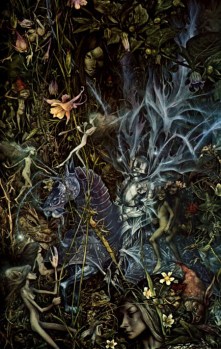
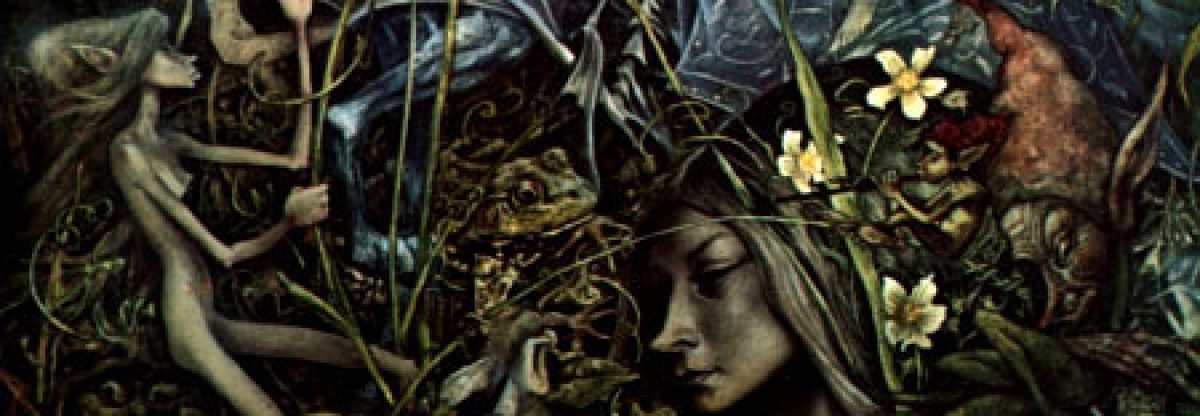
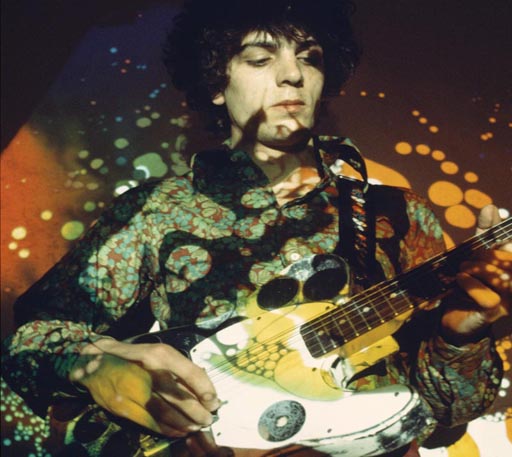
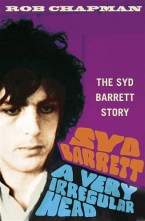 published in 2010. Chapman goes to some length in analysing Syd’s early influences, and how they translated into the first Pink Floyd album Piper at the Gates of Dawn in 1967. The very name of the album is taken from a chapter in Kenneth Graham’s Wind in the Willows, where Rat and Mole take a distinctly mystical journey downriver, and encounter the god Pan playing his pipes in tune with the natural world around him: “in that utter clearness of the imminent dawn, while Nature, flushed with fullness of incredible colour, seemed to hold her breath for the event, Mole looked in the very eyes of the Friend and Helper; saw the backward sweep of the curved horns,
 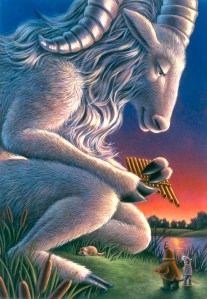 gleaming in the growing daylight.” Chapman suggests that Graham’s influence ran deep with Syd, whose ideas about transcendentalism and pantheism came largely from the author’s works. This is confirmed by Syd’s compatriot Emily Young (potentially the inspiration for the Floyd song See Emily Play), who suggested that Syd brought the faerie-tale influences from his childhood into his adult songwriting: “That English Robin and Puck and Goodfellow thing. The slightly whimsical faerie quality that he had, always reading Wind in the Willows. He thought the trees have secrets… I think he was absolutely in touch with that.”
 into song, is not known, but is certainly a possibility. There is little doubt that much of the musical and lyrical content of Piper at the Gates of Dawn evolved from psychedelic states, imbuing the record with an otherworldy enchantment, punctuated by the arcane whimsy of Syd’s influences. Outside of the cosmic rock-outs of Astronomy Domine and Interstellar Overdrive, the album is overwhelmingly Syd’s vision of a faerie-tale world, in the English tradition. This is not all fey whimsy though. Matilda Mother is a good example of a faerie-tale laced with hints of darkness:
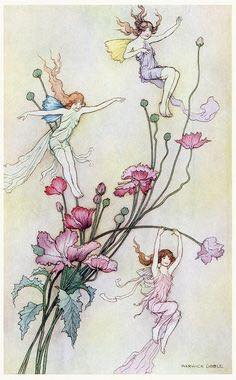
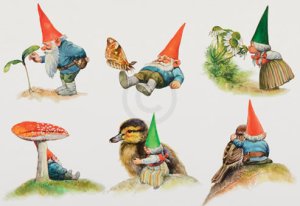
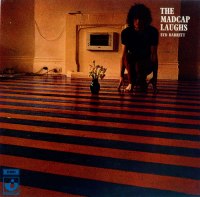
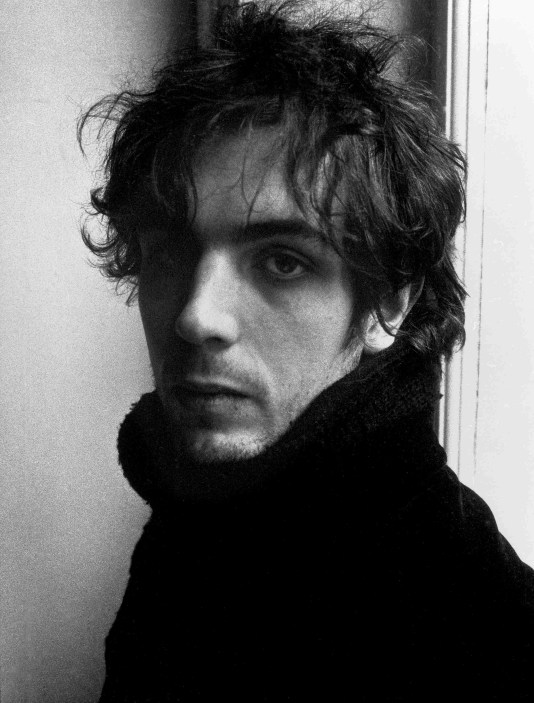
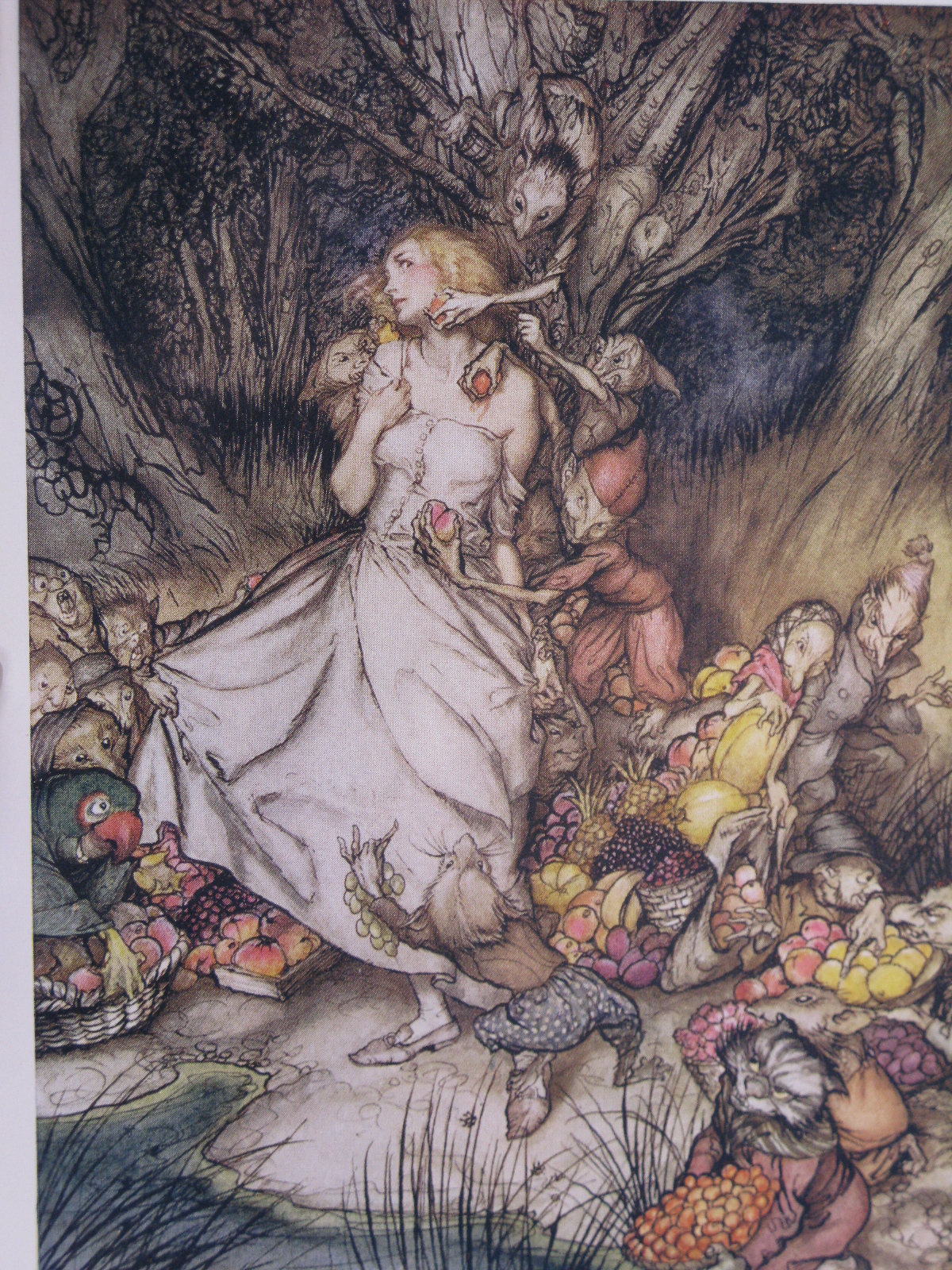
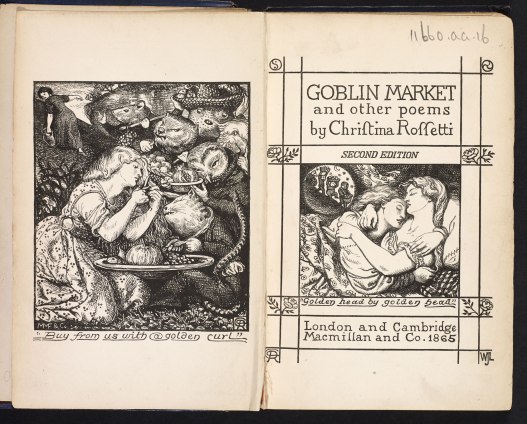
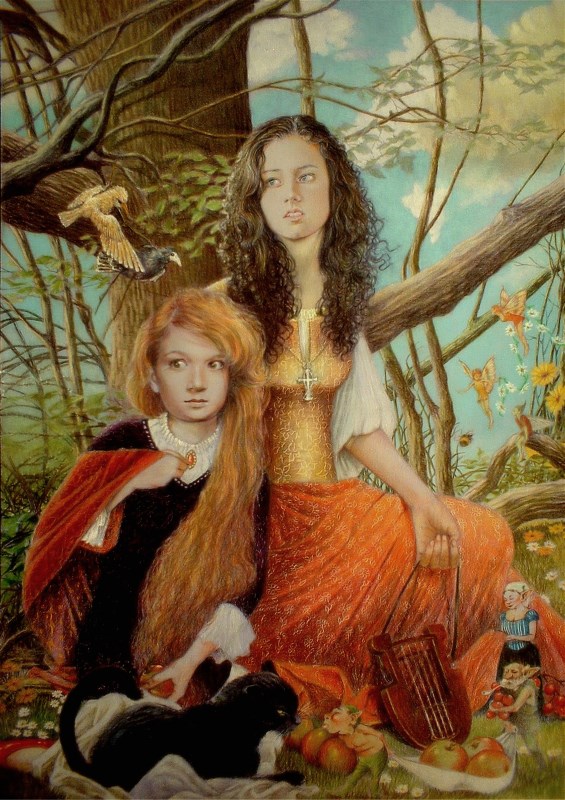
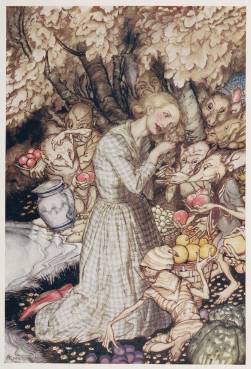
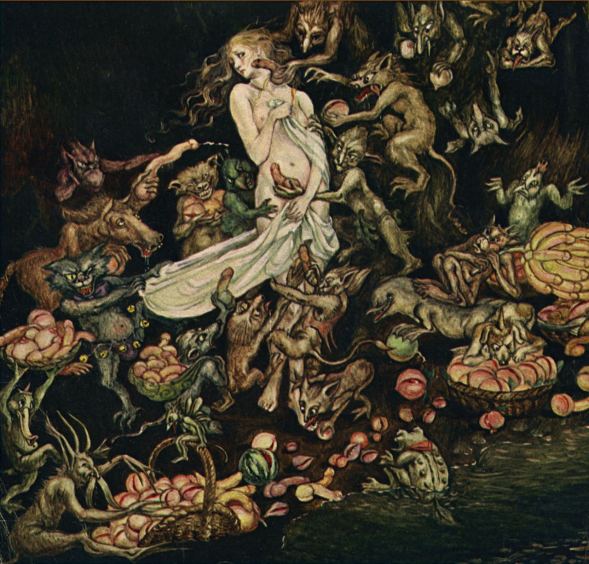
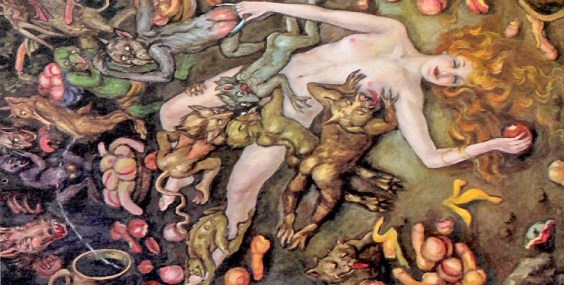
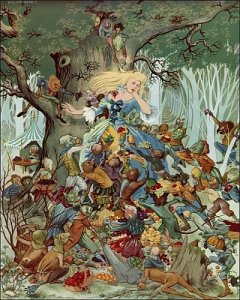 The 20th-century revival of interest in the poem opened the floodgates for Feminist, Marxist, Freudian, Queer Theory and New Historicist critiques which variously interpreted the poem as a warning about the dangers of a free-market economy, a protest against hazardous practices in 19th-century food-adulteration, a Christian tale of sacrifice and salvation, a parable of lesbian empowerment, a fable about anorexia, an expression of incestuous yearning and a tribute to the delicious oral and aural pleasures of poetry itself. ‘Goblin Market’ has continued to thrive in the academic marketplace. The poem continues to attract critical interpretations and artistic adaptations as colourful and diverse as the goblin merchants’ wares, challenging Christina Rossetti’s surely disingenuous claim that she ‘did not mean anything profound by this fairytale’.[6]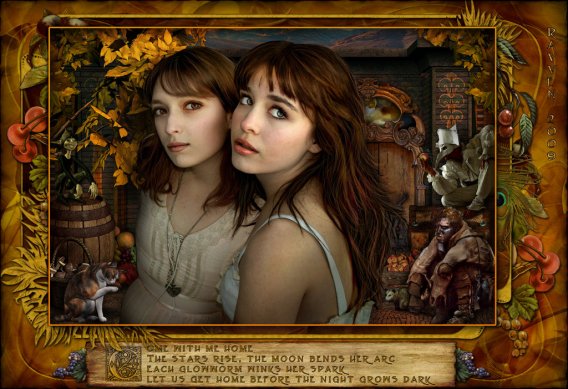
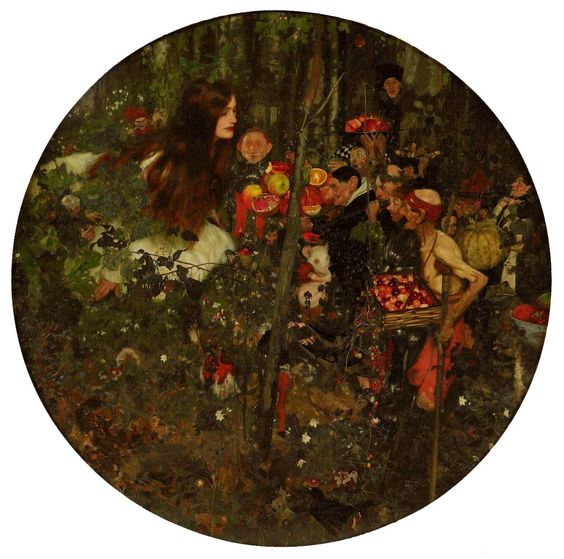
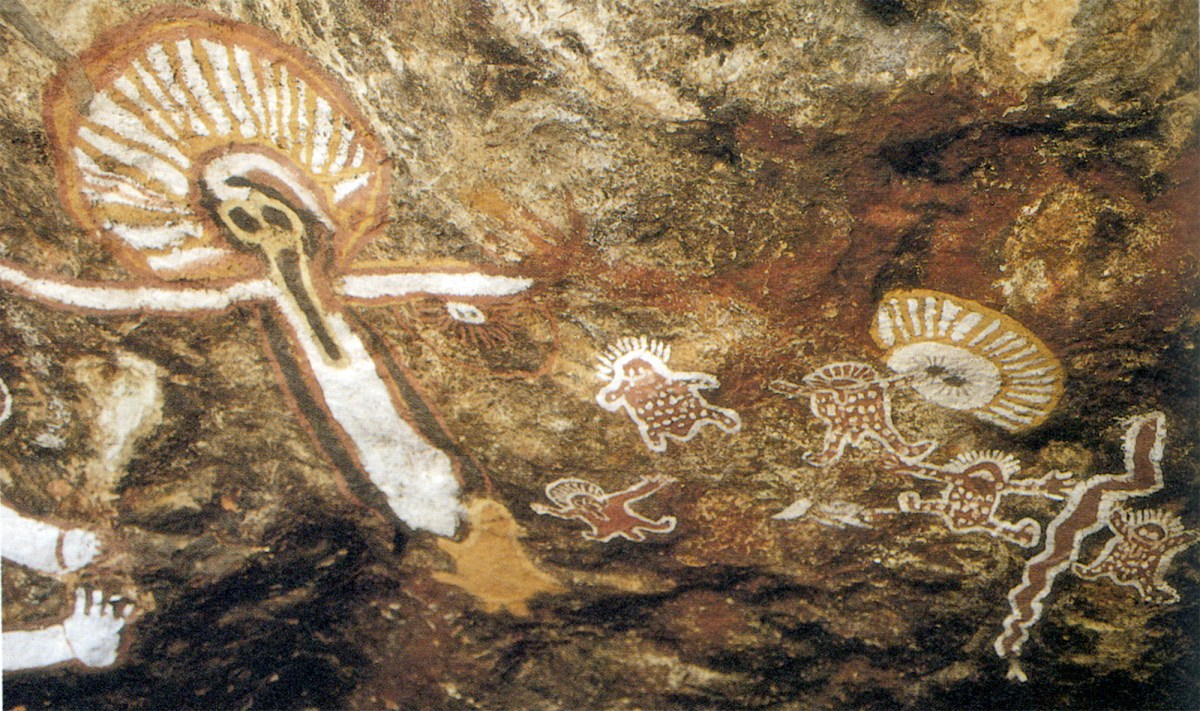
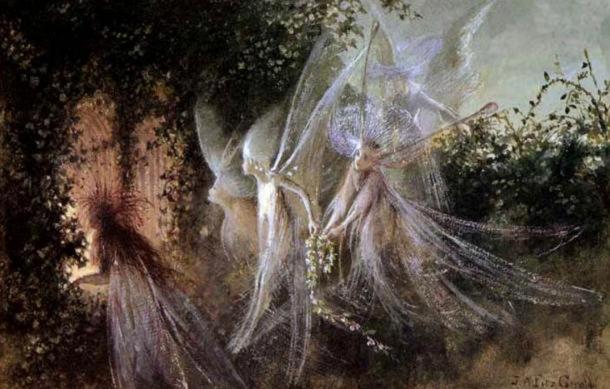
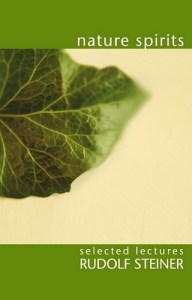 In a series of lectures between 1908 and 1924, the Austrian spiritual philosopher
  This sounds much like a meditative state. It is certainly an altered state of consciousness, where thought forms take over from the five senses. Steiner insists that this is the only way to enter into the metaphysical world of the nature spirits. It’s a concept explored in more detail in my previous post, which links perception of faeries to shamanic trance and states induced by psychedelic substances: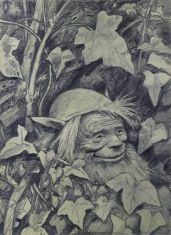
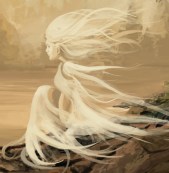
 er’s vision of nature spirits in action. There are invisible forces that are essential in ordering life on earth, something that conventional science accepts in the case of gravitational waves or magnetism, but has a hard time with when it comes to life itself. Steiner’s thesis is that the nature spirits are anthropogenic representations of these morphogenetic fields, imposed upon them through the thought forms of the observer, who perceives them clairvoyantly. Call them what you will, but they exist, and are essential in maintaining reproductive life; they are a form of consciousness responsible for the creation and sustenance of matter. They are the memory of nature.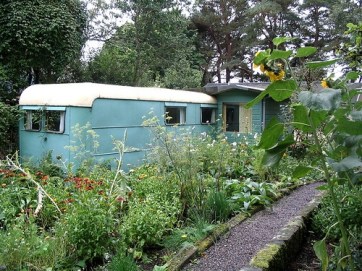
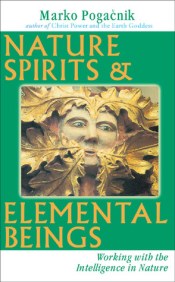 surrounding landscapes and individual components within them. One of the ways he heals these landscapes is through what he calls lithopuncture, art installations of standing stones, meant to act upon the earth in the same way as acupuncture works on the human (or animal) body. This links us clearly to prehistoric morphological designs, such as stone circles and rows. Marko suggests that our prehistoric ancestors were full-time collaborators with the nature spirits, and were using their own lithopuncture partly to induce harmony and regulation to their surrounding environments. Post-industrial ignorance of the invisible intelligence in nature has created a disconnection with natural landscapes, much to the detriment of all life and the earth’s biosphere itself: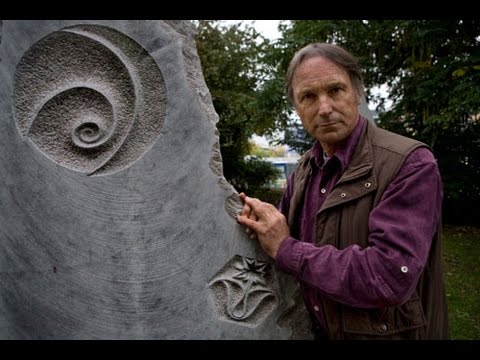
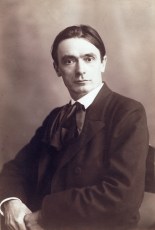
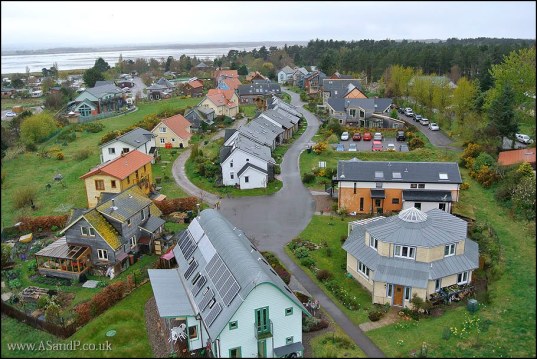

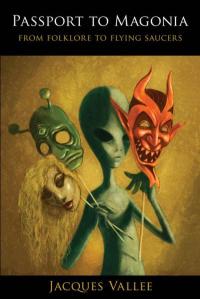 His hypothesis is that there is a commonality to the experiences reported in alien abduction scenarios, and the reports of interactions with faeries in folklore. He suggests the aliens and the faeries are essentially the same phenomena, tuned through the cultural receptors of the time and then interpreted accordingly. He makes special reference to the regular motifs in faerie-tales of the abduction, by various means, of humans by faeries. There’s a lot of data here – it’s the commonest motif in faerie folklore. For a variety of reasons humans are taken to faerieland in the stories, either as…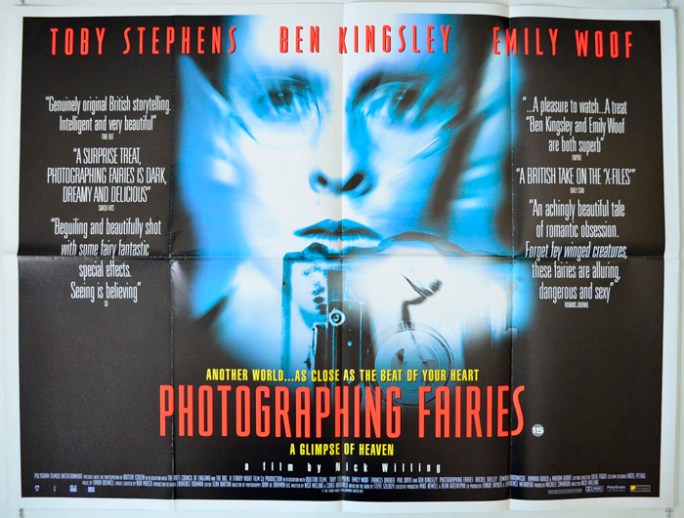
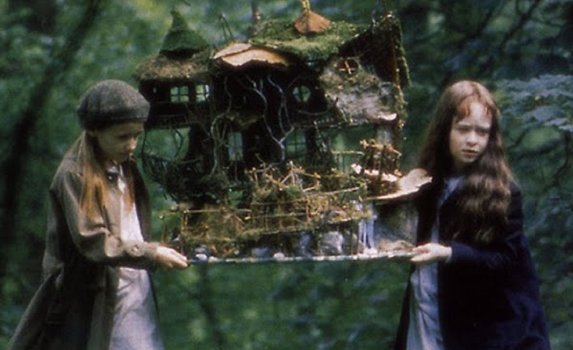

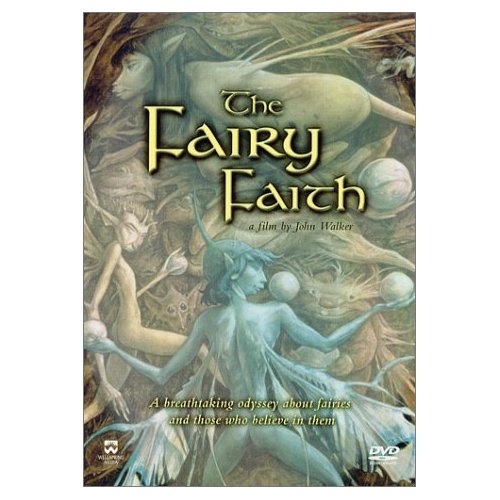
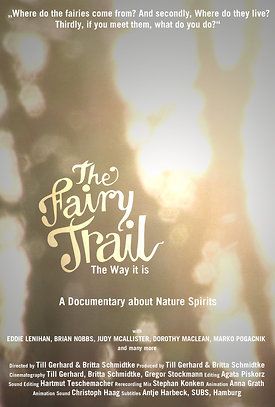
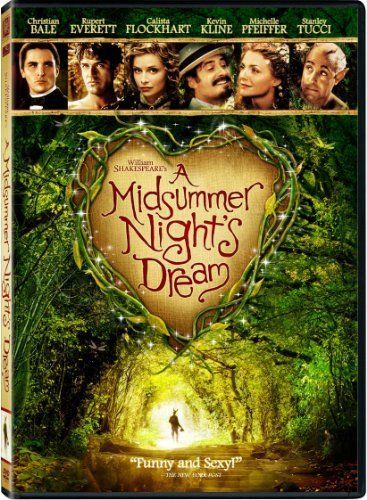
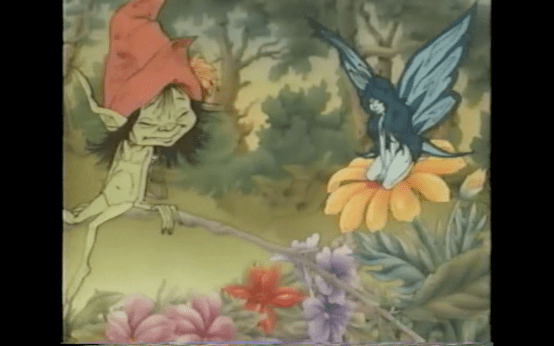
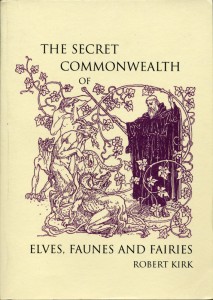 v. Robert Kirk and his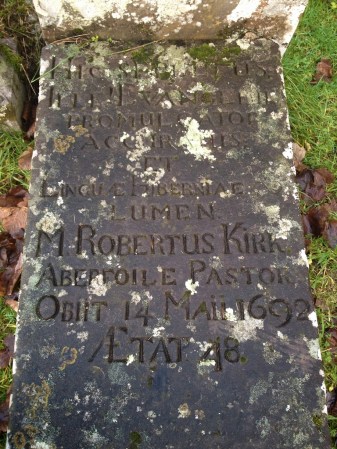
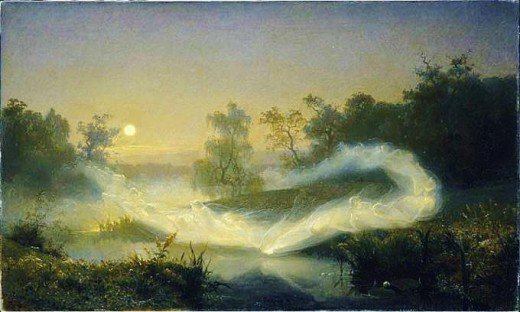
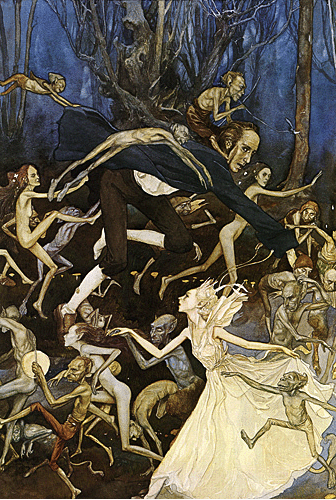
 In the 1891 publication The Science of Fairy Tales, the folklorist Edwin Hartland devoted three chapters to ponder over The Supernatural Lapse of Time in Fairyland. He makes it clear that this motif is deeply embedded in worldwide folklore and mythology from a wide variety of chronological periods. He suggests that the consistency of the story elements involving the strange relative movement of time in faerieland, must stem from a common mythological theme, although he usually stops short of discussing this theme in favour of telling the actual stories. Within these supernatural lapse of time tales there are essentially three ways that time can behave in contradistinction to normal reality: 1. Time stops in the outside world, whilst in faerieland many years can pass with the human participant living a life of enjoyment or suffering with the faeries. The protagonist usually breaks a taboo of some sort and finds themselves back in the real world, where no time has passed. These stories are in the small minority. More often the time dilation moves the other way. 2. This can be quite a drastic shift, so that a character spending days or weeks in faerieland comes back to consensus reality to find decades or even centuries have passed, or, 3. that a few minutes caroling with the faeries turns out to be any length of time up to a year and a day, once they return to the world they came from. Here are examples of each type of time warp, taken from Hartland’s investigations.
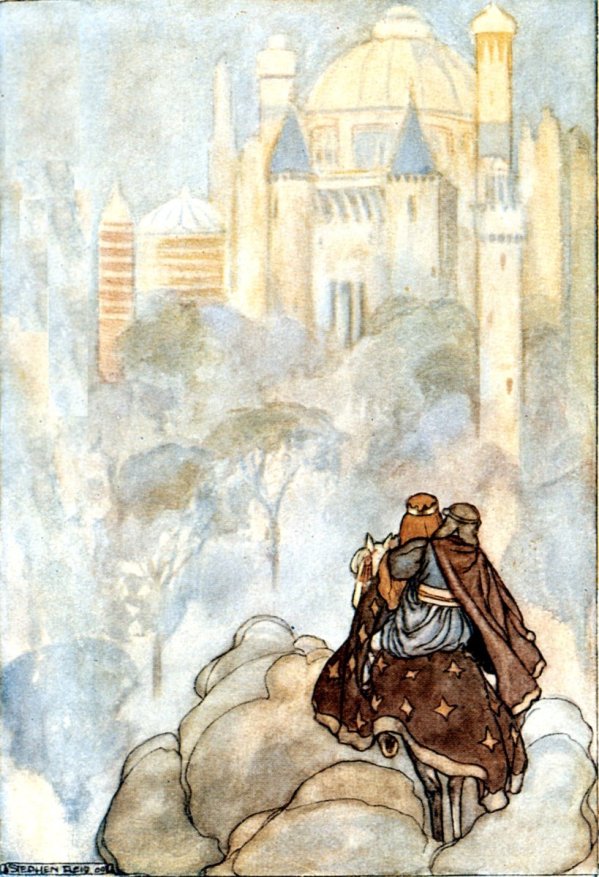
 This might be explained by seeing folktales of this type as representing a surviving pagan belief system of the afterlife. This afterlife did not follow the strictures of Christianity or other world religions, and provided an alternative view of what happens to consciousness after death. It is a view that was (in the West) superseded by Christian theology, but that may be surfacing in these folktales as remnants of the previous system of belief (a belief system that remained partially intact but operated underground for fear of religious persecution). The presence of faeries in this otherworld, and their ability to materialise in standard reality, suggests that they were an essential element in pagan ideas about consciousness and that they had a role to play when it came to death. In this theory the characters in the story play the part of messengers, telling us about the true nature of a timeless reality that is distinct and separate from consensus reality, and showing us that human consciousness disassociates from the physical body to exist in a parallel reality such as Tir na n’Og, where the faeries are in charge. This message is encoded in the stories.
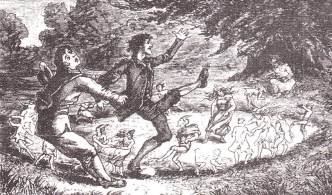 Stories of this type rarely say much about the faeries doing the abducting, only that they seemed capable of drawing the participant out of their own world and into an alternative reality with a different space-time continuum. The year and a day motif is important and is a common time-frame appearing in medieval romances as the amount of time protagonists were given to succeed in quests. In The Golden Bough, Sir James George Frazer highlights the ancient global concept of the Divine King, who was to be ritually murdered after a period of time in charge, which was often a year and a day. The time period was also used in common law to substantiate the legal situation of unwed couples, and it was (in theory) the amount of time a person living under feudal serfdom needed to be absent from his lord’s manor to gain his freedom. Interestingly, a year and a day is also used in Wiccan and other neo-pagan traditions for the time of learning required before being initiated into the first degree. This may all suggest that the folktales of this type have the year and a day motif embedded within them as a message, conveying the idea that it is a magical time-frame. It was a symbolic time-marker for life quests, ruling over others, decisions being made, learning a tradition, securing a marriage, or gaining freedom as one year tips over into another. It was evidently deeply ingrained in both esoteric tradition and everyday life from an early date, rooted in the cycles of the natural world.
 knowledge, who operated within the constraints of Christianity, but who was evidently practising pagan sorcery. Emma Wilby in her 2005 book
 deadbutdreaming